Quick Answer: Tin-plated copper cable lugs do not carry a hard expiry date, but the tin layer is a barrier, not a permanent shield — its protection is proportional to plating thickness and storage humidity, and it degrades faster than most buyers assume. A 5-micron tin coating (the industry-common minimum) is typically rated for around two years of shelf life under proper storage, backed by salt-spray and coulometric testing [Direct: L1]. In Delhi NCR’s monsoon humidity, unsealed or poorly stored stock can show early tarnish well before that. A genuine Cable Lug Supplier India should be able to state the plating thickness, batch date, and storage condition of the stock you’re buying — not just the brand name on the box.
Introduction
A cable lug sitting in a warehouse looks like it isn’t doing anything. No current is flowing through it, no crimp has been made, nothing is under load. It seems reasonable to assume it’s simply waiting, unchanged, for the day someone opens the carton and crimps it onto a conductor.
That assumption is wrong more often than procurement teams realise. A tin-plated copper lug is a piece of base metal wearing a thin, sacrificial metallic coating — and that coating is reacting with the air around it from the day it’s plated, whether or not the lug is ever installed. The reaction is slow under good storage conditions and considerably faster under bad ones. Somewhere between “slow” and “visible tarnish on the barrel” is a line that a lot of bulk-purchased stock crosses quietly, in a godown, before it ever reaches a crimping tool.
This matters more than it sounds like it should, because cable lugs are almost never bought one at a time. EPC contractors, panel builders, and solar and EV-charging integrators buy in bulk — hundreds or thousands of pieces per size — ahead of a project schedule that can slip by months. That stock sits. And North India’s climate, specifically Delhi’s long, hot summer followed by a humid monsoon, is not a neutral environment for exposed metal to sit in.
This guide answers a question that gets asked far less often than it should: does tin-plated cable lug stock actually degrade before installation, and if so, how do you know when it has? It draws on the engineering behind tin plating classes, published corrosion test data, and the specific climate conditions a Delhi NCR warehouse deals with across a year — not generic “keep it in a dry place” advice.
If you’re still working through which lug material and type fits your project, our pillar guide — Cable Lug Supplier India: Complete Industrial Buying Guide for Copper, Aluminium & Bimetal Cable Lugs — covers that ground first. This article picks up after the lug is chosen, at the point where the stock has to sit in storage before it’s crimped.
Cable Lug Supplier India: Why Tin Plating Exists — and What It’s Actually Protecting Against
Bare copper does not fail gracefully in humid air. Within days of exposure to moisture, copper forms a visible oxide layer, and given enough time and salt or sulphur exposure, it develops the green-black patina familiar on old copper fittings. That oxide layer is not just cosmetic — it’s a poor electrical conductor, and its growth at a crimp joint is exactly the mechanism that raises contact resistance and generates heat at a termination. [Direct: L9]
Tin plating exists to interrupt that process. Electrodeposited tin forms a continuous barrier over the copper surface, and tin itself oxidises far more slowly and more stably than copper does — its oxide layer is thin, adherent, and doesn’t progressively consume the metal beneath it the way copper patina does. [Direct: L2] Tin-plated conductors have been shown to survive 96 hours of salt-spray exposure under ASTM B117 testing where equivalent bare copper fails in under 24 hours. [Direct: L9]
But “tin-plated” is not a single, fixed level of protection. It’s a coating with a thickness, and thickness is exactly what determines how long that barrier actually lasts before pinholes and thin spots let moisture through to the copper underneath.
The Standard Behind the Claim: ASTM B545 Service Classes
ASTM B545, the standard specification for electrodeposited tin coatings, defines five service classes by minimum plating thickness, each tied to an expected operating environment and a corresponding salt-spray test duration:
| ASTM B545 Class | Minimum Thickness | Typical Environment | Salt-Spray Withstand (ASTM B117) |
| Class A | 2.5 µm | Mild, shielded (electronic housings) | 24 hrs |
| Class B | 5.0 µm | Mild, low humidity — standard indoor electrical hardware | 48 hrs |
| Class C | 8.0 µm | Moderate, periodic moisture — outdoor industrial | 96 hrs |
| Class D | 15.0 µm | Severe, high humidity — coastal, marine | 240+ hrs |
| Class E | 30.0 µm | Very severe, continuous dampness — marine busbars | 500+ hrs |
(Table compiled from ASTM B545 service class data.) [Direct: L2, L3]
Here is the detail most buyers never see on a product listing: an industry-standard catalogue reference for tin-plated cable lug terminals states a minimum tin coating of 5 microns — squarely Class B — checked by coulometric testing and salt-spray testing, and states this thickness is intended “to ensure a shelf life of at least two years.” [Direct: L1]
Read that figure carefully. Class B is the indoor, low-humidity service class under ASTM B545 — not the outdoor or severe-environment class. A lug plated to this minimum is engineered to protect against ordinary handling and short-term indoor storage, not against a full monsoon season sitting exposed in a warehouse with poor ventilation. That distinction is the entire subject of this article.
Cable Lug Supplier India: The Two-Year Shelf Life Number, and Why It’s a Starting Point, Not a Guarantee
The “two years” figure above is a genuinely useful, specific number — far more useful than the vague “long shelf life” language most listings use. But it comes with conditions attached, even where those conditions aren’t always spelled out on the box.
What the Two-Year Figure Assumes
A shelf-life claim tied to a specific plating class assumes the stock is stored within a defined temperature and humidity envelope, sealed against direct moisture ingress, and not subjected to repeated condensation cycles. Salt-spray testing, the method used to validate these classes, runs at a controlled, continuous fog exposure — it establishes a comparative corrosion-resistance ranking between coating thicknesses, not a literal real-world clock. [Direct: L2] Real warehouse conditions rarely match a salt-spray chamber, but they can, over a longer period, deliver a comparable cumulative moisture exposure — particularly across a monsoon season with sustained high relative humidity.
Where Tin Coatings Actually Fail in Storage: Not Uniform Corrosion, But Localised Attack
The failure mode that matters for stored lugs isn’t a uniform thinning of the tin layer — it’s localised. Pinholes, thin spots at sharp edges (a cable lug barrel has plenty of edges and crimp-relevant geometry), and micro-porosity in the plated layer are where moisture reaches the copper substrate first. Once that happens, a small area of copper oxide forms under an otherwise intact-looking tin surface — which is why a lug can look fine from a casual glance and still have started corroding underneath.
Tin Whiskers: A Less-Discussed Storage Risk Tied Directly to Humidity
A separate and less commonly discussed risk with pure tin plating is whisker growth — thin, filamentary crystal structures that can grow from a tin-plated surface over time, occasionally long enough to bridge adjacent conductive surfaces. Research into this phenomenon has specifically linked whisker growth to corrosion of the tin surface under elevated humidity: studies storing tin and tin-copper alloy coatings at 85°C and 85% relative humidity observed a direct relationship between surface corrosion and whisker formation, with the effect attributed to the lower density of the tin oxide layer that develops under humid storage compared to the original plated tin. [Direct: L6] JEDEC’s standard test protocol for evaluating this risk (JESD22-A121) uses storage conditions of 30°C/60% RH sustained for 4,000+ hours and 55°C/85% RH for 4,000 hours as its accelerated-ageing benchmarks. [Direct: L4] Those humidity figures are worth holding in mind, because — as the next section shows — they sit uncomfortably close to what a Delhi monsoon actually delivers.
The Underplate Detail Most Suppliers Don’t Mention
One further engineering detail affects both corrosion resistance and whisker risk, particularly for lugs made from brass or brass-alloy components rather than pure electrolytic copper: an unbrightened nickel underplate beneath the tin layer blocks diffusion of base-metal elements — copper, and especially zinc from brass — up through the tin during storage and thermal cycling, and is specifically recommended to maximise the shelf life of a solderable tin deposit. [Direct: L7] A cable lug specification that only states “tin-plated” without confirming whether a nickel underplate is used is leaving out a detail that measurably affects how well that plating holds up over an extended storage period — not just in service.
Cable Lug Supplier India: What Delhi NCR Storage Conditions Actually Do to Plated Stock
Generic “store in a cool, dry place” advice is not particularly useful without knowing what “the place” actually experiences across a year. Delhi’s climate has two seasons that matter for stored metal stock, and they attack tin plating through different mechanisms.
Summer: Heat Accelerates Chemical Ageing, Even Without Direct Moisture
Delhi’s pre-monsoon summer routinely pushes maximum temperatures into the 39–40°C range in May and June, with the city’s average May maximum around 39.6°C. [Direct: L10] A metal-roofed godown without active climate control commonly runs hotter than the ambient outdoor air — direct radiant heating of a metal roof and poor air circulation inside a packed storage area both push internal temperatures above what a weather station records outside. Elevated storage temperature accelerates the chemical ageing processes behind oxide growth and intermetallic diffusion at the tin-copper interface, even in the absence of high humidity — heat alone shortens the effective margin of any published shelf-life figure.
Monsoon: The Humidity Numbers That Actually Matter
This is where the real risk sits. Delhi’s monsoon season runs from roughly late June through mid-September, and average relative humidity climbs sharply during this period — climate data puts New Delhi’s August average relative humidity at around 77% to 82% depending on the dataset and measurement period used, making it consistently the most humid month of the year. [Direct: L10, L11]
Compare that against the JEDEC accelerated-ageing benchmark referenced above: 55°C/85% RH sustained over 4,000 hours is used specifically because it’s understood to meaningfully accelerate tin-surface corrosion and whisker risk. [Direct: L4] A Delhi warehouse in August isn’t running a JEDEC chamber, and it isn’t hitting 55°C internal humidity-controlled conditions — but a poorly ventilated store sitting at high-70s to low-80s percent relative humidity for six to twelve weeks straight, repeated across multiple monsoon seasons for slow-moving stock, is applying a real, cumulative version of the same stress the standard is designed to simulate. This is the specific, calculable reason a “two-year shelf life” figure validated under controlled test conditions deserves a safety margin when the actual storage location is a Delhi NCR godown rather than a humidity-controlled warehouse.
Why This Matters More for EV Charging and Battery Storage Cable Lug Stock Specifically
This climate risk isn’t evenly distributed across every type of cable lug buyer. It matters disproportionately for two growing categories of Indian procurement: cable lug for EV charging installations and battery storage cable lug India projects — both of which involve DC busbar and battery terminal connections where a stable, low-resistance, corrosion-free termination is directly tied to thermal safety, not just electrical performance. EV charging infrastructure and battery energy storage rollouts in India frequently involve procurement well ahead of site readiness — hardware ordered in bulk for a rollout schedule, then held in a central store for weeks or months before individual site installation. A battery terminal lug dealer Delhi supplying this segment is effectively also a short-to-medium-term custodian of that stock’s corrosion margin, whether or not that responsibility is written into the purchase order. For readers working specifically on DC termination for battery and EV systems, Thunderbolt’s related guide, Cable Lugs for Battery Storage and EV Charging Systems: DC Termination Guide, covers the termination side of that work directly.
Customer Problems and Solutions
Problem: A batch of tin-plated copper lugs purchased eight months ago, stored in a general warehouse through one monsoon, now shows dull grey-brown discolouration on the barrel exterior.
Solution: Discolouration alone doesn’t automatically mean the lug is unusable, but it’s a signal to inspect further before crimping. Wipe a sample with a clean, dry cloth — surface tarnish that lifts easily is typically superficial oxide on the tin surface itself. Discolouration that doesn’t lift, or shows a greenish tint through the tin (indicating the copper substrate underneath is already reacting), means that batch should be quarantined and tested for contact resistance before use on any critical termination, not simply crimped as-is.
Problem: Procurement bought a large lot of lugs to lock in pricing ahead of a project that has now slipped by a year.
Solution: This is the single most common way stock crosses from “within shelf life” to “questionable” without anyone deciding it should. Apply a simple stock-cover rule: hold no more than roughly half of the documented shelf-life class as working inventory of unknown-condition stock. For Class B (5-micron, ~2-year rated) lugs, that means treating anything held longer than about 12 months as due for inspection before use, not automatic use.
Problem: A supplier can’t confirm the plating thickness or manufacture batch date of the stock being quoted.
Solution: Treat this as a real red flag, not a minor omission. A genuine Cable Lug Supplier India working with reputable manufacturers should be able to provide the coating class or micron thickness and a batch or manufacture date on request — these aren’t proprietary figures, they’re standard technical datasheet fields. A supplier who can only say “it’s tin-plated, it’ll be fine” is asking you to accept an unverifiable claim on a component that sits directly in a fault-current path.
Problem: Lugs stored in Delhi NCR through two consecutive monsoons are being pulled for an urgent installation, and there’s no time for lab testing.
Solution: Run a fast field check rather than skipping inspection entirely. Wipe and visually inspect the barrel and palm under good light for pitting or green-tinted discolouration; test crimp a sample piece and check that the crimp still seats cleanly without the barrel cracking or flaking; where the installation is critical (main feeders, DC battery terminations, EV charger busbars), pull a small sample for a basic contact-resistance check before committing the full batch.
Problem: Bulk EV charging or battery storage project stock has been sitting in a shared general store alongside other unrelated hardware, with no dedicated packaging.
Solution: Tin-plated stock benefits measurably from being kept in its original sealed packaging or re-wrapped in vapour corrosion inhibitor (VCI) paper — a kraft paper impregnated with compounds that vaporise slowly inside a sealed wrap and form a thin protective molecular layer on nearby metal surfaces, commonly rated to extend protected shelf life by roughly two years under proper sealed storage. [Direct: L8] This is inexpensive, standard industrial practice for corrosion-sensitive metal stock and is disproportionately underused for electrical hardware specifically, compared to how routinely it’s applied to tooling and machined parts.
Comparison Table: Storage Risk by Plating Class and Environment
| Plating Class (ASTM B545) | Thickness | Rated For | Delhi NCR Indoor Store (No AC) | Delhi NCR Monsoon Exposure | Recommended Use |
| Class A (2.5 µm) | Mild, shielded | Short-term, controlled indoor only | Marginal beyond a few months | Not recommended | Electronic housings, not industrial lug stock |
| Class B (5 µm) | Standard indoor hardware | ~2 years under proper storage [Direct: L1] | Adequate with sealed packaging; inspect after 12 months | Inspect after one monsoon season; re-verify before critical use | General indoor panels, control cabinets |
| Class C (8 µm) | Moderate, periodic moisture | Longer indoor/light outdoor storage | Good | Better tolerance; still inspect stock over 18–24 months old | Outdoor panels, general industrial feeders |
| Class D (15 µm) | Severe, high humidity | Extended outdoor/coastal-grade storage | Very good | Good tolerance across multiple monsoons | Outdoor, coastal, EV/battery DC terminations held in long-term stock |
| Class E (30 µm) | Very severe, continuous dampness | Long-term marine-grade storage | Excellent | Excellent | Marine, direct-burial, extreme long-term stock |
Procurement Checklist: Verifying Cable Lug Storage Condition Before You Buy
- ✔ Ask the supplier for the tin plating thickness or ASTM B545 service class — not just “tin-plated.”
- ✔ Ask whether a nickel underplate is used, particularly for brass-bodied or bimetal components.
- ✔ Request the manufacture or batch date, not just the delivery date.
- ✔ Confirm how and where the stock has been stored — sealed original packaging, VCI wrap, or open shelf.
- ✔ For stock older than roughly half its documented shelf-life class, request a visual inspection or sample crimp test before accepting the batch.
- ✔ For EV charging and battery storage DC terminations specifically, specify Class C or higher plating given the criticality of low, stable contact resistance at these joints.
- ✔ Avoid over-ordering lug stock beyond your realistic 6–12 month usage window, particularly ahead of projects with a track record of schedule slippage.
- ✔ Store incoming stock off the floor and away from direct exposure to a metal roof, and rotate older batches into use first.
Cable Lug Supplier India: Why Choose Thunderbolt Electromech for Plated Stock You Can Trust
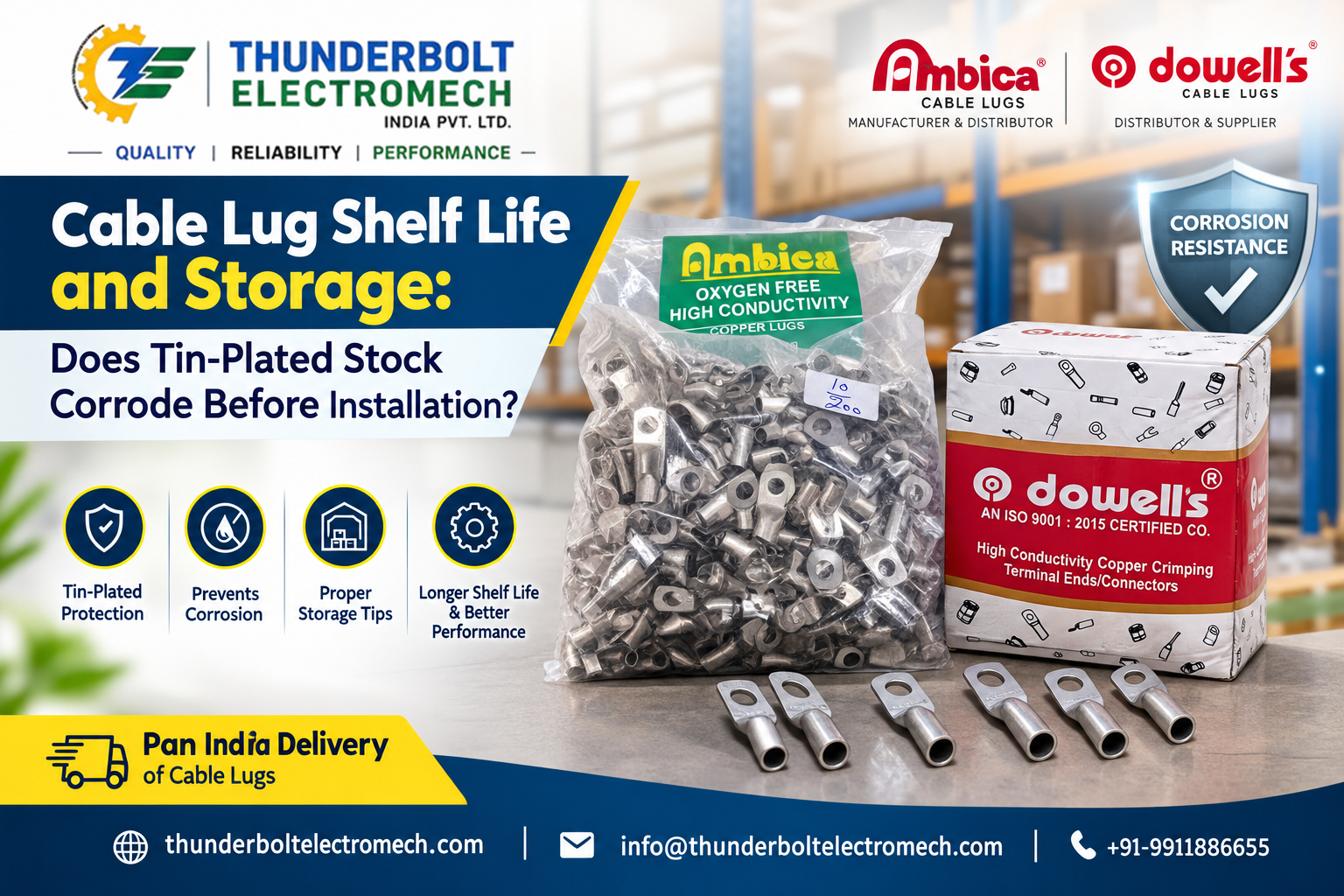
A cable lug’s plating is only as good as the storage discipline behind it between the plating shop and the crimping tool. As a Cable Lug Supplier India and Cable Lug Supplier Delhi NCR, Thunderbolt Electromech supplies genuine Dowell’s cable lugs alongside its own manufactured Ambica cable lug range, sourced and stocked with attention to plating quality and turnover — not held as static, aging inventory.
For engineers, EPC contractors, solar and EV-charging integrators, and battery storage project teams across Delhi NCR sourcing an EV charging cable lug supplier Delhi NCR or a battery terminal lug dealer Delhi, Thunderbolt provides technical guidance on plating class, batch traceability, and storage-appropriate stock selection — not just a price per piece. The company delivers pan-India, so this same attention to stock condition applies whether your project sits in Delhi, Gurugram, or a site several states away.
Browse the full range on the Cable Lugs product page, or the Cable Lugs category/cluster page for related buying guides.
Frequently Asked Questions
1. Does a tin-plated cable lug have an actual expiry date?
No printed expiry date exists in the way a food product would have one, but the plating does have a documented shelf-life class tied to its thickness — commonly around two years for standard 5-micron (Class B) plating under proper storage. [Direct: L1] Treat it as a dimensional and corrosion margin that shrinks with age and poor storage, not a hard cutoff.
2. How can I tell if a stored cable lug has started corroding?
Look for discolouration that doesn’t wipe off with a clean, dry cloth, any greenish tint suggesting the copper underneath is reacting, and pitting or roughness on the barrel or palm surface. A lug that looks bright and uniform under good light, with no green tint after a light wipe, has likely retained its tin barrier intact.
3. Is Delhi’s climate genuinely worse for stored cable lugs than other regions?
Delhi’s combination of high summer heat (accelerating chemical ageing) and a sustained, high-humidity monsoon (accelerating oxide and whisker-related corrosion mechanisms) puts real stress on stored plated metal across the year, compared with a drier or more climate-stable storage location. [Direct: L10, L11] It isn’t uniquely severe compared to genuinely humid coastal regions, but it’s a meaningfully harder environment than the controlled conditions most published shelf-life figures are validated under.
4. Should I ask for a higher plating class than the standard for long-term stock?
For stock that’s realistically going to sit in storage for a year or more before use — a common scenario for large EV charging or battery storage rollouts — specifying Class C (8 µm) or higher rather than the standard Class B (5 µm) minimum gives a meaningfully larger corrosion margin for the same reason it’s specified for outdoor industrial and automotive applications.
5. Can a discoloured lug still be used safely after cleaning?
Superficial tarnish that’s purely on the tin surface, and that lifts with a clean wipe, generally does not compromise the termination. Corrosion that has reached the copper substrate beneath the tin is a different situation — cleaning the visible surface doesn’t undo copper oxide that has already formed at pinholes or thin spots, and that lug should not be used on a critical connection without a resistance check.
6. Does the same shelf-life logic apply to aluminium and bimetal cable lugs?
Aluminium forms its own natural oxide layer very quickly on exposure to air, which is actually somewhat self-limiting and protective in typical storage conditions, unlike copper’s more actively progressive patina. Bimetal lugs carry the storage considerations of both halves — the aluminium barrel and the copper (often tin-plated) palm — so the tin-plating storage guidance in this article applies specifically to the copper-palm side of a bimetal lug.
7. How do I know if my current cable lug stock has been stored properly by my supplier before I even received it?
Ask directly for the manufacture date, the plating specification, and how the stock was warehoused before dispatch. A supplier with nothing to hide on storage practice will generally answer this without hesitation; a vague or deflected answer is itself useful information.
8. Is vapour corrosion inhibitor (VCI) packaging worth the extra cost for bulk cable lug orders?
For stock you expect to hold longer than a few months, yes — VCI paper is a low-cost, standard industrial practice for protecting metal parts in storage, and it specifically targets the humidity-driven corrosion mechanism described throughout this article. [Direct: L8] It’s a small addition to a bulk order relative to the cost of replacing or reworking a batch that’s corroded before it was ever installed.
Cable Lug Shelf Life and Storage: Conclusion
Tin-plated cable lugs are engineered to resist corrosion, not to be immune to it indefinitely. The protection they offer is directly tied to plating thickness — and a standard 5-micron, Class B coating, the common industry minimum, is rated for roughly two years under proper storage conditions, not for indefinite shelf presence regardless of climate. Delhi NCR’s combination of high summer heat and sustained monsoon humidity applies real, measurable stress to that margin, particularly for bulk stock held ahead of projects that don’t always run on the original schedule — EV charging and battery storage rollouts especially.
None of this means tin-plated stock is fragile or unreliable. It means the storage period between purchase and installation deserves the same engineering attention that gets applied to the lug’s material, size, and crimp specification. Ask for plating thickness, batch dates, and storage practice as standard procurement questions, not exceptions. Inspect stock that has sat through a monsoon before committing it to a critical termination. And treat a two-year shelf-life figure as a starting assumption validated under controlled test conditions — not a guarantee that survives unchanged in a Delhi godown in August.
As a Cable Lug Supplier India, Thunderbolt Electromech supplies genuine Dowell’s and Ambica cable lugs with attention to plating quality, batch traceability, and storage-appropriate stock turnover, delivering pan-India from its Delhi NCR base.
Contact Thunderbolt Electromech
Phone: +91-9911886655 Email: info@thunderboltelectromech.com Website: https://thunderboltelectromech.com Location: Shop no 3538, Sitaram Bazar Rd, Bazar Sirkiwalan, Chawri Bazar, Chandni Chowk, Delhi
Get in touch for bulk cable lug orders, plating specification queries, or technical guidance on storage-critical stock for EV charging and battery storage projects across Delhi NCR and pan-India.