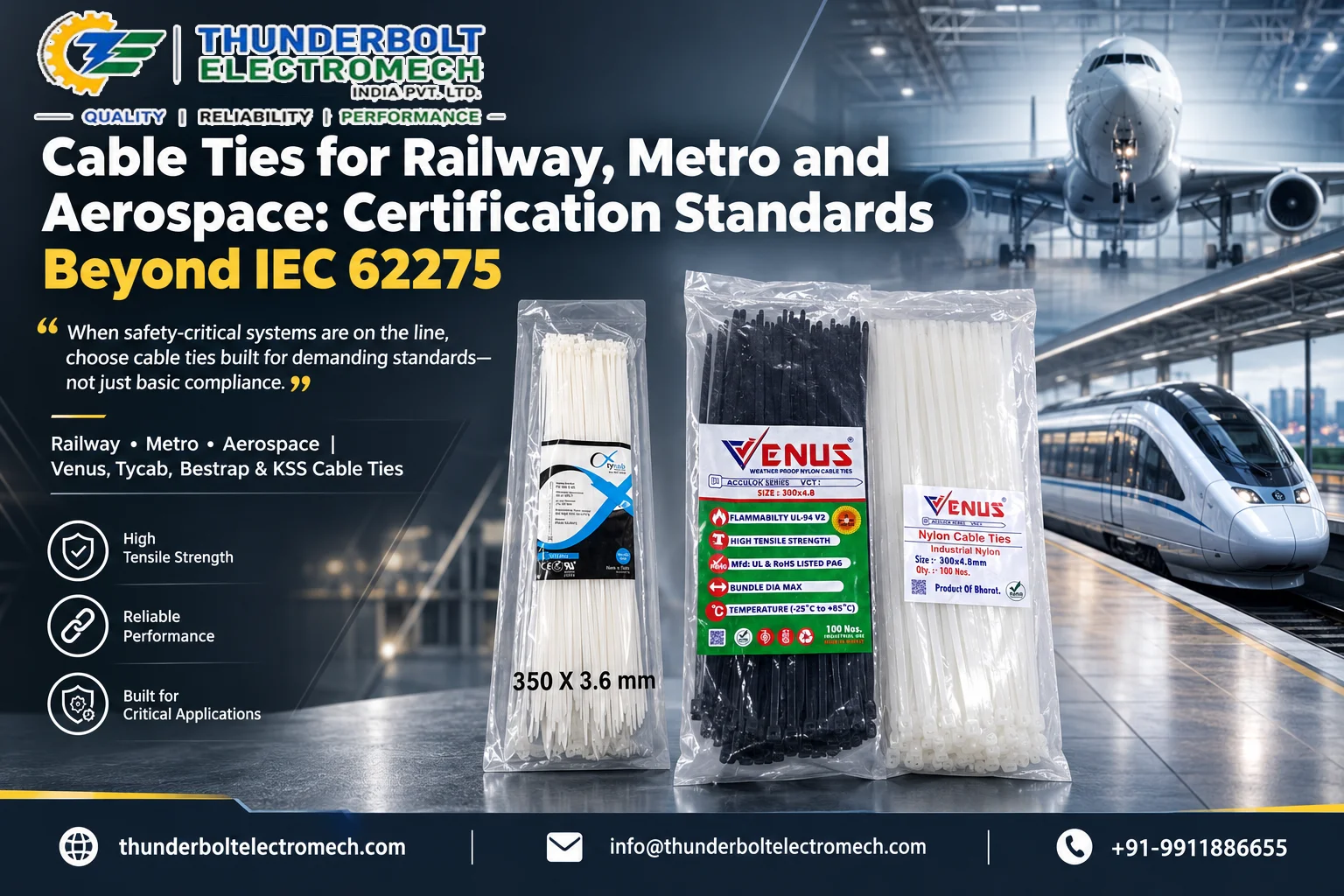
Quick Answer: Railway, metro and aerospace buyers need more than IEC 62275. Rail projects add EN 45545-2 fire, smoke and toxicity limits plus IEC 61373 vibration performance. Metro tenders often demand halogen-free, low-smoke ties. Aerospace work points to SAE AS33671, outgassing and smoke density tests. Choose a tie by material grade, test report and bundle load, never by tensile rating alone. Thunderbolt Electromech India Pvt. Ltd., a cable ties supplier India project teams rely on, stocks Venus, Tycab, Bestrap and KSS ties from Delhi.
Why IEC 62275 Is the Starting Line, Not the Finish
A cable tie fails quietly. Nobody hears it. A bundle sags a few millimetres, a sheath rubs against a bracket for eighteen months, and one night a harness shorts inside a locomotive cab. The maintenance crew opens the panel and finds a tie that passed every catalogue test and still did the wrong job.
That gap between “certified” and “fit for this duty” is the subject of this article. IEC 62275 gives buyers a sound baseline for cable ties used in electrical installations. It does not tell you whether a tie survives a bogie, a tunnel fire or an aircraft equipment bay. Railway, metro and aerospace projects stack extra standards on top, and each one tests something different.
Thunderbolt Electromech India Pvt. Ltd. is the Delhi stockist that procurement teams call when a tender sheet lists EN 45545-2, LSZH or AS33671 and nobody on site feels sure what to order. We supply the complete Venus range and also stock Tycab, Bestrap and KSS cable ties. If you want the wider buying picture first, read our complete guide to sizes, types, materials and strength. This piece is a cluster article. It goes deep on regulated sectors only.
What IEC 62275 Covers and What It Leaves Out
IEC 62275 sets requirements and test methods for cable ties used in electrical installations. It classifies ties by material, temperature range, flame behaviour and weather resistance. It measures loop tensile strength, checks impact behaviour at low temperature and looks at how the tie ages. For a factory panel or a commercial building, that is a useful filter.
Now look at what the standard does not measure.
- Smoke density and toxic gas output. A tie can resist flame and still fill a tunnel with dense smoke.
- Vibration fatigue. The loop tensile test pulls a clean loop on a lab machine. A bogie shakes a tie sideways for years.
- Long-term load retention. Nylon creeps. The pawl and serrations slowly relax under constant tension.
- Compatibility with the cable sheath. The standard says nothing about a tie edge cutting into a soft halogen-free jacket.
- Lot traceability. Rail and aerospace quality systems expect a batch number you can trace back.
- Behaviour after a fire starts. The tie must still hold the cable, or it must fail in a way the designer planned.
Here is the engineering point most catalogues skip. A loop tensile rating is a ceiling, not a working load. Under vibrating service, we suggest planning for roughly a quarter of the rated figure. A 50 lb tie then carries about 12 lb of sustained load in design calculations. That margin absorbs creep, temperature swings and installer variation.
EN 45545 Cable Tie Certification: What Rail Buyers Must Read in the Test Report
EN 45545-2 governs fire behaviour of materials and components on railway vehicles. Buyers who search for EN 45545 cable tie certification usually hold a tender clause that reads “materials shall comply with EN 45545-2, hazard level HL3.” The clause looks simple. The paperwork behind it is not.
The hazard level, HL1 to HL3, comes from the vehicle’s operation category and design category. Underground metro stock typically sits at the upper end, because passengers cannot leave quickly. Each component then falls under a requirement set that lists which tests apply and what limits it must meet. Depending on that set, a tie may face oxygen index, smoke density and toxic gas testing.
A datasheet that says “EN 45545 compliant” tells you almost nothing. Ask for the test report and read five lines:
- Hazard level and requirement set. The report must name both. HL2 results do not satisfy an HL3 tender.
- Sample colour. Pigments change fire and smoke numbers. A report for natural nylon ties does not cover black ones, and carbon black loadings shift smoke behaviour.
- Sample thickness. Thin sections burn differently. The tested sample should match the tie you buy.
- Laboratory accreditation. An ISO/IEC 17025 accredited lab adds weight to the numbers.
- Report date and material formulation. Resin suppliers change flame-retardant packages. A report from six years ago may not describe today’s pellets.
Other fire standards still appear in older or foreign specifications. BS 6853 covers UK metro fire precautions. NFPA 130 applies to fixed guideway systems in the United States. French NF F 16-101 and the retired German DIN 5510-2 turn up in legacy drawings. Most new rolling stock specifications now cite EN 45545-2, so that is the document to master first.
Choosing Cable Ties for Railway Applications: Vibration, Heat and Sheath Damage
People who search for cable ties for railway applications often start with fire. Field failures start somewhere else. Vibration, temperature cycling and sheath wear remove more ties than flames do.
IEC 61373 defines shock and vibration testing for rolling stock equipment. It separates mounting locations into categories: body-mounted equipment, bogie-mounted equipment and axle-mounted equipment, each with a harsher spectrum than the last. A tie on a roof duct sees mild shaking. A tie on a bogie cable sees severe, broadband excitation for every kilometre. Nobody tests the tie alone to that standard, but the designer must pick a tie that outlasts the equipment test.
Moisture adds a second variable. Polyamide 66 absorbs water from the air, roughly 2.5 percent by weight at 50 percent relative humidity and above 8 percent at saturation. Dry, freshly moulded ties feel stiff and can crack at the head when tensioned. Conditioned ties turn tougher. Delhi swings from dry winter air to monsoon humidity, so the same tie behaves differently in January and August. Install ties in the season you will operate them in, or specify conditioned stock.
Use this table to match symptoms with causes:
| Field problem | Root cause | Practical fix |
| Tie head cracks within months | Over-tensioning, dry nylon, sharp bracket edge | Set tool tension, use conditioned stock, add edge guard |
| Cable sheath shows cut line under tie | Narrow tie, high tension, vibration sawing | Move to 4.8 mm or wider, lower tension, add sleeve |
| Bundle sags on cable tray | Creep at the pawl, spacing too wide | Tighten pitch, use heavy-duty pawl design |
| White chalky surface outdoors | UV breakdown of unstabilised resin | Specify UV-stabilised black nylon 66 |
| Sharp tail scratches maintenance staff | Tie cut with side cutters, not flush | Use a tensioning tool with flush cut |
| Ties turn brittle near hot equipment | Continuous temperature above rating | Use heat-stabilised or higher-temperature material |
Low-smoke, halogen-free cable jackets deserve special mention. Their compounds usually feel harder to touch but resist abrasion less than PVC. A narrow tie pulled tight acts like a slow saw. We tell railway customers to choose width before they choose length, and to control tensioning with a calibrated tool rather than by hand.
Metro Tunnels and Depots: Why a Cable Ties Supplier India Buyers Trust Should Ask About Fire Survival
Every tunnel designer asks one question about fire. Will the cable that runs the lights, ventilation fans and communication gear keep running while people evacuate? Plastic cable ties complicate the answer.
Nylon 66 melts near 260 degrees Celsius, yet it loses most of its strength well below that point. In a tunnel fire, plastic ties soften, the bundle drops, and a cable that was meant to survive lands on the track bed or against a hot surface. EN 45545-2 checks the fire behaviour of the material. It does not check whether the tie still holds a cable after ten minutes of heat. Those are different questions.
Fire-survival circuits therefore often use stainless steel ties or metal cable supports in addition to plastic ties. A coated stainless tie combines a metal core that holds through the fire with a coating that protects the cable sheath during normal service. Plastic ties still serve the large non-critical bundles in panels and carriage interiors, where they save weight and installation time.
Halogen content matters too. Burning PVC releases hydrogen chloride, which turns into hydrochloric acid on moist surfaces and damages signalling electronics long after the flames die. That is why metro specifications favour low-smoke zero-halogen cable and accessories. Nylon itself contains no halogens, but some flame-retardant grades add halogenated compounds. Others use red phosphorus, which tints the tie brownish red. Read the formulation note, not only the colour.
Delhi Metro and the Delhi–Meerut regional rapid transit corridor keep pushing specifications in this direction. Contractors on depot fit-outs, signalling rooms and station electrical works ask us the same thing each season: which tie meets the low-smoke clause and still installs fast? Browse our cable tie product range and send us the clause. We will match the grade.
Aerospace Cable Ties: AS33671, Outgassing and Smoke Density
Aerospace sits furthest from IEC 62275. The industry works from its own documents, and most of them care about two things: what the part releases and what it does when it burns.
SAE AS33671 replaced the older MS3367 military specification for plastic self-clinching tie-down straps. It defines types, sizes, materials, tensile strength and environmental performance for aircraft and defence wiring. Heat-stabilised nylon 66 covers many positions. Hotter zones call for ETFE or PEEK ties, which handle continuous temperatures that nylon cannot.
The supporting tests read like a different language:
- ASTM E595 outgassing. Spacecraft hardware must lose little mass and release little condensable material, or vapour settles on lenses and sensors.
- FAR 25.853 flammability. Cabin materials in transport aircraft must self-extinguish within set limits.
- Airbus ABD0031 and Boeing BSS 7238 and 7239. These cover smoke density and toxic gas generation for cabin materials.
- NASA-STD-8739.4. This workmanship standard governs how technicians route, tie and terminate harnesses, including tie spacing, tension and the clean cut of the tail.
Two engineering habits stand out. First, foreign object debris. A clipped tail that falls into a bay is a hazard, so technicians use flush-cut tools and count every tie they open. Second, location limits. Many aircraft maintenance manuals restrict plastic ties near flight controls and moving parts, and call for lacing cord or clamps there instead. The standard for the part matters less than the rule for the position.
We will state this plainly. Flight-qualified ties need an approved source and a certificate of conformance tied to the specification. Thunderbolt Electromech supplies industrial-grade ties for ground support equipment, test rigs, simulators, MRO workshops and non-flight panels. When a request needs a qualified part, we say so and point you in the right direction rather than quote a tie that does not fit.
Case Study: A Metro Depot Retrofit That Replaced Standard Ties Mid-Project
Illustrative scenario, built from failure patterns we see repeatedly. Project details are anonymised.
The problem. A contractor fitting out an underground metro depot in Delhi NCR bought general-purpose natural nylon ties for signalling and auxiliary cabling. The purchase order cited IEC 62275 and nothing else. During pre-commissioning review, the client’s consultant flagged the cable support scheme against the EN 45545-2 clause in the technical specification. The ties had no smoke or toxicity test report. Several bundles also showed cut marks on low-smoke jackets after only weeks of trial running of ventilation equipment.
The diagnosis. The team found three separate problems. The ties lacked the documentation the tender demanded. The narrow ties, tightened by hand, cut into soft halogen-free jackets. And the emergency lighting circuits relied on plastic ties alone for support in a tunnel section.
The fix.
- The contractor moved to black, UV-stabilised, flame-retardant nylon 66 ties of 4.8 mm and wider, with batch-marked packs and a test report naming hazard level, sample colour and thickness.
- Installers switched to a calibrated tensioning tool with flush cut.
- The designers added coated stainless steel ties and supports on emergency circuits, spaced at a tighter pitch than the plastic runs.
- The store kept retained samples from every batch for audit.
The result. The rework closed the consultant’s observations without a change to cable routing. The lesson is the useful part: the contractor lost time because the document trail came last. Requesting the report before the purchase order would have cost one phone call.
Brand Quick Reference Charts From a Cable Ties Supplier India Teams Can Visit in Delhi
We stock four brands. Each suits different duties, and no single brand fits every clause. The charts below give selection points to confirm for each brand. Final values depend on the exact product code and production lot, so always check the current datasheet and test report before you order.
Venus Cable Ties Quick Reference
The Venus range is the one we stock in full, from light bundling ties to heavy-duty and weather-resistant types.
| Selection point | What to confirm | Rail, metro or aerospace relevance |
| Suggested use | General harness, tray bundling, panel wiring, depot works | Widest choice of lengths and widths from one source |
| Material grade | Nylon 66, heat-stabilised, UV black for exposed runs | Outdoor and rooftop duct runs need UV stability |
| Width to request | 4.8 mm and above for low-smoke jackets | Wider tie spreads load and protects sheath |
| Fire documentation | Flame-retardant grade report with hazard level and colour | Tender clauses cite EN 45545-2 and UL 94 |
| Tensile planning | Work at about a quarter of rated loop strength | Allows for vibration, creep and heat |
| Pack information | Batch marking and test certificate on request | Supports quality audit trails |
Tycab Cable Ties Quick Reference
Tycab suits teams that want a dependable tie for distribution boards, control panels and tidy bundle work.
| Selection point | What to confirm | Rail, metro or aerospace relevance |
| Suggested use | Panel wiring, distribution boards, control cabinets | Fits wayside and station electrical rooms |
| Material grade | Nylon 66 grade and temperature rating on datasheet | Panels run warm in Delhi summers |
| Colour choice | Natural for indoor, black for sunlight areas | Pigment changes fire and UV behaviour |
| Fire documentation | Flame class and any halogen-free statement | Low-smoke clauses need written proof |
| Installation method | Hand or tool tensioning, flush cut | Tool tensioning stops sheath cuts |
| Pack information | Lot number and datasheet reference | Helps trace a problem batch |
Bestrap Cable Ties Quick Reference
Bestrap works for teams that bundle thick cable groups and need ties with a firm pawl and a broad strap.
| Selection point | What to confirm | Rail, metro or aerospace relevance |
| Suggested use | Thick bundles, cable trays, conduit groups | Depot and substation routes carry heavy loads |
| Strap width and thickness | Heavy-duty sizes for large diameters | Load per millimetre of strap stays lower |
| Material grade | Nylon 66 with UV stabiliser for open runs | Sunlight breaks down unprotected resin |
| Fire documentation | Flame rating and test sample colour | Colour must match what you buy |
| Spacing advice | Tighter pitch near vibration sources | Reduces sag from creep at the pawl |
| Pack information | Batch code and manufacturer datasheet | Needed for audit and warranty |
KSS Cable Ties Quick Reference
KSS is a Japanese maker of wiring accessories, so we recommend it when a project asks for precision-moulded ties and mounting accessories from one brand.
| Selection point | What to confirm | Rail, metro or aerospace relevance |
| Suggested use | Precision harness work, equipment racks, mounting accessories | Suits rolling stock workshops and test benches |
| Material options | Standard, heat-resistant and flame-retardant variants | Match grade to the hottest point in the route |
| Halogen content | Written statement from the manufacturer | Low-smoke zero-halogen clauses need it |
| Fire documentation | Test reports for the exact series | Series differ in formulation |
| Mounting accessories | Check tie-to-mount compatibility | One brand keeps tolerances consistent |
| Pack information | Lot number and series code | Supports traceability in quality systems |
Need a different brand mix for one project? Call us. Many railway jobs use two grades, one for panels and one for open runs.
Railway Cable Tie Supplier Delhi and Metro Cable Tie Dealer Delhi NCR: Why Local Stock Matters
A tender deadline does not wait for a shipping container. Project engineers in Delhi, Gurugram, Noida, Faridabad and Ghaziabad often need a few hundred ties by tomorrow because an inspector rejected yesterday’s batch. Local stock turns that crisis into a day’s delay.
As a railway cable tie supplier Delhi buyers can call or visit, we keep common lengths and widths on the shelf in our Chawri Bazar location in Chandni Chowk. As a metro cable tie dealer Delhi NCR contractors use for depot fit-outs, we help site teams match the right grade to the clause before they place a bulk order. Our team also supports electrical contractors, panel builders and rolling stock workshops across the NCR belt, from Manesar and Bahadurgarh to Greater Noida.
Local supply helps in three ways:
- Faster correction. A rejected batch gets replaced in days, not weeks.
- Direct documentation. You talk to the people who handle the datasheets, not a call centre.
- Sample checks. You can see and handle the tie before you commit to thousands of pieces.
Visit the cable tie category on our blog for more guides on sizes, materials and installation practice, or go straight to the cable tie products page to compare options.
Research Notes: What Is Changing for Cable Ties Over the Next Five Years
Three shifts are already visible, and each one affects what buyers should specify today.
Halogen-free requirements will spread. Indian metro and regional rail projects follow international rolling stock practice, and new projects cite EN 45545-2 more often than older drawings did. Buyers who adopt halogen-free, low-smoke ties now avoid expensive rework when the next tender tightens.
Traceability will become standard. Aerospace and rail already expect batch numbers. Laser-marked lot codes and QR-coded packs are moving into general industrial supply. Ask your supplier now whether packs carry batch marking, because audits increasingly start at the store shelf.
Resin chemistry is changing. Producers are testing bio-based polyamides and recycled-content nylon grades to cut carbon footprints. These materials carry different moisture absorption and creep behaviour from classic nylon 66. Treat any new grade as a new material: demand fresh test data rather than assuming old numbers apply.
One more research point deserves attention. Many field failures trace back to tie installation, not tie quality. Studies of wiring faults in transport and industrial settings repeatedly name poor routing, over-tensioning and unsupported spans among the main causes of cable damage. Training installers pays back more than buying a more expensive tie.
Documents to Request Before You Order From Any Cable Ties Supplier India Offers
A good supplier answers these requests quickly. A weak one dodges them. Use this checklist for every rail, metro or aerospace-adjacent order:
- Datasheet for the exact product code, with material, temperature range and tensile strength.
- Fire test report naming standard, hazard level, sample colour and thickness.
- Halogen-free statement from the manufacturer if the clause demands it.
- UV and weathering information for exposed runs.
- Batch or lot certificate with a traceable number on the pack.
- RoHS and REACH declarations where the project requires them.
- Installation guidance, including recommended tension and tool type.
Send us the clause and the document list. We will tell you which Venus, Tycab, Bestrap or KSS product fits, or tell you honestly when none does.
Frequently Asked Questions
These questions come up repeatedly on search engines, Reddit electrical and engineering threads and Quora. Short answers follow, with the engineering reason behind each.
Do cable ties need EN 45545 certification on trains?
When the vehicle specification cites EN 45545-2, yes. The standard applies to materials and components inside railway vehicles. The tie must meet the requirement set and hazard level assigned to its position, and the supplier should provide a test report that names both.
Are nylon cable ties fire resistant?
Standard nylon 66 burns slowly but does burn. Flame-retardant grades, often rated UL 94 V-2 or V-0, resist ignition and self-extinguish. A UL 94 rating applies to a specific thickness and colour, so check that the report matches the tie.
What is the difference between halogen-free and flame-retardant ties?
Flame-retardant describes how the tie behaves in fire. Halogen-free describes what the tie releases when it burns. A tie can be flame-retardant and still contain halogenated additives. Metro projects usually need both properties in writing.
What cable ties do aircraft use?
Aircraft wiring uses ties built to specifications such as SAE AS33671, often in heat-stabilised nylon 66, or in ETFE and PEEK where temperatures climb. Many maintenance manuals also limit ties near flight controls and call for lacing cord there.
Why do cable ties break in hot or cold weather?
Cold, dry nylon turns stiff and brittle at the head. Heat softens the strap and speeds up creep. Prolonged sunlight attacks unstabilised resin. Pick a UV-stabilised, heat-stabilised grade and install it with a tensioning tool.
How long do nylon cable ties last outdoors?
Unprotected natural nylon can crack within a year or two in strong sunlight. UV-stabilised black ties often last many years outdoors, depending on temperature and load. No tie lasts forever, so inspect critical runs on a schedule.
Can I reuse cable ties?
Standard ties lock once. Cutting and re-tying wastes time and risks cable damage. Releasable ties exist for situations where you need to reopen a bundle, but they carry a lower load rating.
What tensile strength should I choose?
Choose based on bundle weight and vibration, not on the biggest number in the catalogue. Plan for about a quarter of the rated loop strength under vibration, then pick width to protect the cable sheath.
Which cable ties suit metro tunnels?
Use flame-retardant, halogen-free, low-smoke nylon ties for general bundling. For fire-survival circuits, add coated stainless steel ties or metal supports, because plastic softens long before the cable burns.
Where can I buy certified cable ties in Delhi?
Thunderbolt Electromech India Pvt. Ltd. supplies Venus, Tycab, Bestrap and KSS ties in Delhi and across India. Call +91-9911886655 with your clause or datasheet requirement.
Trust Signals: Talk to Thunderbolt Electromech India Pvt. Ltd.
We answer technical questions in plain language and we send datasheets before you buy. We also say no when a product does not fit the clause.
- Company: Thunderbolt Electromech India Pvt. Ltd.
- Address: Shop No. 3538, Sitaram Bazar Rd, Bazar Sirkiwalan, Chawri Bazar, Chandni Chowk, Delhi, 110006
- Phone: +91-9911886655
- Email: info@thunderboltelectromech.com
- Brands stocked: Venus (complete range), Tycab, Bestrap, KSS
Conclusion
IEC 62275 opens the conversation. It does not close it. Railway buyers add EN 45545-2 and IEC 61373 thinking, metro teams add low-smoke and fire-survival design, and aerospace teams add outgassing, smoke density and workmanship rules. Match the tie to the duty, read the test report line by line, and plan for a quarter of the rated strength where vibration rules.
Send your clause to Thunderbolt Electromech India Pvt. Ltd. on +91-9911886655 or at info@thunderboltelectromech.com. As a cable ties supplier India project teams can reach in Delhi, we will help you pick the right Venus, Tycab, Bestrap or KSS tie before the first bundle goes in.