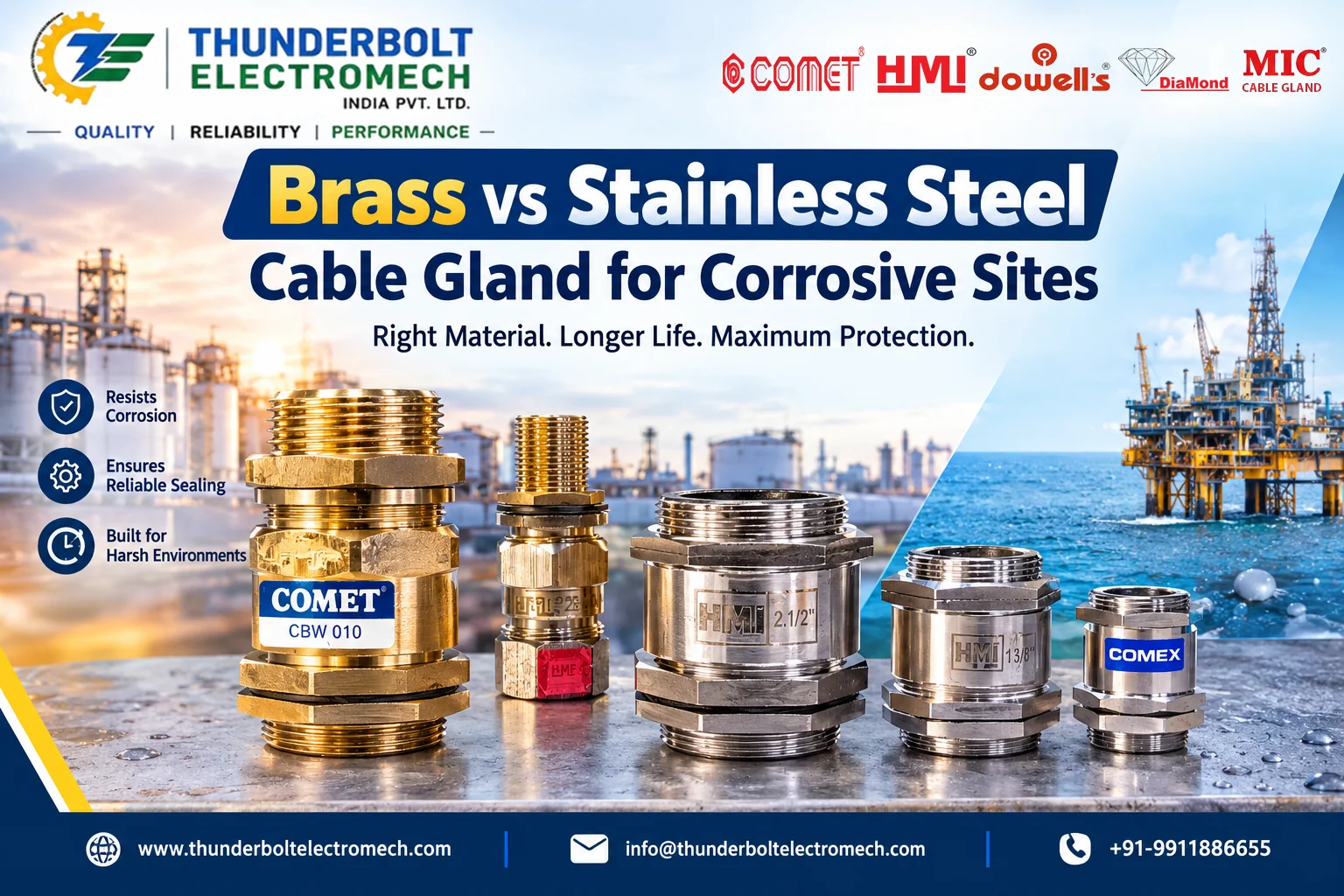
Quick Answer: Use nickel-plated brass for dry and general industrial duty. Move to SS 316 wherever chlorides, acids, ammonia or frequent washdowns reach the gland, because molybdenum in 316 resists chloride pitting. Then match the gland metal to the enclosure metal and check the locknut too. If you need a stainless steel cable gland India sites can rely on, ask your cable gland supplier India for the grade certificate and the corrosion test report, not only the stamp on the body.
Introduction
Walk through an effluent plant in NCR after the monsoon and you can read the gland metal from ten feet away. Green crust on brass. Rust-coloured streaks on a “stainless” body. White powder around the entry hole of an aluminium box. Three metals, three failure patterns, one root cause: someone picked the metal from a price list instead of from the environment.
Thunderbolt Electromech is a cable gland supplier India plant teams and EPC contractors call when they want this choice settled before the purchase order goes out. As a stainless steel cable gland supplier Delhi buyer’s use, and a brass cable gland dealer Delhi NCR contractors rely on, we know the two mistakes that keep repeating on purchase orders. Buyers put brass where 316 was needed. Others put 316 where brass would have lasted for years.
This guide fixes both. It covers how to read a corrosive site properly, what nickel plating really does, what molybdenum buys you, why aluminium enclosures change the maths, and how passivation separates a real 316 gland from a rusting one. A worked case study then puts the numbers together.
Why a Gland Fails Differently From a Bolt
A gland is a stack of crevices. The thread root meets the enclosure bore. The locknut face meets the wall. The sealing washer meets the surface. The dome nut meets the body. The elastomer meets the cable sheath. Every one of those joints can trap water.
Inside a trapped film, oxygen runs out and chloride concentrates. A gland can therefore fail where a flat plate of the same metal survives. Published data on stainless steel in chloride water shows crevice corrosion can begin at lower temperatures than pitting under similar test conditions. For a gland, that makes the seal and thread zone the weak point, not the smooth body.
Enclosures also breathe. A sealed box heats in the afternoon and cools at night. The air inside contracts and pulls humid outside air through any leak path, including thread clearances. Condensation then forms on the inside face of the gland as well. This is our engineering reading of standard thermal behaviour, not a figure from one source, but it explains a pattern maintenance teams report often: corrosion that starts inside the gland first.
Brass fails by a different route. It loses zinc, it cracks in ammonia, and its nickel skin develops pores. So the metal you choose sets the failure mode. Your installation sets the failure date. Our 17 installation mistakes guide covers the date. This post covers the metal.
Reading Your Site: What ISO 9223 Tells You and What It Hides
Many tenders write “C5 environment” and stop there. ISO 9223 does classify atmospheres from C1 (very low) to C5 (very high). It bases each class on the first-year corrosion rate of standard specimens, and those specimens are carbon steel, zinc, copper and aluminium. Stainless steel and nickel-plated brass are not the yardsticks.
The standard also names its drivers: the temperature-humidity complex (time of wetness), sulphur dioxide pollution and airborne salinity. And it states plainly that it does not characterise specific service atmospheres such as chemical or metallurgical plants.
That last point matters more than any table. A “C4” label on a fertiliser unit, a pickling shop or a chlorinated water plant says little about the air at the gland. The corrosion there comes from the process, not the weather. So ask the plant chemist three questions before specifying any gland:
- Which chemicals escape into air or splash onto equipment?
- How long does each surface stay wet?
- What is the worst cleaning agent used nearby?
Write the answers on the gland schedule. A one-page chemistry note beats a generic corrosivity label every time.
What Nickel-Plated Brass Does Well, and Where It Quits
Most gland brass is a free-cutting copper-zinc alloy with lead added for machining. Zinc is the weak partner. Copper-zinc alloys above roughly 15% zinc can lose zinc selectively, which leaves a weak, porous copper layer that can eventually leak. Small arsenic additions suppress the effect, and ISO 6509 defines the dezincification test. Ask whether your brass has ever been tested to it.
Nickel plating helps, but it works as a barrier, not as a cure. Nickel is more noble than brass. When a pore or scratch exposes the brass, you get a tiny anode surrounded by a large cathode, and that unfavourable area ratio speeds local attack. A shiny finish tells you nothing about pore count. Ask the plating thickness in micrometres. Keep pipe wrenches off the hex. Replace any gland whose plating shows bright scratches in a wet zone.
Ammonia deserves its own warning. Brass under tensile stress in ammonia-bearing air can develop stress corrosion cracks, a long-established behaviour of copper alloys. Cold stores, fertiliser units, dairy refrigeration and aeration tanks at sewage plants all carry this risk. A dome nut tightened to torque is a stressed part. Stainless handles ammonia far better.
Brass Cable Gland for Industrial Use India: Where Brass Still Wins
Brass earns its place. It clamps armour firmly, carries earth continuity, supports EMC shielding, and threads without seizing. It costs the least of the three metals. For most Indian factory floors, motor control rooms, indoor panels and sheltered outdoor boxes, a brass cable gland for industrial use India is the correct and economical specification.
An experienced voice on the Mike Holt electrical forum, answering a question about offshore Hawke-style glands, framed the choice as basically a matter of metallurgy and said most of the fittings discussed work fine in most atmospheres. The point travels well. Do not escalate the metal until the atmosphere forces you to.
Our material selection guide compares brass, stainless and nylon at a general level. This post goes narrower, to corrosive sites only.
SS 316: What Molybdenum Actually Buys You
Type 316 carries 2 to 3% molybdenum. That addition improves resistance to pitting and crevice attack in chloride environments. Engineers score the benefit with the pitting resistance equivalent number: chromium plus 3.3 times molybdenum plus 16 times nitrogen. Run it with typical figures of 16.5% chromium, 2.1% molybdenum and 0.05% nitrogen and you get about 24.2. Type 304, with 18% chromium, no molybdenum and the same nitrogen, lands near 19. The 3.3 multiplier explains the gap. Two percent molybdenum adds roughly 6.6 points by itself.
Temperature data makes the gap concrete. At 300 ppm chloride, type 304 has a critical pitting temperature near 40°C. Type 316 at 500 ppm chloride sits near 70°C. A sun-baked enclosure on a rooftop in an Indian summer can run well above 40°C at the surface, so those thresholds are not academic (that reading is ours, not the source’s). Even so, 304 is generally considered safe in waters up to about 100 ppm chloride, which covers a lot of ordinary process water.
Three limits matter just as much:
- 316 is not seawater-immersion grade. Its PREN of roughly 25 to 30 signals limited suitability for continuous seawater service. For submersion, look at duplex grades.
- Stress cracking ignores molybdenum. Resistance to chloride stress corrosion cracking shows no real difference between 304 and 316.
- Machined glands don’t need “L” for weld reasons. Gland bodies are turned from bar, not welded. Molybdenum content and surface condition matter more than the carbon letter. (Engineering judgement.)
For hazardous areas, read our Ex d certification guide before you choose any metal.
Where SS 316 Wastes Money
Overspending is the quieter mistake. A stainless gland in a dry, indoor motor control room gains nothing. It brings thread galling, a longer lead time and a bigger invoice. Stainless threads need anti-seize during installation, and installers who skip it tear threads in the field.
Delhi NCR sits well inland, so sea salt rarely drives the decision here. The chloride comes from inside the plant: chlorinated water treatment, swimming pool plant rooms, pickling and galvanising lines, textile bleaching, and dairy washdowns with hypochlorite. Map those zones on a plant layout. Specify 316 only inside them. Keep brass everywhere else.
One honest caution: hypochlorite residue dries into concentrated chloride, and even 316 will pit under dried bleach crusts. Rinse after washdown. A metal choice cannot replace a cleaning routine.
Galvanic Coupling With Aluminium Enclosures
Aluminium enclosures change the whole calculation. In seawater, brass sits around −0.4 to −0.3 V while aluminium sits around −1.0 to −0.76 V. Stainless sits at the noble end, further from aluminium still. Both gland metals act as cathodes. The aluminium is the anode and it pays the bill.
Area ratio then decides how fast. Big box, small gland sounds reassuring, because a small cathode on a large anode spreads the attack thin. But only the wetted region of the less noble metal acts as the anode. Water pools around the gland entry, so damage concentrates in a ring there.
Run a back-of-envelope check with illustrative geometry. An M25 gland sits in a 25 mm hole, and water wets an 8 mm ring of aluminium around it. That ring covers roughly 830 mm². The gland’s exposed metal, dome nut plus body, covers roughly 4,000 mm². The cathode-to-anode ratio inside the wet zone is about 5 to 1. The big box does not save you. You will see white powder first, then a loosened thread in the aluminium.
Die-cast boxes make it worse. Powder coat protects the surface, but the gland hole is usually drilled or tapped on site, which exposes bare aluminium. You can’t change the metals, so control the electrolyte:
- Seat the gland on a bonded sealing washer, not just a thread O-ring.
- Coat the bare bore edge before fitting.
- Keep the earth path. If the gland carries armour earth, don’t isolate it. Use an earthing tag with a conductive inhibitor paste. Our accessories guide explains the tag and shroud choices.
- Point entries downward, or form a drip loop in the cable.
Check the locknut. This is the detail most specifications miss. A 316 body fitted with a zinc-plated steel locknut creates a small, active fastener against a large noble surface. Carbon steel fasteners in stainless assemblies are among the most damaging couples in practice, because the small fastener area concentrates the whole corrosion current. Specify the locknut, washer and earthing tag metal as clearly as you specify the body.
The matching rule is simple. Steel enclosure: brass works, and 316 only if the site demands it. Stainless enclosure: use stainless, with anti-seize and the lower torque on our torque specification page. Plastic or GRP enclosure: choose by environment alone.
Passivation: The Step Buyers Forget to Ask About
Turning stainless bar on a lathe can leave microscopic iron particles on the surface. Those particles rust within weeks, and the buyer concludes the gland isn’t really 316. The grade is often fine. The surface was never cleaned.
Passivation removes that free iron and lets the chromium oxide film form. ASTM A967 covers nitric acid immersion, citric acid immersion and electrochemical treatment. Its acceptance tests include water immersion, high humidity, salt spray, copper sulphate and a free iron test. You don’t need a laboratory. You need a supplier who can say which treatment the lot received and show a simple humidity or water-immersion result.
Also separate cosmetic tea staining from pitting. Staining wipes off and leaves a smooth surface. Pitting leaves craters you can feel with a fingernail. Wipe a stained gland with a clean cloth and a mild cleaner. If the metal underneath is smooth, you have a surface problem. If it’s rough, you have a grade problem.
Case Study: Zoning a 40-Entry Effluent Plant Instead of Specifying 316 Everywhere
Read this first: this is an illustrative engineering scenario. We built it from published standards data and standard arithmetic. It is not a record of a named customer. We label it that way on purpose, because readers deserve to know which examples are field records and which are worked models.
The situation. An effluent treatment plant in an NCR industrial area needs 40 cable entries. The first draft specification says “SS 316 for all glands, plant is corrosive.”
The zone survey. The plant chemist and the maintenance head walk the site and sort the entries:
- Zone A, 14 entries: chlorine and hypochlorite dosing room and sump. Constant humidity, chemical splash, regular washdown.
- Zone B, 18 entries: indoor pump hall and motor control room. Dry, air-conditioned or ventilated, no chemical exposure.
- Zone C, 8 entries: outdoor aluminium junction boxes along the aeration basins. Monsoon wetting, some ammonia release from the water surface.
The decisions.
- Zone A takes 316. Chloride plus warm splash is exactly the case where 304 and plated brass lose.
- Zone B takes nickel-plated brass. Nothing in that air attacks it, and brass gives the best earth continuity and armour grip.
- Zone C takes 316 with sealing washers, a coated bore edge and inhibitor paste. Ammonia rules out brass, and the aluminium boxes need the galvanic controls described above.
The arithmetic. Assume, for illustration only, that a 316 gland costs three times a brass gland of the same thread. Use your own quote in place of that factor.
- Everything in 316: 40 × 3 = 120 cost units.
- Zoned: (22 × 3) + (18 × 1) = 84 cost units.
- Saving: 36 units, or 30%.
The hidden catch. The draft schedule also listed zinc-plated steel locknuts for every entry. Fitted to the 22 stainless glands, those locknuts would have created the worst possible area ratio. The revised schedule specifies 316 locknuts for Zones A and C.
The follow-up. After the first monsoon, the team inspects: a chloride test strip on a wiped sample from one Zone A gland, a torque recheck on a Zone C gland, and a photo of each aluminium entry. Findings go on one sheet. If Zone C shows white powder, the team fixes the washers and paste, not the gland metal.
What to add if you publish a real version. Replace the scenario with a real project when you have one. Record the site type and city, the chemistry that drove the decision, the original specification, the final specification, what failed or survived, photos with dates, and the name of the person who signed off. Real photos and a named reviewer carry more weight with readers and with Google than any model can.
Customer Problems and Solutions
Problem 1: Brass glands turn green at a chemical plant.
Plating pores or scratches expose brass to acid fumes. Solution: Move to SS 316 for entries inside the fume zone. Keep brass elsewhere.
Problem 2: SS 316 glands seize in stainless enclosures.
Galling welds the threads together. Solution: Apply anti-seize, fit slowly, and respect torque limits.
Problem 3: Procurement specified 316 for the entire site.
The budget overshoots. Solution: Zone the plant, as the case study shows.
Problem 4: White powder around aluminium box entries.
Galvanic action plus trapped water. Solution: Bonded sealing washer, coated bore edge, conductive earth path.
Problem 5: Brass cracks near ammonia refrigeration.
Stress corrosion cracking. Solution: Specify stainless for the whole cold-store entry set.
Problem 6: “Stainless” glands rust within weeks.
Free iron on the surface, a wrong grade, or a steel locknut. Solution: Request passivation evidence, a material test certificate, and check the locknut metal.
Comparison Table: Brass vs SS 304 vs SS 316
| Factor | Nickel-plated brass | SS 304 | SS 316 |
| Main failure mode | Pore pitting, zinc loss, ammonia cracking | Chloride pitting, staining | Crevice attack under seals in hot chloride; galling |
| Chloride tolerance | Low to moderate, depends on plating | Fair in cool water up to about 100 ppm | Better, PREN about 24 |
| Acid resistance | Weak | Moderate | Better, still limited in hot strong acid |
| Ammonia | Poor | Good | Good |
| Aluminium enclosure | Smaller potential gap | Wider gap | Wider gap |
| Earth and EMC | Excellent | Good | Good |
| Thread galling | Rare | Yes | Yes |
| Relative cost | Lowest | Middle | Highest |
| Best fit | Motor control rooms, sheltered outdoors | Fresh-water washdown, food areas | Effluent, chlorinated, pickling, chemical, coastal |
A Five-Step Decision Method for Plant Teams
- Name the chemical, not the mood. “Corrosive” is not a specification. Chloride, acid, ammonia and hypochlorite each push the choice differently.
- Check temperature. Hot, wet chloride is where 304 fails first.
- Check the enclosure metal. Aluminium demands sealing and bonding discipline.
- Check the cleaning routine. Frequent washdown favours stainless.
- Price the failure, not the gland. One wet termination can stop a line. Compare that cost with the price gap, then decide.
Choosing a Cable Gland Supplier India EPC Teams Can Audit
A tender can name SS 316, but only the supplier decides what ships. EPC procurement and plant stores teams should ask for these items:
- A material test certificate showing the molybdenum content for the bar stock.
- Passivation method and lot-level test evidence.
- Plating thickness for brass glands.
- A corrosion test report. IEC 62444 is the performance standard for cable glands, and it includes a resistance-to-corrosion clause (12.2) alongside mechanical, electrical and ingress tests. Industry commentary notes that not every gland on the market is tested or certified to it. Ask for the report for the exact product, not a brochure line.
- Thread standard and IP rating proof. Our IP rating guide explains what to request.
- Storage conditions. Our shelf life and storage guide explains why this matters before installation.
SS 316 Cable Gland Supplier India: Specification Checklist
When you request a quote, send these details so the supplier can match product to site:
- Thread size and cable outer diameter.
- Armoured or unarmoured cable. See our armoured vs unarmoured guide.
- Enclosure material and finish.
- Chemical exposure, temperature and washdown frequency.
- Locknut, washer and earthing tag material.
- Earthing and EMC need.
- Hazardous-area certification, if any.
Thunderbolt Electromech India Pvt. Ltd. supplies high-range Dowell’s, Comet and HMI cable glands, plus medium-range Diamond and MIC. Browse the cable gland product category, our cable gland blog category, or the pillar guide to choosing the right cable gland. For solar sites, read our solar cable gland sourcing guide.
Frequently Asked Questions
1. Is brass or stainless steel better for cable glands?
Neither wins everywhere. Brass suits dry and general industrial duty. Stainless suits chlorides, acids and heavy washdowns. Evidence: no direct Reddit or Quora thread found. This follows the common Google “People also ask” pattern. The answer rests on the metallurgical sources listed below.
2. Is SS 304 enough for outdoor cable glands?
Often yes, inland and away from chemicals. It resists pitting in water up to about 100 ppm chloride but loses ground in warm, chloride-rich splash. Choose 316 for those zones. Evidence: no direct forum thread found. Based on published stainless steel technical data and critical pitting temperature figures.
3. Does nickel plating stop brass corroding?
It slows corrosion while the plating stays intact. Pores and scratches become small, fast-corroding anodes. Thickness and pore count matter. Evidence: no direct thread found. Reasoned from the area-ratio principle in the galvanic sources below.
4. Can I use brass glands in an aluminium enclosure?
Yes, with controls. Seal the joint, coat the bare bore edge and keep a conductive earth path. Stainless carries the same galvanic risk, so the remedy is the same. Evidence: no direct thread found. Based on published galvanic series data and the wetted-area principle.
5. Do stainless steel cable glands rust?
They can show surface rust if free iron stays on the part after machining, if the grade is lower than stamped, or if a steel locknut sits against them. Proper passivation prevents most of it. Evidence: no direct thread found. Based on the scope of ASTM A967.
6. Which metal suits offshore Hawke-style glands: brass, nickel-plated brass or stainless?
An engineer asked exactly this on the Mike Holt forum. A reply framed it as metallurgy and said most of those fittings suit most atmospheres. For chloride-heavy splash, lean toward 316. Evidence: direct source found (Mike Holt forum thread, “Brass or Stainless Hawke Gland”).
7. How do I confirm a gland is really SS 316?
Ask for the material test certificate on the bar stock. For large orders, request a molybdenum check by handheld analyser. A magnet or a body stamp proves little. Evidence: no direct thread found. Based on the 2 to 3% molybdenum specification for 316.
8. Is the extra cost of SS 316 worth it?
Only inside chloride, acid, ammonia or washdown zones. Elsewhere it buys galling and a bigger invoice. Evidence: no direct thread found. The answer reflects the zoning approach in the case study.
About This Guide and Its Limits
We prepared this guide from published stainless steel technical data, galvanic corrosion references, ASTM and ISO standard scopes, and public forum discussion. We state where a point is our own engineering judgement. We could not find direct Reddit or Quora threads on this exact topic, so the FAQ labels say so. The case study is a labelled scenario, not a customer record. We don’t quote plating thickness or price multiples because no reliable public source supports one number for every supplier. Ask your supplier for the real figures.
Trust and Contact Block
Thunderbolt Electromech India Pvt. Ltd., a Delhi-based cable gland supplier Chawri Bazar buyers and EPC teams across India use.
Address: Shop No. 3538, Sitaram Bazar Rd, Bazar Sirkiwalan, Chawri Bazar, Chandni Chowk, Delhi, 110006
Phone: +91-9911886655
Email: info@thunderboltelectromech.com
Send your enclosure metal, site chemistry and cable details. We will help you shortlist a brass or SS 316 cable gland.
Conclusion
Brass isn’t the cheap option and stainless isn’t the safe option. Each is the right answer for a different environment. Use nickel-plated brass for general industrial duty, with checks on plating thickness and ammonia exposure. Use SS 316 where chlorides, acids, ammonia or washdowns reach the gland, and ask for proof of molybdenum and passivation. Match the gland to the enclosure, check the locknut, and control water around every aluminium entry.
A good cable gland supplier India buyers can audit will hand you certificates, answer these questions, and zone your plant instead of upselling it. Thunderbolt Electromech works that way from Chawri Bazar, Delhi. Send us your specification and we will build the shortlist.