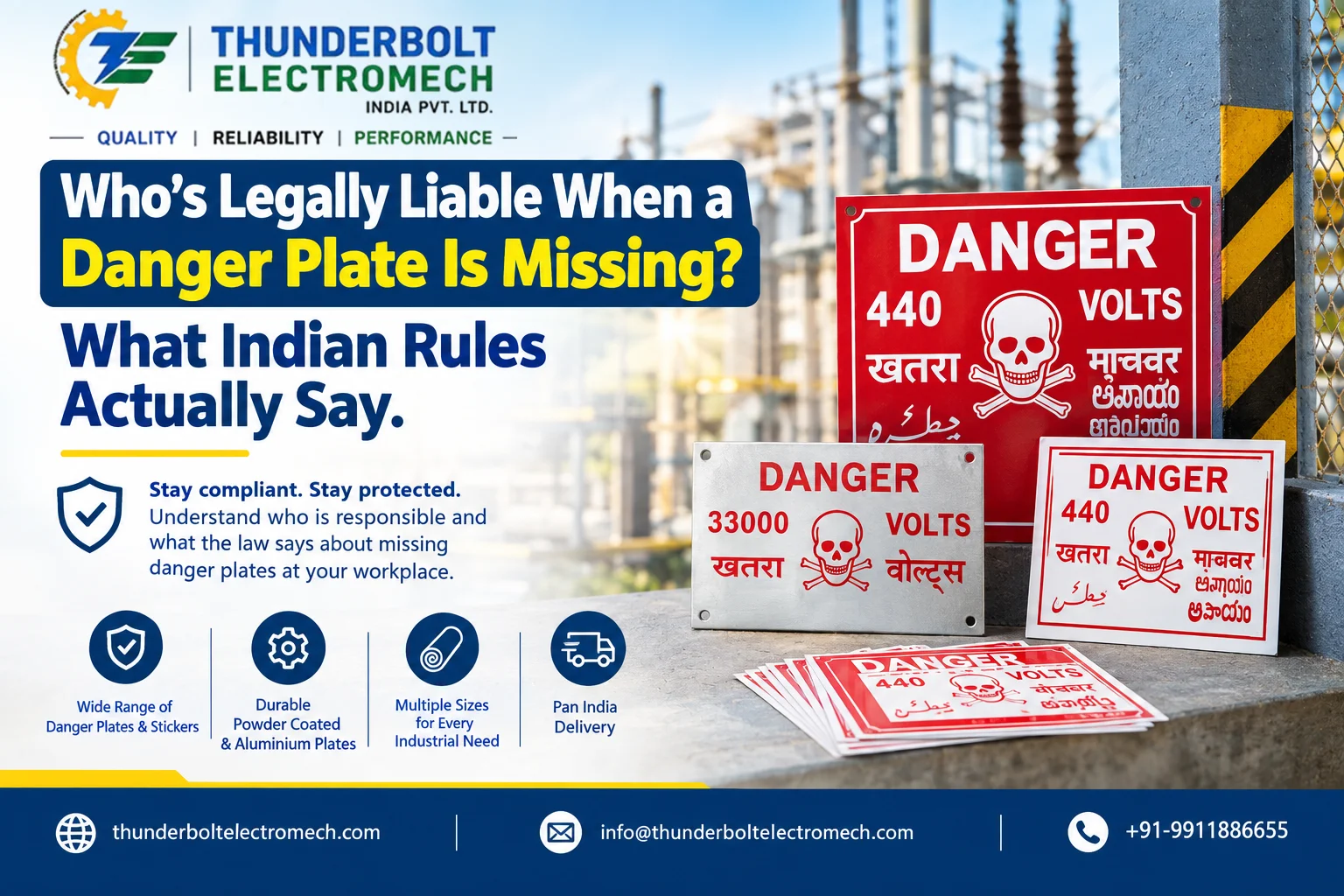
This article gives general information. It is not legal advice. Thunderbolt Electromech is a supplier, not a law firm. Confirm any live case with a qualified lawyer.
Quick Answer: Under Regulation 20 of the CEA Safety Regulations 2023, the owner of any installation above 250 V must affix danger notices permanently. So the owner carries the first duty when a plate is missing. Suppliers, contractors and employers can share liability through contract, control or negligence. A good Danger Plate Supplier cannot move an owner’s legal duty, but it can supply IS 2551-aligned plates and batch records that prove diligence. Courts also apply strict liability in electrocution claims, so a missing plate rarely helps a defence.
Why a Missing Plate Becomes a Legal Problem
A transformer yard loses a danger plate in March. Nobody notices until an electrician climbs the fence in July. Then the questions start. Who should have checked? Who installed it? Who sold it? Who signed the last inspection?
Plant managers rarely ask these questions before an accident. They ask them afterwards, with a lawyer in the room.
This guide sorts the answers by source. It starts with the regulation text, then moves to the plate standard, the civil cases, the criminal provision and the new labour code. Where a source says nothing, I say so. Thunderbolt Electromech supplies powder coated plates, aluminium plates and danger stickers, and I write from the buyer’s side of the counter. For product sizing and selection, see our Danger Plate Supplier pillar guide to buying and safety standards.
What the Rules Actually Say: Regulation 20 in Plain Terms
The core rule sits in the Central Electricity Authority (Measures relating to Safety and Electric Supply) Regulations, 2023. These regulations replaced the 2010 set, and the notification dated 8 June 2023 says so directly. Regulation 20 makes the owner of every installation above 250 V responsible for affixing a permanent danger notice in a conspicuous position, written in Hindi or English plus the local language of the district, with a skull-and-bones sign.
The regulation lists where the notice must go:
- On every motor, generator, transformer and other electrical plant, along with the apparatus that controls it.
- On supports of overhead lines above 650 V that someone can climb without a ladder.
- On luminous tube signs, X-ray and similar high-frequency installations between 650 V and 33 kV.
Two provisos matter in practice. If the owner cannot fix a plate on the apparatus itself, the owner must fix it as close as possible, or paint the word “danger” and the voltage on the apparatus. And where equipment sits inside an enclosure, one notice on the enclosure satisfies the rule.
Read that again. The duty falls on the owner of the installation. It does not name the plate supplier, the electrical contractor or the plant operator. That choice shapes everything below.
The duty does not end at installation
Regulation 32(8) adds a continuing duty. The owner of every installation must maintain and operate it free from danger, as the manufacturer or the relevant standards recommend. For installations above 650 V, Regulation 48(7) repeats the same wording.
My engineering reading: “affix permanently” and “maintain free from danger” together turn a plate into a maintained asset. A plate bolted on at commissioning and faded beyond reading five years later fails the spirit of the rule. A plate that fell off and was never replaced fails it outright. [This reading is ours; no direct source applies the two regulations together to plate condition.]
What IS 2551 Adds, and Where Buyers Go Wrong
Regulation 20 asks for a skull-and-bones sign “as per relevant standards.” The 2023 regulations define “standard” as the Indian Standard first, then IEC, IEEE or European norms if no Indian Standard exists. For danger plates, the Indian Standard is IS 2551.
I retrieved the 1982 text of IS 2551. It says:
- The plate is mild steel at least 1.6 mm thick, vitreous enamelled white, with lettering and the skull in signal red on the front.
- The rear side is also enamelled. Corners are rounded.
- It recommends two sizes: 200 × 150 mm for medium voltage and 250 × 200 mm for high and extra high voltage.
- It lists a colour retention test for the enamel, which checks weather performance. [Direct found, via a supplier summary of the test]
Here is where buyers go wrong. They read “IS 2551” on a listing and assume every finish passes. The standard text I retrieved names vitreous enamel. A powder coated, printed or sticker plate may copy the layout, but copying the layout does not make it the plate the standard describes. I found no source that says an Electrical Inspector accepts powder coating as equal to vitreous enamel.
So I advise buyers to do two things. Match plate size to voltage class as the standard lists it. And ask the inspector, in writing, whether the finish you plan to buy is acceptable for your installation. That one email can settle a later argument.
An odd detail: the 1982 standard still quotes “Rule 35” of the old Indian Electricity Rules. The regulation number has since moved to 20 in the 2023 set. Old documents and old listings often carry the stale reference.
Who Is Liable? A Layer-by-Layer Map
Liability for a missing danger plate does not sit in one place. Different laws reach different people. The table below is my map. Each row notes what the sources support.
| Party | Likely exposure | What the sources say |
| Installation owner | Primary statutory duty under Regulation 20, and continuing duty under Regulation 32(8) | Direct found: regulation text |
| Occupier or employer | Workplace safety duties under the OSH Code | Direct found for the code’s start date; I did not retrieve the section text on employer duties |
| Electrical Safety Officer or designated person | Duty to inspect and record, where appointed | Direct found: Regulations 3 and 5 |
| Licensed electrical contractor | Duty tied to work done and handover | Partly found: Regulation 31 requires licensed contractors; no source ties them to plate fixing |
| Electricity supplier or licensee | Duty for its own lines and apparatus on a consumer’s premises | Direct found: Regulation 15 |
| Plate supplier | Contract or consumer-law claims if the plate misdescribes its standard or fails early | No direct found in retrieved sources |
| Injured person | Contributory fault argument | General tort principle; not confirmed in retrieved summaries |
Look at the electrical safety roles more closely, because they decide who can show diligence.
Regulation 5(3) requires a factory with more than 250 kW connected load to designate an Electrical Safety Officer, who must inspect installations at least yearly and keep records in the prescribed forms. Those records form the paper trail. A plate-check line in that annual record helps a plant a great deal.
Regulation 3 requires owners to keep a record of designated persons. No one without a certificate of competency or work permit may be on that list.
I should say plainly what I could not find. I found no retrieved source that states a specific fine for a missing danger plate under the CEA regulations. The consequence usually arrives through inspection, an adverse report, a disconnection notice or a civil or criminal case after an accident. Under Regulation 32(7), an owner who fails to fix defects an Electrical Inspector reports can see the installation disconnected after a notice of at least 48 hours.
The Civil Side: Strict Liability and the August 2026 Ruling
If someone dies or is injured, the family usually sues for compensation. Here Indian courts lean toward the victim.
The foundation is M.P. Electricity Board v. Shail Kumari (2002). That case recognised that people who undertake hazardous activities exposing human life to risk may be liable even without proof of negligence. High Courts have applied it repeatedly. The Rajasthan High Court did so in 2026 for a double electrocution death. The Delhi High Court relied on it in a January 2025 judgment that I found in its published records. [Direct found for reliance on Shail Kumari; I did not read the full ruling.]
The newest development matters most. In August 2026 the Supreme Court decided Karnataka Power Transmission Corporation Ltd. v. Rekha (2026 INSC 847). It held that electrocution claims against electricity boards attract strict liability, not absolute liability. Strict liability carries recognised exceptions, so disputed facts about the victim’s conduct and the authority’s fault become legally relevant. The Court also held that compensation should be “just and reasonable,” not computed by the Motor Vehicles Act multiplier. And it said writ petitions under Article 226 are the wrong route where the facts are disputed.
What does this mean for a missing plate?
My analysis, which is reasoning and not a held rule:
- The ruling concerned electricity boards. I found no summary stating that the same standard applies to a private factory owner with its own 11 kV substation. Courts may extend the logic, since Shail Kumari speaks of anyone undertaking a hazardous activity. [No direct found for private owners]
- Strict liability lets a defendant argue exceptions. A properly fixed, legible danger plate is evidence that the owner took precautions and warned the victim. A missing plate removes that argument.
- Because the victim’s own conduct now counts, documentation matters more than before. A dated photo showing a plate in place on the day of the accident has real value.
The Chhattisgarh High Court’s earlier line captures the harsh part. Under strict liability, the defendant is liable whether or not extra precautions could have prevented the particular harm. A plate alone does not stop a claim. It still helps in the exceptions debate and in showing compliance.
Criminal Exposure: BNS Section 106
If a death follows, police may register a case for negligence. The Bharatiya Nyaya Sanhita replaced the old IPC provision. Section 106(1) punishes causing death by a rash or negligent act with up to five years’ imprisonment and a fine, where the old IPC 304A allowed up to two years. The higher maximum applies to offences from 1 July 2024.
Courts separate rashness from criminal negligence. One summary says rashness means running a risk with indifference to consequences, while criminal negligence means a gross failure to take proper care. A plant that knew a plate was missing for months and did nothing sits closer to the “gross failure” end than a plant that replaced it within days.
The Electricity Act also adds reporting duties. Section 161 requires notice of an electrical accident to the Electrical Inspector, and the government can order an inquiry into accidents affecting public safety. Section 162 provides for the appointment of the inspectors. Late or missing reporting becomes its own problem.
What Changed in 2025 and 2026
Two shifts changed the ground for plant owners.
The OSH Code. The Occupational Safety, Health and Working Conditions Code, 2020 came into force on 21 November 2025. The central rules under it were notified on 8 May 2026. The code repealed the Factories Act, 1948, along with twelve other labour laws. One explainer says contraventions after 21 November 2025 fall under the code’s penalty chapter, while earlier ones continue under the saved Factories Act provisions. [Direct found, single secondary source] State rules are still being notified through 2026. I did not retrieve the Delhi rules, so confirm your state’s position.
Self-certification. Regulation 32 lets owners self-certify installations at or below a notified voltage, with an Electrical Inspector inspecting those above it. The interval cannot exceed five years. The notified voltage differs by state, and I did not find Delhi’s figure. Self-certification means the owner signs a statement. A missing plate in a self-certified installation is the owner’s own signed gap.
Engineering Insights: What “Missing” Really Means in the Field
Inspectors and courts rarely face a simple present-or-absent plate. Plates fail in seven ways. I list them in rough order of how often a site audit catches them. [This list is our engineering classification; no source states it.]
- Absent. Fell off, stolen or never fitted.
- Illegible. Faded, scratched or painted over.
- Wrong voltage. The plate says 440 V on an 11 kV panel.
- Wrong size class. A medium-voltage plate on high-voltage plant.
- Wrong language. English only, with no Hindi or local language where Regulation 20 asks for it.
- Wrong place. On a door that stays open, not on the enclosure.
- Wrong spec. A plate that does not match the standard the owner declared.
Most owners worry about the first failure and miss the other six.
Three practical controls come out of this:
- Plate inventory at commissioning. List every piece of equipment that needs a plate. Record plate size, language and fixing method. The list turns “affix permanently” into something you can audit.
- Photograph at handover and at each annual check. A dated photo log builds the diligence record that strict liability debates reward.
- Fix against removal. Plates on exposed fences invite casual removal. Rivets or tamper-resistant fasteners slow that down. I found no data on theft rates for plates, so treat this as sensible practice, not a proven statistic.
One more insight. A standard-size plate does not fit every spot. Where the apparatus is too small, Regulation 20 lets you paint “danger” and the voltage on it. Keep a stencil kit and weatherproof paint in the store for those cases. [Direct found for the proviso; the stencil advice is ours.]
Comparison Table: Which Plate Fits Which Job
I compare our range against the IS 2551 benchmark. I used our product page for the powder coated plate’s specifications. I did not have confirmed specification sheets for the aluminium plates and stickers, so those cells state only what is general and ask you to confirm details.
| Option | Sizes we supply | Strong points | Limits to know | Match to IS 2551 text |
| Powder coated danger plate (1.6 mm MS) | 200 × 150 mm, 200 × 250 mm | Rigid steel, baked-on finish, pre-drilled corner holes, suits panels, fences and outdoor yards | Finish is powder coating, not vitreous enamel | Matches thickness and symbol; the finish differs, so confirm with your inspector |
| Aluminium danger plate | 150 × 75 mm, 200 × 150 mm, 200 × 250 mm | Light, does not rust, easy to fix on small panels | Softer than steel; confirm thickness and finish on the product page | 150 × 75 mm falls outside the two sizes in the standard; the material is not mild steel |
| Danger sticker | 75 × 150 mm, 150 × 200 mm, 200 × 250 mm | Fast, cheap, good for small enclosures and temporary work | Adhesive can fail in heat, dust and moisture | Not a plate; treat as a supplement to a plate, not a replacement |
| Vitreous enamelled plate (the standard’s own spec) | 200 × 150 mm, 250 × 200 mm | The finish the standard names | Not in our current range | Direct match |
How I would use this table: use the plate sizes the standard ties to voltage. A 415 V panel suits 200 × 150 mm. High voltage plant suits 250 × 200 mm, which is our 200 × 250 mm size turned on its side. Use small aluminium plates and stickers for secondary labelling. Keep stickers away from the main legal notice on high-voltage plant.
You can see the powder coated range on the product pages for the 200 × 150 mm plate and the 200 × 250 mm plate. The full danger plate category lists the aluminium plates and stickers.
Customer Problems and Solutions
These are typical situations, described as scenarios, not as named clients.
Problem 1: Plates vanish from an outdoor substation fence.
The site has a plate on each side in the drawing, but the inspector finds two missing. Solution: Replace on a fixed schedule, log each replacement, fix with rivets, and keep spares on site. Buy in lots so the replacement matches the existing plates.
Problem 2: A contractor hands over a panel with no notice.
The work was finished, but the plate was on a snag list and never closed out. Solution: Add “danger plates fixed and photographed” to the handover checklist. Make the owner’s representative sign it.
Problem 3: Stickers peel in a hot, dusty plant room.
Adhesive fails and the notice drops to the floor. Solution: Use a metal plate for the statutory notice and stickers only as extra labels. Heat is the likely culprit, but I found no test data.
Problem 4: The purchase team orders the wrong size.
They buy 200 × 150 mm plates for 11 kV equipment because the price is lower. Solution: Tie size to voltage class in the purchase specification. Use the table above.
Problem 5: English-only plates in a Hindi-speaking district.
The plate looks professional but ignores the language requirement. Solution: Order bilingual plates, or the language pair your district needs. Regulation 20 asks for Hindi or English and the local language.
Problem 6: The owner cannot prove the plate was ever there.
An accident happens, and the only evidence is a memory. Solution: Start the dated photo log now. It costs almost nothing.
Choosing a Danger Plate Supplier You Can Check
A good Danger Plate Supplier gives you facts you can verify. Ask five things before you order:
- What is the base material and thickness?
- What is the finish, and does it match what your inspector accepts?
- Which standard does the listing claim, and which parts does the plate meet?
- Can you get matching replacements later?
- Who answers when a lot is wrong?
Thunderbolt Electromech India Pvt. Ltd. answers that last one directly.
- Phone: +91-9911886655
- Email: info@thunderboltelectromech.com
- Registered office: Shop No. 3538, Sitaram Bazar Rd, Bazar Sirkiwalan, Chawri Bazar, Chandni Chowk, Delhi, 110006
Our powder coated plates carry a minimum order of 100 pieces on the product page, which suits plant-wide rollouts. For smaller needs, call us and we will tell you what we can supply. You can read more guides in our danger plate blog category, including our piece on danger sign fatigue and whether too many warning signs weaken safety.
When to Call a Danger Plate Compliance Lawyer in Delhi
A supplier explains plates. A lawyer explains liability. Do not mix the two.
Call a danger plate compliance lawyer Delhi owners trust in four situations:
- An accident has happened and a police or inspector inquiry has started.
- An Electrical Inspector has issued a defect notice with a deadline.
- You are drafting a contract that assigns plate duties between owner and contractor.
- You need a view on whether your finish and size choices meet your inspector’s expectations.
For civil claims in the capital, the Delhi High Court has already applied the Shail Kumari principle, as noted above. A lawyer can tell you how the August 2026 Supreme Court ruling affects your case. I am not that lawyer.
Frequently Asked Questions
1. Who is responsible if a danger plate is missing from a transformer?
Regulation 20 puts the first duty on the owner of the installation. Others may share liability depending on contract and conduct. [Direct found for the owner duty]
2. Is a missing danger plate an offence on its own?
The regulation creates the duty. I found no retrieved source naming a specific fine for a missing plate. The usual consequences come through inspection and defect notices. [No direct found for a stated fine]
3. Does a danger plate protect me from a compensation claim?
Not by itself. Courts apply strict liability in electrocution cases, but exceptions exist, and a visible plate helps on those exceptions. [Direct found for strict liability; the plate’s role is our reasoning]
4. What size danger plate do I need?
IS 2551 recommends 200 × 150 mm for medium voltage and 250 × 200 mm for high and extra high voltage.
5. Can I use a sticker instead of a plate?
Regulation 20 asks for a permanent notice. A sticker’s permanence depends on the adhesive and environment. I would not rely on a sticker as the main notice on high-voltage plant. [No direct found for a ruling on stickers]
6. Must the plate be in Hindi?
Regulation 20 asks for Hindi or English plus the local language of the district.
7. Does the OSH Code change danger plate rules?
The code is in force from 21 November 2025, but the plate duty sits in the CEA regulations. The code adds employer-side safety duties. [Direct found for dates; the split of duties is our reading]
8. Is causing death by negligence a serious charge?
BNS Section 106(1) allows up to five years and a fine.
Conclusion
A missing danger plate is a small object with a large legal shadow. The CEA regulations put the first duty on the installation owner. IS 2551 describes the plate. Courts apply strict liability in electrocution claims, and the Supreme Court’s August 2026 ruling sharpened the exceptions debate. BNS Section 106 raises the criminal stakes to five years.
So treat plates as maintained assets. Match size to voltage. Use bilingual wording. Photograph every plate at commissioning and at every annual check. Ask your inspector about finish before you buy.
Thunderbolt Electromech India Pvt. Ltd. supplies powder coated plates, aluminium plates and danger stickers.
Call: +91-9911886655
Email: info@thunderboltelectromech.com
Visit: Shop No. 3538, Sitaram Bazar Rd, Bazar Sirkiwalan, Chawri Bazar, Chandni Chowk, Delhi, 110006.
For the full buying framework, return to the Danger Plate Supplier pillar guide.