Quick Answer: Selecting the best cable lug for a solar power system is not simply about matching cable size. It involves choosing the correct conductor material, terminal design, plating, crimping method, and installation environment. A properly selected cable lug minimizes voltage loss, prevents overheating, reduces maintenance, and increases the overall life of solar plants.
For most commercial and utility-scale solar installations:
- Tinned Copper Cable Lugs are ideal for copper conductors because they provide excellent conductivity and corrosion resistance.
- Bimetallic Cable Lugs are essential when connecting aluminium conductors to copper busbars to prevent galvanic corrosion.
- Aluminium Cable Lugs are suitable for long-distance aluminium power cables where weight and cost are important.
- Heavy Duty Copper Lugs perform best in high-current inverter outputs, battery banks, transformers, and switchgear.
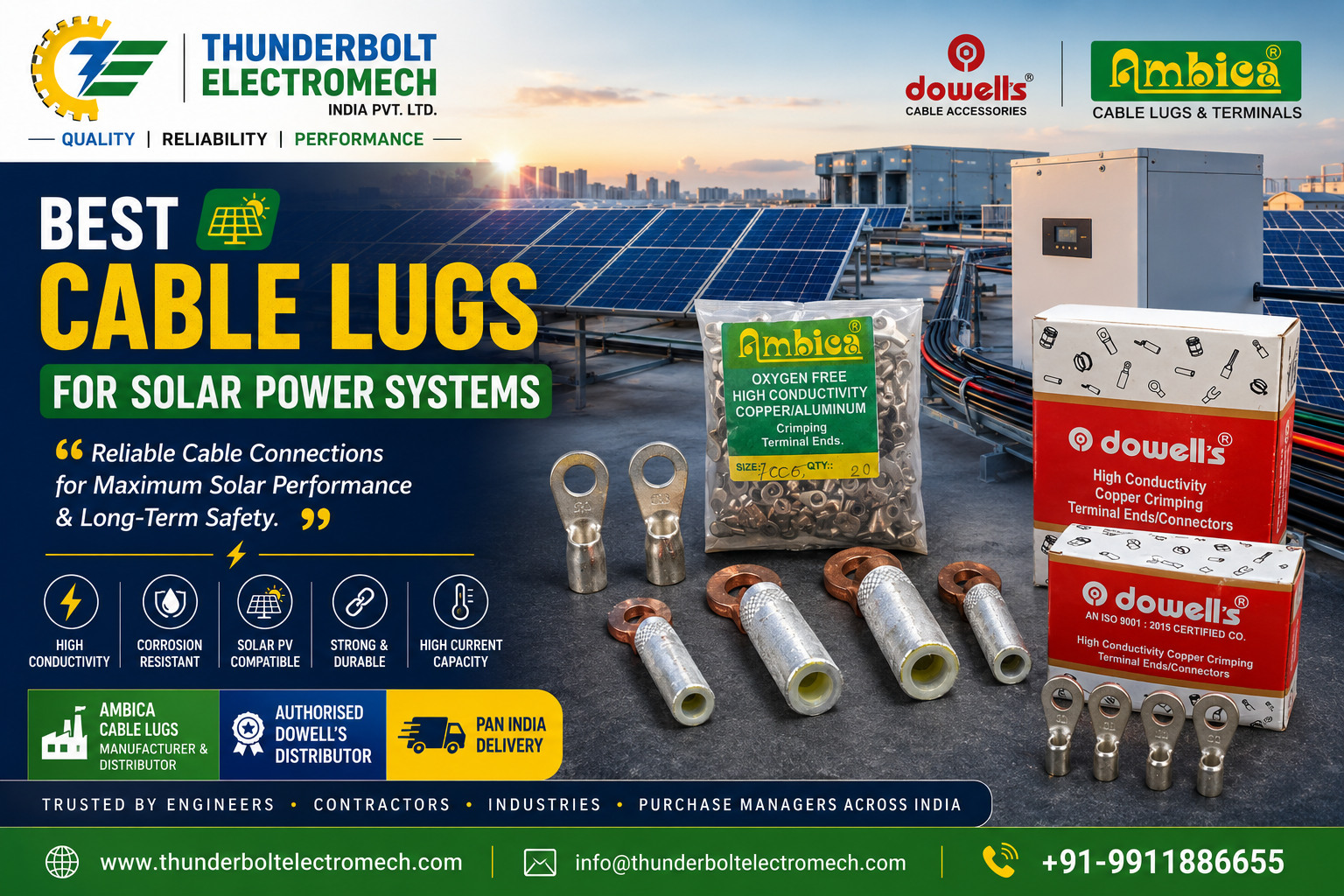
- Choosing a trusted Cable Lug Supplier India such as Thunderbolt Electromech, supplying Dowells Cable Lugs and manufacturing Ambica Cable Lugs, ensures certified products, Pan India delivery, and technical support for engineers, EPC contractors, industries, and purchase managers.
Introduction
India’s solar industry is expanding at an unprecedented pace. From rooftop installations to multi-megawatt solar parks, the demand for dependable electrical connections has never been greater. While solar panels and inverters often receive the most attention, experienced engineers know that the reliability of a solar system depends equally on the quality of its electrical terminations.
A single loose or poorly selected cable lug can generate excessive heat, increase resistance, reduce system efficiency, and even trigger electrical fires. Such failures frequently occur at cable termination points rather than within the cables themselves.
Choosing the correct cable lug involves evaluating multiple technical parameters, including:
- Conductor material
- Cable cross-sectional area
- Current carrying capacity
- Environmental exposure
- Corrosion resistance
- Crimping quality
- Mechanical strength
- International electrical standards
As a leading Cable Lug Supplier India, Thunderbolt Electromech supplies premium Dowells Cable Lugs and manufactures Ambica Cable Lugs, serving customers across India with products suitable for solar EPC projects, industrial electrical panels, substations, battery energy storage systems (BESS), and utility-scale renewable energy installations.
This guide combines engineering knowledge, field experience, procurement insights, and practical recommendations to help engineers and purchase managers make technically sound purchasing decisions.
Cable Lug Supplier India: Understanding Solar Cable Lugs & Industrial Procurement in India
Selecting cable lugs for a solar power project should never be based solely on price. The performance of every DC string, combiner box, inverter, transformer, and AC distribution panel depends on secure electrical connections.
A cable lug serves three critical purposes:
- Transfers electrical current with minimal resistance.
- Provides mechanical support to heavy cables.
- Protects the conductor from loosening under vibration and thermal expansion.
Unlike conventional buildings, solar power plants operate outdoors under harsh conditions:
- High UV exposure
- Heavy rainfall
- Humidity
- Dust accumulation
- Wide temperature fluctuations
- Continuous thermal cycling
These environmental factors gradually weaken poor-quality cable terminations. High-quality cable lugs are specifically designed to withstand these demanding operating conditions.
Why Standard Terminal Lugs Fail in Utility-Scale Solar Plants
Many failures observed in large solar installations are not caused by the cable itself but by incorrect termination practices.
Common causes include:
- Incorrect lug sizing
- Poor crimp quality
- Low-grade copper
- Absence of tin plating
- Loose bolted connections
- Aluminium directly connected to copper
- Moisture ingress
- Oxidation
These issues increase contact resistance, leading to localized heating. Over time, the insulation degrades, resulting in equipment failure and unplanned shutdowns.
Why Solar Projects Need High-Quality Cable Lugs
Solar plants are designed to operate continuously for 25 years or more. During this period, electrical joints experience thousands of heating and cooling cycles due to daily load variations.
A premium cable lug offers:
- Lower electrical resistance
- Stable contact pressure
- Better heat dissipation
- Higher pull-out strength
- Improved corrosion resistance
- Longer maintenance intervals
- Reduced downtime
These advantages directly improve plant reliability and reduce lifecycle costs.
Role of a Reliable Cable Lug Supplier India in Solar Procurement
A trusted Cable Lug Supplier India does much more than supply products. It acts as a technical partner throughout the procurement and installation process.
A professional supplier helps customers with:
- Correct lug selection
- Material recommendations
- Size matching
- Availability of bulk stock
- Technical documentation
- Product traceability
- Fast Pan India delivery
- After-sales support
Thunderbolt Electromech supports engineers, contractors, OEMs, and industries by offering:
- Dowells Cable Lugs
- Ambica Cable Lugs
- Copper Cable Lugs
- Aluminium Cable Lugs
- Bimetallic Cable Lugs
- Heavy Duty Copper Lugs
- Pin Type Cable Lugs
- Copper Ring Terminals
This broad product range simplifies sourcing for projects of all sizes.
Cable Lug Supplier India: Evaluating Cable Lugs Manufacturer in Delhi NCR & Wholesale Hubs Like Cable Lugs Bhagirath Palace
Bhagirath Palace in Delhi has long been recognized as one of India’s largest electrical wholesale markets. It serves as a key sourcing hub for contractors, electrical traders, OEMs, and project buyers.
However, purchasing cable lugs should involve more than comparing prices.
Engineers should assess suppliers based on:
- Product certifications
- Manufacturing quality
- Copper purity
- Tin plating thickness
- Dimensional accuracy
- Availability of technical support
- Consistent stock levels
- Warranty and traceability
For industrial and renewable energy projects, consistent quality is often more valuable than a marginally lower purchase price.
Understanding Solar Cable Lugs
A cable lug is a compression connector that permanently joins an electrical conductor to equipment terminals such as:
- Solar inverter terminals
- AC distribution panels
- Battery banks
- Transformers
- Busbars
- MCC panels
- Junction boxes
- Combiner boxes
After compression using the correct crimping tool, the lug forms a low-resistance electrical connection capable of carrying high current safely for decades.
Major Types of Cable Lugs Used in Solar Installations
Copper Cable Lugs
Manufactured from electrolytic copper, these offer excellent conductivity and mechanical strength. Tinned copper versions provide additional corrosion protection for outdoor installations.
Applications include:
- Solar inverters
- Battery banks
- Switchgear
- DC combiner boxes
- Copper busbars
Aluminium Cable Lugs
Aluminium cable lugs are designed specifically for aluminium conductors.
Advantages include:
- Lower weight
- Lower material cost
- Suitable for long-distance feeders
- Good conductivity when correctly installed
Bimetallic Cable Lugs
Bimetallic lugs combine an aluminium barrel with a copper palm.
They prevent galvanic corrosion when joining aluminium conductors to copper equipment, making them essential in many utility-scale solar projects.
Heavy Duty Copper Lugs
These feature thicker walls and higher mechanical strength.
Ideal applications include:
- Transformer terminations
- High-current inverters
- Industrial switchboards
- Battery energy storage systems
Customer Problems & Practical Solutions
| Customer Problem | Engineering Solution |
| Cable lug becomes hot during operation | Use the correct lug size and certified crimping die. |
| Green corrosion on terminals | Use tinned copper lugs with heat-shrink insulation. |
| Aluminium cable connected directly to copper busbar | Replace with certified bimetallic cable lugs. |
| Loose termination after one year | Apply proper torque values and spring washers. |
| Frequent inverter trips | Inspect cable termination resistance using a thermal camera. |
| Voltage drop in DC strings | Upgrade to heavy-duty copper lugs with proper conductor sizing. |
| Water ingress into outdoor terminations | Use adhesive-lined heat shrink tubing over crimped joints. |
Technical Research: Why Cable Lug Quality Directly Affects Solar Plant Efficiency
Industry studies on electrical reliability consistently show that a significant percentage of power failures originate at electrical connections rather than within the conductor itself. The reason is straightforward: every connection introduces a potential point of resistance.
A poorly crimped or undersized lug creates a small increase in resistance. While this increase may seem insignificant, the heat generated follows the relationship Power Loss = I²R. In high-current solar installations, even a slight rise in resistance can produce substantial heat, accelerating insulation aging, loosening connections through thermal cycling, and reducing overall system efficiency.
Modern utility-scale solar plants therefore specify:
- Electrolytic-grade copper with high conductivity
- Uniform tin plating for corrosion resistance
- Precision-manufactured barrels for consistent crimp quality
- Compression lugs compliant with recognized electrical standards
- Periodic thermographic inspections to identify high-resistance joints before failure occurs
This engineering approach improves long-term reliability, minimizes unscheduled maintenance, and supports the expected 25-year service life of photovoltaic systems.
Engineering Comparison Table
| Feature | Copper Cable Lugs | Aluminium Cable Lugs | Bimetallic Cable Lugs |
| Conductivity | Excellent | Good | Excellent at transition joint |
| Corrosion Resistance | Very High (Tinned) | Moderate | Excellent |
| Weight | Higher | Lower | Medium |
| Cost | Medium | Low | Medium-High |
| Best Application | Inverters, Busbars, Batteries | Long AC Feeders | Copper-Aluminium Connections |
| Maintenance | Low | Moderate | Low |
| Service Life | 25+ Years | 20+ Years | 25+ Years |
Cable Lug Supplier India: Material Selection for Long-Life Solar Power Systems
Selecting the correct cable lug material is one of the most important engineering decisions in a solar power project. Every electrical joint introduces a point of resistance. If that joint is made with the wrong material, poor conductivity, corrosion, or thermal expansion can gradually increase resistance and lead to overheating, voltage loss, and equipment failure.
Modern solar EPC companies no longer choose cable lugs solely based on price. They evaluate electrical conductivity, corrosion resistance, mechanical strength, compatibility with conductor material, installation environment, and long-term maintenance costs.
As a leading Cable Lug Supplier India, Thunderbolt Electromech supplies premium Dowells Cable Lugs and manufactures Ambica Cable Lugs, delivering certified products across India for solar plants, battery storage systems, substations, industrial panels, and infrastructure projects.
Copper Cable Lugs: The Preferred Choice for High-Performance Solar Systems
Copper remains the preferred conductor material for solar applications because of its excellent electrical conductivity and mechanical strength. High-purity electrolytic copper minimizes resistance, allowing more power to reach the inverter with lower heat generation.
For outdoor installations, tinned copper cable lugs provide an additional layer of protection. Tin plating reduces oxidation caused by moisture, humidity, and industrial pollutants, helping maintain low contact resistance over decades of operation.
Advantages of Copper Cable Lugs
- Excellent electrical conductivity
- Low voltage drop
- High current-carrying capacity
- Strong mechanical performance
- Long service life
- Superior corrosion resistance when tinned
- Ideal for DC solar circuits and inverter outputs
Typical Applications
- Solar inverter output terminals
- Battery energy storage systems (BESS)
- DC combiner boxes
- Transformer LV terminations
- Industrial switchgear
- MCC and PCC panels
Heavy Duty Copper Lugs: Built for High-Amperage Solar Installations
Utility-scale solar plants often operate with continuous currents exceeding several hundred amperes. Under these conditions, standard cable lugs may experience excessive heating if not designed for high-current applications.
Heavy Duty Copper Lugs feature:
- Thicker barrel walls
- Higher mechanical strength
- Better crimp compression
- Increased pull-out resistance
- Lower joint resistance
- Improved thermal performance
These characteristics make them suitable for:
- Central inverter stations
- Battery banks
- Transformer connections
- Generator panels
- Industrial distribution boards
When properly crimped, heavy-duty lugs distribute current more uniformly, reducing localized heating and extending equipment life.
Aluminium Cable Lugs: Cost-Effective for Long-Distance Power Distribution
Large solar parks frequently use aluminium conductors for long AC feeder cables because aluminium offers a lower cost and lighter weight than copper. Aluminium cable lugs are designed specifically to terminate aluminium conductors while maintaining adequate electrical performance.
Advantages
- Lower material cost
- Lightweight installation
- Suitable for large cable sizes
- Easy handling during installation
Limitations
- Lower conductivity than copper
- More susceptible to oxidation
- Requires correct installation torque
- Not suitable for direct connection to copper busbars
Because aluminium expands and contracts more than copper during thermal cycling, regular inspection of bolted joints is recommended.
Bimetallic Cable Lugs: Eliminating Galvanic Corrosion
One of the most common mistakes in industrial installations is connecting an aluminium conductor directly to a copper busbar.
This creates galvanic corrosion, an electrochemical reaction accelerated by moisture. Over time, the joint corrodes, resistance increases, and excessive heat develops.
Bimetallic cable lugs solve this problem by combining:
- An aluminium barrel for the cable
- A friction-welded copper palm for the equipment connection
Benefits
- Prevent galvanic corrosion
- Maintain stable resistance
- Increase joint reliability
- Reduce maintenance
- Extend service life in outdoor environments
For solar EPC projects using aluminium feeders connected to copper equipment, bimetallic lugs are considered the engineering best practice.
Engineering Comparison Table: Copper vs Aluminium vs Bimetallic Cable Lugs
| Parameter | Copper Cable Lugs | Aluminium Cable Lugs | Bimetallic Cable Lugs |
| Conductivity | Excellent | Good | Excellent at transition |
| Corrosion Resistance | Excellent (Tinned) | Moderate | Excellent |
| Mechanical Strength | High | Medium | High |
| Weight | Higher | Lower | Medium |
| Cost | Medium | Lower | Medium-High |
| Best Use | Copper conductors | Aluminium conductors | Copper-to-aluminium joints |
| Outdoor Performance | Excellent | Good | Excellent |
| Maintenance | Low | Moderate | Low |
| Solar Application | Highly Recommended | Suitable | Essential for mixed-metal systems |
Cable Lug Supplier India: Why Dowells Cable Lugs and Ambica Cable Lugs Are Preferred by Engineers
When selecting cable lugs for industrial and renewable energy projects, brand reputation is almost as important as material selection. Consistent manufacturing quality ensures predictable crimping performance, dimensional accuracy, and long-term reliability.
Thunderbolt Electromech offers two trusted product ranges:
- Dowells Cable Lugs (Authorised Distributor)
- Ambica Cable Lugs (Manufacturer and Distributor)
Together, these brands meet the requirements of EPC contractors, panel builders, OEMs, utilities, and industrial maintenance teams.
Dowells Cable Lugs
Dowells has built a strong reputation in India’s electrical industry by supplying high-quality cable accessories for demanding applications. Their cable lugs are widely used in:
- Solar EPC projects
- Industrial automation
- Electrical panels
- Transformers
- Switchgear
- Railways
- Infrastructure
Why Engineers Prefer Dowells Cable Lugs
- High-purity electrolytic copper
- Uniform tin plating
- Accurate barrel dimensions
- Reliable crimping performance
- Consistent quality control
- Wide size availability
- Suitable for demanding industrial environments
Dowells cable lugs are particularly popular where reliability and compliance are critical procurement requirements.
Ambica Cable Lugs
Ambica Cable Lugs are manufactured to provide dependable performance while offering excellent value for large-volume procurement.
Key Features
- Electrolytic copper construction
- Precision-machined barrels
- Uniform wall thickness
- Excellent conductivity
- Available in multiple sizes
- Bulk supply capability
- Pan India delivery through Thunderbolt Electromech
Ambica products are widely selected by:
- Electrical contractors
- Solar EPC companies
- Panel manufacturers
- Government projects
- Industrial maintenance departments
Engineering Comparison: Dowells vs Ambica Cable Lugs
| Feature | Dowells Cable Lugs | Ambica Cable Lugs |
| Product Range | Extensive | Extensive |
| Copper Quality | High-purity electrolytic | High-purity electrolytic |
| Tin Plating | Premium finish | High-quality finish |
| Industrial Projects | Excellent | Excellent |
| Solar Applications | Highly Recommended | Highly Recommended |
| Bulk Availability | Yes | Yes |
| Pan India Supply | Through Thunderbolt | Through Thunderbolt |
| Suitable for EPC Projects | Yes | Yes |
Copper Ring Terminals: Reliable Connections for Solar Batteries and Control Panels
Solar battery systems and control circuits often experience vibration, temperature changes, and repeated maintenance. In these applications, Copper Ring Terminals provide a secure bolted connection that minimizes the risk of accidental disconnection.
Advantages
- Excellent pull-out strength
- Stable electrical contact
- Suitable for vibration-prone equipment
- Easy maintenance
- Wide stud-size availability
Applications
- Battery banks
- DC combiner boxes
- Control panels
- PLC systems
- Terminal blocks
- UPS systems
Ring terminals are particularly valuable in energy storage systems where dependable connections are essential for uninterrupted operation.
Pin Type Cable Lugs: Compact Solutions for Modern Electrical Panels
As electrical panels become more compact, space-efficient terminations are increasingly important. Pin Type Cable Lugs are designed for applications where standard ring terminals cannot be accommodated.
Features
- Compact design
- Easy insertion into terminal blocks
- Low contact resistance
- Neat wiring layout
- Fast installation
Common Applications
- Solar inverter control terminals
- Modular circuit breakers (MCBs)
- Relay panels
- PLC control systems
- Automation cabinets
Their compact profile simplifies wiring while maintaining reliable electrical performance.
Research Insights: Why Cable Lug Quality Determines Long-Term Solar Reliability
Field studies conducted across utility-scale solar installations consistently show that electrical termination failures account for a significant share of maintenance interventions. Thermal imaging surveys frequently identify hotspots at cable lug connections rather than within the cables themselves.
Engineering best practices to reduce these failures include:
- Using tinned copper lugs for outdoor copper conductors
- Selecting bimetallic lugs for copper-to-aluminium transitions
- Employing calibrated hexagonal crimping tools
- Applying the manufacturer’s specified torque values
- Protecting exposed joints with adhesive-lined heat-shrink sleeves
- Performing periodic infrared thermography to detect rising joint temperatures before failure occurs
Although premium cable lugs may have a higher initial cost, they typically lower the total cost of ownership by reducing downtime, maintenance, and energy losses over the life of the solar plant.
Real Use Case #1: Preventing Overheating in a 500 kW Rooftop Solar Plant
An EPC contractor installing a 500 kW rooftop solar project initially used standard, untinned copper lugs for inverter output terminations. After one monsoon season, routine thermal imaging revealed several hotspots exceeding acceptable temperature limits. Investigation showed early oxidation and increased contact resistance at the cable terminations.
The affected lugs were replaced with Dowells tinned copper cable lugs, installed using calibrated hexagonal crimping dies and finished with adhesive-lined heat shrink sleeves. Follow-up inspections over the next operating cycle showed stable temperatures, improved electrical continuity, and no further signs of corrosion.
This example demonstrates that selecting the right cable lug is not simply a procurement decision—it is an engineering decision that directly influences plant reliability, maintenance costs, and long-term energy generation.
Real Use Case #2: Utility-Scale Solar Farm Improves Reliability with Bimetallic Lugs
A utility-scale solar project used aluminium AC feeder cables connected directly to copper busbars inside transformer panels. Within two years of operation, routine maintenance detected discoloration, elevated temperatures, and increased joint resistance caused by galvanic corrosion.
During the corrective maintenance shutdown, all transition points were replaced with certified bimetallic cable lugs, anti-oxidant compound was applied to the aluminium conductors, and joints were reassembled using calibrated torque values.
Subsequent thermal imaging inspections showed uniform temperatures across all terminations, and the project reported a noticeable reduction in maintenance-related shutdowns. The upgrade also improved confidence in the long-term reliability of the power distribution system, demonstrating how selecting the correct cable lug material can directly influence plant performance and operating costs.
Cable Lug Size 10 sqmm to 300 sqmm: Complete Engineering Selection Guide for Solar Power Systems
Selecting the correct cable lug size is just as important as choosing the right solar cable or inverter. An oversized lug leads to poor crimp density. An undersized lug damages conductor strands and increases electrical resistance. Both conditions create localized heating, voltage loss, insulation degradation, and eventually system failure.
For engineers designing solar power plants, battery energy storage systems (BESS), rooftop PV systems, or utility-scale solar farms, the objective is always the same:
- Lowest possible contact resistance
- Maximum current carrying capability
- Long-term corrosion resistance
- Reliable mechanical strength
- Zero maintenance connections
A professional Cable Lug Supplier India understands that every installation begins with cable size—not with the lug itself.
Complete Cable Lug Sizing Chart (10 sqmm to 300 sqmm)
The following chart is widely accepted across industrial solar installations. Final selection should always match the actual conductor class, cable construction, and equipment manufacturer’s recommendations.
| Cable Size (sq.mm) | Typical Current (Approx.) | Recommended Stud Hole | Common Applications |
| 10 sq.mm | 60–70 A | M6 | Small Solar Panels |
| 16 sq.mm | 80–100 A | M8 | Rooftop PV |
| 25 sq.mm | 120–150 A | M8/M10 | Combiner Boxes |
| 35 sq.mm | 160–180 A | M10 | String Inverters |
| 50 sq.mm | 220 A | M10/M12 | DC Disconnect |
| 70 sq.mm | 260–300 A | M12 | Battery Banks |
| 95 sq.mm | 340 A | M12 | LV Panels |
| 120 sq.mm | 400 A | M12/M16 | Main DC Feeders |
| 150 sq.mm | 450 A | M16 | Solar Transformers |
| 185 sq.mm | 520 A | M16 | Industrial Busbars |
| 240 sq.mm | 620 A | M16/M20 | Utility Solar Plants |
| 300 sq.mm | 700+ A | M20 | Grid Substations |
Choosing the Correct Stud Size
The cable conductor is only one part of the equation.
The terminal stud also determines the lug selection.
Standard Stud Hole Guide
| Stud Size | Hole Diameter | Common Equipment |
| M6 | 6.5 mm | MCB |
| M8 | 8.5 mm | SPD |
| M10 | 10.5 mm | MCCB |
| M12 | 13 mm | Busbar |
| M16 | 17 mm | Transformer |
| M20 | 21 mm | Heavy Busbar |
Never enlarge a lug hole by drilling. This weakens the palm area and voids manufacturer specifications.
Solar Inverter Cable Lug Selection Guide
Different inverter capacities demand different cable sizes.
Quick Reference
| Solar Inverter | Typical Cable | Recommended Lug |
| 5 kW | 10 sq.mm | Copper Lug |
| 10 kW | 16 sq.mm | Tinned Copper Lug |
| 20 kW | 25 sq.mm | Heavy Duty Copper Lug |
| 30 kW | 35 sq.mm | Compression Lug |
| 50 kW | 50 sq.mm | Dowells Cable Lug |
| 75 kW | 70 sq.mm | Ambica Heavy Duty Lug |
| 100 kW | 95 sq.mm | Copper Ring Lug |
| 250 kW | 150 sq.mm | Long Barrel Lug |
| 500 kW | 240 sq.mm | Heavy Compression Lug |
| 1 MW | 300 sq.mm | Industrial Copper Lug |
Crimping Guide for Solar Cable Lugs
A cable lug performs only as well as its crimp.
Many field failures occur because installers purchase quality lugs but use incorrect crimping tools.
Proper crimping creates:
- Full conductor compression
- Gas-tight electrical contact
- Low resistance joint
- High pull-out strength
- Long service life
Recommended Crimping Pressure
| Cable Size | Crimp Type |
| 10–25 sq.mm | Hand Hydraulic |
| 35–70 sq.mm | Hydraulic |
| 95–150 sq.mm | Heavy Hydraulic |
| 185–300 sq.mm | Industrial Hydraulic |
Professional installers should never use ordinary pliers or hammer crimping.
Hexagonal Crimp vs Indent Crimp
This is one of the most discussed topics among electrical engineers on technical forums.
Hexagonal Crimp
Advantages
✔ Uniform compression
✔ Better conductivity
✔ Low contact resistance
✔ Preferred for solar installations
✔ Suitable for tinned copper lugs
Applications
- Solar PV
- Battery Storage
- Wind Power
- Utility Plants
Indent Crimp
Advantages
- Faster installation
- Lower tooling cost
Disadvantages
- Uneven compression
- Higher resistance
- Localized heating
- Less suitable for high-current DC circuits
Engineering Comparison
| Feature | Hex Crimp | Indent Crimp |
| Electrical Contact | ★★★★★ | ★★★☆☆ |
| Mechanical Strength | ★★★★★ | ★★★★☆ |
| Current Distribution | Excellent | Good |
| Heat Generation | Very Low | Medium |
| Solar Recommendation | Best Choice | Acceptable |
For solar power systems, hexagonal crimping remains the preferred option because it produces more consistent compression around the conductor strands.
Why Proper Crimping Matters
Even premium Dowells Cable Lugs or Ambica Cable Lugs cannot compensate for poor workmanship.
Improper crimping can cause:
- Voltage drops
- Hot joints
- Oxidation
- Loose terminals
- Fire hazards
- Inverter shutdowns
- Arc faults
Field inspections frequently trace these issues back to installation quality rather than the cable lug itself.
Research: Anti-Oxidant Paste and Cable Lug Reliability
When aluminium conductors are terminated, oxidation begins almost immediately after the conductor is exposed to air.
The oxide layer:
- Increases electrical resistance
- Raises operating temperature
- Weakens electrical continuity
- Accelerates joint degradation
Anti-oxidant compounds such as Penetrox and similar conductive joint compounds fill microscopic air gaps, reduce oxidation, and improve long-term performance.
Benefits
- Prevents corrosion
- Reduces moisture ingress
- Lowers contact resistance
- Improves thermal stability
- Extends service life
This is especially important when using Bimetallic Cable Lugs to connect aluminium conductors to copper busbars.
Thermal Expansion Research
Copper expands differently from aluminium during heating cycles.
Solar plants experience daily thermal cycling:
Morning → Cold
Afternoon → Hot
Night → Cold again
These repeated expansion and contraction cycles gradually loosen poorly designed electrical joints.
Using:
- Bimetallic Cable Lugs
- Proper hydraulic crimping
- Correct torque settings
- Anti-oxidant paste
Helps maintain stable electrical performance over years of operation.
Common Installation Mistakes in Solar Projects
1. Using the Wrong Lug Size
Small lugs damage conductor strands.
Oversized lugs create loose electrical joints.
Solution:
Always match the conductor cross-section exactly.
2. Mixing Copper and Aluminium Directly
Direct copper-to-aluminium connections encourage galvanic corrosion, particularly in humid or coastal environments.
Solution:
Use certified Bimetallic Cable Lugs with anti-oxidant compound.
3. Reusing Old Cable Lugs
Some installers reuse lugs removed during maintenance.
This can introduce cracks, deformation, and unreliable compression.
Solution:
Install new lugs whenever a cable is re-terminated.
4. Incorrect Crimping Tool
Improvised tools create inconsistent compression.
Solution:
Use calibrated hydraulic crimping equipment matched to the lug manufacturer’s die specifications.
5. Incorrect Torque
Under-tightening causes loose joints.
Over-tightening can crack the lug palm or strip studs.
Solution:
Follow the equipment manufacturer’s recommended tightening torque.
6. Exposed Copper
Bare copper exposed outside the barrel allows moisture ingress and accelerates corrosion.
Solution:
Select the correct barrel length and complete the crimp before sealing with heat shrink tubing where required.
Insights from Reddit & Quora Engineering Discussions
Professional installers and maintenance engineers often raise recurring questions about cable lug reliability. The following themes appear consistently across community discussions.
Bare Copper vs. Tinned Copper Lugs
A common consensus is that tinned copper lugs are preferable for outdoor solar plants because the tin coating slows oxidation and maintains low contact resistance in humid conditions. Bare copper remains suitable indoors but generally requires stricter environmental control.
Why Bimetallic Lugs Matter
Engineers working on large solar farms frequently recommend bimetallic lugs whenever aluminium feeder cables terminate on copper busbars. This approach minimizes galvanic corrosion and reduces long-term maintenance issues.
Compression Quality
Experienced technicians emphasize that the crimping process is as important as the lug itself. A high-quality lug installed with an incorrect die or insufficient hydraulic pressure can fail prematurely despite using premium materials.
Hydraulic Crimping
Field experience consistently shows that hydraulic hexagonal crimping delivers more uniform compression, lower resistance, and better mechanical retention than improvised or hammer-style crimping methods.
Preventive Maintenance
Routine thermal imaging of cable terminations is often recommended for utility-scale solar plants. Detecting temperature rise early helps identify loose or deteriorating connections before they lead to outages or equipment damage.
These practical observations reinforce the engineering principle that selecting the correct lug, applying the proper crimp, and following installation best practices are all essential to achieving long-term reliability in solar power systems.
Frequently Asked Questions (FAQ): Addressing Sourcing & Engineering Search Intent
1. What is the difference between tinned copper cable lugs and standard copper cable lugs in solar power plants?
The primary difference lies in corrosion resistance. Standard copper lugs offer excellent electrical conductivity but can oxidize over time when exposed to moisture, humidity, or industrial pollutants. Tinned copper cable lugs have a protective tin coating that significantly slows oxidation while maintaining low contact resistance.
For rooftop solar systems, utility-scale PV plants, battery energy storage systems (BESS), and outdoor switchyards, tinned copper cable lugs are generally the preferred choice because they provide longer service life and lower maintenance requirements.
2. Why are bimetallic cable lugs mandatory when connecting aluminium solar cables to copper busbars?
Directly joining aluminium conductors to copper busbars creates galvanic corrosion. Moisture accelerates this electrochemical reaction, increasing resistance and generating excessive heat.
Bimetallic cable lugs combine an aluminium barrel with a copper palm through friction welding, creating a reliable transition that minimizes corrosion and maintains stable electrical performance over the life of the installation.
3. How do I select the correct cable lug size from 10 sqmm to 300 sqmm?
The cable lug should match:
- Conductor cross-sectional area
- Conductor material (copper or aluminium)
- Terminal stud size
- Current carrying capacity
- Equipment manufacturer’s recommendations
- Environmental conditions
Selecting a lug based only on cable diameter is not sufficient. Engineers should always verify conductor specifications and terminal requirements before installation.
4. Where can I source certified Dowells Cable Lugs and Heavy Duty Copper Lugs in bulk in India?
Thunderbolt Electromech supplies Dowells Cable Lugs as an authorized distributor and manufactures Ambica Cable Lugs, offering bulk quantities with Pan India delivery. This enables EPC contractors, industries, panel builders, and OEMs to procure reliable cable termination products from a single source.
5. Which cable lug is best for solar inverters?
For copper conductors used in inverter outputs, tinned copper compression lugs are widely recommended because they offer high conductivity, corrosion resistance, and dependable long-term performance. Heavy-duty copper lugs are preferred for higher current ratings.
6. Can aluminium cable lugs be used with copper cables?
No. Aluminium cable lugs are designed specifically for aluminium conductors. Using them on copper cables can compromise the connection and reduce reliability. Copper conductors should be terminated with copper lugs, while copper-to-aluminium transitions require bimetallic cable lugs.
7. Why do cable lugs overheat even when the cable size is correct?
Overheating is usually caused by installation issues rather than cable size alone. Common causes include poor crimping, loose bolts, incorrect lug selection, corrosion, or inadequate tightening torque. Proper installation practices and periodic inspection are essential to maintain safe operating temperatures.
8. What type of crimping is recommended for solar cable lugs?
Hydraulic hexagonal crimping is generally preferred because it provides uniform compression around the conductor strands, resulting in lower contact resistance and improved mechanical strength compared with less consistent crimping methods.
9. How often should cable lug connections be inspected in a solar plant?
Routine visual inspections should be combined with periodic infrared thermography, particularly for utility-scale installations. Thermal imaging helps identify abnormal temperature rises before they develop into equipment failures or unplanned outages.
10. What causes green corrosion on copper cable lugs?
Green deposits are typically a sign of oxidation accelerated by moisture and environmental exposure. Using tinned copper cable lugs, sealing terminations where appropriate, and maintaining clean electrical joints help reduce corrosion.
11. Are heavy-duty copper lugs necessary for battery energy storage systems (BESS)?
Battery systems operate at high current levels, making robust electrical terminations essential. Heavy-duty copper lugs offer improved mechanical strength and lower electrical resistance, making them well suited for demanding battery applications.
12. What is the advantage of copper ring terminals over fork terminals?
Ring terminals provide a fully enclosed connection around the stud, making them more resistant to vibration and accidental loosening. This makes them particularly suitable for battery terminals, combiner boxes, and industrial control panels.
13. Are pin type cable lugs suitable for solar control panels?
Yes. Pin type cable lugs are commonly used in terminal blocks, PLC panels, modular circuit breakers, and inverter control wiring where compact, reliable terminations are required.
14. Why is proper torque important when installing cable lugs?
Incorrect tightening torque can either leave the connection loose or damage the terminal. Both conditions increase electrical resistance and reduce long-term reliability. Always follow the equipment manufacturer’s recommended torque values.
15. What standards should engineers consider when purchasing cable lugs?
In addition to matching the application, engineers should evaluate conductor material, dimensional accuracy, manufacturing quality, and compliance with relevant electrical standards. Product traceability and consistent quality are equally important for industrial and renewable energy projects.
16. Why is Thunderbolt Electromech a preferred Cable Lug Supplier India?
Thunderbolt Electromech combines manufacturing capability with nationwide distribution, offering both Ambica Cable Lugs and Dowells Cable Lugs. Customers benefit from technical assistance, reliable stock availability, and Pan India logistics for projects ranging from rooftop solar systems to utility-scale installations.
Why Engineers Across India Choose Thunderbolt Electromech
Selecting a cable lug supplier involves more than comparing prices. Engineers and procurement teams require dependable products, technical support, and consistent delivery performance.
Thunderbolt Electromech provides:
- Manufacturer and distributor of Ambica Cable Lugs
- Authorized distributor of Dowells Cable Lugs
- Complete range of Copper, Aluminium, and Bimetallic Cable Lugs
- Heavy Duty Copper Lugs
- Copper Ring Terminals
- Pin Type Cable Lugs
- Cable sizes from 10 sqmm to 300 sqmm and beyond
- Technical guidance for EPC contractors and industries
- Bulk supply for infrastructure and renewable energy projects
- Pan India delivery
- Competitive industrial pricing
Contact Details
Thunderbolt Electromech India Pvt. Ltd.
Phone: +91-9911886655
Website: https://thunderboltelectromech.com
Email: info@thunderboltelectromech.com
Location: Bhagirath Palace, Delhi NCR, India
Why Buy Cable Lugs from Thunderbolt Electromech?
Purchasing cable lugs from a knowledgeable supplier reduces procurement risks and helps ensure long-term system reliability.
Technical Product Selection
The team assists customers in selecting the appropriate cable lug based on conductor material, cable size, terminal configuration, and operating environment.
Wide Product Availability
Whether the requirement is for Copper Cable Lugs, Aluminium Cable Lugs, Bimetallic Cable Lugs, Copper Ring Terminals, or Pin Type Cable Lugs, Thunderbolt Electromech offers a comprehensive portfolio suitable for industrial and renewable energy applications.
Reliable Supply Chain
Bulk orders are supported with nationwide delivery, helping EPC contractors and industrial customers maintain project schedules.
Industrial Expertise
With experience serving solar EPC companies, panel builders, OEMs, utilities, and manufacturing industries, Thunderbolt Electromech understands the technical and logistical requirements of large-scale electrical projects.
About Ambica Cable Lugs
Ambica Cable Lugs are manufactured using high-quality materials and precision production processes to deliver dependable electrical performance. The range includes copper, aluminium, and specialized termination solutions suitable for electrical panels, transformers, solar installations, and industrial power distribution.
Key benefits include:
- High-conductivity materials
- Precision dimensions
- Strong mechanical performance
- Reliable crimp quality
- Suitable for demanding industrial environments
About Dowells Cable Lugs
Dowells Cable Lugs are widely recognized in India’s electrical industry for their consistent quality and engineering standards. They are commonly specified for industrial projects, utilities, infrastructure developments, and renewable energy installations where dependable performance is essential.
Their reputation is built on:
- High-quality electrolytic copper
- Uniform tin plating
- Accurate manufacturing tolerances
- Broad product range
- Proven performance across diverse applications
Pan India Delivery
Thunderbolt Electromech supplies cable lugs to customers across India, supporting projects in metropolitan cities as well as remote industrial locations. Efficient logistics and inventory management help minimize procurement delays for EPC contractors, panel manufacturers, OEMs, and maintenance teams.
Industries served include:
- Solar Power
- Wind Energy
- Battery Energy Storage Systems (BESS)
- Power Transmission & Distribution
- Electrical Panel Manufacturing
- Oil & Gas
- Railways
- Infrastructure
- Manufacturing
- Commercial & Industrial Facilities
Why Engineers Recommend Quality Cable Lugs
Experienced engineers recognize that the long-term reliability of a solar installation depends on every electrical connection. High-quality cable lugs contribute to:
- Lower contact resistance
- Improved thermal stability
- Reduced voltage drop
- Greater resistance to corrosion
- Longer maintenance intervals
- Increased system uptime
- Enhanced operational safety
Investing in reliable cable terminations helps reduce lifecycle costs while supporting consistent power generation over the expected life of the project.
Conclusion
Selecting the best cable lugs for solar power systems requires careful consideration of conductor material, cable size, environmental conditions, installation practices, and application requirements. Copper Cable Lugs, Aluminium Cable Lugs, Bimetallic Cable Lugs, Copper Ring Terminals, Heavy Duty Copper Lugs, and Pin Type Cable Lugs each play a specific role in achieving safe, efficient, and durable electrical connections.
For engineers, EPC contractors, industries, and purchase managers seeking a dependable Cable Lug Supplier India, partnering with a technically experienced supplier can simplify procurement and improve project outcomes. Thunderbolt Electromech supports customers with Ambica Cable Lugs, Dowells Cable Lugs, technical guidance, bulk supply capability, and Pan India delivery, helping ensure reliable cable termination solutions for projects across the country.
Whether you are designing a rooftop PV installation, a utility-scale solar farm, or an industrial electrical system, selecting the right cable lug today contributes to safer operation, reduced maintenance, and dependable performance for years to come.