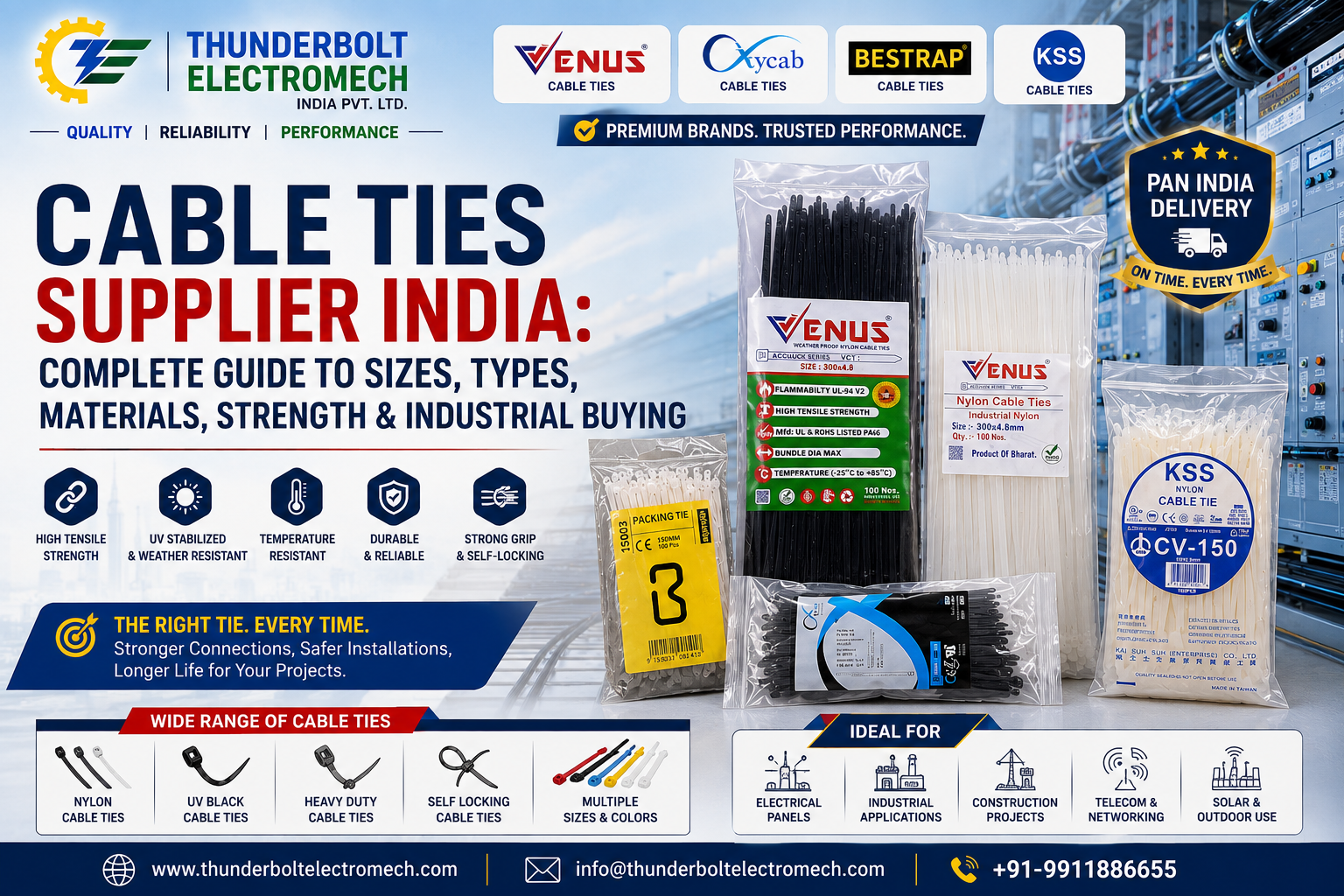
By Thunderbolt Electromech India Pvt. Ltd. — Delhi-based Stockist & Distributor of Venus, Tycab, Bestrap & KSS Cable Ties
📞 +91-9911886655 | ✉️ info@thunderboltelectromech.com | 🌐 thunderboltelectromech.com | 📍 Shop No. 3538, Sitaram Bazar Rd, Bazar Sirkiwalan, Chawri Bazar, Chandni Chowk, Delhi – 110006
Quick Answer
Looking for the short version before you read the full guide?
If you are buying cable ties in India for electrical panels, control panel wiring, industrial bundling, or outdoor cabling, here is the fastest way to choose correctly:
- Material: Use Nylon 66 (PA66) cable ties for 90% of industrial and electrical panel work. Use UV-black PA66 for outdoor/rooftop solar and telecom cabling. Use stainless steel (SS304/SS316) ties only for high-heat, high-vibration, or hazardous-area installations.
- Size: Match the tie width to your bundle diameter and the tie length to (3.14 × bundle diameter) + 20mm slack. Most Indian electrical panels use 2.5mm, 3.6mm, or 4.8mm width ties in 100mm–300mm lengths.
- Tensile strength: 8kg–18kg (18lb–40lb) covers 80% of panel wiring and light bundling. 22kg–50kg (50lb–120lb) heavy-duty ties are needed for outdoor cable bundles, conduit routing, and structural bundling on machinery.
- Standard vs Heavy-Duty: Standard ties suit indoor, low-vibration bundling. Heavy-duty ties are needed wherever there is vibration, weight-bearing, or repeated thermal cycling — e.g., motor panels, transformers, and rooftop installations.
- Quantity/Price: Bulk pricing in India typically drops 12–25% once you move from retail packs (100 pcs) to bulk cartons (1,000–5,000 pcs), and further with annual rate contracts.
- Where to buy: Choose a supplier who stocks multiple brands (so you’re never stuck when one brand is out of stock), holds test certificates (RoHS, UL94V-2), and understands both cable ties and allied products like cable lugs, cable glands, and panel wiring accessories.
Thunderbolt Electromech India Pvt. Ltd., a Delhi-based authorised stockist of Venus, Tycab, Bestrap, and KSS cable ties, supplies the complete size and strength range described in this guide — from 2.5mm mini ties to 12mm heavy-duty industrial ties — along with copper and aluminium cable lugs for panel and switchgear work.
The sections below go deep into every buying variable — sizes, materials, tensile ratings, UV resistance, pricing logic, and how to vet a genuine cable ties supplier India businesses can rely on for repeat industrial orders.
Introduction
Cable ties look like a commodity item until the wrong one fails inside a live electrical panel, a rooftop solar array, or a vibrating machine enclosure. At that point, the ₹2 component becomes a safety incident, a warranty claim, or an unplanned shutdown. For procurement teams, panel fabricators, EPC contractors, and MRO buyers across India, the real question is never “where do I buy cable ties” — it is “which size, which material, which tensile rating, and which cable ties supplier India can deliver it consistently, in the quantity my project needs, without me having to test every batch.”
This guide is written for exactly that buyer: someone comparing specifications before placing a purchase order, not someone who needs cable ties explained from scratch. We cover the technical decision points (size charts, PA66 vs stainless steel, UV resistance, tensile load), the commercial decision points (pack sizes, bulk pricing, vendor evaluation), and the Thunderbolt Electromech product range across Venus, Tycab, Bestrap, and KSS — along with where cable lugs fit into the same panel-wiring purchase order.
1. Cable Ties Supplier India: What Are Cable Ties and Where Are They Used?
A cable tie (also called a zip tie, nylon tie, or self-locking strap) is a fastening device with a ratchet-toothed strap and a locking head. The strap is pulled through the head, the internal pawl engages the teeth, and the loop tightens and locks in one direction — it cannot loosen on its own once tensioned correctly. That one-way ratchet mechanism is what separates a cable tie from a simple wire wrap or hook-and-loop strap: it is a self-locking, tamper-resistant restraint, not a temporary bundling aid.
In Indian industrial and electrical practice, cable ties are used across five distinct environments, and the correct product differs for each:
- Electrical & control panels — securing wire looms to panel backplates, dressing bus-bar leads, bundling control wiring inside MCC/PCC panels, and routing cables away from hinge points. This is the single largest volume category for any cable ties supplier India deals with, because every panel builder — from small fabrication shops in Wazirpur and Naraina to large panel OEMs in Faridabad and Manesar — consumes ties on every panel shipped.
- Outdoor and rooftop installations — solar rooftop DC/AC cable runs, telecom tower cabling, streetlight wiring, and outdoor junction box dressing. These require UV-stabilised material because standard indoor ties degrade and snap within 12–18 months of direct sun exposure.
- Machine building & OEM assembly — bundling wiring harnesses inside CNC machines, packaging machinery, textile machinery, and pump/motor control boxes, where vibration resistance matters more than UV resistance.
- Data centres & structured cabling — server room cable management, where releasable (reusable) ties are preferred over cut-only ties because racks get reconfigured frequently.
- General MRO and facilities — everything from bundling garden hoses to securing tarpaulins on trucks, where price sensitivity is highest and mid-tensile, general-purpose ties dominate.
Buyers frequently source cable ties in the same purchase order as cable lugs (copper and aluminium terminal lugs used to terminate cable ends onto bus-bars and equipment terminals) because both are consumed on every panel-wiring job. A supplier who stocks both categories — ties for bundling, lugs for termination — saves panel fabricators a second vendor relationship and a second freight line item, which is one reason Delhi-based buyers increasingly consolidate both purchases with a single cable ties supplier India vendor.
2. Types of Cable Ties Available for Industrial Applications
Not all cable ties are interchangeable. The type determines whether it can be reused, how it behaves under vibration, and whether it is suitable for a hazardous or food-grade environment.
Standard (cut-only) nylon ties — the most common type, made from PA66, non-reusable once tensioned. Used for permanent bundling in panels, harnesses, and general wiring.
Releasable (reusable) cable ties — feature a tab on the locking head that can be pressed to release tension, allowing the tie to be reused. Preferred in data centres, test labs, and any application where cables are reconfigured regularly.
Self-locking (one-piece ratchet) ties — the standard mechanism described above; distinguished from “screw-mount” or “push-mount” ties that use a separate mounting base fixed to a panel or chassis before the tie is threaded through.
Mounting-head / screw-mount ties — have an integrated flat mounting hole so the tie can be screwed directly onto a chassis, eliminating the need for a separate cable clamp.
Metal-tongue (stainless steel barb) nylon ties — a nylon strap with an embedded stainless-steel locking barb instead of a plastic pawl, giving higher tensile strength and better performance at elevated temperature than a pure-nylon locking mechanism.
Stainless steel cable ties (SS304/SS316) — an all-metal band-and-buckle tie used where nylon cannot survive: high-temperature ducting, exhaust systems, outdoor solar farm structural cabling, marine and offshore applications, and hazardous/explosion-risk zones where plastic is restricted.
Coated stainless steel ties (nylon or PVC coated) — stainless ties with a protective outer coating to prevent the metal band from scratching cable insulation or painted surfaces, common in food-processing and pharma-grade installations.
Beaded/ladder ties — a continuous ball-chain style tie used mainly for bundling irregular shapes or for identification tagging rather than tight bundling.
Push-mount / Christmas-tree ties — designed to snap directly into a pre-drilled panel hole without a separate screw, common in automotive and appliance wiring harnesses.
Double-head / dual-loop ties — used where a bundle needs to be secured to a structure and held at a fixed standoff distance simultaneously, common in cable-tray routing.
Marker/identification ties — a standard tie with an integrated flag or tab for wire marking and circuit identification, widely used in panel wiring to comply with IS/IEC labelling practices.
For most panel builders sourcing from a Delhi-based cable ties supplier India vendor, the working mix is roughly: 70% standard PA66 ties (multiple sizes), 15% UV-black outdoor ties, 10% heavy-duty/metal-tongue ties, and 5% releasable or stainless variants for special applications. Thunderbolt Electromech stocks all of these across its Venus, Tycab, Bestrap, and KSS ranges so buyers are not forced into a single-type limitation.
3. Cable Tie Size Chart: Length, Width & Bundle Diameter
Cable tie sizing is specified by three numbers: width (mm), length (mm), and the maximum bundle diameter it can comfortably close around. Width determines tensile strength (wider = stronger); length determines the maximum bundle it can wrap.
| Width | Common Lengths | Typical Tensile (approx.) | Max Bundle Diameter | Typical Use |
| 2.5 mm | 100 mm, 150 mm | 8 kg (18 lb) | 25 mm | Light wire dressing, small harnesses, PCB assembly |
| 3.6 mm | 150 mm, 200 mm, 250 mm | 18 kg (40 lb) | 50–60 mm | Standard panel wiring, control cabinets |
| 4.8 mm | 200 mm, 250 mm, 300 mm, 370 mm | 22 kg (50 lb) | 75–100 mm | General industrial bundling, MCC panels |
| 7.6 mm | 300 mm, 370 mm, 450 mm, 550 mm | 50 kg (120 lb) | 130–150 mm | Heavy-duty bundling, outdoor cable runs |
| 9.0 mm | 550 mm, 750 mm | 79 kg (175 lb) | 200–230 mm | Structural bundling, large conduit groups |
| 12.0 mm | 750 mm, 900 mm, 1200 mm | 113 kg (250 lb) | 300 mm+ | Heavy cable bundles, industrial trunking, exterior structural ties |
A practical formula panel fabricators in India use to select length before ordering:
Required length = (π × bundle diameter) + tail allowance (15–25 mm for the locking head and pull-through tail)
For example, a 40mm-diameter wire bundle needs roughly (3.14 × 40) + 20 = 145.6mm, so a 150mm tie is the correct choice — not the next size up, which wastes strap length and cost, and not the size down, which will leave insufficient tail to lock securely.
Buyers requesting a quote from any cable ties supplier India should always specify width, length, and colour (natural/black) together — quoting length alone is the most common cause of wrong-size deliveries in bulk industrial orders.
Case Study — Part 1: Panel Fabricator, Wazirpur Industrial Area, Delhi
A control-panel fabrication unit in Wazirpur was standardising its BOM (bill of materials) across 40+ panel types and found that its store had accumulated eleven different tie sizes procured from four different vendors over two years, most bought reactively when a size ran out mid-shipment. Cross-referencing actual bundle diameters measured across their panel range showed that 92% of their internal wiring needs were covered by just three sizes — 2.5×100mm, 3.6×200mm, and 4.8×300mm — with the remaining sizes needed only for occasional large busbar dressing. By consolidating to a core set of three sizes plus one heavy-duty size for outdoor-rated panels, the fabricator cut SKU count from eleven to five, reduced dead stock, and simplified their purchase order to a single monthly bulk carton order rather than five ad-hoc small orders. The lesson for similar buyers: audit actual bundle diameters before finalising a size list, rather than ordering “one of everything.”
4. How to Choose the Right Cable Tie Size
Choosing size correctly avoids two failure modes: a tie that is too short to lock (unsafe, will not hold tension) and a tie that is too long (wastes material and leaves an excess tail that can snag or scratch adjacent components).
Step 1 — Measure the bundle diameter, not the number of wires. Group the wires as they will actually sit once bundled, and measure the outer diameter with a flexible tape, not a ruler across a flat surface.
Step 2 — Apply the length formula. Use (π × diameter) + 20mm tail allowance, then round up to the nearest standard length in the size chart above.
Step 3 — Match width to load, not just to length availability. A common mistake is buying a longer tie in a narrow width because it was in stock, when the bundle actually needs a wider, higher-tensile tie. Width governs strength; length only governs reach.
Step 4 — Account for insulation growth and thermal cycling. In outdoor and high-temperature panels, bundles can expand slightly with heat. Leave a small amount of extra length (5–10mm beyond the calculated minimum) so the tie is not stressed to its absolute limit at installation temperature.
Step 5 — Standardise across your BOM. As shown in the Wazirpur case above, most operations need only 3–5 sizes covering 90%+ of use cases. Standardising reduces both procurement complexity and installation error (technicians reaching for the “usual” size rather than hunting through a mixed bin).
Step 6 — Confirm colour requirement. Natural (white/translucent) nylon ties are the default indoor choice; black UV-stabilised ties are mandatory for any tie that will see direct sunlight, even briefly during transport or storage before installation.
5. Nylon 6.6 / PA66 Cable Ties: What Buyers Should Know
The overwhelming majority of industrial cable ties sold in India — across Venus, Tycab, Bestrap, and KSS — are manufactured from Nylon 6.6 (Polyamide 66, PA66), not generic “nylon” or cheaper PA6. This distinction matters more than most buyers realise:
- PA66 vs PA6: PA66 has a higher melting point (~255°C vs ~220°C for PA6), better dimensional stability, and superior long-term tensile retention. Some low-cost imported and unbranded ties use PA6 or PA6/PA66 blends to cut raw material cost, which results in ties that feel similar on the shelf but fail earlier under sustained tension or heat — a difference that is invisible until the tie is already installed in a live panel.
- Moisture absorption behaviour: PA66 absorbs a small amount of ambient moisture, which actually improves its flexibility and impact resistance compared to bone-dry nylon — this is a known and accepted characteristic, not a defect, and is why properly stored PA66 ties perform consistently across Indian humidity conditions from Delhi’s dry summers to coastal high-humidity regions.
- Flame rating: Genuine PA66 electrical-grade cable ties used in panel wiring should carry a UL94V-2 flame-retardant rating as standard, meaning the material is self-extinguishing within a specified time after flame removal — a specification worth asking for explicitly on the test certificate, since not every low-cost tie in the market is genuinely rated, regardless of what the packaging states.
- Operating temperature range: Standard PA66 ties typically perform reliably from -40°C to +85°C continuous, with brief excursions higher during transport; heat-stabilised variants extend this range for under-bonnet or near-motor applications.
- RoHS compliance: For panels destined for export or for OEMs supplying to EU-linked buyers, RoHS-compliant material certification (absence of restricted heavy metals/phthalates) should be requested and retained with the purchase order, since panel-level compliance audits will ask for component-level certificates.
Buyers sourcing PA66 ties in bulk from a cable ties supplier India vendor should always ask for the raw material grade and batch test certificate rather than accepting “nylon” as a sufficient description — this single question filters out a large share of unbranded, blended-resin product circulating at aggressively low prices.
6. Standard vs Heavy-Duty Cable Ties
The line between “standard” and “heavy-duty” is not marketing language — it corresponds to measurable differences in strap thickness, width, and tensile rating.
| Parameter | Standard Cable Tie | Heavy-Duty Cable Tie |
| Typical width | 2.5–4.8 mm | 7.6–12 mm+ |
| Typical tensile | 8–22 kg (18–50 lb) | 50–220 kg (120–500 lb) |
| Strap thickness | 1.0–1.3 mm | 1.4–2.2 mm |
| Common use | Indoor panel wiring, light bundling | Outdoor bundling, structural cable runs, vibration-heavy machine mounting |
| Typical failure mode if under-specified | Tail pull-out under vibration | Rarely fails if correctly sized |
| Price per piece (indicative range) | Lower | 2–4x standard, due to material volume |
Heavy-duty ties are not simply “better” — using an oversized heavy-duty tie on a light PCB harness wastes cost and can be harder to tension precisely by hand. The correct approach is to match tie category to load: standard for indoor wiring, control panels, and equipment under 5–10kg pull load; heavy-duty for outdoor bundles, conduit-adjacent routing, structural cable-tray lashing, and anywhere sustained vibration (motors, compressors, transport vehicles) is present.
A frequent under-specification error seen in Delhi-NCR panel workshops is using standard 4.8mm ties to bundle heavy control cables running to outdoor junction boxes — a combination that works initially but fails within a monsoon season once UV and thermal cycling combine with an undersized tensile margin. This is precisely where heavy-duty, UV-rated ties (covered next) should replace standard indoor stock.
7. UV Resistant Cable Ties for Outdoor Applications
Standard black colouring alone does not make a cable tie UV-resistant — carbon black must be compounded into the PA66 resin at the correct loading percentage (typically 2–3% carbon black by weight) to genuinely block UV degradation. Ties that are simply dyed black on the surface, or that use a lower carbon-black percentage to save cost, will still embrittle and crack within one to two Indian summers of direct sun exposure.
Genuine UV-stabilised black PA66 ties are essential for:
- Rooftop solar installations — DC string cable bundling and AC output cable dressing on module frames and combiner boxes, where ties sit in direct, continuous sun for the 25-year design life of the installation.
- Telecom tower and outdoor cabinet cabling — tower-top RF jumper bundling and outdoor cabinet cable dressing.
- Streetlight and outdoor lighting wiring, where ties are exposed year-round with no shelter.
- Outdoor junction boxes, cable trays, and gantry cabling at industrial sites, warehouses, and logistics hubs across the Delhi-NCR industrial belt (Bawana, Narela, Faridabad, and Manesar all have significant outdoor cabling exposure).
A useful field test buyers can perform on a sample batch: expose a small sample to accelerated outdoor conditions (or request the supplier’s UV test data, typically measured via xenon-arc weatherometer testing to standards referenced in cable tie datasheets) and compare tensile retention after exposure — genuine UV-black ties typically retain the large majority of original tensile strength after extended accelerated exposure, while surface-dyed ties show significant embrittlement and strength loss well before the same exposure duration.
Because solar rooftop and outdoor infrastructure projects have grown sharply across NCR in recent years, demand for genuinely UV-rated ties (as opposed to “black” ties sold as a substitute) has become one of the fastest-growing segments any serious cable ties supplier India vendor now needs to stock correctly, with proper documentation to back the UV claim.
Case Study — Part 2: Rooftop Solar EPC Contractor, Faridabad
A solar EPC contractor executing rooftop installations across industrial sheds in the Faridabad-Ballabgarh belt had standardised on a low-cost black cable tie for DC string bundling, based on price alone, without requesting UV test documentation. Within roughly 14–16 months of installation — one full summer and monsoon cycle — site visits during routine O&M checks found a meaningful proportion of ties on south-facing, unshaded module rows had become brittle and several had snapped, leaving DC cables loose against the module frame (a safety and insulation-abrasion risk, not just a cosmetic issue). Root-cause investigation traced the failure to insufficient carbon-black loading in the original tie batch rather than a labelling error — the ties were genuinely black in colour but not compounded for UV resistance. The contractor switched specification to a certified UV-stabilised PA66 tie with documented carbon-black content and began requesting batch-level UV test certificates as a standing purchase order condition. The broader lesson for EPC buyers: colour is not a specification — carbon-black loading and test documentation are, and any cable ties supplier India partner for solar work should be able to produce that documentation on request, not just assert it verbally.
8. Cable Tie Tensile Strength: How Much Load Can They Handle?
Tensile strength (also called loop tensile strength) is the maximum pull force the locked tie can withstand before the strap breaks or the locking mechanism releases, typically expressed in kilograms or pounds. It is tested by pulling the closed loop until failure under standardised laboratory conditions.
Why it matters more than it seems: a cable tie’s job is not just to hold a bundle together at rest — it must survive installation tension, thermal expansion/contraction cycling, vibration from adjacent machinery, and occasional accidental snagging during maintenance, all without the loop loosening or snapping. Under-specifying tensile strength is the single most common root cause of “the tie just broke” complaints, and it is almost always a sizing error rather than a manufacturing defect.
Practical tensile selection guide:
- 8kg (18lb): Light-gauge wire dressing, PCB-level harnessing, low-vibration indoor equipment.
- 18kg (40lb): The default for most indoor control panel wiring — this single rating covers the majority of MCC/PCC panel wiring in India.
- 22kg (50lb): General industrial bundling, slightly heavier gauge cable groups, equipment subject to occasional handling.
- 50kg (120lb): Outdoor bundles, cable tray lashing, motor/compressor panel wiring where vibration is present.
- 79kg (175lb) and above: Structural bundling, heavy conduit groups, and applications where the tie is load-bearing rather than purely organisational (e.g., securing a cable run to a support structure, not just holding wires together).
A note on “safety factor”: professional installation practice is to size the tie so that the expected sustained load is no more than roughly 50% of the tie’s rated tensile strength, leaving margin for vibration fatigue and thermal cycling over the installation’s service life — rather than selecting a tie whose rated strength exactly matches the calculated static load.
Buyers should also distinguish tensile strength from loop tensile strength testing method — a reputable cable ties supplier India vendor will be able to state which standard/method the quoted tensile figure was tested to, since figures quoted without a stated test method are not directly comparable across brands.
9. Cable Tie Pack Sizes, Quantity & Bulk Buying
Cable ties in the Indian market are sold across three broad purchase tiers, and the per-piece price drops meaningfully at each tier:
- Retail/small packs: 100 pieces per pack — used for maintenance stock, small repair jobs, or trial/sample orders before a bulk commitment.
- Standard trade cartons: 500–1,000 pieces per carton — the typical unit panel fabricators and electrical contractors order against a project BOM.
- Bulk/industrial cartons: 2,500–10,000+ pieces — used by large panel OEMs, EPC contractors, and distributors running continuous production, where per-piece cost is optimised and freight is consolidated.
Why bulk pricing improves non-linearly: raw material (resin) cost is a relatively fixed proportion of per-piece cost regardless of order size, but packaging, handling, and logistics costs are heavily diluted at higher volumes — which is why the jump from retail pack to trade carton typically shows the largest percentage price improvement, with more gradual improvement at higher bulk tiers.
Annual rate contracts: For panel OEMs and EPC contractors with predictable, recurring consumption, locking a 6–12 month rate contract with a cable ties supplier India vendor (fixed price per size/type against a committed annual volume, drawn down via periodic release orders) typically secures better pricing than repeated one-off bulk purchase orders, while also protecting against raw material (PA66 resin) price volatility mid-year — a genuine risk given that PA66 resin pricing tracks crude-oil-linked petrochemical feedstock costs and has shown noticeable swings over recent years.
Practical quantity planning tip: base annual tie consumption estimates on panels/units produced per month multiplied by average ties-per-unit (measured from an actual BOM audit, as in the Wazirpur case above) rather than round-number estimates — this avoids both stock-outs mid-project and excess dead stock sitting in a single size that was over-ordered.
10. Cable Ties Supplier India: What Affects Cable Tie Price?
Cable tie pricing in India is driven by four factors, in descending order of impact:
- PA66 resin cost — the single largest input cost, subject to global petrochemical price movement; genuine PA66 costs meaningfully more than PA6 or recycled/blended resin, which is the primary reason unbranded ties can be priced well below branded ones — the buyer is often paying for a different (lower-grade) material, not just a different brand name.
- Width/size (material volume) — a 4.8mm tie uses roughly double the resin of a 2.5mm tie of the same length, so per-piece price scales with cross-sectional volume, not linearly with length alone.
- UV stabilisation and special coatings — genuine carbon-black UV loading, and any additional coating (e.g., coated stainless variants), add real material and processing cost, reflected in a price premium over standard black or natural colour.
- Brand and quality assurance overhead — established brands (Venus, Tycab, Bestrap, KSS) carry a modest premium over unbranded product, reflecting consistent batch testing, tensile/UV certification, and supply reliability — a premium that is generally recovered many times over in avoided panel failures, warranty claims, and reinstallation labour compared to unverified low-cost alternatives.
A pricing trap to watch for: two quotes with an identical “size” description (e.g., “4.8×300mm, black”) can differ 20–30% in price because one is genuine UV-stabilised PA66 and the other is unstabilised or blended resin — buyers comparing quotes purely on size and colour, without confirming material grade and UV certification, frequently end up comparing two different products, not two prices for the same product.
For an accurate, project-specific price, the most reliable approach is to request a formal quotation from a cable ties supplier India vendor against your exact size/tensile/UV specification and order quantity, rather than relying on generic per-piece figures quoted for a different specification — the request-a-quote section at the end of this guide covers how to do that efficiently with Thunderbolt Electromech.
Case Study — Part 3: Machine Building OEM, Okhla Industrial Area, Delhi
A textile machinery OEM in Okhla was comparing two vendor quotes for the same nominal tie size for its motor control panel wiring — one roughly 25% cheaper than the other. Both quotes listed “4.8mm x 300mm black” with no further specification. A sample batch from the lower-priced vendor was tested against the OEM’s existing tensile benchmark (a simple loop-pull test using a spring scale, run internally before the switch) and showed noticeably lower breaking tension than the incumbent branded product, alongside visibly rougher strap edges suggesting a lower-grade or partially recycled resin blend. Rather than switching purely on price, the OEM retained its existing branded supply and instead renegotiated volume-based pricing against a firm annual quantity commitment, which closed most of the price gap without any material downgrade. The broader takeaway for cost-focused industrial buyers: a like-for-like size description on two quotes is not proof of a like-for-like product — always verify material grade before switching suppliers purely on unit price, and use committed-volume negotiation as the safer lever for cost reduction.
11. Cable Ties for Electrical Panels, Control Panels & Industrial Wiring
Panel wiring has specific requirements that differ from general bundling, and choosing correctly here has direct safety and compliance implications:
- Flame retardancy (UL94V-2): any tie used inside a live electrical panel should carry a genuine self-extinguishing flame rating, since panels are enclosed spaces where a localised fault could otherwise propagate along combustible material.
- Marker/identification ties for circuit labelling, supporting panel documentation and IS/IEC wiring identification practices during commissioning and later maintenance.
- Screw-mount and push-mount bases for securing wire looms to panel backplates without relying purely on adhesive-backed mounts, which can fail in high-temperature panel interiors (adhesive mounts are one of the most common quiet failure points in Indian panel installations, especially in poorly ventilated enclosures that run hot).
- Correctly rated tensile strength for bus-bar dressing, where cables are heavier gauge and the tie may be supporting cable weight against gravity within a vertical panel, not just organisational bundling.
- Termination alongside cable lugs: panel wiring invariably combines cable ties (for bundling/dressing) with cable lugs (for terminating stripped cable ends onto bus-bars, MCB/MCCB terminals, and equipment lugs) — copper lugs for copper conductors, and bimetallic or specifically rated lugs where aluminium conductors terminate onto copper bus-bars, to avoid galvanic corrosion at the joint. Sourcing both from a single cable ties supplier India vendor who also stocks a proper cable lug range (pin type, ring type, and tube-type lugs in copper and aluminium) simplifies panel-wiring procurement into one purchase order and one delivery, rather than coordinating two separate vendor relationships for two components used on every single panel.
- Colour-coding practice: many panel builders use natural (white) ties for phase-identification-neutral bundling and specific coloured ties for circuit segregation (control vs power, or phase identification) — worth specifying explicitly in the purchase order if your panel standard requires it.
For panel fabricators and EPC contractors across the Delhi-NCR industrial belt, a supplier who understands this combined bundling-and-termination workflow — not just “cable ties as a generic commodity” — is generally a more reliable long-term partner than a pure-price vendor with no panel-wiring context.
12. Cable Ties Supplier India: How to Select the Right One for Your Business
Selecting a supplier is fundamentally a risk-management decision, not just a price comparison. The following checklist reflects what actually differentiates reliable industrial suppliers from opportunistic low-cost sellers in the Indian market:
- Multi-brand stock, not single-brand dependency. A supplier stocking only one brand leaves you exposed the moment that brand faces a stock-out or price hike. A vendor stocking Venus, Tycab, Bestrap, and KSS in parallel gives buyers a fallback within the same purchase order without switching vendors mid-project.
- Material and test documentation on request. As shown in the Faridabad and Okhla case studies above, a supplier who can produce PA66 grade confirmation, UV/carbon-black data, and tensile test method on request is fundamentally more trustworthy than one who cannot.
- Full size and tensile range in stock, not just fast-moving sizes. Panel builders need the 2.5mm–12mm range available together, since a single panel BOM often spans multiple sizes; a supplier who stocks only the two or three fastest-moving sizes forces buyers to split orders across vendors.
- Understanding of allied products (cable lugs, glands, connectors). As covered in Section 11, panel-wiring buyers benefit from a supplier who also stocks cable lugs and related termination hardware, reducing vendor fragmentation.
- Reliable bulk and rate-contract terms. As covered in Section 9, the ability to lock an annual rate contract with periodic release orders matters more to recurring industrial buyers than the lowest one-off spot price.
- Location and logistics reliability for time-sensitive projects. For Delhi-NCR based buyers, a locally based cable ties supplier India vendor (rather than a distant distributor) shortens replenishment lead time for urgent panel-completion or site-commissioning deadlines — a genuinely practical advantage when a panel cannot ship without the last carton of ties.
- Willingness to supply sample batches before bulk commitment. As in the Okhla case study, a supplier confident in their material quality will readily provide a test sample before a large order — reluctance to do so is itself a signal worth noting.
Thunderbolt Electromech India Pvt. Ltd., based in Delhi, is structured around exactly this checklist: multi-brand stock (Venus, Tycab, Bestrap, KSS), documented material specifications, full size/tensile range, allied cable lug stock, and rate-contract terms for recurring industrial buyers across the NCR industrial belt.
13. Cable Ties Supplier India: Thunderbolt Electromech’s Trusted Product Range
Thunderbolt Electromech India Pvt. Ltd. is a Delhi-based authorised stockist and distributor supplying the complete cable tie and allied panel-wiring product cluster to electrical contractors, panel OEMs, EPC contractors, and industrial MRO buyers across India. The full range includes:
Venus Cable Ties
- Standard natural (white) PA66 nylon cable ties across the full 2.5mm–9mm width range, 100mm–600mm lengths.
- UV-stabilised black PA66 cable ties for outdoor, rooftop, and solar applications.
- Heavy-duty cable ties (7.6mm–12mm) for structural bundling and outdoor cable-tray lashing.
- Releasable/reusable cable ties for data-centre and rack-cabling applications.
- Metal-tongue (stainless barb) cable ties for higher-tensile, temperature-resistant installations.
- Marker/identification cable ties for panel circuit labelling.
- Mounting bases and cable clamps (screw-mount and push-mount) for panel and chassis mounting.
Tycab Cable Ties
- Full standard and heavy-duty PA66 range, popular for general industrial bundling and MRO stock replenishment.
- UV-black outdoor range for telecom, streetlighting, and outdoor cabinet applications.
Bestrap Cable Ties
- Standard and heavy-duty nylon ties widely used in panel fabrication and OEM machine-building applications across the NCR industrial belt.
- Stainless steel band-and-buckle ties for high-temperature and hazardous-area installations.
KSS Cable Ties
- Precision-moulded PA66 ties across the full size range, commonly specified by panel OEMs for consistent tensile and locking-head performance.
- Coloured and marker tie variants for circuit and phase identification.
Allied Products — Cable Lugs & Panel Wiring Accessories Alongside the complete cable tie range, Thunderbolt Electromech stocks copper cable lugs, aluminium cable lugs, bimetallic lugs, pin-type and ring-type lugs, and tube-type cable lugs for panel termination work — allowing panel fabricators and electrical contractors to source both bundling (cable ties) and termination (cable lugs) components from a single Delhi-based supplier, rather than managing separate vendor relationships for two components that appear together on virtually every panel-wiring BOM.
This combination — multi-brand cable tie depth (Venus, Tycab, Bestrap, KSS) plus cable lug stock — is what positions Thunderbolt Electromech as a complete panel-wiring consumables partner, rather than a single-category cable tie seller, for buyers across Delhi-NCR and pan-India industrial customers.
14. Frequently Asked Questions
Q1. What is the difference between a standard cable tie and a heavy-duty cable tie? Heavy-duty ties are wider (typically 7.6mm and above), thicker, and rated for significantly higher tensile strength (50kg/120lb and above), designed for outdoor bundles, structural cable-tray lashing, and vibration-heavy machine environments — whereas standard ties (2.5mm–4.8mm, 8–22kg tensile) suit indoor panel wiring and light bundling.
Q2. Are UV-resistant cable ties the same as black-coloured cable ties? No. Genuine UV resistance requires the correct carbon-black loading compounded into the PA66 resin during manufacturing; a tie that is simply surface-dyed black without adequate carbon-black content will still embrittle under prolonged sun exposure, as shown in the Faridabad solar EPC case study above.
Q3. What tensile strength cable tie should I use for control panel wiring? Most indoor control panel wiring is adequately served by 18kg (40lb) rated ties in 3.6mm width; heavier bus-bar dressing or outdoor-adjacent panels may require 22kg–50kg rated ties.
Q4. How do I calculate the correct cable tie length for a bundle? Use the formula: length = (π × bundle diameter) + 15–25mm tail allowance, then round up to the nearest standard length.
Q5. Is Nylon 66 (PA66) better than regular nylon cable ties? PA66 has a higher melting point, better long-term tensile retention, and superior dimensional stability compared to PA6 or blended-resin ties often sold simply as “nylon” — genuine PA66 grade should be confirmed on the material test certificate rather than assumed from the word “nylon” on packaging.
Q6. When should I use stainless steel cable ties instead of nylon? Use stainless steel (SS304/SS316) ties for high-temperature ducting, exhaust and engine-bay applications, hazardous/explosion-risk zones, and marine/offshore installations where nylon’s temperature or chemical resistance is insufficient.
Q7. Do bulk cable tie orders in India get cheaper per piece? Yes — per-piece pricing typically improves meaningfully moving from 100-piece retail packs to 500–1,000-piece trade cartons, with further (though more gradual) improvement at 2,500+ piece bulk volumes, and additional savings available through annual rate contracts for recurring industrial buyers.
Q8. What is a releasable (reusable) cable tie used for? Releasable ties have a press-tab locking head allowing them to be opened and reused, making them the preferred choice for data-centre rack cabling and any application requiring frequent reconfiguration, as opposed to permanent cut-only installation ties.
Q9. Why do cable ties need to be paired with cable lugs in panel wiring? Cable ties bundle and dress wiring runs, while cable lugs terminate stripped cable ends onto bus-bars and equipment terminals — both are used on virtually every electrical panel, which is why sourcing both from a single supplier simplifies panel-wiring procurement.
Q10. How do I verify a cable tie supplier’s material claims before a bulk order? Request the PA66 material grade confirmation, UV/carbon-black test data (for outdoor-rated ties), and the tensile test method used, and where possible, request a small sample batch for an internal loop-pull test before committing to a bulk purchase order — a practice demonstrated in the Okhla machine-building case study above.
15. Request a Quote for Cable Ties
Thunderbolt Electromech India Pvt. Ltd. supplies the complete Venus, Tycab, Bestrap, and KSS cable tie range — standard, heavy-duty, UV-black outdoor, releasable, and stainless steel variants — along with copper and aluminium cable lugs, to electrical contractors, panel OEMs, EPC contractors, and industrial buyers across Delhi-NCR and pan-India.
To receive an accurate bulk or rate-contract quotation, share the following against each line item:
- Width and length required (or bundle diameter, if size needs to be calculated)
- Tensile strength requirement (or application description, if unsure)
- Colour/UV requirement (natural indoor vs UV-black outdoor)
- Estimated monthly/annual quantity (for bulk or rate-contract pricing)
- Any accompanying cable lug requirement (type, size, copper/aluminium)
Contact Thunderbolt Electromech India Pvt. Ltd. directly to request a formal quotation, sample batch, or annual rate-contract proposal for your project or recurring MRO requirement.
Get in touch:
- Phone: +91-9911886655
- Email: info@thunderboltelectromech.com
- Website: thunderboltelectromech.com
- Address: Shop No. 3538, Sitaram Bazar Rd, Bazar Sirkiwalan, Chawri Bazar, Chandni Chowk, Delhi – 110006
Conclusion
Choosing the right cable tie is a specification exercise, not a commodity purchase — the correct width, length, tensile rating, and material grade determine whether a panel passes years of thermal cycling and vibration or fails within a single monsoon season. Across the sizing charts, material comparisons, tensile guidance, and the three real-world case studies in this guide, the recurring theme is the same: verify the specification behind the label — PA66 grade, genuine UV carbon-black loading, and stated tensile test method — rather than comparing suppliers on size description and price alone.
For Delhi-NCR based electrical contractors, panel fabricators, EPC contractors, and industrial MRO buyers, working with a single, well-documented cable ties supplier India partner who stocks Venus, Tycab, Bestrap, and KSS in full size and tensile range — alongside cable lugs and allied panel-wiring accessories — removes both the technical risk of under-specification and the commercial friction of managing multiple vendor relationships for components that appear on every panel-wiring bill of materials.
Thunderbolt Electromech India Pvt. Ltd. is structured to be that single partner: documented material specifications, full brand and size depth, bulk and rate-contract pricing, and a Delhi-based supply chain built specifically around the needs of industrial and electrical panel buyers.