Quick Answer: Releasable cable ties cost roughly 60-80% more per piece than standard ties, and that premium only pays off when a bundle genuinely needs reopening — temporary wiring, prototyping, or maintenance-heavy installations like solar arrays. For a permanent bundle that’s tied once and never touched again, a standard tie does the identical job for less. The trade-off isn’t just price: a releasable tie’s hinged release mechanism typically delivers somewhat lower tensile strength than an equivalent-width standard tie, a genuine engineering cost for the convenience of reuse.
Introduction
Cable tie buying decisions usually revolve around strength and size — how much weight, how wide a bundle. This guide is about a different axis entirely: whether the tie needs to come apart again. That’s a genuinely separate question from the standard-versus-heavy-duty comparison Thunderbolt has covered elsewhere, and conflating the two leads to a specific, avoidable buying mistake: choosing based on strength tier alone and discovering months later that the installation actually needed to be reopened for maintenance, with every tie in the bundle now sitting in a landfill instead of back in service.
We’ll walk through what’s mechanically different inside a releasable tie’s locking head, the real tensile strength trade-off involved, and the cost math that determines when paying more for reusability actually saves money rather than just adding expense. Thunderbolt Electromech India Pvt. Ltd. stocks both types across its Venus, Tycab, Bestrap, and KSS ranges, as a Cable Ties Supplier India engineers and facility teams turn to when the honest answer is “it depends,” not a one-size recommendation.
How a Releasable Cable Tie Actually Works Inside the Locking Head
A standard cable tie’s locking head contains a fixed pawl — a rigid tooth that engages permanently with the ratchet teeth running along the strap. Once threaded and pulled tight, that pawl doesn’t move. The only way out is cutting the strap.
A releasable tie replaces that fixed pawl with a hinged one, mounted on a small pivot inside the head. Press the release tab, and the pawl rotates out of engagement with the strap’s teeth, letting the tie loosen and slide free without cutting (Source: GTSE, “Cable Tie Locking Mechanisms — Single-Use vs Releasable” — Direct source found). That single design change — swapping a fixed tooth for a pivoting one — is the entire mechanical difference between the two categories, and it’s also the source of every trade-off covered in this guide.
Metal and stainless steel ties work on a completely different principle again. Rather than a pawl-and-teeth ratchet, many use a roller-ball mechanism: a hardened ball bearing sits in a tapered housing, and tension wedges the ball against the strap to lock it — a genuinely non-releasable design in most stainless variants, built for chemical, fire, and sub-zero resistance rather than reusability (Source: GTSE — Direct source found). Worth knowing before assuming “metal tie” and “releasable tie” are interchangeable categories — often, they aren’t.
The Tensile Strength Trade-Off Nobody Explains Clearly
Here’s where the research gets genuinely interesting, because two credible sources describe this trade-off differently, and the honest answer sits between them.
One European industrial supplier’s technical comparison states releasable ties have tensile strength comparable to standard “universal use” ties at matching widths — both built from the same polyamide 6.6 material, with a locking barb rated up to roughly 22.2kg at a common width — and that only wider standard ties (7.6mm and above, rated up to roughly 114kg) genuinely exceed what a releasable tie can offer (Source: WKK Europe, “Releasable cable ties – which types are there and how do they work?” — Direct source found).
A separate, more general comparison states plainly that releasable ties generally carry slightly lower tensile strength than standard ties, specifically because of the release mechanism itself (Source: cabletienylon.com, “Standard vs Releasable Cable Ties: 6 Differences” — Direct source found).
The engineering reason behind that second claim comes from patent literature on cable tie locking design, and it’s worth understanding precisely: a fixed wedge (standard tie) locking mechanism achieves high loop tensile strength because the tooth stays rigidly engaged, but this rigidity also creates a higher insertion force during installation. A hinged, flexible wedge design — the releasable mechanism — reduces insertion force by letting the pawl pivot out of the way during threading, but this same flexibility typically reduces the loop tensile strength achievable compared to the fixed design (Source: USPTO patent literature, “In-line cable tie with fixed and hinged locking mechanisms” — Direct source found).
The honest synthesis: at matching widths, a releasable tie is not dramatically weaker than a standard tie of the same size — but it is very unlikely to match the absolute highest tensile ratings available in the standard, non-releasable heavy-duty range, because the widest, highest-rated heavy-duty ties are built specifically with a fixed, non-releasing pawl to maximise that exact figure. If your application needs the single highest tensile rating available, standard heavy-duty construction — not a releasable equivalent — is where you’ll find it.
Cable Ties Supplier India — When Reusability Is Worth Paying For
A genuine Cable Ties Supplier India should help a buyer answer one question honestly before recommending releasable stock: will this bundle actually be reopened, or is “just in case” doing the deciding? Reusability earns its premium in a specific, identifiable set of situations:
Temporary or prototype wiring, where a configuration is genuinely expected to change before the installation is finalised — testing benches, R&D setups, and pre-commissioning trial runs.
Maintenance-heavy installations where cables are routinely accessed, adjusted, or rerouted as part of normal operation, not exceptional repair.
Environments where sustainability genuinely factors into procurement policy — releasable ties reduce the volume of cut plastic waste generated across repeated maintenance cycles, a real (if modest) factor for facilities tracking waste reduction targets.
Outside these categories, the premium buys convenience the installation will never use.
The Real Cost Calculation: Break-Even Reuse Cycles
This is the calculation most buying guides skip entirely, and it’s the one that actually settles the “worth it or not” question with numbers rather than opinion.
Real market pricing illustrates the gap clearly: one European industrial supplier quotes roughly €2.61 for a pack of 100 releasable ties at a common size, against roughly €1.42 for 100 standard ties of matching specification — a premium of approximately 84% per piece (Source: WKK Europe — Direct source found; figures are in euros from a European supplier and offered here as an illustrative ratio rather than an Indian price reference — no direct Indian rupee pricing source found for this specific comparison).
Here’s the practical break-even logic that ratio implies: if a releasable tie costs roughly 1.8 times a standard tie, and a bundle genuinely needs reopening even once during its service life, the releasable tie has already paid for itself compared to the alternative of cutting a standard tie and buying a fresh one to re-close the bundle. Every reuse beyond that first reopening is pure savings against the standard-tie-plus-replacement cost. The catch, covered next, is that a releasable tie’s practical reuse count isn’t unlimited — repeated flexing of the hinge mechanism does wear it over time (Source: cabletienylon.com — Direct source found), so the real-world savings curve flattens rather than climbing forever.
The one-line rule this calculation produces: if you’re confident a bundle will be reopened at least once, releasable pays for itself immediately. If you’re not confident it will be reopened at all, standard is the cheaper, equally effective choice.
The Installation Mistake That Silently Kills Reusability
This is a genuinely underappreciated detail, and it’s the single most common way facilities pay the releasable premium and then lose the entire benefit through one small installation habit.
Trimming the tail too short is the most common mistake with releasable ties. If a bundle is expected to be reused or expanded later, enough tail material has to remain to grip and re-thread through the head — cut that tail flush the way you would on a standard, permanent tie, and the tie’s reusability is severely limited even though the locking mechanism itself is completely undamaged (Source: GTSE — Direct source found).
This is worth putting directly into any installation instructions or toolbox talk for a crew handling releasable stock: leave visible tail length on every releasable tie during first installation, every time, regardless of whether that specific tie is expected to be reopened soon. The cost of a slightly longer tail is negligible; the cost of re-buying a releasable tie because the tail was trimmed flush is the entire premium paid for reusability, wasted on the first use.
Where Releasable Ties Genuinely Outperform Standard Ties
Solar installation and maintenance work is a strong practical example. Rooftop and ground-mount solar arrays routinely need cable runs adjusted during commissioning, and again during periodic maintenance, panel replacement, or string reconfiguration — exactly the repeated-access pattern that makes reusability valuable rather than incidental. A facility sourcing UV resistant cable tie for outdoor solar work should weigh releasable stock specifically for these access-heavy sections, reserving standard ties for runs that are genuinely fixed once commissioned. Buyers researching cable ties for solar panels often default to whichever tie is already in the general inventory, without separating out the specific runs that will actually need reopening from the ones that won’t.
Prototype and R&D wiring, where configurations change iteratively and cutting a fresh tie every revision adds up in both cost and time.
Server rooms and control cabinets undergoing frequent reconfiguration, where cable management needs to flex with equipment changes rather than being re-tied from scratch each time.
Where Standard (Non-Releasable) Ties Remain the Better Choice
Any permanent installation with no realistic maintenance-access need — a bundle tied once inside a sealed enclosure, for instance — gains nothing from reusability and pays a real premium for a feature it will never use.
Applications needing the absolute highest available tensile rating, since the widest, highest-strength standard heavy-duty ties are built without a release mechanism specifically to maximise that figure.
Harsh environments where a moving mechanical part is a genuine liability, since a hinge that flexes repeatedly is one more point of potential wear compared to a fixed, static pawl with nothing to fatigue over time.
Metal and Stainless Releasable Options: A Different Mechanism Entirely
Worth restating plainly since it trips up buyers comparing across material categories: most stainless steel and metal cable ties use the roller-ball locking principle covered earlier, and that design is generally not releasable — tensioning wedges the ball permanently against the strap. If a project genuinely needs a metal tie with reusability, confirm this explicitly with the supplier rather than assuming “metal” and “releasable” describe the same product family; in most cases, metal ties trade reusability for extreme environmental resistance, the opposite trade-off releasable nylon ties are built around.
Cable Ties Supplier India — Matching Brand Range to Reusability Needs
Thunderbolt’s four stocked brands each cover this decision slightly differently, and a genuine Cable Ties Supplier India relationship should be able to steer a buyer toward the right one rather than defaulting to whichever is in stock.
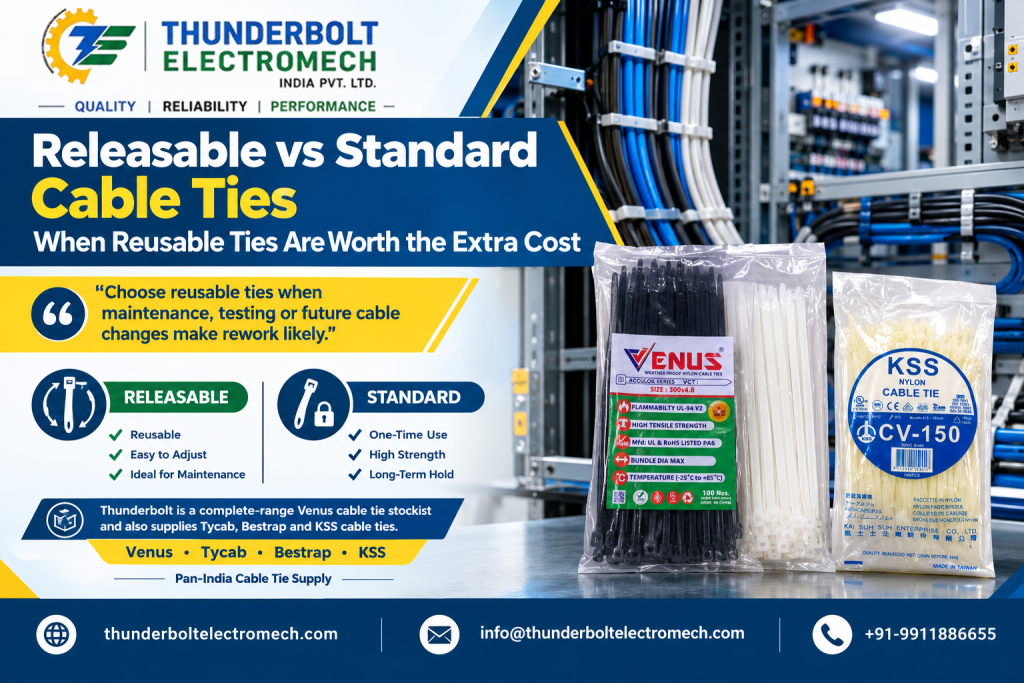
Venus — Thunderbolt’s core stocked range, covering both standard and releasable options across common widths for general industrial use.
Tycab — UL-documented ranges suited to projects needing traceable compliance alongside the standard/releasable decision, useful where a client audit will ask for certification either way.
Bestrap — a reliable mid-market option across both tie types for volume industrial orders where cost efficiency matters alongside function.
KSS — notable specifically for a wide releasable/reusable SKU spread, making it a strong first call for server rooms, control panels, and other maintenance-heavy environments where releasable stock genuinely earns its place.
Venus Cable Ties — Standard vs Releasable
| Type | Typical Width Range | Best Fit |
| Standard | 2.5mm – 9mm | Permanent bundling, panel wiring, outdoor runs with no planned reopening |
| Releasable | 3.6mm – 7.6mm | General industrial reconfiguration, moderate-access installations |
Tycab Cable Ties — Standard vs Releasable
| Type | Typical Width Range | Best Fit |
| Standard | 2.5mm – 9mm | Compliance-driven, UL-documented permanent installations |
| Releasable | 3.6mm – 7.6mm | Projects needing traceable certification alongside reusability |
Bestrap Cable Ties — Standard vs Releasable
| Type | Typical Width Range | Best Fit |
| Standard | 2.5mm – 9mm | High-volume industrial bundling |
| Releasable | 3.6mm – 7.6mm | Volume orders where periodic access is still expected |
KSS Cable Ties — Standard vs Releasable
| Type | Typical Width Range | Best Fit |
| Standard | 2.5mm – 9mm | General electrical and panel wiring |
| Releasable | 3.6mm – 9mm | Server rooms, control cabinets, and frequently reconfigured cable management |
Comparison Table: Releasable vs Standard Cable Ties at a Glance
| Attribute | Standard (Non-Releasable) | Releasable |
| Reusable | No — must be cut | Yes — press-tab release |
| Typical price premium | Baseline | Roughly 60-85% higher per piece |
| Tensile strength at matching width | Generally higher at the top end of the range | Comparable at common widths, lower at the extreme heavy-duty tier |
| Best for | Permanent installations | Temporary, maintenance-heavy, or reconfigurable installations |
| Key installation risk | None specific to reusability | Trimming the tail too short defeats reusability |
| Moving parts | None | Hinged pawl — a wear point over repeated cycles |
Common Customer Problems and Solutions
Problem: “We bought releasable ties for our solar installation, but half of them can’t be reopened anymore.”
This is almost always the trimmed-tail mistake covered above — installers cut the tail flush the way they would on a standard tie, removing the material needed to re-thread the head. Training the crew to leave visible tail length on every releasable tie, regardless of near-term reuse plans, prevents this from recurring.
Problem: “We’re not sure if paying more for releasable ties is actually worth it for our project.”
Apply the break-even logic covered above: if the bundle will genuinely be reopened at least once, releasable pays for itself against the cost of cutting and replacing a standard tie. If there’s no realistic reopening need, standard is the more cost-effective, equally functional choice.
Problem: “Our releasable ties feel weaker than the standard ties we used to use.”
At matching widths, the difference is usually smaller than it feels — but if your previous standard ties were from the widest heavy-duty tier, that specific rating genuinely isn’t matched by most releasable equivalents. Confirm you’re comparing releasable stock against standard ties of the same width, not against your facility’s highest-rated heavy-duty range.
Problem: “Our metal cable ties don’t have a release mechanism even though we ordered ‘reusable’ stock.”
Most stainless and metal ties use a roller-ball lock that is inherently non-releasable, trading reusability for chemical, fire, and temperature resistance. Confirm explicitly with your supplier before assuming a metal tie shares the reusability of a nylon releasable tie.
Cable Lugs: A Related Decision Worth Planning Alongside Cable Ties
Cable ties bundle a run; cable lugs terminate it — and the same maintenance-access thinking driving a releasable-versus-standard tie decision applies just as directly to lug selection on the same project. As Indian industrial and solar installations increasingly favour higher-current aluminium and XLPE conductor runs, correctly specified terminations matter as much as correctly specified bundling, and the two purchases are frequently made together on the same order.
Two details worth carrying into that lug decision: conductor construction changes barrel sizing — round stranded, compacted, and flexible conductors need different barrel diameters at an identical nominal cross-section — and larger cross-sections need more than a single crimp, with 240mm² and above typically requiring two crimps along the barrel rather than one. Thunderbolt’s guide, Aluminium Cable Lug Sizing & Crimping Guide: IS 8309 Barrel Charts, Dies & Common Mistakes, covers this in full — worth a read for any project where cable ties and cable lugs are being specified on the same purchase order, since getting the bundling decision right and the termination decision wrong still leaves a weak point in the same installation.
How to Choose the Right Cable Ties Supplier India for Reusable Tie Applications
A capable Cable Ties Supplier India should be able to:
- Ask directly whether a project genuinely needs reopening access, rather than defaulting every order to whichever tie type carries the higher margin
- Confirm tensile strength at the specific width being ordered, not a generic “comparable to standard” claim without supporting figures
- Flag the tail-length installation guidance proactively, not leave it for a buyer to discover through a failed reuse attempt
- Distinguish clearly between reusable nylon releasable ties and non-releasable metal/stainless options when a buyer requests “reusable” stock
Why Thunderbolt for Releasable and Standard Cable Ties
Thunderbolt Electromech India Pvt. Ltd. is a Delhi-based Cable Ties Supplier India stocking both releasable cable ties India buyers search for and standard heavy-duty ranges across Venus, Tycab, Bestrap, and KSS — matched to whether a project genuinely needs reopening access, not sold as a blanket upgrade. For teams comparing reusable cable tie vs standard options for a specific installation, or searching for a releasable cable tie supplier Delhi can reach directly, or a reusable cable tie dealer Delhi NCR contractors already trust for solar and outdoor cable tie dealer Delhi work, Thunderbolt’s Chandni Chowk base covers same-day collection and pan-India dispatch from the same stock. For the broader material, sizing, and strength framework across Thunderbolt’s full cable tie range, see the pillar guide, Cable Ties Supplier India: Complete Guide to Sizes, Types, Materials, Strength & Industrial Buying, and the related deep dives on Nylon 6.6 (PA66) material properties and Cable Tie Tensile Strength.
Contact Thunderbolt Electromech India Pvt. Ltd.: 📍 Shop No. 3538, Sitaram Bazar Rd, Bazar Sirkiwalan, Chawri Bazar, Chandni Chowk, Delhi – 110006 📞 +91-9911886655 ✉️ info@thunderboltelectromech.com
Frequently Asked Questions
Are releasable cable ties actually weaker than standard ones?
At matching widths, the difference is smaller than commonly assumed — one detailed comparison found releasable and standard ties comparable up to a certain rating, with only the widest, highest-strength standard heavy-duty ties genuinely exceeding what releasable stock offers. The releasable mechanism does typically cost some tensile strength compared to a fixed-pawl design at the very top end of the range, which is a fair question people raise often when comparing the two types side by side.
How many times can you actually reuse a releasable cable tie?
There’s no fixed universal number — it depends on the specific product and how carefully the tail length was preserved during installation — but the release mechanism does wear with repeated flexing over time, so treating a releasable tie as reusable indefinitely isn’t realistic. Expect diminishing reliability after multiple reopening cycles rather than unlimited reuse.
Is it worth paying more for releasable ties if I’m not sure I’ll ever reopen the bundle?
Generally no, the break-even logic favours releasable ties specifically when reopening is expected at least once; if there’s genuine uncertainty about future access needs, a standard tie does the identical initial job for less, and you haven’t paid for a feature you may never use.
Why did my releasable cable tie stop working after I cut it?
Cutting the tail flush removes the material the release mechanism needs to re-thread through the head, effectively converting the tie into a single-use tie despite its releasable design. Always leave visible tail length on a releasable tie if there’s any chance it will need reopening.
Are stainless steel cable ties reusable?
Most aren’t. Stainless and metal ties commonly use a roller-ball locking mechanism that wedges permanently under tension, trading reusability for resistance to chemicals, fire, and extreme temperature — the opposite design priority from a nylon releasable tie.
What’s the difference between “releasable” and “heavy-duty” cable ties?
These describe two separate, independent specifications — releasable refers to whether the tie can be reopened without cutting, while heavy-duty refers to tensile strength tier. A tie can be releasable and moderately rated, or standard (non-releasable) and rated for very high tensile strength; they’re not opposite ends of the same scale.
Conclusion
Releasable and standard cable ties solve different problems, and the “which is better” framing misses the actual decision a buyer needs to make: will this specific bundle ever need to come apart again. This guide walked through the real mechanical difference between a fixed and hinged locking pawl, the honest tensile strength trade-off — smaller than commonly assumed at matching widths, real at the extreme heavy-duty tier — and the break-even cost logic that turns “is the premium worth it” into a straightforward calculation rather than a guess. The single most common way facilities lose the entire benefit of paying for reusability is trimming the tail too short on first installation, a habit worth correcting before it costs an entire order’s worth of releasable stock its actual reusability. Thunderbolt Electromech India Pvt. Ltd. stocks both types across Venus, Tycab, Bestrap, and KSS, matched to whether your installation genuinely needs reopening access or simply needs to be tied once and left alone. Call +91-9911886655 or write to info@thunderboltelectromech.com to get the right type specified before your next order ships.