
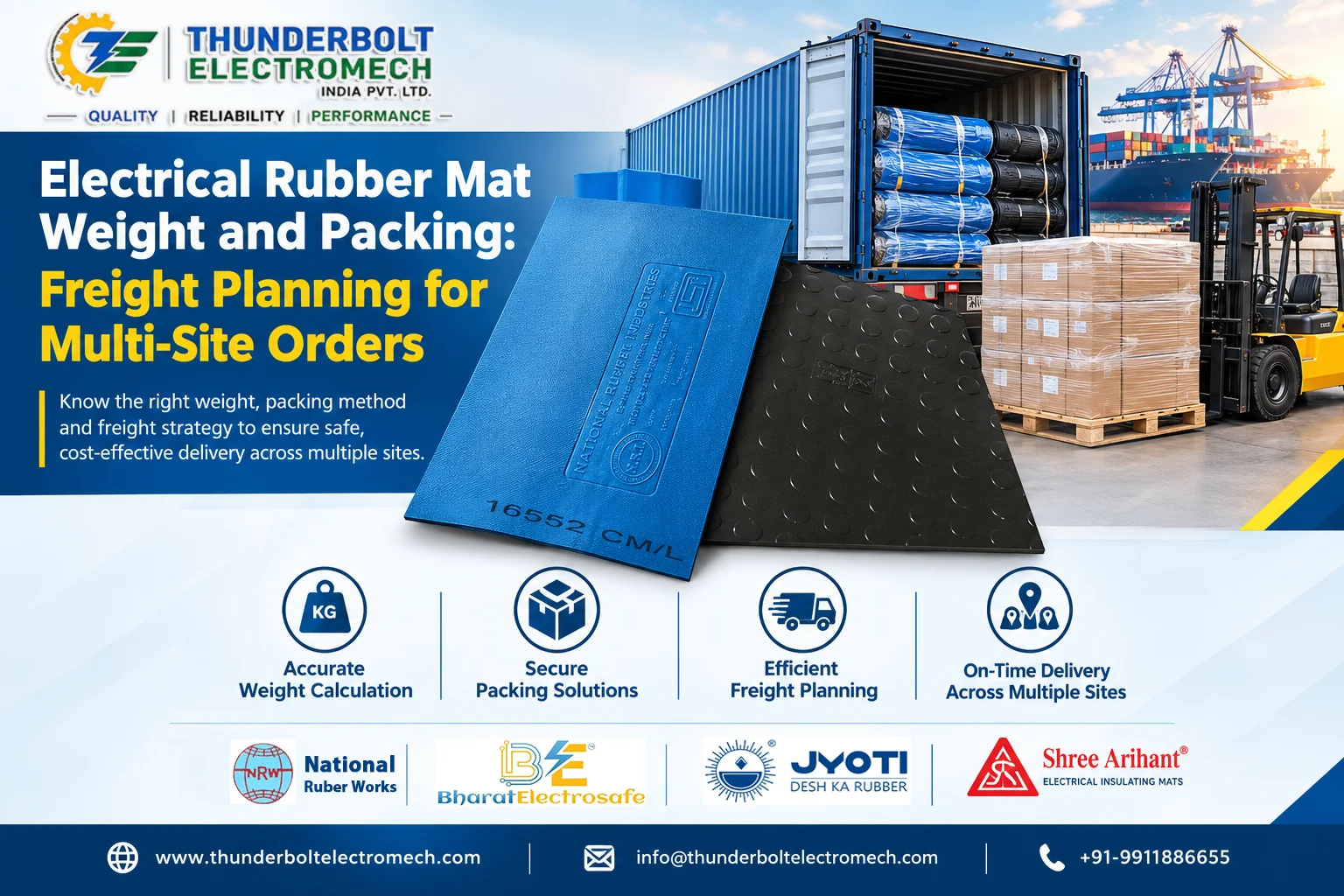
Quick Answer:Plan freight by weight, not by volume. A 1 m × 10 m electrical rubber mat roll weighs about 45 kg at 3 mm and about 75 kg at 5 mm, using a typical compound density. Rolls pack dense, so carriers bill actual kilograms. Roll mats, never fold them. Label every roll by site. Ask your Electrical Rubber Mat Supplier India for batch-wise weights before you book transport.
Introduction
Most buyers ask about price per metre. Few ask about weight per roll.
That gap causes real trouble. A site engineer orders ten rolls for a substation. The truck arrives. Two labourers cannot lift one roll. The driver wants extra money for unloading. The mats sit in the rain for a day.
Weight shapes everything that happens after you place the order. It decides your vehicle, your freight bill, your unloading crew, and your delivery date. If you run a multi-site project, the effect multiplies.
This guide covers the numbers and the logic. You will see how to estimate electrical rubber mat weight per roll, how rolls behave in transit, and how to split one order across several sites without paying twice. We also share what we see on actual dispatches from Delhi.
If you need class and thickness details first, read our complete guide to IS 15652 classes, thickness and buying in India. This cluster blog stays on weight, packing and freight.
Why Weight Matters More Than Most Buyers Think
Rubber is heavy. A sheet of mat that looks thin weighs more than it appears.
Think of it this way. A 1 m × 1 m piece of 5 mm mat holds 5,000 cm³ of rubber. At a density near 1.5 g/cm³, that piece weighs about 7.5 kg. Now stack ten metres of it in one roll. You carry 75 kg.
Three things follow.
Handling gets harder than the order suggests. Common ergonomic guidance keeps single-person lifts well below 30 kg. A 5 mm roll is more than double that. You need two people or a trolley.
Freight gets priced by kilograms. Rubber mats are dense freight. They fill little space for their weight. Carriers bill on the higher of actual and volumetric weight. For mats, actual weight almost always wins.
Vehicle choice changes. A small loader has a payload limit. Ten 5 mm rolls weigh 750 kg before pallets and packing. That already sits near the limit of a light vehicle.
So weight is not a footnote. It is the first line of your logistics plan.
How to Calculate Electrical Rubber Mat Weight Per Roll
You do not need special software. You need three numbers.
Weight = length × width × thickness × density
Use consistent units. In metric terms:
- Length and width in metres
- Thickness in millimetres
- Density in kg per m² per mm of thickness
For an insulating rubber compound near 1.5 g/cm³, one square metre at 1 mm thickness weighs about 1.5 kg. So:
Weight (kg) ≈ length (m) × width (m) × thickness (mm) × 1.5
Example: a roll 1 m wide, 10 m long, 3 mm thick.
10 × 1 × 3 × 1.5 = 45 kg.
Why the answer is an estimate, not a fixed figure
We call this a planning figure. Four things move the real number.
- Compound density. Natural rubber, SBR blends and filled compounds sit in different density bands. Typical electrical mat compounds fall roughly between 1.3 and 1.6 g/cm³. A ten per cent density swing changes a 45 kg roll by about 4.5 kg.
- Thickness tolerance. Mats carry a manufacturing tolerance on thickness. A 3 mm mat may run at 3.2 mm in places. That extra 0.2 mm adds about 3 kg to a 10 m roll.
- Surface pattern. Ribbed or corrugated mats carry thickness at the rib, not between ribs. Ask whether the stated thickness is at the base or over the rib. The difference shifts weight noticeably.
- Roll length. Manufacturers cut rolls to different standard lengths. Always confirm the length before you convert weight.
Our advice: use the formula to plan, then ask your supplier for the weighed figure from the batch. That figure goes into your transport booking.
Weight Per Roll: A Reference Table
The table below uses 1 m width and 1.5 kg per m² per mm. These are calculated planning values. They are not manufacturer specifications. Confirm the weighed figure for your batch and brand.
| Thickness | Weight per m² | 1 m × 5 m roll | 1 m × 10 m roll | 1 m × 20 m roll | Approx. outer diameter, 10 m roll* |
| 2.5 mm | 3.75 kg | 18.8 kg | 37.5 kg | 75 kg | about 21 cm |
| 3 mm | 4.5 kg | 22.5 kg | 45 kg | 90 kg | about 22 cm |
| 5 mm | 7.5 kg | 37.5 kg | 75 kg | 150 kg | about 27 cm |
| 6 mm | 9 kg | 45 kg | 90 kg | 180 kg | about 29 cm |
| 8 mm | 12 kg | 60 kg | 120 kg | 240 kg | about 33 cm |
| 10 mm | 15 kg | 75 kg | 150 kg | 300 kg | about 37 cm |
*Outer diameter estimated for a roll wound on a core of about 10 cm. It ignores winding looseness.
Read the table once. Then notice what it shows.
A 10 mm, 20 m roll weighs 300 kg. One person cannot move it. A forklift or a hand pallet truck with a ramp has to do the job.
Thickness also changes the diameter. A thicker mat wraps into a fatter roll, and a fatter roll is stiffer to unroll on site.
Which thickness you need depends on class and voltage. Our pillar guide on IS 15652 classes and thickness walks through that choice.
Why Rubber Mats Are “Dense Freight” (And What That Means for Your Bill)
Here is an engineering point most freight guides skip.
Carriers charge on chargeable weight. That is the greater of actual weight and volumetric weight. Volumetric weight comes from the box size, divided by a carrier-specific divisor. Divisors differ between carriers and between modes. Ask your transporter for theirs.
Let us run the numbers for one 3 mm, 10 m roll.
- Outer diameter: about 22 cm
- Roll width: 100 cm
- Bounding box: 22 × 22 × 100 cm = 48,400 cm³ (about 48 litres)
- Actual weight: 45 kg
- Volumetric weight at a divisor of 4,000: 48,400 ÷ 4,000 = about 12 kg
The roll weighs nearly four times more than its volumetric figure. So the carrier bills 45 kg.
The reverse happens with light, bulky goods like foam. Rubber mats sit at the other end. Packing tighter will not cut your bill. Packing smarter will protect your mats and speed up handling, but it will not change the chargeable weight.
This leads to a useful rule for buyers: do not pay for fancy packing to reduce volume. Pay for packing that prevents damage.
Packing Methods: What Works and What Fails
We have packed mats for many dispatches. Here is what holds up.
Roll, never fold
Folding creates a hard crease. Over time, rubber at a crease cracks, especially in sun or heat. A creased insulating mat can also develop a weak line. We roll every mat and wind it on a core.
Use a large enough core
A tight core stresses the inner layers. A larger core, within practical limits, keeps the mat flatter when you unroll it. This matters on thick mats, which resist curling.
Keep the surface clean and dry
Wrap the roll in HDPE or a similar waterproof film. Add outer protection such as woven sack or stretch wrap. Rain, oil and dust damage surface finish and mislead inspection.
Strap, do not squeeze
Straps hold the roll in shape. Overtightened straps leave marks that can persist. Use wide straps or add edge protectors under the strap line.
Palletise multi-roll orders
Rolls stack on pallets in a pyramid or in layers. Pallets make forklift unloading possible. They also protect the bottom roll from moisture on a wet truck bed.
Avoid heavy stacking on thin rolls
A thick-roll stack on top of a 2.5 mm roll can leave a flat spot. Put heavy rolls at the bottom. Put thin rolls on top.
Keep away from oils, solvents and heat
Rubber degrades near fuel, grease and hot surfaces. A truck carrying drums of oil next to your mats is a risk. Ask the transporter about co-loaded goods on shared loads.
Mark each roll
Every roll should show size, thickness, class, batch number and destination. Marking saves hours on multi-site orders.
Electrical Rubber Mat Supplier India: Why a Delhi-Based Dispatch Point Helps Multi-Site Buyers
Thunderbolt Electromech India Pvt. Ltd. works from Chawri Bazar in Delhi. This is not only an address. It is a freight advantage.
Delhi sits on major road corridors to Uttar Pradesh, Haryana, Punjab and Rajasthan. Rubber mat delivery in Delhi NCR often leaves the same day. For projects further out, a Delhi origin gives you access to many carriers at competitive rates.
If you are searching for an Electrical Rubber Mat Supplier India buyers can reach by road quickly, origin matters. Shorter first-mile time cuts the total delivery window. Faster dispatch also reduces site idle time.
For multi-site rubber mat logistics in Delhi, we handle a few extra steps:
- Single stock point, multiple drops. We hold stock in Delhi and split dispatches by site.
- Same-batch matching. We try to allocate mats from one batch to one project, so test certificates match.
- Pre-dispatch weight confirmation. We confirm roll weights before booking transport, so you do not discover surprises at unloading.
- Local pickup available. Buyers in Delhi NCR can collect from our Chawri Bazar location after confirming a time.
One local note matters. Old Delhi markets have narrow lanes. Large vehicles cannot always enter. Delhi also applies time windows for goods vehicles in many areas. We plan pickup and loading around those windows. If you send your own vehicle, tell us its size so we can plan the loading point.
Real Use Cases: How Weight Planning Changes the Result
These are representative scenarios drawn from the kinds of orders we handle. They show how weight, packing and routing interact.
Use case 1: An EPC contractor outfitting twelve small substations
The need. An EPC team needed insulating mats for twelve 11 kV substations across three districts. Each site needed two mats, 1 m wide, 3 m long.
The weight maths. At 3 mm, a 1 m × 3 m piece weighs about 13.5 kg. Two pieces per site: 27 kg. Twelve sites: about 324 kg total.
The planning choice. Two options existed. Ship twelve small parcels by courier, or ship one consolidated load to a central yard and redistribute.
Courier would have meant twelve separate bookings and twelve chances of damage. A consolidated load meant one truck and one invoice, followed by the team’s own vehicles for last-mile drops.
The result. The team chose consolidation. Each piece was cut to length at dispatch, rolled, labelled by site, and strapped by site group. The site teams collected labelled bundles without opening a single roll.
Use case 2: A factory group with five plants in the NCR belt
The need. A manufacturing group wanted new mats at switchgear rooms in five plants: Noida, Greater Noida, Faridabad, Gurugram and Bahadurgarh.
The weight maths. Each plant needed roughly ten rolls of 5 mm, 1 m × 5 m. Each roll weighs about 37.5 kg. Ten rolls: 375 kg per plant. Five plants: 1,875 kg.
The planning choice. The total fit one medium truck. But five stops in five different directions meant long driving. We split the load into two routes: east (Noida, Greater Noida, Faridabad) and west (Gurugram, Bahadurgarh).
The result. Two vehicles, two routes, one dispatch day. Rolls were palletised by plant. Each pallet carried a plant label so unloading crews did not guess.
Use case 3: A hospital network upgrading electrical panel rooms
The need. A hospital group needed insulating mats at panel rooms across several campuses. Deliveries had to arrive at set windows, because loading bays were busy.
The planning choice. Mats went in rolls wrapped in waterproof film, with delivery windows agreed in advance. Smaller rolls (5 m) let one person and a trolley move them through corridors. The 10 m rolls would have needed two people and lift access.
The result. Roll length was chosen for the building, not only for the room. The team treated roll length as a handling decision.
Case Study: A Multi-Site Order That Cost More in Freight Than It Should Have
A note on this case study: it describes a pattern we see frequently. We can share supporting dispatch records on request.
The situation. A utility contractor ordered mats for eight remote locations. The first quote from another vendor showed a low per-metre price. The freight line arrived later.
What went wrong. The vendor shipped each site’s order separately by surface courier, in folded stacks, without weights on the paperwork. Three problems followed.
- Creased mats. Folded mats arrived with sharp creases. The site engineer rejected two pieces.
- Weight disputes. With no weight on the paperwork, the carrier re-weighed each parcel and billed a higher figure at two destinations.
- Mixed batches. Mats at one site came from two batches. The test certificate matched only one batch, so the audit file had a gap.
What we changed. When the contractor reordered through us, we applied the same rules we describe in this blog:
- We weighed each roll before dispatch and put the figure on the delivery note.
- We rolled all mats on cores. We did not fold any.
- We grouped dispatch by route, not by order date.
- We tied each batch number to a destination.
The result. Fewer carrier disputes. No creased rejections. A clean certificate trail for every site.
The lesson. The cheapest quote is not always the cheapest delivery. A rubber mat price without weight, packing and batch control is only half a price.
Freight Options Compared
Different order sizes call for different transport. The table below shows how we usually think about it.
| Order size (approx. total weight) | Typical mode | Strength | Watch out for |
| Under 50 kg (one or two small rolls) | Surface courier or local pickup | Fast, simple booking | Courier handling can crease unprotected mats |
| 50 to 300 kg | Part-load (LTL) road freight | Lower cost per kg than courier | Multiple handling points; confirm pallet use |
| 300 kg to 1.5 tonnes | Small commercial vehicle or part-load | Direct delivery, fewer hand-offs | Payload limits; loading help at destination |
| 1.5 tonnes and above | Full truck or consolidated multi-drop | Best cost per kg; control of route | Needs unloading equipment and route planning |
| Multi-site, many small drops | Consolidated truck with site-wise bundles, or hub-and-spoke | One booking, one batch, site-wise labels | Needs clear labelling and a delivery sequence |
Payload limits vary by vehicle make and model. Ask the transporter to confirm payload before booking.
Electrical Rubber Mat Supplier India: Brands We Stock
We supply the full range of Bharat electrical rubber mat. We also stock Jyoti electrical rubber mat, National electrical rubber mat, Vardhman electrical rubber mat and Shree Arihant electrical rubber mat.
Why does brand matter for freight planning? Because brands differ in three ways that affect logistics.
- Standard roll lengths. One brand may cut rolls at 5 m, another at 10 m. That changes the weight per roll.
- Surface pattern. Ribbed and plain surfaces weigh differently at the same stated thickness.
- Compound. Density differs between formulations. That shifts weight at the same dimensions.
So do not assume one brand’s weight applies to another. Ask for brand-specific, batch-specific figures.
If you plan to buy an electrical rubber mat for a project, tell us the class, thickness, brand preference and number of sites. We will quote weight, packing and delivery together. Browse more buying guides in our electrical rubber mat blog category.
Electrical Rubber Mat Supplier India: Checklist for Bulk and Multi-Site Orders
Use this list before you place a bulk order. It works for any supplier, including us.
- Confirm the standard and class. Match the mat to IS 15652 class and your voltage level. See our pillar guide.
- Fix thickness and roll length. These two numbers set weight.
- Ask for weighed roll figures. Not a catalogue estimate. A batch figure.
- Ask how the mats are packed. Rolled on a core, wrapped, strapped, palletised.
- Split by site before dispatch. Tell the supplier site names and quantities.
- Request site-wise labels. Each roll should show site, size, thickness and batch.
- Match batch to destination. Keep test certificates aligned.
- Share unloading details. Tell the supplier if the site has no forklift, narrow access, or restricted hours.
- Check documents. Invoice, delivery note and, where needed, an e-way bill. Goods movement above the prescribed value threshold generally needs an e-way bill, so confirm current rules with your accounts team.
- Inspect on arrival. Check for creases, cuts, oil marks and moisture. Photograph any damage before signing.
- Store properly. Keep rolls flat or upright on a dry floor, away from sunlight, heat and oil.
Storage and Handling After Delivery
Many mat problems start after unloading.
Keep rolls off wet ground. Place them on pallets or a dry floor.
Avoid direct sun. Ultraviolet light and heat age rubber surfaces.
Keep away from oils and solvents. Fuel, grease and cleaning chemicals can attack the compound.
Unroll and rest before use. A roll that sat tight for weeks may curl. Lay it flat, let it relax, then position it. Do not stamp it flat with heavy loads.
Handle with two people. For 5 mm and thicker rolls, plan two-person lifts.
Inspect before energised work. Check each mat for cuts, cracks and surface damage. Replace any mat that looks compromised.
High-Intent Questions Buyers Ask Us
What is the electrical rubber mat weight per roll?
It depends on thickness, width, length and compound. As a planning rule, a 1 m × 10 m roll weighs about 45 kg at 3 mm and about 75 kg at 5 mm. Ask for the batch-weighed figure.
What is the best packing for rubber mat freight?
Roll the mat on a core. Wrap it in waterproof film. Strap it. Palletise multi-roll orders. Never fold.
Can you deliver rubber mats across Delhi NCR the same day?
For many standard orders, yes. Stock, vehicle availability and delivery timing decide. Call us to confirm.
Can you split one order across multiple sites?
Yes. Send us site names, quantities and contact details. We label and bundle by site.
Do you supply mats outside Delhi?
Yes. We dispatch across India by road freight.
Where do I buy an electrical rubber mat in bulk?
Contact us with class, thickness, brand and quantity. We quote price, weight and delivery together.
Which brands do you stock?
Bharat, Jyoti, National, Vardhman and Shree Arihant.
Conclusion
Weight shapes every freight decision for electrical rubber mats. A 1 m × 10 m roll weighs about 45 kg at 3 mm and about 75 kg at 5 mm, using a typical compound density. Real figures shift with density, tolerance, surface pattern and roll length. Plan with the formula. Confirm with a batch weight.
Rubber mats are dense freight. Carriers bill actual kilograms, not volume. So pack for protection, not for compression. Roll on a core. Wrap against moisture. Strap without crushing. Palletise multi-roll loads. Label every roll by site, size, thickness and batch.
For multi-site projects, consolidate when you can. Group dispatch by route. Match each batch to its destination so test certificates line up. Share unloading conditions early. Check documents before the truck leaves.
Why choose Thunderbolt Electromech India Pvt. Ltd.?
- One supplier, five brands. Bharat, Jyoti, National, Vardhman and Shree Arihant electrical rubber mats, so you compare options in one conversation.
- Delhi dispatch. We ship from Chawri Bazar, with fast access to road corridors and quick rubber mat delivery in Delhi NCR.
- Weight-first quoting. We give you price, roll weight and freight planning together, so no surprise appears at unloading.
- Multi-site handling. We split, label and bundle orders by site and by batch.
- Straight answers. We tell you when a thinner mat will do and when a project needs more.
If you are looking for an Electrical Rubber Mat Supplier India that treats logistics as part of the product, talk to us.
Contact Thunderbolt Electromech India Pvt. Ltd.
Address: Shop No. 3538, Sitaram Bazar Rd, Bazar Sirkiwalan, Chawri Bazar, Chandni Chowk, Delhi, 110006
Phone: +91-9911886655
Email: info@thunderboltelectromech.com
Send us your class, thickness, brand, quantity and site list. We will reply with weight, packing and delivery details.