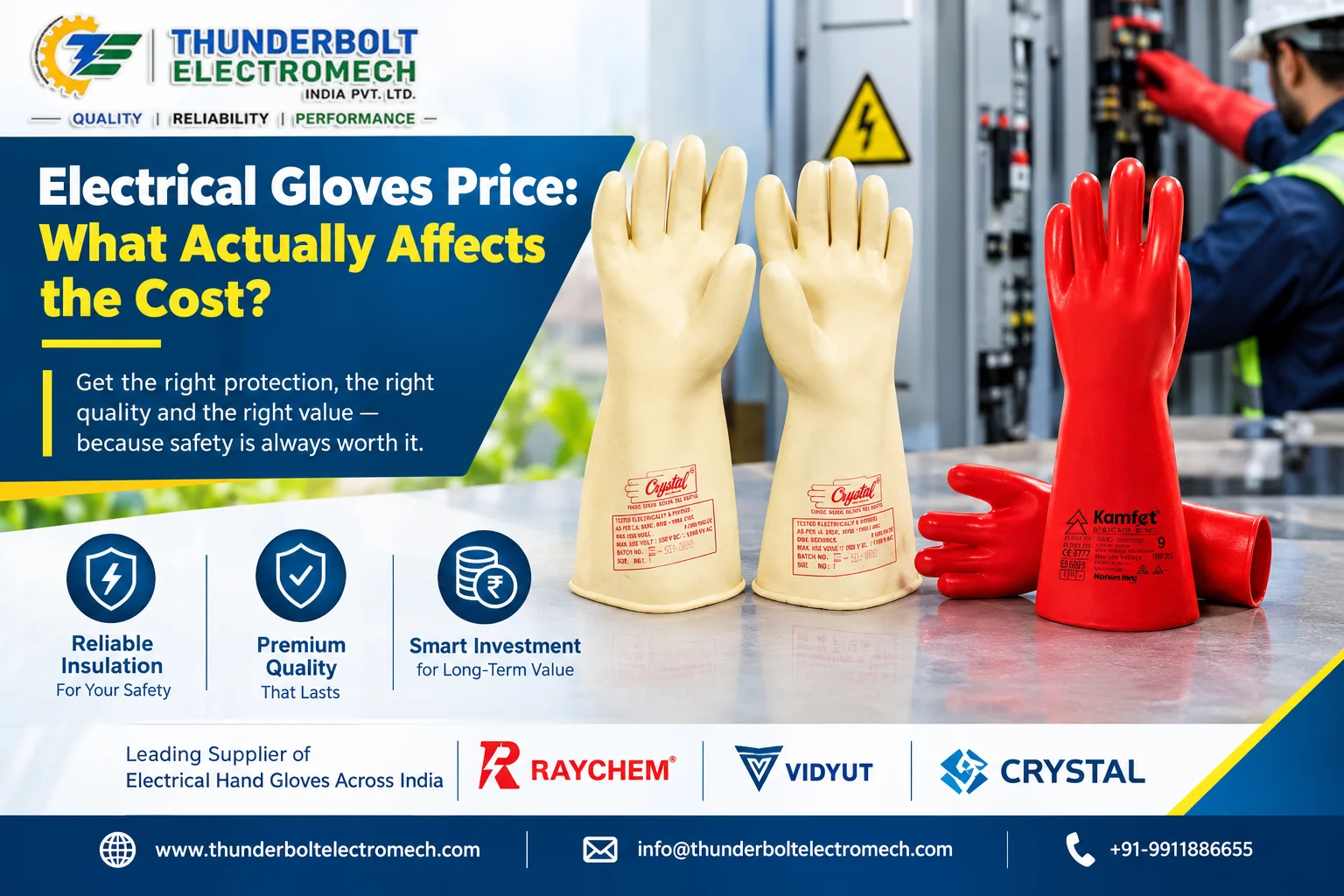
Quick Answer: Electrical gloves price depends on six things: voltage class, rubber thickness, the dipping method, per-piece testing, certification, and glove length. A Class 00 glove costs far less than a Class 4 glove because it uses less rubber and carries a wider safety margin. Very cheap pairs often skip full testing. Choose by class and test report first, then compare rates. A reliable electrical hand gloves supplier will show you both before you pay.
Introduction
Two pairs of electrical gloves can look identical on a shelf. Same colour. Same cuff. Same size stamp. Yet one costs twice as much as the other.
Buyers ask us about this every week. Most of them suspect that the dearer pair is just a brand tax. Sometimes that is true. More often, the difference sits inside the rubber, in the factory process, and in the test bay where nobody sees it.
This guide explains where the money goes. We wrote it from the supplier side of the counter, so you will see the reasoning behind the rates we quote. We also cover every glove class, a comparison table, the hidden costs of owning gloves, and a worked cost example.
One point before we start. Price matters, but a glove is not an ordinary purchase. It is the last barrier between a hand and a live conductor. A pair that saves ₹300 and fails once costs far more than the saving. So we treat price as one input into a safety decision, not the decision itself.
Thunderbolt Electromech India Pvt. Ltd. supplies Raychem, Vidyut and crystal electrical hand gloves from Delhi to buyers across India. Our team sells to electricians, plant maintenance heads, EPC contractors and procurement managers. The patterns below come from those conversations.
What Drives the Price at an Electrical Hand Gloves Supplier in India
Let us start with the rubber, because that is where most of the cost lives.
1. Voltage class sets the rubber volume
Standards limit how thick a glove may be in each class. These limits come from the IEC 60903 family and from the maximum thickness values published in manufacturer datasheets for gloves made to that standard.
- Class 00: under 1.1 mm
- Class 0: under 1.6 mm
- Class 1: under 2.1 mm
- Class 2: under 2.9 mm
- Class 3: under 3.5 mm
- Class 4: under 4.2 mm
Compare the two ends. A Class 4 glove can be nearly four times as thick as a Class 00 glove. That means more latex, more dipping cycles, more curing time, and a larger glove former to hold the whole thing. Material cost climbs with every step up.
But thickness is not the only reason higher classes cost more. We will come back to the safety margin shortly. It adds a second, less obvious cost.
2. Dipping method and rubber compound
Good insulating gloves come off a hand-shaped former. The former dips into liquid natural latex, comes out, dries, and dips again. Makers repeat this several times until the wall reaches the right thickness. The result is seamless. No joint exists where electricity can find a weak line.
Cheaper gloves sometimes take a shortcut. The maker cuts them from flat rubber sheet and joins the pieces. The seam becomes a stress point. Older Indian practice allowed gloves made from calendered sheet in some conditions, but a seamless dipped glove gives a more even wall and fewer weak spots.
The compound matters too. Latex producers add fillers to bring down cost. A little filler is normal. A lot of it lowers dielectric strength and tear resistance. You cannot see this by looking at the glove. You can see it in the test results, which is why we ask makers for batch data.
Think of it like cement. Two bags look the same. One cures strong. One crumbles. The difference sits in the mix.
3. Testing is a price line, not a free bonus
Here is a point many buyers miss. Insulating gloves need two kinds of testing during manufacture.
Routine testing applies to every glove. The maker raises the voltage to the class proof level and holds it for one minute. A glove that punctures is scrapped.
Sampling testing applies to a few gloves per batch. These samples go through water soaking, longer withstand tests, and ageing checks.
Each glove that fails routine testing is a loss to the maker. Strict makers accept that loss. Careless makers do not test every piece, or they test at lower voltage. They can then sell at a lower rate and still look profitable.
So when you see a rate far below the market, ask a plain question: who tested this pair, and at what voltage? A genuine electrical hand gloves supplier answers that without hesitation.
4. The safety margin shrinks as class rises
This is the insight we find most useful when we explain pricing to engineers.
Compare each class’s proof test voltage with its maximum working voltage:
- Class 00: 2,500 V proof, 500 V working. Ratio about 5 to 1.
- Class 0: 5,000 V proof, 1,000 V working. Ratio about 5 to 1.
- Class 1: 10,000 V proof, 7,500 V working. Ratio about 1.33 to 1.
- Class 2: 20,000 V proof, 17,000 V working. Ratio about 1.18 to 1.
- Class 3: 30,000 V proof, 26,500 V working. Ratio about 1.13 to 1.
- Class 4: 40,000 V proof, 36,000 V working. Ratio about 1.11 to 1.
Read that list again. A Class 0 glove has a five-fold cushion. A Class 4 glove has barely ten percent.
What does this mean for cost? A tiny flaw in a Class 00 glove, such as a thin patch or a trapped bubble, will likely still pass. The same flaw in a Class 3 glove can fail the proof test. Makers of high-class gloves therefore reject more pieces, control their compound more tightly, and inspect more closely. That rejection rate shows up in your price.
In plain terms: you are not just paying for more rubber. You are paying for a tighter quality window.
5. Certification, markings and brand
Reputable gloves carry permanent markings. These include the class, the manufacturer, the size, and usually a date or batch code. Many also carry a category code. For example, “AZC” means the glove resists acid, ozone and very low temperature. “RC” means it adds resistance to oil. Higher classes typically carry the RC rating.
Special properties raise the compound cost. A glove built for oil resistance or extreme cold needs a different formulation.
Brand adds cost as well, but it also adds traceability. A named maker with a test lab can trace a failure back to a batch. An unmarked glove cannot be traced at all. When something goes wrong, that gap decides who pays.
6. Length, size and colour
Gloves come in different cuff lengths. A longer gauntlet covers more forearm and uses more rubber. The common lengths are 280 mm, 360 mm and 410 mm, though availability varies by class and maker.
Size also shifts the price a little. Larger formers use more material. Colour has less effect, but Indian practice under IS 4770 has historically used colour coding by type, with black, blue, green and red tied to different voltage types. Colour-coded stock is easier for site stores to manage.
The hidden cost: retesting and storage
The shelf price is not the full price. Gloves keep costing money after you buy them.
Many standards and manufacturer guides call for periodic electrical retesting. ASTM F496 sets an in-service retest interval of six months for gloves, with limited exceptions up to nine months. Manufacturers aligned with IEC 60903 apply similar rules for Classes 1 to 4 and recommend a check for air leaks and a visual inspection for Classes 00 and 0. Gloves held in storage are commonly retested every twelve months.
That cycle matters for budgeting. A Class 2 glove in a utility crew may need two lab retests a year. Each retest costs money, and each takes the gloves out of service for days. If your lab turnaround is slow, you need a spare pair. Add that to the price.
Add these as well:
- Leather over-gloves, which protect the rubber from cuts and punctures
- Cotton inner liners, which absorb sweat
- A glove bag or box that keeps out light, heat and ozone
- A hand inflator for the daily air test
None of these is expensive alone. Together they can add a meaningful share to the first-year cost. Skip them and the glove wears out faster, which costs more.
Class-by-Class Guide From an Electrical Hand Gloves Supplier
Every Indian buyer eventually asks the same thing: which class do I need? Here is how we explain each one.
Two classification systems appear in India. IEC 60903 and ASTM D120 use Classes 00, 0, 1, 2, 3 and 4. The older Indian standard IS 4770:1991 uses types. Under IS 4770, Type 1 gloves suit voltages up to 650 V, and the revised standard modified Type 4 so it could work up to 7,500 V. Types 2 and 3 sit between those two. Check the standard text for exact limits before you write a tender specification.
Most export-grade and utility-grade gloves now follow the class system. We use it below.
Class 00: maximum use voltage 500 V AC
This is the lightest class. Proof test voltage is 2,500 V AC. Electronics technicians, panel testers and control-room staff uses it for low-voltage diagnostics. It is thin, flexible and cheap. It does not belong anywhere near a 415 V distribution board that may fault. For that, move up one class.
Class 0: maximum use voltage 1,000 V AC
Proof test voltage is 5,000 V AC. This is the workhorse for general electricians. It covers 415 V panels, motor control centres and building maintenance. It also covers 1,100 V equipment, since the limit is 1,000 V AC maximum use at the glove. If your work involves 1,100 V circuits, read the glove’s own marking and consult the datasheet. Thunderbolt’s 1,100 V crystal electrical hand gloves serve this common maintenance need.
Class 1: maximum use voltage 7,500 V AC
Proof test voltage is 10,000 V AC. Plant electricians use Class 1 around 3.3 kV and 6.6 kV systems. Some HT maintenance teams carry them as a backup glove.
Class 2: maximum use voltage 17,000 V AC
Proof test voltage is 20,000 V AC. The 11 kV distribution network sits inside this limit when you use the correct work method. Discoms, line crews and substation teams buy Class 2 in volume.
Class 3: maximum use voltage 26,500 V AC
Proof test voltage is 30,000 V AC. These gloves cover 22 kV and 33 kV work in some contexts, though the maximum use voltage here is below a nominal 33 kV phase-to-phase voltage. Always read how the standard defines maximum use voltage before you apply a glove to a nominal line voltage.
Class 4: maximum use voltage 36,000 V AC
Proof test voltage is 40,000 V AC. This is the top of the range. These gloves are thick, heavy and costly. Most Indian buyers need them for transmission-side or specialist work, not daily maintenance.
Comparison table
| Class | Max use voltage (AC) | Proof test voltage (AC) | Max thickness | Typical user | Relative cost* |
| 00 | 500 V | 2,500 V | under 1.1 mm | Electronics and low-voltage testing | Lowest |
| 0 | 1,000 V | 5,000 V | under 1.6 mm | General electricians, panels, 415 V and 1,100 V work | Low |
| 1 | 7,500 V | 10,000 V | under 2.1 mm | Plant HT maintenance | Medium |
| 2 | 17,000 V | 20,000 V | under 2.9 mm | 11 kV line and substation crews | Medium-high |
| 3 | 26,500 V | 30,000 V | under 3.5 mm | 22 kV to 33 kV class work | High |
| 4 | 36,000 V | 40,000 V | under 4.2 mm | Specialist transmission work | Highest |
*Relative cost reflects rubber volume and quality control. It is a general pattern, not a price list. Contact us for current rates.
Sources for class data: manufacturer datasheets for gloves made to EN 60903 / IEC 60903, and ASTM D120 summaries.
How to pick without overspending
Follow this order.
- Find the highest voltage your crew may touch.
- Pick the class whose maximum use voltage sits above it.
- Choose the cuff length your work method needs.
- Ask for the test report.
- Only then compare rates.
Notice that price comes fifth. Many buyers start there and end up with the wrong class.
One more warning. Do not buy a higher class “to be safe” and then use it on the wrong job. Thick Class 3 gloves reduce finger feel. An electrician working on small terminals may remove them. A glove on the bench protects nobody. The right glove is the one the worker keeps on.
How a Trusted Electrical Hand Gloves Supplier Helps You Avoid Costly Mistakes
Theory helps. Real sites teach more. Here are the problems we hear most, and the fixes we suggest.
Customer problems and solutions
Problem 1: “The cheapest quote is half of everyone else’s.”
Solution: Ask for the test report and the batch number. Check the proof test voltage on the paper against the class on the glove. If the supplier cannot produce either, walk away. A low quote usually means the glove skipped a step.
Problem 2: “Our gloves wear out in three months.”
Solution: Look at how the crew stores them. Gloves dumped in a toolbox with screwdrivers pick up cuts and pinholes. Heat, sunlight and ozone near motors also age rubber fast. Give each worker a glove bag. Add leather over-gloves for mechanical work. The same glove can last far longer with this care.
Problem 3: “We bought Class 2 for everything and the crew hates them.”
Solution: Match class to task. A team that works only on 415 V panels does not need 17 kV gloves. Class 0 is safer in practice because workers actually wear it. Reserve higher classes for the jobs that need them.
Problem 4: “We do not know when to retest.”
Solution: Set a calendar. Stamp the issue date on the glove bag. For Classes 1 to 4 in active use, plan lab retests about every six months. For stored gloves, plan about every twelve. For Classes 00 and 0, run an air leak check and visual inspection before every shift. Keep a simple register with glove serial, class, issue date and last test date.
Problem 5: “Our audit asked for glove certificates and we had none.”
Solution: Keep the supplier’s invoice, the manufacturer’s test certificate and your internal inspection register in one folder. Auditors usually ask for these three things. A supplier that gives you the paperwork at purchase saves you an awkward audit day.
The daily air test
Every worker should do this before every shift. It takes thirty seconds.
Roll the cuff tightly toward the fingers. Trap the air inside. Squeeze the glove gently and listen. Look for bulges, pinholes and thin patches. If the glove loses air, reject it. Check the cuff edge and fingertips closely, because those are the usual failure points.
No standard replaces this habit. It catches damage that happened since the last lab test.
Real use cases
Use case 1: Factory maintenance on 415 V panels.
A mid-size manufacturing unit runs motor control centres and sub-distribution boards. Fitters rack out breakers and tighten lugs. Class 0 gloves with leather over-gloves fit this job. The class gives a good safety margin and the thin rubber keeps finger feel.
Use case 2: Discom line crew on 11 kV feeders.
Line crews work near energised conductors on poles. Class 2 gloves match the voltage level. Crews carry spare pairs because a cut glove ends the shift on that task. Retest records matter, since inspectors check them after any incident.
Use case 3: Solar plant electrician.
Solar sites combine DC strings and AC inverters. Electricians test combiner boxes and inverter terminals. Class 0 covers many low-voltage tasks. For higher-voltage evacuation lines, the team steps up to a higher class. Heat is the enemy here. Gloves in a hot vehicle degrade faster, so a shaded bag helps.
Use case 4: Hospital and commercial building maintenance.
Facility teams handle UPS rooms, DG panels and lighting distribution. Class 00 and Class 0 gloves suit most tasks. The risk is not high voltage. It is routine contact on live terminals, where a single slip causes injury.
Case study: a cost comparison over twelve months
This is an illustrative example built to show how total cost works. The figures are round numbers for explanation, not a record of one customer. We can replace it with a documented customer story on request.
Take a maintenance team of ten electricians at a processing plant. They work on 415 V and some 3.3 kV equipment. The plant manager asks for gloves and gets two quotes.
Option A: Untested Class 1 gloves at a low rate. No test certificate. Unmarked batch.
Option B: Tested Class 1 gloves from a known maker at a higher rate. Test certificate and batch marking included.
On paper, Option A saves money on day one. Now follow twelve months.
Under Option A, the team has no proof of testing. The safety officer cannot defend the gloves in an audit. Two pairs fail the air test within two months, with pinholes at the fingertips. The team replaces them. The plant also decides to pay for a lab retest at six months, and the lab rejects several more pairs. Replacement cost grows, and the plant loses working days waiting for new stock.
Under Option B, all gloves arrive with certificates. The plant stamps issue dates and runs a six-month retest. Almost all pairs pass. Replacement is rare.
The upfront saving from Option A disappears within the year. The bigger loss is risk. A pinhole in a Class 1 glove, with only a 1.33 to 1 safety margin, gives a worker very little protection against a fault.
The lesson: judge price over a year, not at the counter. Count replacements, retests, downtime and audit exposure. The cheapest purchase often costs the most to own.
Why Buy From Thunderbolt, a Delhi Electrical Hand Gloves Supplier
Thunderbolt Electromech India Pvt. Ltd. is a Delhi-based supplier of electrical safety equipment. We sell to buyers across India, from Delhi NCR workshops to plants in other states.
Our glove range
We supply three families.
- Raychem electrical hand gloves. A recognised name in the electrical trade. Buyers choose Raychem when they want a known maker’s marking and batch traceability.
- Vidyut electrical hand gloves. A practical option for teams that want solid protection at a sensible rate.
- Crystal electrical hand gloves. Our 1,100 V crystal gloves suit routine maintenance on low-voltage panels. You can see the product here: Hand Gloves Electrical 1100 Volt Crystal.
Each family serves a different budget and use. We help you pick based on class, task and testing needs, not on whichever pair carries the highest margin.
More than gloves: danger plates and site safety
Most customers who buy gloves also need to mark their site. Our team supplies danger plates, which makes us a one-stop electrical safety equipment supplier in Delhi. A clear sign at the door of a panel room tells people what hazard sits behind it. A glove protects the worker at the panel. A danger plate warns everyone else.
If you are fitting out a substation, factory or commercial building, you can buy both from us. Read our danger plate supplier guide for India to see the sizes and finishes we offer, or browse the danger plate category. Our powder coated danger plate in 200 x 150 mm is a common pick for HT panels.
What to ask any supplier, including us
Use this checklist when you request a quote.
- Which class is the glove, and what is its proof test voltage?
- Does the glove carry a permanent class and batch marking?
- Can you share the manufacturer’s test certificate?
- What cuff length and size range do you stock?
- What retest schedule do you recommend for this class?
- Do you supply over-gloves, liners and storage bags?
- How fast can you deliver to my location?
A supplier who answers all seven clearly deserves your order. One who dodges two or three does not.
Where to learn more
Our buying guide covers the full process in more depth. Read the complete electrical hand gloves supplier buying and safety guide for selection, standards and care. You can also browse our electrical hand gloves blog category for articles on class ratings, testing and glove selection.
Contact Thunderbolt Electromech
We answer questions before you buy. Call, email or visit us.
- Company: Thunderbolt Electromech India Pvt. Ltd.
- Phone: +91-9911886655
- Email: info@thunderboltelectromech.com
- Address: Shop No. 3538, Sitaram Bazar Rd, Bazar Sirkiwalan, Chawri Bazar, Chandni Chowk, Delhi, 110006
Tell us your voltage, your task and your quantity. We will suggest a class, quote a rate, and share the test paperwork.
Conclusion: Electrical Gloves Price Comes Down to What You Cannot See
Electrical gloves price reflects six main factors. Voltage class sets the rubber volume, because maximum thickness rises from under 1.1 mm in Class 00 to under 4.2 mm in Class 4. The dipping method and rubber compound decide how even and strong the wall is. Per-piece testing decides whether a weak glove ever reaches you. Certification and brand add traceability. Cuff length and size change the material used. And retesting plus storage add cost after purchase.
One engineering point deserves a second look. The safety margin between proof voltage and working voltage shrinks as class rises. Class 0 has about a five-to-one cushion. Class 4 has about ten percent. That tight window forces makers of higher classes to control quality harder and reject more pieces, and that is a large part of why they cost more.
We covered every class. Class 00 serves low-voltage testing at 500 V. Class 0 serves general electricians up to 1,000 V. Class 1 covers 7,500 V plant work. Class 2 covers 17,000 V line crews. Class 3 covers 26,500 V work. Class 4 covers 36,000 V specialist tasks. Match the class to the highest voltage your team may touch, then think about price.
We also looked at common customer problems. Low quotes often hide skipped testing. Short glove life usually comes from poor storage. Over-specified gloves get left on the bench. Missing retest records cause audit trouble. Each problem has a simple fix: ask for test reports, protect the rubber, match class to task, and keep a register.
The twelve-month example showed the central idea. An untested pair that saves money at the counter can cost more through replacements, retests, downtime and risk. Judge cost over a year.
When you are ready to buy, work with an electrical hand gloves supplier that shares the class, the proof voltage and the test certificate before you pay. Thunderbolt Electromech supplies Raychem, Vidyut and crystal gloves across India, along with danger plates for your site. Call +91-9911886655 or write to info@thunderboltelectromech.com. Our team will help you choose the right glove at a fair rate.