
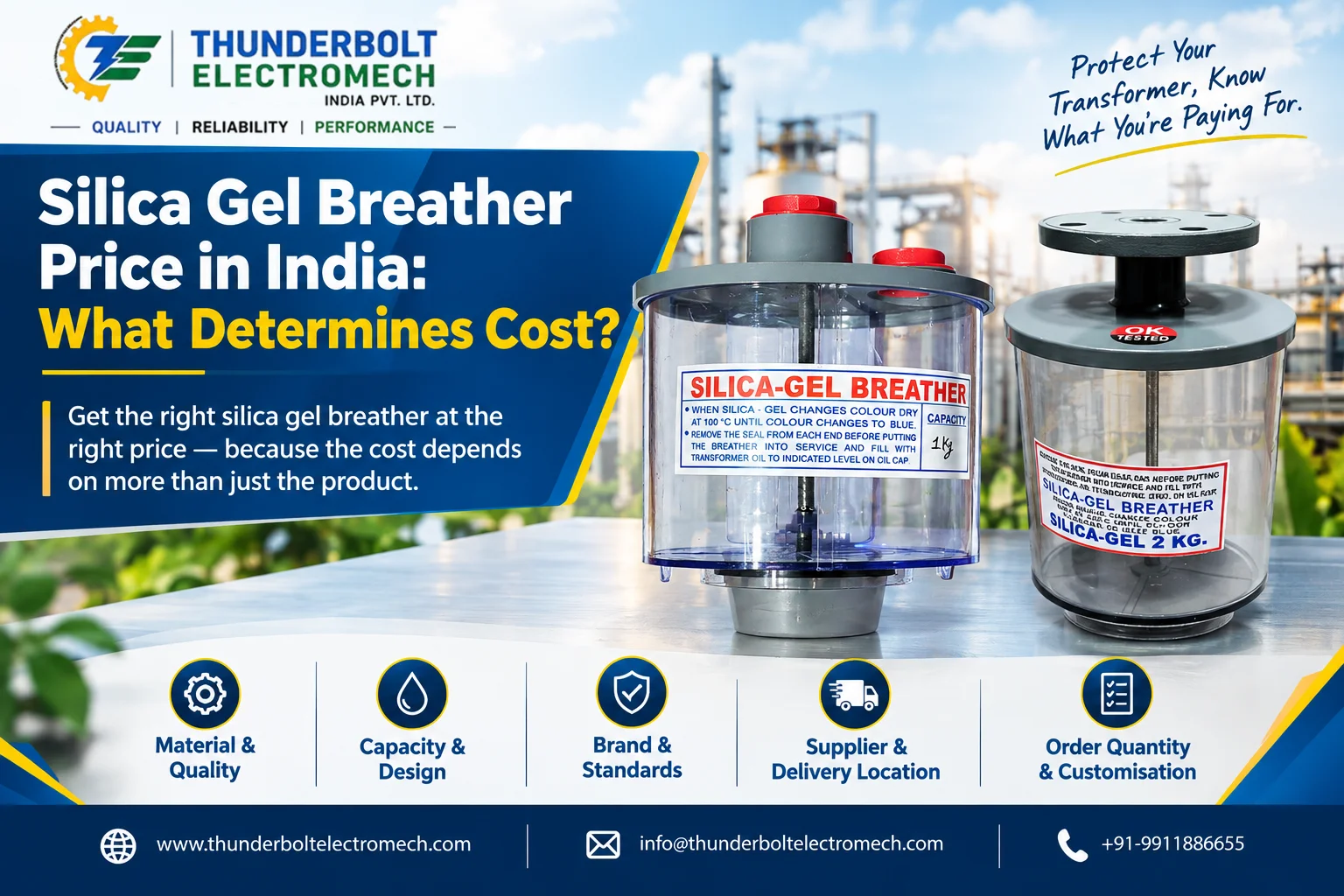
Quick Answer: The Silica Gel Breather Price in India depends on the breather’s capacity, construction material, connection type, oil-seal arrangement, included accessories and whether the unit comes empty or filled with silica gel. A 500g empty breather, 1Kg empty breather and 2Kg empty breather serve different purchasing requirements, so buyers should compare equivalent specifications rather than choosing the lowest quotation. Thunderbolt Electromech India Pvt. Ltd., a Delhi-based Silica Gel Breather Supplier, offers all three empty-breather options for transformer maintenance and industrial procurement. Confirm the required size and configuration before requesting a quotation.
Introduction: Why Silica Gel Breather Prices Differ Between Suppliers
A purchasing manager receives three quotations for a transformer breather. One supplier offers a low price, another quotes a considerably higher amount, and a third asks for the transformer details before confirming the rate.
Which quotation should the buyer trust?
The answer depends on what each supplier is actually offering.
A silica gel breather is not simply a container filled with desiccant. In a conventional oil-filled transformer, the breather forms part of the air path between the atmosphere and the conservator. As the transformer heats and cools, its insulating oil expands and contracts, changing the volume of air moving through that path. The breather uses silica gel to reduce the moisture carried by incoming air.
That function makes the breather a maintenance component rather than an ordinary plastic or metal container. Its price can reflect the housing, sealing arrangements, usable desiccant capacity, connection dimensions, manufacturing quality and supply conditions.
For buyers searching for Silica Gel Breather Price, the challenge is to compare products that perform the same job and fit the same equipment.
Thunderbolt Electromech India Pvt. Ltd. supplies three empty breather options:
These options allow buyers to source the breather housing separately from the silica gel charge. That can be useful when a maintenance team already stocks suitable desiccant or wants to manage refilling independently.
This guide explains the factors that influence the price, how to compare quotations, what information to provide when requesting a rate, and how to avoid paying for the wrong specification. It also covers practical purchasing situations for factories, electrical contractors, transformer service companies and maintenance teams across Delhi NCR and India.
The objective is straightforward: help you select the right product before you spend money.
1. Silica Gel Breather Supplier: The Main Factors That Determine Price
When comparing a quotation from a Silica Gel Breather Supplier, start with the product specification rather than the final amount. Two breathers may have similar external shapes but different capacities, construction details and connection arrangements.
The following factors deserve attention.
1.1 Silica gel capacity: 500g, 1Kg or 2Kg
Capacity is one of the first details buyers notice. A larger-capacity breather generally requires a larger desiccant chamber and more material, although the exact price difference depends on the design and supplier.
Thunderbolt offers these empty options:
| Product | Nominal capacity | What buyers should verify |
| Silica Gel Breather 500g Empty | 500g | Required charge, connection and installation dimensions |
| Silica Gel Breather (Empty), 1Kg | 1Kg | Chamber capacity, mounting arrangement and compatibility |
| Silica Gel Breather 2Kg Empty | 2Kg | Required capacity, available space and connection details |
The nominal capacity should not be the only selection criterion. A 2Kg breather is not automatically the right choice for every large transformer, and a 500g unit is not necessarily adequate for every small transformer.
The correct capacity depends on the transformer manufacturer’s specification, conservator arrangement, oil volume, breathing behaviour, ambient humidity and maintenance schedule.
A larger breather may be useful where the moisture load is higher or inspections are less frequent, but it will not compensate for an incorrect connection, a damaged seal or air entering through an unintended path.
Practical buying advice: Confirm the required capacity from the existing breather, transformer documentation or equipment supplier before requesting a quotation.
1.2 Housing material and construction
The housing holds the silica gel and provides a controlled path for air to pass through it. Its material and construction influence the product’s durability, visibility, weight and suitability for the installation environment.
Depending on the design, a breather may use a transparent chamber with metal or polymer components. The buyer should establish exactly which materials the quoted product contains instead of assuming that every unit follows the same construction.
Consider the following points:
- Is the chamber sufficiently clear to inspect the desiccant condition?
- Does the housing suit the intended indoor or outdoor installation?
- Are the top and bottom sections securely assembled?
- Can the unit tolerate the expected site conditions?
- Are the sealing surfaces and joints suitable for the intended service?
- Can the chamber be opened and refilled as required?
A low-cost housing may be suitable for one application and unsuitable for another. The important question is whether its construction meets the actual operating requirement.
For outdoor substations and industrial yards, inspect the material specification and the manufacturer’s environmental suitability claims. Do not infer UV resistance, chemical resistance or a particular ingress-protection rating unless the supplier provides supporting documentation.
1.3 Connection type and dimensions
A breather that cannot connect correctly to the transformer is not a bargain.
The connection may involve a threaded fitting, flange or another arrangement specified by the equipment manufacturer. Thread size, thread form, mounting orientation and available clearance can all affect compatibility.
Before purchasing, check:
- The existing breather connection.
- The thread or flange dimensions.
- The connecting pipe arrangement.
- The mounting position and available space.
- Any specified adapter or fitting.
- The requirements stated in the transformer drawing or manual.
A supplier may quote a standard configuration at one price and a different configuration at another. Additional adapters, custom fittings or non-standard arrangements may affect the final quotation.
Do not assume that two fittings are interchangeable merely because their nominal diameters appear similar. Thread standards and sealing arrangements matter.
Cost-saving insight: Photograph the existing breather beside a ruler or measuring tape, record its connection dimensions, and share the transformer details with the supplier. This simple step can prevent ordering the wrong component and paying for another shipment.
1.4 Empty breather versus filled breather
This distinction matters directly when comparing prices.
An empty breather is supplied without the silica gel charge. A filled breather includes the specified desiccant, provided that the quotation explicitly confirms it.
The total purchase cost may therefore differ because the supplier is pricing different items.
An empty unit may suit a maintenance department that already purchases silica gel in bulk. It can also make sense when a business manages refilling across a fleet of transformers.
A filled unit may suit a buyer who wants a ready-to-prepare assembly and does not maintain separate desiccant stock.
However, the buyer must check more than the word “filled.” Ask whether the quote includes the correct grade and quantity of silica gel, whether the product is ready for installation, and whether any protective plugs, seals or other necessary components are included.
| Buying requirement | Empty breather | Filled breather |
| Silica gel included | No, unless explicitly stated otherwise | Should be confirmed in the quotation |
| Separate gel purchase | Usually required | Usually not required for the initial charge |
| Useful for existing maintenance stock | Often suitable | May be less necessary if gel is already stocked |
| Initial preparation | Requires the specified charge and preparation | Still requires installation checks |
| Price comparison | Compare the housing and included parts | Compare the complete quoted assembly |
Thunderbolt’s three linked product listings are explicitly for empty breathers. Buyers should therefore budget separately for the silica gel charge if they do not already have suitable material.
1.5 Oil cup, seals and other components
In a conventional breather design, the oil cup helps form an oil seal in the breathing path. Its condition and correct assembly matter because a damaged or improperly maintained seal can undermine the intended breathing arrangement.
When comparing quotations, establish whether the unit includes the oil cup and any required fittings, covers, gaskets or seals.
Do not treat an accessory as included simply because it appears in a representative photograph. Request a written list of supplied components if the quotation is unclear.
Replacement parts also influence long-term purchasing decisions. If the breather will be used across a fleet, ask whether the supplier can provide compatible replacement components or another complete unit when maintenance requires it.
A modest difference in initial price may be justified if the higher-priced product includes the exact components required for installation. Equally, a higher price does not prove better quality without specification and supporting evidence.
1.6 Order quantity and purchasing channel
A single replacement breather and a multi-unit procurement order are different buying situations.
The quoted price may depend on the quantity ordered, stock availability, packaging, dispatch location and delivery requirements. Suppliers may also apply different commercial terms to repeat orders or project quantities.
For a fair comparison, ask each supplier to quote the same quantity and specification. Make sure the price includes or separately identifies applicable taxes, freight and other charges.
A low unit rate can become less attractive if the supplier has limited stock or if delivery does not match the maintenance schedule. Conversely, do not assume a bulk order will automatically receive a discount; request the actual terms.
1.7 Brand, documentation and traceability
Brand and documentation may influence the quotation, particularly where a project requires approved components or traceable procurement.
Ask for the manufacturer or product identification, available technical details, invoice and any documentation required by your organisation. Where the transformer OEM specifies an approved breather design, that requirement takes priority over a general price comparison.
Do not pay a premium for an unsupported claim such as “best quality” or “heavy duty.” Ask what the supplier means by it and which specification demonstrates the difference.
1.8 Delivery location and urgency
Delivery can affect the total cost of a purchase. A buyer in Delhi may have different freight and lead-time options from a buyer ordering the same item for a remote project location.
Urgent replacement requirements can also limit the available choices. If a transformer maintenance shutdown is scheduled, a product that arrives after the work window may create costs well beyond the breather’s purchase price.
For procurement across Delhi NCR, check the dispatch timeline, delivery address, stock confirmation and freight terms before approving the order.
The key principle: compare the complete delivered cost of a correctly specified breather, not just the advertised unit price.
2. Silica Gel Breather Supplier: How to Compare Price and Total Ownership Cost
The purchase price is only one part of the cost. For a transformer maintenance team, the more useful comparison includes installation, refilling, inspection, replacement and the consequences of choosing an unsuitable component.
This does not mean the most expensive breather is always the best choice. It means the cheapest initial quotation should be evaluated against the actual maintenance requirement.
2.1 Use a like-for-like quotation checklist
Before comparing offers, make sure every supplier has quoted the same product specification.
| Quotation detail | Why it matters |
| Capacity | Prevents comparing 500g, 1Kg and 2Kg units as though they were identical |
| Empty or filled | Confirms whether the silica gel charge is included |
| Housing material | Helps evaluate suitability for the operating environment |
| Connection dimensions | Reduces the risk of ordering an incompatible unit |
| Oil cup and seals | Clarifies which essential components are included |
| Quantity | Makes unit-rate comparisons fair |
| Tax and freight | Reveals the actual delivered cost |
| Dispatch lead time | Helps align the purchase with maintenance work |
| Documentation | Supports procurement approval and traceability |
| Warranty or replacement terms | Clarifies the supplier’s commercial conditions |
If one quotation excludes the oil cup and another includes it, the two prices do not describe the same purchase. Obtain a revised quotation or adjust the comparison to reflect the missing components.
2.2 Calculate the landed purchase cost
A basic procurement calculation is:
Landed purchase cost = product value + freight + applicable taxes + other stated charges.
For example, suppose a maintenance department compares two quotations for the same 1Kg empty breather. Supplier A offers a lower product rate but charges additional freight. Supplier B includes delivery in its quoted amount.
The buyer should compare the final amount payable for the same quantity, not the headline rate alone.
This calculation is straightforward, but it avoids a common purchasing mistake: approving the lowest unit price before checking the invoice total.
2.3 Calculate the annual maintenance cost
For repeat purchases, consider the expected maintenance expenditure over a defined period.
A practical worksheet is:
| Cost component | What to enter |
| Initial breather purchase | Actual quoted and delivered cost |
| Initial silica gel | Cost of the specified charge, if purchased separately |
| Inspection labour | Labour attributable to scheduled checks |
| Replacement or regeneration | Actual cost under the approved maintenance procedure |
| Replacement components | Oil cups, seals or other parts where required |
| Repeat freight | Freight associated with future purchases |
| Unplanned maintenance | Documented costs attributable to the breather issue |
Do not enter assumed replacement intervals as fixed facts. Silica gel consumption varies with humidity, breathing rate, sealing condition and site conditions. Use your own inspection records wherever possible.
A breather with a higher initial price could prove economical if it meets the required specification and reduces avoidable replacement or installation work. But that conclusion should come from actual operating data, not a marketing claim.
2.4 Why the cheapest quote can become expensive
Consider a realistic purchasing scenario.
A factory needs a replacement breather during a planned shutdown. The purchasing team selects the cheapest available unit without confirming the thread size. During installation, the maintenance engineer discovers that the fitting does not match the existing pipe.
The team must now arrange a replacement or an approved adapter. Installation takes longer, the work schedule changes, and the original saving disappears.
A second example involves an empty breather. The buyer assumes the silica gel is included because the product photograph shows a filled chamber. The delivered unit arrives empty, and the maintenance team cannot complete the job because no suitable gel is available.
Neither problem requires a complicated engineering failure. Both arise from unclear purchasing specifications.
The solution is to confirm capacity, connection, included components and delivery terms before payment.
2.5 When should a buyer choose an empty breather?
An empty unit can be a sensible purchase when the organisation already manages desiccant stock and has an established maintenance procedure.
It may be particularly suitable for:
- Transformer service contractors handling repeat maintenance jobs.
- Industrial plants that maintain several oil-filled transformers.
- Electrical maintenance departments that hold spare breather assemblies.
- Procurement teams standardising selected replacement parts.
- Buyers who want to purchase the housing and desiccant separately.
The decision still depends on the actual product specification and the transformer manufacturer’s requirements.
An empty breather is not automatically cheaper overall if the buyer needs to purchase a small quantity of silica gel, arrange separate freight or source missing components at short notice.
2.6 When should a buyer request a filled assembly?
A filled assembly may be convenient when the buyer does not stock desiccant or wants a consolidated supply arrangement. It can reduce the need for separate sourcing, provided the supplier confirms the grade, quantity and included parts.
For a site with a defined procurement specification, a filled unit may also simplify ordering because the buyer receives a more complete supply package.
Nevertheless, the installation team must follow the equipment manufacturer’s instructions. A filled breather is not automatically ready for service without checking the connection, seals, oil cup where applicable and any shipping protection.
2.7 How should procurement teams compare suppliers fairly?
Use the same written enquiry for each supplier.
Include the required capacity, empty or filled status, connection details, quantity, delivery address, required delivery date and any documentation needed for approval. Ask the supplier to identify exclusions and state whether freight and taxes are included.
Then compare:
- Technical suitability.
- Completeness of the supply.
- Final delivered price.
- Dispatch commitment.
- Documentation and traceability.
- Availability of repeat supply.
This process helps procurement teams avoid comparing products with different specifications or commercial terms.
2.8 A simple decision example
Imagine a Delhi-based maintenance contractor needs six empty breathers for a scheduled service programme. The existing equipment uses two different capacities, and the contractor already stocks the specified silica gel.
The correct approach is not to order six units of one size just because a bulk rate looks attractive. The contractor should list each transformer’s required capacity, confirm connections, and request prices for the exact quantities.
If four units require one capacity and two require another, the enquiry should state that split clearly. The contractor can then compare the total cost for the actual order.
This method reduces the risk of surplus stock in the wrong size and avoids an additional order later.
2.9 Research and engineering considerations behind the price
Transformer breathers operate within a moisture-control system. Their performance depends on more than the size of the housing.
Technical maintenance references describe how air moves through a conventional silica gel breather as the transformer’s oil volume changes. They also emphasise inspection of the desiccant and the oil cup. The Government of India’s Rural Electrification Corporation training material, for example, discusses the breather’s role in limiting moisture in air that comes into contact with transformer oil. See the transformer maintenance training material.
The procurement implication is important: a breather should be priced and selected according to its intended duty and compatibility, not merely its external dimensions.
A larger chamber may hold more desiccant, but it does not correct a leaking connection. Fresh silica gel cannot make up for a missing oil seal. Nor does a low price establish that the unit meets the requirements of a particular transformer.
These are reasons to ask technical questions before approving a quotation.
3. Silica Gel Breather Supplier: Common Buyer Problems and Practical Solutions
Buyers searching for a Silica Gel Breather Supplier often begin with price because they need a quick replacement or want to estimate a maintenance budget. The following problems explain why the cheapest product is not always the most suitable purchase.
Problem 1: The supplier quotes a price without asking for capacity
A quotation arrives with a single price, but the buyer has not specified whether the requirement is 500g, 1Kg or 2Kg.
Why this creates a problem: The quote may not match the required capacity. Comparing it with a different product can produce a misleading cost estimate.
Solution: Identify the existing breather or consult the transformer documentation. Ask the supplier to quote the exact capacity and configuration. If the capacity remains uncertain, share photographs, dimensions and equipment details for clarification.
Problem 2: The quoted price excludes silica gel
The buyer expects a filled assembly, but the supplier quotes only an empty breather.
Why this creates a problem: The buyer must source the desiccant separately, which can delay maintenance and change the total purchase cost.
Solution: State “empty” or “filled” in the purchase enquiry. For an empty unit, include the cost of suitable silica gel in the budget if required. Confirm the specified grade and quantity rather than substituting an unverified material.
Problem 3: The breather does not fit the transformer
The chamber capacity appears correct, but the thread, flange or mounting dimensions differ.
Why this creates a problem: The buyer may need a replacement, an approved adapter or a revised installation plan.
Solution: Record the connection dimensions and refer to the equipment drawing. Do not assume that a fitting is compatible because it looks similar to the existing one.
Problem 4: Silica gel changes colour unusually quickly
A maintenance team replaces the gel, but it becomes saturated again sooner than expected.
Why this creates a problem: The team may repeatedly purchase gel or a larger breather without investigating the underlying cause.
Solution: Inspect the breathing path, connections, seals and oil cup as required by the equipment design. Review site humidity and operating patterns. A damaged seal or unintended air path may contribute to rapid saturation, so replacing the desiccant alone may not solve the problem.
Problem 5: The buyer cannot establish the true delivered price
One supplier quotes a product rate; another includes freight, and a third adds charges later.
Why this creates a problem: The apparent cheapest option may not have the lowest final cost.
Solution: Request a written quotation showing the product value, quantity, applicable taxes, freight, delivery terms and any exclusions.
Problem 6: A maintenance team buys the wrong size for a fleet
The procurement department standardises one breather capacity across all transformers to simplify purchasing.
Why this creates a problem: Different transformers may have different conservator arrangements, oil volumes and specified breather requirements.
Solution: Standardise only where engineering documentation supports it. Prepare a small asset register showing transformer identification, existing breather capacity, connection dimensions and the approved replacement.
Problem 7: The product arrives, but installation cannot proceed
The buyer has the breather but has not checked the availability of the required silica gel, fittings or other specified components.
Why this creates a problem: A small missing item can delay a planned maintenance job.
Solution: Use a pre-purchase checklist. Confirm the contents of the package, the separate items required for installation and the expected delivery date for every component.
Problem 8: The buyer assumes every supplier offers the same quality
The purchase decision relies entirely on the quoted amount.
Why this creates a problem: The quotation may not reveal differences in construction, capacity, included parts or documentation.
Solution: Request product specifications and compare the same technical requirements. Evaluate the supplier’s ability to confirm compatibility, provide a clear invoice and meet the delivery requirement.
Problem 9: The buyer needs urgent delivery in Delhi NCR
A breather becomes due for replacement during a scheduled maintenance visit, and the contractor needs stock quickly.
Why this creates a problem: The buyer may focus on a low advertised price without confirming actual availability.
Solution: Contact a Silica Gel Breather Supplier Delhi and confirm the required capacity, stock status, dispatch time and delivery address. Local sourcing may simplify logistics, but the supplier must still confirm the product configuration.
Problem 10: The buyer cannot justify the selection internally
The purchase request states only “transformer breather required,” and the approving manager asks why a particular product was selected.
Why this creates a problem: Procurement lacks a traceable technical reason for the expenditure.
Solution: Attach the existing breather details, transformer reference, required capacity, connection specification and comparative quotations. A short written justification is more useful than an unsupported statement that a product is the cheapest or best.
4. Silica Gel Breather Supplier: Price Enquiry, Use Cases and Buying Guide for India
The most effective price enquiry gives the supplier enough information to quote the correct product without unnecessary back-and-forth.
4.1 Real use case: A factory maintenance department
A manufacturing plant operates several oil-filled transformers. Its maintenance team plans a shutdown and wants to keep replacement breathers available before the work begins.
The purchasing officer first checks the existing breather assemblies and the transformer documentation. The team identifies the required capacities and records the connection details. It then asks for quotations for the specified empty units.
Because the plant already stocks approved silica gel, the team compares the empty-breather price and confirms whether each unit includes the required cup, seals and fittings.
The result is a more accurate purchase plan. The team avoids paying for a filled assembly it does not need and reduces the risk of buying an incompatible size.
4.2 Real use case: An electrical contractor in Delhi NCR
An electrical contractor maintains transformers at several customer sites in Delhi, Noida, Gurugram, Ghaziabad and Faridabad.
The contractor needs a reliable source of replacement breathers but does not want to carry excessive inventory. It keeps records of the capacity and connection details for commonly serviced equipment.
When a requirement arises, the contractor contacts a Silica Gel Breather Dealer Delhi or supplier with the exact specification and quantity. The supplier confirms the available option, price and delivery schedule.
This approach allows the contractor to manage urgent requirements without ordering an arbitrary capacity for every site.
4.3 Real use case: A transformer service company
A service company works on transformers from different manufacturers. Some jobs require a simple replacement; others involve inspection of the existing breather and its connections.
The company does not rely on transformer rating alone to determine the replacement. It checks the existing arrangement, relevant drawings and the equipment manufacturer’s requirements.
For procurement, it requests a quotation for each required capacity and confirms the included components. If the company purchases an empty breather, it also verifies that the correct desiccant is available for the maintenance procedure.
The commercial advantage comes from better specification control, not from choosing the largest unit or the lowest price.
4.4 Real use case: A procurement team purchasing spare stock
A purchasing manager wants to create a small stock of replacement breathers for an industrial facility. The manager reviews past maintenance records to identify the capacities most frequently required.
Instead of purchasing an arbitrary number of each size, the team compares expected demand, available storage and the cost of repeat orders. It then requests quotations for the planned quantity of 500g, 1Kg and 2Kg empty breathers.
The final decision considers the delivered price, storage needs and the consequences of holding the wrong size. The team can review the stock plan again when maintenance records change.
4.5 Real use case: A buyer sourcing for a project outside Delhi
A project procurement team works outside the National Capital Region but wants to purchase from a Delhi-based supplier.
The buyer should not assume that the Delhi location guarantees the fastest delivery to every destination. Instead, the enquiry should include the project PIN code, quantity, required delivery date and exact configuration.
The supplier can then confirm dispatch options and freight terms. This makes it easier to compare a Delhi quotation with a local alternative on the same delivered-cost basis.
4.6 How to request the Silica Gel Breather Price
When contacting a supplier, provide these details:
- Required capacity: 500g, 1Kg or 2Kg, as specified.
- Product condition: empty or filled.
- Transformer make and model, where available.
- Existing breather photograph or technical drawing.
- Connection dimensions and mounting arrangement.
- Quantity required.
- Delivery location and required date.
- Any project documentation or approval requirements.
If you do not know the capacity, say so. Share the information you have and ask the supplier to help identify what needs verification. This is safer than ordering a size based on a guess.
4.7 Where to buy a silica gel breather in Delhi NCR
Businesses searching for Silica Gel Breather Delhi NCR, Silica Gel Breather Supplier Delhi or Transformer Breather Supplier should look for a supplier that can confirm the product configuration and commercial terms.
Thunderbolt Electromech India Pvt. Ltd. is based in Delhi and supplies empty silica gel breathers in 500g, 1Kg and 2Kg options.
Choose the relevant product listing to review the available details:
- 500g: Silica Gel Breather 500g Empty
- 1Kg: Silica Gel Breather (Empty), 1Kg
- 2Kg: Silica Gel Breather 2Kg Empty
If the listing does not show the exact information you need, contact the company before ordering. Confirm the current price, availability, applicable taxes, delivery terms and compatibility with your application.
4.8 Why contact a supplier before choosing the lowest price?
A supplier enquiry is useful when the buyer needs to clarify capacity, dimensions, included components or delivery.
For example, a buyer may know that the existing unit is a 1Kg breather but may not know whether its connection uses the same thread as the replacement under consideration. A supplier can review the details provided and identify what information is still missing.
This does not replace the transformer manufacturer’s instructions or the responsibility of the installation team. It helps the buyer prepare a more complete and accurate order.
4.9 Internal resources for buyers
If you are still deciding which breather to purchase, use the following related guides from Thunderbolt Electromech:
- Complete buying and safety guide: Silica Gel Breather: Complete Transformer Breather Buying & Safety Guide. Use this pillar page for broader buying, selection and maintenance considerations.
- Capacity comparison: 500g vs 1Kg vs 2Kg Silica Gel Breather: How to Choose. Review the differences between the three capacities before requesting a quote.
- Maintenance: Silica Gel Breather Maintenance Guide. Learn what to inspect and why the desiccant and oil cup need attention.
- Installation: How to Install a Silica Gel Breather on a Transformer. Check the preparation and installation considerations before arranging replacement work.
- Size selection: Transformer Silica Gel Breather Size Guide. Use the guide as a starting point, then verify the selection against the transformer’s documentation.
For more related articles, visit the Silica Gel Breather blog category.
4.10 Frequently Asked Questions
1. What determines the Silica Gel Breather Price in India?
Capacity, construction material, connection type, oil cup and seals, whether silica gel is included, order quantity, taxes, freight and delivery terms can all influence the final price. Compare equivalent specifications before deciding.
2. What is the difference between a 500g, 1Kg and 2Kg silica gel breather?
The main stated difference is nominal desiccant capacity. The correct option depends on the transformer’s approved specification and operating conditions. Capacity alone does not establish compatibility.
3. Does an empty silica gel breather include silica gel?
Not unless the supplier explicitly states that it does. Thunderbolt’s linked 500g, 1Kg and 2Kg products are listed as empty breathers. Buyers should budget for suitable silica gel separately if required.
4. Where can I buy a silica gel breather in Delhi NCR?
You can contact Thunderbolt Electromech India Pvt. Ltd., a Delhi-based supplier, through its website at thunderboltelectromech.com. Confirm stock, capacity, connection details and delivery terms before ordering.
5. How do I select a silica gel breather for a transformer?
Start with the transformer manufacturer’s documentation, existing breather specification, conservator arrangement, connection details and required capacity. Consider site humidity and maintenance conditions, but do not choose by transformer kVA alone.
6. Is a filled breather better than an empty breather?
Neither is universally better. An empty unit may suit a maintenance team that already stocks the correct desiccant. A filled unit may be convenient when the buyer wants a more complete supply. Compare the actual contents and total cost.
7. Why does silica gel become saturated quickly?
High moisture exposure, frequent transformer breathing, a compromised seal or an unintended air path may contribute. Check the complete breathing arrangement rather than repeatedly replacing the gel without investigating the cause.
8. Can I use one breather size for every transformer?
No. The required configuration depends on the equipment specification and operating conditions. Confirm the capacity and connection for each application before standardising inventory.
9. Should I compare prices before confirming the connection size?
You can request an indicative quotation, but final selection should confirm the connection and mounting details. An inexpensive incompatible unit can create additional costs and delay installation.
10. Does the lowest price always provide the best value?
No. The best-value quotation meets the required specification, includes the necessary components, provides clear commercial terms and arrives when needed. A low headline price may exclude freight, desiccant or other required items.
11. Can Thunderbolt supply 500g, 1Kg and 2Kg empty breathers?
Thunderbolt lists all three options on its website. Contact the company to confirm current availability, pricing, delivery and the configuration required for your application.
12. What information should I send to get a quotation?
Send the capacity, empty or filled requirement, quantity, connection details, transformer information where available, delivery location and required date. A photograph of the existing unit or a technical drawing can help clarify compatibility.
4.11 Contact Thunderbolt Electromech India Pvt. Ltd.
For a quotation or assistance identifying the appropriate empty breather, contact:
Thunderbolt Electromech India Pvt. Ltd.
- Website: https://thunderboltelectromech.com/
- Email: info@thunderboltelectromech.com
- Phone: +91-9911886655
- Address: Shop No. 3538, Sitaram Bazar Road, Bazar Sirkiwalan, Chawri Bazar, Chandni Chowk, Delhi – 110006, India.
When requesting a quotation, mention whether you need the 500g, 1Kg or 2Kg empty breather. Include your quantity and delivery PIN code, and ask the company to confirm the current price and availability.
Conclusion: Choose the Right Silica Gel Breather Supplier Before Comparing Price
The Silica Gel Breather Price in India reflects more than the size of the product. Capacity, housing construction, connection dimensions, included components, desiccant supply, order quantity and delivery conditions all influence the final amount.
For a reliable purchase, begin with the transformer’s approved requirements. Confirm whether you need an empty or filled unit, check the connection, and compare quotations that include the same components and commercial terms. Consider maintenance and delivery costs alongside the initial purchase price.
If you are searching for a Silica Gel Breather Supplier, Silica Gel Breather Dealer Delhi, Transformer Breather Supplier or Silica Gel Breather Delhi NCR, Thunderbolt Electromech India Pvt. Ltd. offers empty breather options in 500g, 1Kg and 2Kg capacities.
Review the product specifications, request a current quotation and verify compatibility before placing your order. A few minutes spent checking the details can prevent an avoidable purchasing mistake and help your maintenance team obtain the component it actually needs.