
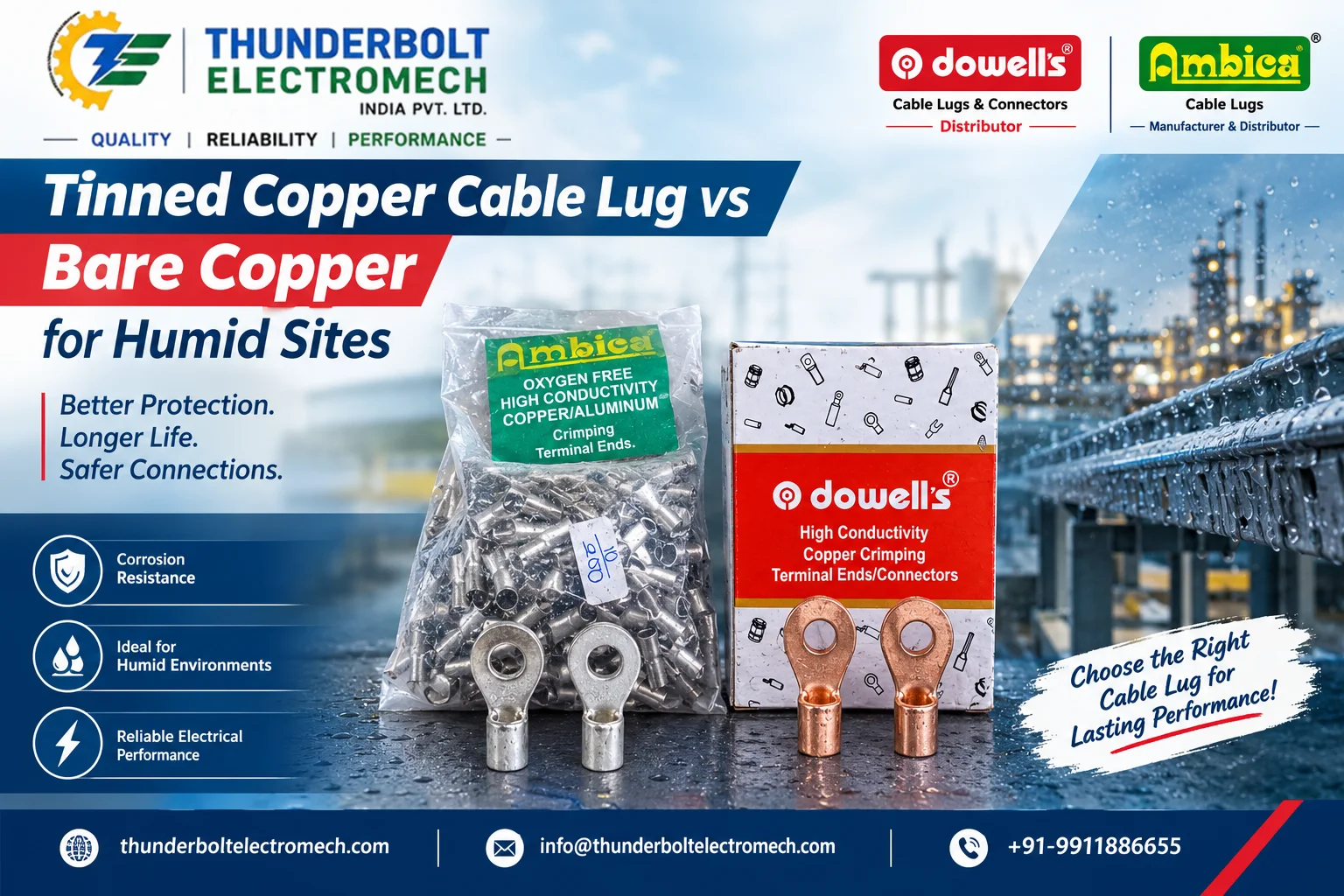
Quick Answer: Use tinned copper lugs for humid, coastal, outdoor and battery sites. Use bare copper for dry indoor copper-to-copper joints. Tin guards the surface, but it does not fix an aluminium-to-copper contact. That joint needs a bimetal lug. Before you order from any cable lug supplier India offers, ask for the tin thickness in microns. Thickness decides how long the coating survives damp air, and many datasheets leave it out.
Introduction
Open a panel after a Delhi monsoon and you can read the history of its lugs. Some palms still shine. Others have turned dull brown, and a few carry green crust around the bolt.
The usual explanation is simple: bare copper corroded, tinned copper did not. That story is partly right. It also hides three facts that decide whether a joint survives damp air. Where does moisture enter? How thick is the tin? And what metal sits on the other side of the joint?
This guide answers those questions for panel builders, maintenance engineers and procurement teams who must choose a tinned copper cable lug or a bare one for humid sites. We pulled numbers from a 2,000-hour salt fog test, a plating handbook chapter, connector-maker technical notes and field reports. We also ran one calculation of our own, on resistance, and it changes how you should read any tin-versus-copper argument.
Thunderbolt Electromech India Pvt. Ltd. is a Delhi-based company. We distribute Dowell’s cable lugs, and we manufacture and distribute Ambica cable lugs. Orders ship pan India. Buyers in Delhi NCR often ask us for a tinned copper lug supplier Delhi can serve directly, so we wrote this guide from the questions they ask us.
One rule for the evidence. Where a source gives a number, we cite it. Where we reason from engineering principles, we say so. Where we found no direct source, we say that too.
What a Cable Lug Supplier India Buyer Should Know About Tin on Copper
What tin does, and what it does not do
Tin is a soft metal that sits on the lug as a thin coat. It slows the dulling that bare copper shows in humid air. It also holds up well in standard salt spray tests, according to a plating chapter on electrical equipment published by Routledge.
Tin does not help a lug carry more current. Matte pure tin measures about 11.4 µΩ·cm, while copper sits near 1.7 µΩ·cm. Tin conducts roughly seven times worse than the metal under it.
So should that scare you off a tin plated copper lug India buyers see in every catalogue? Do the sum first.
The resistance argument that falls apart
Take a 10 µm tin layer on a palm contact of 2 cm². Resistance equals resistivity times thickness, divided by area:
11.4 µΩ·cm × 0.001 cm ÷ 2 cm² = about 0.006 µΩ.
Now compare that with a measured joint. In the salt fog study described below, the contact between a 2/0 copper conductor and its connector measured 10 to 15 µΩ. The tin layer’s own resistance is about 2,000 times smaller.
Bulk resistivity is not the problem. Contact quality is. Film resistance, true contact area and clamping force set the joint resistance. The Routledge chapter backs this up with a plating comparison: cold ΔR readings of 40 µΩ for tin, 38 µΩ for silver and 42 µΩ for nickel. Tin landed in the middle. The plating gap was small next to the interface itself.
Evidence label: the 0.006 µΩ figure is our own calculation from the cited resistivity and contact values. The ΔR readings come from the Routledge chapter, which does not describe every test condition.
What a 2,000-hour salt fog test showed
Frank and Morton published an IEEE paper in 2005 that the Copper Development Association hosts. The team cycled connectors through 3% sodium chloride fog, buffered to pH 5.5. Each four-hour cycle held fog for 1 hour 45 minutes, then dry heat up to 70 °C, then a 15-minute rinse. After every 500 hours, they pushed 1,800 A rms through 2/0 copper conductor five times, until the control conductor reached about 250 °C.
The copper-on-copper results were calm. Seventy percent of samples rose 0 to 1% in resistance. The other thirty percent fell. None rose more than 1%. Where tin plating existed, it stayed intact. The paper’s verdict: the all-copper connectors performed best.
Two readings follow, and both matter.
First, a copper-to-copper joint with a sound compression or clamp can survive severe salt fog for 2,000 hours. Second, plating was not the variable under study. Several of the copper samples were untinned mechanical connectors, and the test did not pit tinned against bare on matched hardware. So do not cite it as proof that bare equals tinned. Cite it as proof that the joint matters more than the coat.
Now look at the other group. Tin-plated aluminium connectors on copper conductor, pre-filled with oxide inhibitor, fared worse. Forty percent rose 5 to 10% in resistance, and the surfaces showed white corrosion product. The metal mismatch hurt more than any missing plating.
Where moisture attacks: the palm and the barrel
This section is our engineering reasoning. We found no direct source that splits the two zones.
A lug has two very different contact zones.
The crimped barrel meets the conductor under heavy die pressure. The crimp breaks thin oxide films and forces fresh metal together. A good crimp starts gas-tight. The risk arrives later. Moisture and salts wick along the strand gaps from the cable end, and slow corrosion starts inside the barrel. Tin inside the barrel helps a little. A sealed barrel mouth helps far more.
The bolted palm works differently. Two faces meet at tiny high spots under bolt force. No die ruptures the films there. If a film grows between the faces, resistance climbs, and heat follows. Tin on the palm resists film growth. A palm that has dulled to brown before installation starts the joint at a disadvantage.
This split explains a pattern we hear from the field. A bare copper lug on a dry, torqued bolt can last for years. The same lug in a condensing panel fails first at the palm, then at the cable entry.
Four places where tin loses
1. Sulphide-rich air. The Routledge chapter reports a severe test at 2,000 ppm hydrogen sulphide, 100% relative humidity and 40 °C for 30 days. Tin was almost entirely destroyed, leaving black copper oxide and sulphide scale. Silver kept under 15% of its coat. Nickel showed only a dull tarnish. That test is extreme. Real plants never reach 2,000 ppm. Still, sewage works, effluent plants, biogas units and pulp mills carry hydrogen sulphide, and tin is not the best finish there.
2. Fretting under vibration. Tin is soft. Harwin’s technical note lists matte tin at 9 to 12 VHN, and the Routledge chapter says tin’s low durability and fretting susceptibility limit its use to joints with few mating cycles. A lug bolted once fits that profile. A lug on a vibrating DG set or motor terminal box does not, unless torque holds. Our cable lug torque specification guide covers the tightening side.
3. Repeated heat cycling in crimps. Lectromec reviewed aerospace tests under AS4373 Method 807. Tin-plated and nickel-plated wire in crimped joints showed considerable resistance increases during elevated-temperature cycling, while silver-plated wire stayed stable. That work involved wire, not lugs, and aerospace crimps. Treat it as an indirect warning. If your lugs carry high cyclic loads, add infrared scans to your routine.
4. A coat that is too thin. This one earns its own section below, because thickness is the number most buyers never see.
Two smaller notes. Pure tin can grow whiskers. The Routledge chapter advises at least 7 µm without a nickel or silver underlayer, with 10 µm nominal. Whiskers worry designers of fine-pitch electronics far more than they worry users of a 25 mm² lug, which is our reasoning, not a sourced finding. Tin also changes structure below 13 °C, a change called tin pest (Harwin). We found no direct source on tin pest failures in plated lugs, so ask about service temperature if your site sits in high, cold country.
Why tin on a copper lug does not fix aluminium
A common belief says a tinned lug makes any copper-aluminium contact safe. It does not.
Frank and Morton note that tin works as an interface layer between the two metals, but if the tin is compromised, galvanic corrosion between the base metals can still occur. When copper and aluminium touch in moisture, a strong galvanic reaction follows.
An IEEE evaluation of platings for aluminium-to-copper connections points the same way. As reported in the research brief behind this guide, nickel plating on both metals, and copper plating on the aluminium, gave the most stable contact. Bare aluminium against tin-plated or silver-plated copper performed worst. We could not open the full paper text while writing, so check it before you quote the ranking in a tender.
The practical rule is short. If aluminium conductor meets a copper busbar, use a bimetal lug. A friction-welded bimetal terminal moves the aluminium-copper junction inside a solid-state weld, away from moisture. Read our guide to the bimetal cable lug supplier India buyers need to prevent galvanic corrosion, or see the bimetallic terminals (friction welded) in our range.
Site Rules: Choosing Tinned or Bare Copper From a Cable Lug Supplier India Stocks
“Humid” covers a lot of ground. A Chennai pump house, a Delhi basement panel in August and a battery room near Kandla all count, yet they fail in different ways.
Here is the thing about damp sites. Constant high humidity matters less than wet-dry cycling. A panel that cools below the dew point at night and warms by noon deposits moisture, dissolves salts, then dries them into crust, again and again. That cycling mechanism is our reasoning from general corrosion practice; no direct source ties it to lug failures. Plan for the cycles, not the average humidity.
Site-by-site selection
Dry indoor panel, copper to copper. Bare or tinned both work. Choose tinned if the lugs will sit in stores for months. Harwin reports tin connectors keep for at least a year before oxidation becomes a problem. Our shelf life and storage guide goes deeper.
Condensing indoor panel or basement. Choose tinned copper. Seal the barrel mouth with adhesive-lined heat shrink. Our heat shrink sleeve range covers that job.
Coastal or marine outdoor site. Choose tinned copper with a thick coat, then seal and re-check torque. Salt deposits accelerate wet-dry cycling.
Battery banks. Choose tinned copper, and coat the finished joint with terminal grease. A solar-electric forum thread, which is field experience and not test data, reports greased connections with no corrosion after five years indoors and two outdoors, and one poster who saw cheap tinned lugs corrode. Quality of the tin matters. See our battery storage and EV charging DC termination guide.
Sulphide-rich air. Ask for nickel-plated lugs or a fully sealed joint. Tin is a poor bet here.
Heavy vibration or high cyclic load. Choose tinned copper, torque with a spring washer or conical washer, and scan with infrared. Consider silver or nickel for extreme duty.
Any aluminium conductor or aluminium busbar. Use a bimetal lug. No plating on a copper lug replaces it.
Comparison table: tinned copper vs bare copper lug
| Factor | Tinned copper lug | Bare copper lug |
| Surface in humid air | Resists dulling; tin forms a stable barrier | Darkens and tarnishes faster |
| Storage before use | Keeps well; at least a year before oxidation matters (connector-maker guidance) | Tarnishes on the shelf; palm may need cleaning |
| Joint resistance | Tin layer adds about 0.006 µΩ at 10 µm over 2 cm² (our calculation); negligible | Lowest bulk resistivity, but surface films can raise contact resistance |
| Copper-to-copper in salt fog | Intact coat after 2,000 h in a published test | Tested samples also held up; plating was not the test variable |
| Sulphide-rich air | Poor; coat nearly destroyed in a severe H₂S test | Also attacked; nickel performs better |
| Vibration and fretting | Soft coat; needs torque retention | Harder surface, but oxidises under micro-motion |
| Aluminium contact | Does not solve it; use a bimetal lug | Does not solve it; use a bimetal lug |
| Weight and cost | Compare weight per piece; heavier usually means thicker copper wall | Same rule; a lighter lug carries less copper |
| Best fit | Humid, coastal, outdoor, battery, long storage | Dry indoor copper-to-copper joints |
| Ask the supplier for | Tin thickness in µm, salt spray report, batch certificate | Copper grade, wall thickness, dimensions |
How thick should the tin be?
The Routledge chapter on plating electrical equipment lists minimum tin thickness on a copper base by environment:
| Environment | Minimum tin on copper |
| Indoor, dry | 5 µm |
| Indoor, with condensation | 10 µm |
| Outdoor, extreme temperature | 15 µm |
| Outdoor, corrosive | 30 µm |
These are handbook minimums for plated electrical parts. They are not a lug standard, and no Indian standard we found sets a tin thickness for copper lugs. IS 8309:1993, for example, covers compression terminal ends for aluminium conductors, and the BIS page does not mention plating. Use the table as a specification starting point and write the micron value into your purchase order.
Compare the table with your site. A condensing panel in Delhi’s monsoon sits in the 10 µm row. A coastal outdoor yard sits closer to the corrosive row. Many catalogues list the finish simply as “tin plated.” If the datasheet gives no micron value, ask for it.
What to ask on the quote
- What is the tin thickness in µm, and how do you measure it?
- Can you share a neutral salt spray report (ISO 9227 or ASTM B117) on plated samples?
- What is the copper grade and wall thickness at the barrel?
- What conductor range does each barrel size cover?
- Do batch certificates travel with the dispatch?
- Does the lug follow the dimension standard I specified? Buyers commonly cite DIN 46235 for copper compression lugs. Check the current edition.
- Which crimping die and tool do you recommend? Our crimping tools guide compares hydraulic, mechanical and battery tools.
A copper cable lug supplier India buyers trust answers all seven in writing. If a quote dodges the first two, the plating is a guess.
Installation steps that protect either finish
Plating buys time. Installation decides whether you use that time well. These steps reflect general good practice, not one cited standard.
- Keep lugs sealed in their packs until fitting day. Store them in a closed, dry cabinet, off the floor.
- Inspect each palm. A faint haze on bare copper is normal. Brown or green deposits mean the lug has aged, so reject it.
- Never file or sand the palm of a tin plated copper lug India sites rely on. Abrasion strips the coat you paid for.
- Strip the conductor to the barrel depth and no further. No bare strand should show beyond the barrel mouth.
- Crimp with the die that matches the barrel and conductor, and finish every stroke. A half-closed crimp leaves gaps where moisture collects.
- Seal the barrel mouth and the first few centimetres of cable with adhesive-lined heat shrink.
- Torque the bolt to the chart. Add a spring or conical washer where vibration exists, and re-torque after the first thermal cycles.
- Record an infrared baseline under load. Compare it at every maintenance round, because a drifting joint warms up before it fails.
Each step costs minutes. Skipping them costs a shutdown.
Problems Buyers Bring to a Cable Lug Supplier India Counter, and Fixes
Customer problems and solutions
Problem 1: “Our bare copper lugs went green in one monsoon.”
Solution: Look at the cable entry first. Green crust at the barrel mouth means moisture wicked along the strands. Switch to tinned lugs and seal each barrel with adhesive-lined heat shrink. Add a thin film of neutral joint compound on the palm.
Problem 2: “We bought tinned lugs, and they still corroded.”
Solution: Check four things. Was the tin thick enough for the site? Did the site carry hydrogen sulphide? Is aluminium touching copper anywhere in the joint? Did torque slip? One forum poster in our research reported cheap tinned lugs corroding while quality ones lasted decades. The coat’s quality and thickness vary from batch to batch. That is why we ask suppliers for micron values.
Problem 3: “Someone told us tinned lugs fix aluminium-to-copper joints.”
Solution: They do not. The published salt fog test showed corrosion on tin-plated aluminium connectors used on copper conductor. Use a friction-welded bimetal lug.
Problem 4: “Tinned lugs cost more, so we bought bare ones for the whole plant.”
Solution: Split the order by site. Dry control rooms can take bare or tinned. Damp, outdoor and battery areas need tinned copper. Also compare weight. In a forum thread on battery lugs, posters noted that bare lugs weighed less than tinned equivalents, so a lower weight can mean less copper, not more purity. Weigh a sample before you approve a price.
Problem 5: “Our lug joints heat up, and the lugs look fine.”
Solution: Scan with an infrared camera under load, and re-torque. In the salt fog study, 5% rise in total resistance counted as significant and 10% as failure, while the conductor-to-connector contact made up only about 10% of the total reading. A joint can drift without any visible sign.
Problem 6: “The panel sits near an effluent plant.”
Solution: Ask for nickel-plated lugs or a sealed joint. Hydrogen sulphide attacks tin hard in severe tests.
Real use cases
Delhi basement MCC panels. Monsoon humidity and winter fog push the panel through condensation cycles. Tinned copper lugs, 10 µm or more, with heat-shrunk barrels fit this duty.
Coastal cold storage. Salt-laden air reaches the outdoor condensing units. Tinned copper with thick plating, sealed barrels and an annual torque check serve here.
Battery rooms. Acid mist and humidity attack terminals. Tinned copper plus terminal grease follows the field practice reported by installers.
Solar plants. Outdoor DC combiner boxes see daily heat and dew. Use tinned copper, and keep any aluminium cable terminations on bimetal lugs.
Illustrative case study: coastal food plant, 14 months
This case is a constructed example to show the failure chain. It is not a record of a named Thunderbolt customer, and the figures are round numbers for explanation. We can swap in a documented customer story on request.
A food-processing plant near the coast ran its motor control centre with bare copper lugs on 35 mm² and 70 mm² cables. Fourteen months in, an infrared scan showed three joints running 25 to 30 °C hotter than their neighbours. The maintenance team opened the panel and found green crust at the barrel mouths and dull brown palms.
The team’s first guess blamed the missing tin. The investigation gave a fuller answer.
- The barrels had no seal. Moisture wicked along the strands.
- Palms had dulled before installation, because the lugs sat in an open store through one monsoon.
- Two bolts had lost torque after thermal cycling.
- One lug joined an aluminium conductor to a copper bar with no bimetal interface.
The fix used five steps. The plant bought tinned copper lugs with the tin thickness written in the purchase order. It sealed every barrel with adhesive-lined heat shrink. It moved stock into a closed cabinet. It re-torqued after thirty days, then at six months. And it replaced the aluminium-to-copper joint with a bimetal lug.
Notice what happened. Tin was one of five changes. A purchase that swapped bare for tinned and stopped there would have fixed a fraction of the problem. That matches the lesson of the 2,000-hour test: the joint decides the outcome, and the coat helps.
Thunderbolt Electromech: Delhi-Based Cable Lug Supplier India Wide
Thunderbolt Electromech India Pvt. Ltd. supplies cable lugs to panel builders, EPC teams, solar contractors and maintenance departments across India. We deliver pan India from Delhi.
We distribute Dowell’s cable lugs. We also manufacture and distribute Ambica cable lugs. That mix lets us advise on finish, barrel length and conductor range without pushing one product line. Contractors who search for a copper cable lug dealer Delhi NCR sites can visit will find our shop in Chawri Bazar. Teams that want a cable lug supplier Delhi based, with delivery to their site, can order by phone or email. And as a copper cable lug supplier India wide, we quote for outstation projects the same way.
Our cable lug product cluster
Browse the full range on our cable lugs product category. The range includes:
- Copper Tube Terminal, Medium Duty
- Copper Tube Terminal, Heavy Duty Long Barrel
- Copper Reducer Terminal (Ambica and Dowell lugs)
- Copper Tube In-Line Connectors
- Aluminium Tube Terminals
- Aluminium Tube Terminals, Long Barrel
- Aluminium In-Line Connectors
- Bi-Metallic Terminals (Friction Welded)
Our pillar guide to buying cable lugs explains compression versus mechanical lugs, size selection and how to verify IEC 61238-1 and IS 8309 compliance. IEC 61238-1 sets heat-cycle and resistance tests for compression and mechanical connectors. A heat-cycle result does not tell you how the plating survives a monsoon, so ask for the salt spray report as well.
Keep reading in the cable lug cluster
Our cable lug blog category holds the rest of the series:
- Long barrel vs standard barrel lugs, useful when you want more insulated barrel to seal
- Aluminium cable lug sizing and crimping, with IS 8309 charts
- Aluminium cable lug supplier India: which type to choose
- Cable lug HSN code and GST rate for bulk orders
Contact Thunderbolt Electromech
Trade buyers who want a copper cable lug dealer Delhi NCR wide, and plant engineers who need a tinned copper lug supplier Delhi can call directly, can reach us the same way. Tell us your site, your conductor size, and whether aluminium touches the joint. We will suggest a finish and quote.
- Company: Thunderbolt Electromech India Pvt. Ltd.
- Website: thunderboltelectromech.com
- Phone: +91-9911886655
- Email: info@thunderboltelectromech.com
- Address: Shop No. 3538, Sitaram Bazar Rd, Bazar Sirkiwalan, Chawri Bazar, Chandni Chowk, Delhi, 110006
Conclusion: Choose the Finish by Site, Then Verify the Joint
Here is the whole argument in one place.
Use tinned copper cable lugs for humid, coastal, outdoor and battery sites, and for any lug that will wait in storage. Use bare copper for dry indoor copper-to-copper joints. Both finishes can work in the right place. Neither one fixes a bad joint.
Tin does three useful things. It resists dulling, it holds up in standard salt spray, and it keeps lugs ready for installation. It does not add meaningful resistance. Our calculation puts a 10 µm tin layer across a 2 cm² palm at about 0.006 µΩ, roughly 2,000 times smaller than a typical measured contact.
The best test data we found came from a 2,000-hour salt fog study. Copper-to-copper connectors performed best, with no sample rising more than 1% in resistance. The tin-plated aluminium connectors on copper conductor fared worse. The study did not compare tinned and bare copper directly, so read it as proof that the joint matters more than the coat.
Tin has limits. It lost badly in a severe hydrogen sulphide test, where nickel did far better. It is soft, so vibration and lost torque can harm it. Indirect aerospace evidence links tin-plated crimps to rising resistance under heat cycling. And a thin coat gives thin protection. A plating handbook lists 5 µm for dry indoor use, 10 µm for condensing indoor sites, 15 µm outdoors at temperature extremes and 30 µm in corrosive outdoor air.
Aluminium changes the rule. A tinned copper lug does not make an aluminium-to-copper contact safe. Use a friction-welded bimetal lug.
Most failures start at the places a plating label never mentions: an unsealed barrel mouth, a dull palm, a loose bolt. Seal the barrel, store stock dry, torque to the chart, and scan under load.
When you buy, ask your cable lug supplier India wide for the tin thickness in microns, a salt spray report, the copper grade, the barrel wall thickness and the batch certificate. Thunderbolt Electromech supplies Dowell’s and Ambica cable lugs across India from Delhi, and buyers who want a cable lug supplier Delhi based can deal with us directly. Call +91-9911886655 or write to info@thunderboltelectromech.com, and we will match the finish to your site.