Quick Answer: A cable tie mounting base gives a tie a fixed anchor point on a panel, wall or chassis. Use adhesive bases for light, cool runs on clean metal. Use screw or push-in bases when vibration, heat or door movement pulls on the bundle. Use edge clips where drilling is off limits. Match the base colour and UV grade to the tie. Buy both from a Cable Ties Supplier India stockist such as Thunderbolt Electromech, Delhi.
Introduction
A cable tie holds wires to each other. A mounting base holds the bundle to the machine. Most buyers spend hours on the first job and seconds on the second.
That gap causes real failures. You open a control panel six months after commissioning and find the harness hanging in a loose curtain, with a dozen little square bases lying at the bottom of the enclosure. The ties did their job. The bases did not.
This guide covers the accessory side of the cable tie: saddle-style bases, screw mounts, push-in mounts, edge clips and the “anchor” fittings that hold them to walls, trays and concrete. It uses forum evidence from working electricians, a patent filing, fastener-industry testing data and government solar figures. Where a claim has a source, we mark it [Direct]. Where we found no source and the point comes from engineering judgment, we mark it [No direct source found]. You can check every link in the evidence register near the end.
For tie sizes, tensile ratings and PA66 grades, read our pillar guide, Cable Ties Supplier India: Complete Guide to Sizes, Types, Materials, Strength and Industrial Buying. This article starts where that one stops: the point where the tie meets the surface.
Why a Cable Ties Supplier India Buyer Should Specify the Base and the Tie Together
Think of the load path. Bundle weight pulls on the tie. The tie pulls on the base. The base pulls on its adhesive or its screw. That fixing pulls on the panel. Every link carries the same load, and the weakest link decides when the whole chain fails.
In most panels the tie is the strongest link. A 3.6 mm tie rated around 18 kg (as our pillar guide lists) will outlast almost any adhesive pad stuck to a powder-coated door. Yet purchase orders quote the tie’s kilogram rating and say nothing about the base. The strongest component gets specified, and the weakest gets whatever the store has.
Here is a second trap: slot width. Manufacturers size mount slots to a tie width class. One retail range, for example, sells a medium base for ties up to 4.6 mm and a large base for ties up to 5.5 mm. Each base also carries a 3.2 mm or 5 mm screw hole, so you can back up the adhesive with a screw on heavier bundles. [Direct] A common 4.8 mm Indian panel tie will not thread through the 4.6 mm class. It needs the larger slot.
A good Cable Ties Supplier India partner asks three questions on a mounting-base enquiry: what is the tie width, what does the base fix to, and what does the bundle weigh per metre? If your vendor asks none of them, you are buying a commodity, not a solution.
What Counts as a Mounting Base: Saddle Mounts, Screw Bases, Push-In Bases and Edge Clips
Trade language in India is loose, so define terms first.
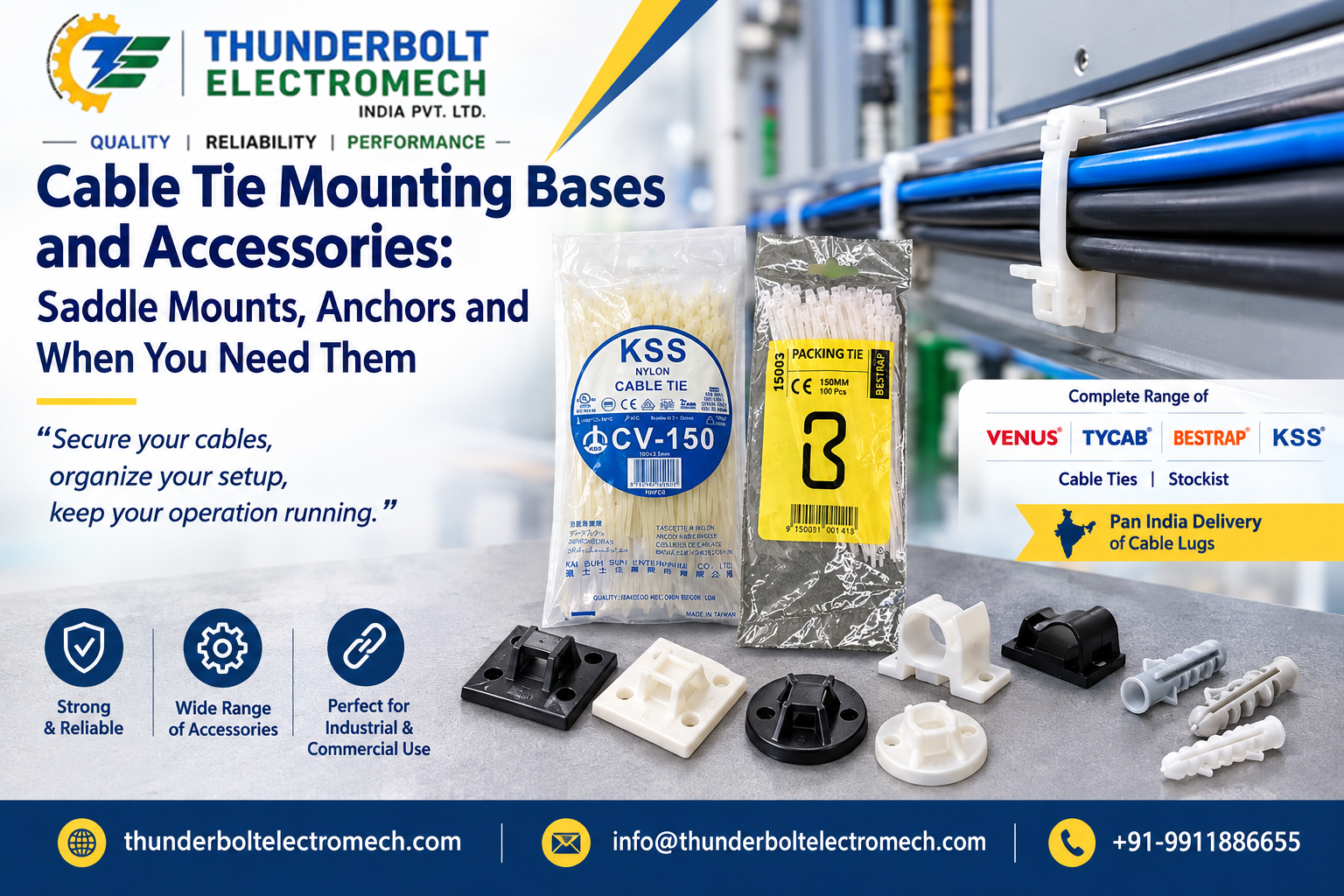
Saddle-style tie base. A small moulded block with a bridge (the “saddle”) that a tie passes under. Some have one entry, some have four-way entry so the tie can leave in any direction. Distributors describe the single and four-way entry designs as ways to route wiring flexibly along backplates and door frames. [Direct] Do not confuse this with the MS saddle clamp used for pipes and cables. Thunderbolt lists that as a separate MS saddle product category. [Direct: Thunderbolt product menu]
Adhesive base. A saddle with a foam-tape back. Fast to fit, good for light loads.
Screw-mount base. The same saddle with a hole for a self-tapping screw or a screw and plug.
Push-in (fir-tree) base. A ribbed stem that clicks into a drilled or punched hole. Each barb flexes inward on entry, then springs back behind the panel and locks against pull-out. [Direct]
Edge clip. A U-shaped clip that grips a sheet-metal edge with no drilling.
Component distributors group the range the same way. Essentra’s catalogue, for instance, splits cable tie mounts into adhesive, edge, push-in and screw types. [Direct] Once you know which of the four you need, the rest of the decision follows from load, temperature and the surface.
Why Adhesive Bases Fall Off (and the Fix That Actually Works)
Adhesive bases cause more complaints than any other accessory. The evidence comes from people who install them daily.
On an electricians’ forum, one contributor said good bases with genuine 3M adhesive can be almost impossible to pry off years later. The same thread warns that cheaper ones look fine at first but can be found dangling six months later, especially on plastic. [Direct] On a panel-building forum, an engineer noted that the adhesive does not age well and has a shelf life, so he stopped stocking large quantities. [Direct] A patent filing records the same weakness: adhesive-backed mounts tend to dislodge over time and fail when the load is too high. [Direct]
Three mechanisms explain these failures. We list them because the fix depends on which one you face.
- Creep under sustained load. Foam adhesive flows slowly under constant shear. The mount does not snap. It slides down the door over months.
- Peel loading. A tie pulled tight lifts the edge of the base. Adhesive resists shear well and peel badly. Over-tightening your tie turns a shear joint into a peel joint.
- Heat softening. In a hot enclosure or on a sun-baked rack, the adhesive turns gooey and gravity finishes the job. One vehicle-forum user described adhesive mounts on a black painted rack slowly falling off for exactly this reason. [Direct]
What fixes it:
- Clean and dry the surface. Contributors recommend isopropyl alcohol, and one adds tape primer and larger 2-inch pads to help mounts stay put. [Direct] Another forum poster adds a warning: buff off the alcohol residue with a dry cloth, because it can leave a film that weakens the bond. [Direct]
- Skip low-energy plastics. Polypropylene resists nearly every adhesive. [Direct]
- Use the screw hole. Most adhesive bases include one. Add a screw wherever the bundle carries real weight. [Direct for the hole: see StarTech above; No direct source found for the rule of thumb]
- Tension the tie lightly. Snug is enough. The tie only needs to hold the bundle, and hard tension lifts the base edge.
- Rotate your stock. Adhesive ages on the shelf. Buy in quantities you use within a season.
Choosing Mounts by Panel Type: A Cable Ties Supplier India Field Guide
Match the base to the situation, not to the price tag.
| Situation | Best base | Reason | Evidence |
| Light control wiring on a clean, cool backplate | Adhesive, 4-way | Fast, no holes | Direct (RS, Essentra) |
| Door harness that flexes on every open/close | Screw or push-in, on the door only | Adhesive sees repeated peel | No direct source found |
| Hot inverter or transformer room | Screw base | Adhesive softens with heat | Direct (forum reports) |
| Sheet-metal frame, no drilling permitted | Edge clip | Grips the edge | Direct (RS) |
| Pre-drilled chassis, high volume assembly | Push-in fir-tree | Tool-free, fast | Direct (Niuli, CTU) |
| Concrete or brick wall run | Screw base with plug | Adhesive fails on dusty plaster | No direct source found |
| Outdoor or rooftop | UV-black screw base | UV plus permanent fixing | Direct for UV need (pillar page) |
Push-in details that decide success. Hole size and panel thickness both matter. One fastener-industry article reports that push-out force varies with temperature, hole diameter, panel thickness and fin design. The same source gives an example: a small fastener in a 0.197-inch hole in HDPE panels resisted roughly 31 pounds of push-out force, while a larger fastener in a 0.281-inch hole in particle board resisted about 175 pounds. [Direct] Do not treat these as your numbers. They show how much the hole and material change the result.
A common push-mount tie fits a quarter-inch hole and panels from 0.052 to 0.25 inches thick, [Direct] which covers the 1.5 to 2 mm sheet steel typical in Indian control panels. [No direct source found for the “typical” panel gauge; it comes from field experience] Seat the fir-tree base fully behind the panel, because it needs the correct depth for proper compression and locking.
A field insight that catalogues skip: powder coating. A drilled hole in bare steel measures what the drill says. After powder coating, the film narrows the hole by the coating thickness on each wall. A hole that fit the stem before painting can grip loosely or refuse to seat after. Test-fit on a painted sample before you order 5,000 pieces.
One supplier guide also advises asking for tested pull-out values in newtons or pounds-force and running your own insertion and pull-out test on the real panel material. [Direct] Good advice, and cheap to follow.
Reuse limits. The same fastener article says push-in fasteners can be removed and reused only two or three times. [Direct] Plan for that on panels that get re-wired often.
What the Trade Means, and When You Need One
Search for “cable tie anchor accessories India” and you will find three different products under one name. Sort them out before you order.
- The screw-mount base itself. Many sellers call a screw base an “anchor” because it anchors the tie. Same part, different word.
- The wall fixing behind it. On brick or concrete, the base needs a plug (rawl plug) or a masonry screw. The plug carries the load. The base only holds the tie.
- Welded or clinched studs on the panel. For panels where drilled holes weaken IP protection, panel builders weld studs or use self-clinching mounts. One panel builder in a forum thread used a stud welder and reported that the welds were not noticeable. [Direct] The same thread notes that an internal raised panel welded to the door lets you screw ties to that panel only, with no extra holes in the front face, which helps outdoor and harsh-environment enclosures.
When you need a true anchor: long wall runs in warehouses and workshops, cable-tray bundles in outdoor yards, rooftop solar string cables and any run where a person or a machine may pull on the bundle. In those places, adhesive is a temporary fix at best.
Match the colour and the UV grade. A UV-black tie clipped to a natural (white) base gives you a weak link in the sunlight. The tie survives. The base whitens and cracks. Order the base in UV-stabilised black whenever the tie is UV-black. [No direct source found: engineering judgment; UV need for ties is covered in our pillar guide]
Five Real-World Failures and Their Fixes
These are illustrative scenarios built from the failure modes above. They are not client case studies.
1. The sagging door harness (panel shop, Naraina).
A fabricator sticks four-way adhesive bases along the hinge side of a door. Every opening flexes the loom, and the adhesive peels. Fix: move the anchors to a welded or screwed strip on the door, leave a service loop at the hinge and stop tightening ties beyond snug. [No direct source found]
2. The melting-adhesive inverter room (industrial unit, Faridabad).
Bases hold for the winter commissioning, then slide off in June. Fix: screw bases in heat zones, with adhesive only in the cool corners. [Direct for heat softening: Ranger5G forum]
3. The wobbly push-in (OEM line, Manesar).
Painted chassis, unpainted test sample. Stems seat firmly in bare holes and rattle in painted ones. Fix: sample on painted metal, or use a stem one size up. [No direct source found]
4. The whitened base on the roof (rooftop array, Noida).
UV-black ties, natural bases. Fix: UV-black bases throughout. [No direct source found]
5. The dusty-wall failure (godown, Bawana).
Adhesive bases on plastered walls fall away within weeks because dust and lime release the tape. Fix: screw bases with plugs, spaced to bundle weight. [No direct source found]
A spacing calculation you can reuse. Assume a control bundle weighs 1 kg per metre and you place a base every 150 mm. Each base carries 0.15 kg static. Door motion and handling can multiply that load several times, so design each mount for about three times static, or roughly 0.5 kg. Adhesive pads without a screw hole are marginal at that load on painted steel, and a screw base is comfortable. [No direct source found: worked example on stated assumptions]
Cable Ties Supplier India Quick Reference Charts: Venus, Tycab, Bestrap and KSS
Each chart below covers one brand. The “listed at Thunderbolt” column comes from the Thunderbolt site menu and pillar guide [Direct]. The pairing advice comes from our engineering judgment. No brand publishes a mounting-base compatibility table that we could find, so confirm slot fit with a sample before bulk orders. [No direct source found for brand-specific base compatibility]
Venus Cable Ties: Quick Reference
| Variant | Listed at Thunderbolt | Pair with | Best for | Check before ordering |
| Venus white (natural) | Yes, direct | Natural adhesive or screw base | Indoor panels | Slot width vs tie width |
| Venus UV black | Yes, direct | UV-black screw base | Solar, outdoor trays | Base colour and UV grade |
| Venus mounting bases and clamps | Yes, pillar page | Same-family ties | Panel and chassis fixing | Screw hole size |
| Venus heavy-duty | Yes, pillar page | Screw base with plug | Vibration, outdoor lashing | Base load rating |
Tycab Cable Ties: Quick Reference
| Variant | Listed at Thunderbolt | Pair with | Best for | Check before ordering |
| Tycab white | Yes, direct | Adhesive 4-way base | Light MRO and panel dressing | Surface cleanliness |
| Tycab UV black | Yes, direct | UV-black screw base | Telecom, streetlight, outdoor cabinets | UV grade of the base |
| Tycab heavy-duty | Yes, pillar page | Screw or push-in base | Industrial bundling | Hole diameter |
Bestrap Cable Ties: Quick Reference
| Variant | Listed at Thunderbolt | Pair with | Best for | Check before ordering |
| Bestrap white | Yes, direct | Adhesive or edge clip | OEM panel wiring | Panel edge thickness (edge clips) |
| Bestrap heavy-duty nylon | Yes, pillar page | Screw base | Machine harnesses | Vibration level |
| Bestrap stainless band-and-buckle | Yes, pillar page | Stainless bracket or stud | Heat, hazardous areas | Do not pair with plastic bases |
KSS Cable Ties: Quick Reference
| Variant | Listed at Thunderbolt | Pair with | Best for | Check before ordering |
| KSS white | Yes, direct | Push-in or adhesive base | Repeat OEM builds | Tie head size vs slot |
| KSS coloured/marker | Yes, pillar page | Any matching base | Phase and circuit identification | Colour consistency across lots |
Browse the current range on our cable tie product page, and read the colour coding guide before you standardise marker colours.
What the Research Says Now, and What Changes Next
Now: solar is the biggest new demand driver. India’s PM Surya Ghar rooftop scheme has passed 50.06 lakh installations, with 14.8 GW commissioned, [Direct] and installations reached over 16,000 per day in July 2026, more than three times the October 2025 pace. [Direct] Every rooftop system carries string cables in direct sun for decades. That makes UV-grade ties and UV-grade bases a growing line item for installers across Delhi NCR. Our pillar guide already covers why surface-dyed black ties fail; the same logic applies to the base.
Now: adhesive failure is documented, not rumour. The forum reports and the patent filing above agree on three points: adhesive bases dislodge, they age on the shelf, and screws or welded studs solve the problem. [Direct]
Now: test standards. Our pillar guide points buyers to IEC 62275 for cable tie testing and explains the Type 1 and Type 2 classes. [Direct: Thunderbolt pillar page; we did not re-verify the standard text independently] We found no equivalent standard for mounting bases. [No direct source found] Ask suppliers for base material grade (PA66), flame rating and test data instead.
Next: three shifts to plan for. These are forecasts from us, not sourced facts. [No direct source found]
- Denser panels. Smaller enclosures with more wiring leave less room for adhesive pads and more need for push-in and edge solutions.
- More outdoor electrical points. Solar, EV charging and telecom growth all raise UV and heat exposure for accessories.
- Documentation pressure. OEM and EPC buyers will ask for pull-out data and material certificates on accessories, not just on ties.
Cable Ties Supplier India Checklist for Delhi NCR Buyers
Use this checklist when you source a cable tie mounting base, whether you buy in bulk for a panel line or in small lots for site work.
- Ask for the base material. PA66 is the standard grade for ties and mounts alike.
- Confirm slot width against your tie width. Bring a tie sample.
- Request a sample batch and test it on your painted panel.
- Ask for UV-black bases for anything outdoors.
- Buy ties and bases together. One purchase order, one delivery, one point of contact.
- Check stock depth. A vendor that carries Venus, Tycab, Bestrap and KSS gives you a fallback if one brand runs short.
If you search for a cable tie mounting base supplier Delhi or a cable tie accessories dealer Delhi NCR, look at location and lead time too. Thunderbolt Electromech sits in Chawri Bazar, Chandni Chowk, the old-Delhi electrical hub. Panel shops in Wazirpur and Naraina, OEM units in Okhla, and contractors working across Noida, Gurugram, Faridabad, Ghaziabad and Manesar can pick up or receive urgent lots quickly. Bulk buyers elsewhere in India can order for dispatch, and rate contracts help recurring users lock pricing. Browse the cable tie category on the blog for related guides, including the tensile strength guide and the releasable vs standard tie comparison.
Frequently Asked Questions
Why do adhesive cable tie mounts keep falling off?
Foam adhesive creeps under load, peels when you over-tighten the tie and softens with heat. Forum users also report shelf-aging and poor bonding on plastic. Cleaning with isopropyl alcohol, using tape primer and choosing larger pads improved results in one thread. [Direct]
How do I stick a cable tie mount to a powder-coated metal panel?
Clean with alcohol, wipe dry with a cloth, press hard and add a screw through the mount hole where the bundle carries weight. [Direct for cleaning; No direct source found for the screw rule]
Do adhesive cable tie mounts work inside hot panels?
Not reliably. Forum reports describe adhesive turning gooey on hot painted surfaces. Use a screw or push-in base in heat zones. [Direct]
What size hole does a push-in cable tie mount need?
It depends on the stem. Published examples include a 0.177 to 0.197 inch hole for one 8-inch push-mount tie with a 50 lb tensile rating, [Direct] and a quarter-inch hole for another product. Always check the datasheet and test on your painted panel.
Can I reuse a push-in mount?
A few times at most. One fastener source says two or three reuses is typical. [Direct]
What is the difference between a cable tie mount and a cable clamp?
A tie mount gives a tie an anchor point. A clamp holds the cable directly with its own strap or saddle. Use a tie mount for bundles that change; use a clamp for a fixed, single cable. [No direct source found]
Are mounting bases UV resistant?
Only if made in UV-stabilised black PA66. Colour alone does not prove UV resistance. Ask for the grade, as you would for the tie. [No direct source found for bases; Direct for ties: pillar page]
Which brand should I pick, Venus, Tycab, Bestrap or KSS?
Pick by application and stock availability, not by brand alone. Use the charts above, then confirm slot fit with a sample. Thunderbolt stocks all four. [Direct for stock: Thunderbolt site]
Why Choose thunderbolt Electromech for Cable Tie Purchase?
Thunderbolt Electromech India Pvt. Ltd. is a Delhi-based stockist and distributor of Venus, Tycab, Bestrap and KSS cable ties, along with cable lugs, glands and allied electrical accessories. [Direct: Thunderbolt pillar page]
- Phone / WhatsApp: +91-9911886655
- Email: info@thunderboltelectromech.com
- Address: Shop No. 3538, Sitaram Bazar Rd, Bazar Sirkiwalan, Chawri Bazar, Chandni Chowk, Delhi – 110006
- Website: thunderboltelectromech.com
Send your tie width, the surface (painted steel, brick, roof rack), the temperature range and the quantity. We will suggest the base type and send a sample batch on request.
Conclusion
A cable tie mounting base is a small part with a large say in how long a wiring job lasts. Specify it the way you specify the tie: by width, load, surface, temperature and UV exposure. Use adhesive on light, cool, clean jobs. Use screw, push-in or welded fixings when heat, vibration or door motion enters the picture. Test a sample on your real painted panel before you buy in bulk.
If you need a Cable Ties Supplier India partner who stocks the ties and the bases together, Thunderbolt Electromech in Chawri Bazar, Delhi carries Venus, Tycab, Bestrap and KSS. Call +91-9911886655 or browse the cable tie product range. For sizing, strength and material rules, return to the pillar guide.
Evidence Register
| Claim area | Source | Label |
| Adhesive bases fall off; screw them in | electriciantalk.com/threads/adhesive-cable-mounts-for-panels.294957/ | Direct |
| Alcohol clean, primer, larger pads, shelf life, stud welding | forums.mikeholt.com/goto/post?id=2771988 | Direct |
| Heat and paint softening; polypropylene; residue buffing | ranger5g.com/forum/threads/need-ideas-regarding-adhesive-backed-zip-tie-mounts-heat-related.15781/ | Direct |
| Adhesive mounts dislodge over time and fail under load | patents.google.com/patent/US6367745 | Direct |
| Push-out force varies; reuse two or three times | assemblymag.com/articles/85900-fastening-christmas-trees-ain-t-just-for-december | Direct |
| Fir-tree behaviour; ask for pull-out values; test on real panel | cabletienylon.com/what-are-push-mount-cable-ties/ | Direct |
| Seat fir-tree fully behind panel | cabletiesunlimited.com (fir-tree bundling clips guide) | Direct |
| Panel thickness and hole range for a 50 lb push-mount tie | amazon.com Pro Tie B8FTPM100 listing | Direct |
| 0.177–0.197 in hole for an 8 in push-mount tie | andfel.com/cable-ties/mount-push-8-inch.html | Direct |
| Mount slot classes 4.6 mm and 5.5 mm, screw holes, PA66, UL94 V-2 | newegg.com StarTech CBMCTM2 / CBMCTM3 listings | Direct |
| Single and four-way entry; edge and wall mounts | ph.rs-online.com/web/p/cable-tie-mounts/0279961 | Direct |
| Adhesive, edge, push-in, screw categories | digikey.com Essentra datasheet preview | Direct |
| PM Surya Ghar 50.06 lakh installations, 14.8 GW; 16,000 per day | pv-magazine.com (5 Aug 2026); newkerala.com (6 Aug 2026) | Direct |
| Tie sizes, UV grade, IEC 62275 Types 1 and 2, brand ranges | Thunderbolt pillar page | Direct (not independently re-verified) |
| Load-path logic, powder-coat hole shrink, spacing example, UV base colour, forecasts | Our engineering judgment | No direct source found |