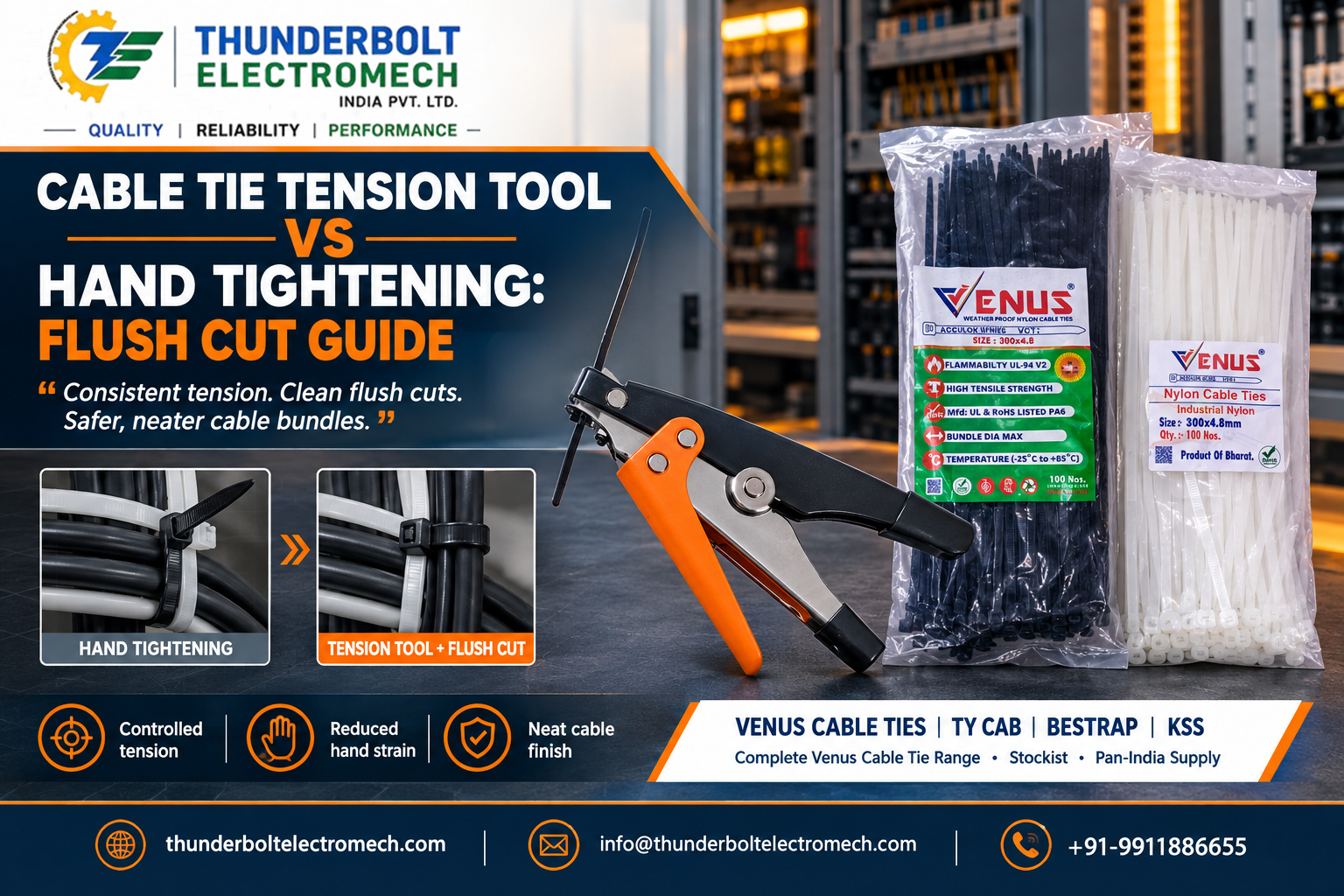
By the Thunderbolt Electromech technical team | Cluster guide in our cable tie series
Quick Answer: Use a cable tie tension tool when bundles are large, vibration is high, or many ties must match. Hand tightening suits small, low-risk bundles but gives uneven tension and leaves sharp tails. Pick a cable tie gun with automatic flush cut-off, set tension below the tie’s rated strength, and replace worn tools early. Thunderbolt Electromech, a Cable Ties Supplier India panel builders and EPC teams rely on, stocks Venus, Tycab, Bestrap and KSS ties.
Introduction
A wireman in an Okhla panel shop pulls a tie by hand, snips the tail with side cutters, and moves to the next bundle. Forty ties later, his wrist aches. Two months later, the commissioning team finds a loom that has slipped loose and a cut tail that has scratched a signal wire. Nobody blames the tie. They should look at how it went on.
If you buy from a cable tie supplier Delhi site engineers recommend, you probably compare price per hundred pieces first. Fair. But installation method decides whether a good tie performs like one. This guide sits inside our cable tie series. Read the complete cable tie buying guide for sizes, materials and strength, browse more articles in the cable tie cluster category, or go straight to the cable tie product range.
Here is what you will learn: when hand tightening is fine, when a tension tool earns its price, how flush cut-off protects hands and cables, how to match tool settings to tie ratings, and when a worn tool needs to go.
Why Tension Control Matters: Notes from a Cable Ties Supplier India Teams Rely On
A cable tie does one job. It holds a bundle with enough clamping force that the bundle cannot slide, rotate or rattle, and with little enough force that the cables inside stay undamaged. That window is narrower than most crews assume.
What tension does inside a bundle
The strap wraps a bundle and locks through a pawl. Pull harder, and the loop shrinks. Cables compress, jackets flatten, and conductors press against each other. Tension also concentrates at the head, where the strap bends sharply. A tie pulled to the edge of its rating carries almost no reserve for thermal expansion, vibration or later cable additions.
That is the first engineering point most guides skip. The tensile rating printed on a pack is a minimum break load of the strap in a lab pull. It tells you what the tie survives. It says nothing about what the bundle should feel. Installed tension should sit far below that figure.
The under-tightening problem
A loose tie looks tidy on day one. Then vibration starts. A motor-control centre, a DG set room or a conveyor panel shakes a bundle all day. A slack loop lets the bundle shift a millimetre at a time. Jackets abrade where they touch a bracket edge. In a DC control loop, that abrasion can expose a conductor within a year or two. Technicians then hunt an intermittent fault for hours, because the cause sits behind a neat-looking harness.
The over-tightening problem
Over-tightening hides better and hurts more. PVC jackets cold-flow under sustained pressure. The tie sinks into the sheath, thins the insulation and leaves a visible groove. Fibre-optic and thin instrumentation cables suffer most, since small crush forces change signal quality. On heat-cycled panels, a tie pulled too tight also cracks sooner, because the strap loses its ability to stretch and recover.
The sharp tail problem
Hand cutting with diagonal pliers often leaves an angled stub. That stub is a small blade. It cuts gloves, scratches wire jackets, and snags the next harness pulled through a duct. Maintenance people know the sting. Many workmanship specifications cap tail length at around one millimetre, or require a flat cut, because a stub that short cannot catch skin or insulation. Hitting that mark by hand, ten thousand times, is unrealistic.
Cable Tie Tension Tool vs Hand Tightening: Side-by-Side
We asked panel wiremen and site supervisors what they notice, then paired their answers with datasheet logic. The table below sums up the contrast.
| Factor | Hand tightening with cutters | Tension tool with flush cut-off |
| Tension consistency | Varies by wrist strength, fatigue and glove thickness | Repeats within the tool’s set range |
| Tail finish | Angled stub, often 2 to 4 mm | Flat cut at the head |
| Speed on 200+ ties | Slow, tiring | Faster, less hand strain |
| Risk of over-tightening | High on thin cables | Low once set correctly |
| Risk of under-tightening | High when the worker tires | Low |
| Hand injury risk | Cuts from stubs, strain from pulling | Lower, but pinch points exist |
| Cost | Near zero for the tool | Tool purchase plus upkeep |
| Best for | Small bundles, tight spots, few ties | Large bundles, repeat work, quality audits |
Notice what the table does not claim. Hand tightening is not wrong. A skilled wireman tying twelve ties on a small relay panel can do it well. The trouble starts with volume, fatigue and mixed crews, because tension drifts when people get tired or change shifts.
When hand tightening still makes sense
- Small bundles under about 10 mm diameter where a tool head does not fit.
- Repair work inside a crowded enclosure with no room for the tool body.
- Temporary bundling that you will cut off within days.
- Light 2.5 mm ties on delicate sensor leads, where a gentle hand beats a preset.
When a tool pays for itself
- Panel builds with hundreds of ties per cabinet.
- Cable trays and risers where tails face the next technician.
- Vibration zones such as pump rooms, crushers and compressor skids.
- Any job where a client audit checks tail length or tie spacing.
What the Research and Patents Say About Installation Tension
This section separates evidence from sales talk, because a stockist should.
Patent literature on cable tie application tools keeps returning to the same complaint: hand tightening produces inconsistent tension. The designs aim to fix that with a mechanical limiter, usually a spring or a cam that releases the pull at a set force. Those same patents describe a second weakness. A mechanical tension limiter drifts as the tool wears. Springs relax, pawls round off, and the same dial setting produces a different pull a year later.
A newer class of electromechanical application tools adds a force sensor. The user presets a target tension, and the tool triggers the cut-off when the sensor reads that force. In principle, this removes the drift that plagues spring tools, since the sensor, not the spring, decides when to cut. One maker also sells a tension tool for 18 to 50 lb ties, with three tension settings and an automatic flush cut-off. That range covers the common 2.5 mm to 4.8 mm sizes used in panel work.
A protruding tail gets its own mention in tool-design patents. They treat it as a safety defect, since the stub can injure hands and catch cables.
How to read these claims
Patent text describes what an inventor hopes a design achieves. Vendor sheets describe what a seller wants you to believe. Neither replaces a test on your own bench. Before you stock or buy any tension tool, check these specs:
- Tie width range the tool accepts, and the lb or kg rating range it supports.
- Number of tension settings, and whether the maker publishes the force at each setting.
- Cut-off type: flush, or a short stub with a stated maximum length.
- Service life in cycles, and the replacement parts available in India.
- Calibration or inspection guidance from the maker.
If a vendor cannot answer the first three, skip the tool. Our team will tell you the same thing when you call.
How Flush Cut-Off Works and Why It Matters
A flush cut-off blade sits against the tool nose. When the tension setting trips, the blade slices the strap tight against the head. The result: a flat surface with almost no tail.
Three benefits follow.
Safer hands. A near-zero tail cannot slice a glove or a fingertip. Maintenance crews who work in panels with bare hands feel the difference on day one.
Cleaner cable runs. In a duct or tray, a tail catches the next cable pulled past it. Flush cuts let new cables slide through.
Better inspection results. A client’s quality inspector can check a hundred ties in minutes when all tails look the same. An uneven row of stubs invites rework, even when tension is fine.
A real-world snag: the blade
The cut-off blade is a wear item. A dull blade crushes the strap instead of slicing it, and the tail rises back into a ragged edge. If your tool leaves a rough face, check the blade before you blame the tie.
Setting Tension to the Tie Rating
The rating class sets the ceiling. The task sets the target.
| Typical width | Nominal rating class | Approx. loop strength | Common use |
| 2.5 mm | 18 lb | about 8 kg | Control wiring, small harnesses |
| 3.6 mm | 40 lb | about 18 kg | Panel looms, medium bundles |
| 4.8 mm | 50 lb | about 22 kg | Power cable bundles, tray fixing |
| 7.6 mm | 120 lb | about 55 kg | Heavy bundles, outdoor trays |
Figures are nominal class values for standard nylon 6.6 ties. Always read the datasheet on your batch.
Here is a simple method that works on site.
- Build a test bundle with the same cable types and diameter as the real job.
- Start the tool at its lowest setting.
- Tie once. Try to rotate the bundle and slide the tie.
- Step up one setting if the bundle moves. Stop as soon as it holds.
- Check the jacket for grooves or flattening. If you see any, step back down.
- Record the setting on the job card, then tie the rest of the run.
That last step matters. Written settings turn a one-person skill into a team process.
Two environment notes for Indian sites
Heat first. Panels in Delhi summers run hot, and a nylon strap softens slightly as temperature climbs. A tie that feels firm at 25 °C may relax a little at 50 °C, so avoid setting tension at the bare minimum on outdoor or sun-facing installations. UV comes second. Use black, UV-stabilised ties outdoors, since natural nylon degrades under sunlight and loses toughness.
Tool Wear: When to Replace Your Tension Tool
Tension tools fail slowly. The settings stay printed on the dial, but the force behind them changes. Watch for these signs.
- Ties slip after a few weeks even though the dial has not moved.
- Tail length grows from flush to a visible stub.
- The tool needs a second squeeze to cut.
- Jaw teeth look polished or rounded.
- Tension varies between two ties pulled back to back.
Set a replacement rule before trouble begins. A practical option: count ties per tool, log the number, and retire or service the tool at the maker’s stated cycle count. If the maker gives no number, ask for one, or run a monthly check with a spring scale on three test ties and retire any tool that drifts more than a setting step from its baseline.
Case Study: A Control Panel Workshop Cuts Rework
Illustrative scenario built from common findings in panel audits. Figures are rounded for explanation and are not a client record.
A mid-size panel builder in the Delhi NCR belt assembled 60 motor control cabinets a quarter. Each cabinet used around 600 ties, mostly 3.6 mm and 4.8 mm. The crew tied by hand and cut with side cutters.
During pre-dispatch checks, the quality team found three repeat issues. Roughly one cabinet in five had loose bundles near door hinges. Several cabinets showed jacket grooves on thin control cables. Inspectors also logged sharp tails on nearly every cabinet, which meant a manual trimming pass before dispatch.
The workshop switched to tension tools with flush cut-off for bundles above 15 mm, and kept hand tying only for tight corners. The supervisor wrote the tension setting for each cable group on a laminated card at each bench.
Within two build cycles, the tail-trimming pass disappeared. Loose-bundle findings fell sharply, and jacket grooves stopped appearing on thin cables. The team also swapped one worn tool after its tails began to lengthen, which a monthly check caught.
The lesson is practical. The tool did not fix the problem alone. The written settings, the test bundle and the wear check did the heavy lifting.
Venus, Tycab, Bestrap and KSS: Brand Charts from a Cable Ties Supplier India Stockist
Thunderbolt Electromech stocks the complete Venus cable tie range and also supplies Tycab, Bestrap and KSS. The four charts below pair common sizes with a tension setting strategy. Class values are nominal for standard nylon 6.6 ties. Exact SKUs, colours and lengths change by batch, so confirm current stock with our team and read the datasheet on your pack before you set a tool.
Venus Cable Tie Quick Reference
| Size class | Rating class | Typical job | Tool setting approach |
| 2.5 mm series | 18 lb | Control wiring, sensor leads | Lowest setting, test on thin cable |
| 3.6 mm series | 40 lb | Panel looms, relay harnesses | Low to mid setting |
| 4.8 mm series | 50 lb | Power cable bundles, tray fixing | Mid setting, check jacket for grooves |
| 7.6 mm series | 120 lb | Heavy bundles, outdoor trays | Heavy-duty tool, outside 18 to 50 lb tools |
Buyer check for Venus: Our Venus stock covers the full run, so you can standardise one brand across a whole panel line. Match every tool setting to the Venus size on the job card.
Tycab Cable Tie Quick Reference
| Size class | Rating class | Typical job | Tool setting approach |
| 2.5 mm series | 18 lb | Signal and control cable dressing | Lowest setting |
| 3.6 mm series | 40 lb | Cabinet looms, instrument bundles | Low to mid setting |
| 4.8 mm series | 50 lb | Power bundles, conduit fixing | Mid setting |
| 7.6 mm series | 120 lb | Heavy trunk bundles | Heavy-duty tool |
Buyer check for Tycab: Ask whether the batch is natural or UV-black before you use it outdoors. Natural nylon in direct sun loses toughness faster.
Bestrap Cable Tie Quick Reference
| Size class | Rating class | Typical job | Tool setting approach |
| 2.5 mm series | 18 lb | Light harness work | Lowest setting |
| 3.6 mm series | 40 lb | General panel bundling | Low to mid setting |
| 4.8 mm series | 50 lb | Tray and riser bundles | Mid setting |
| 7.6 mm series | 120 lb | Outdoor and heavy duty runs | Heavy-duty tool |
Buyer check for Bestrap: Check available lengths against your largest bundle. A tie that barely closes around a bundle gives you no room for a proper tool pull.
KSS Cable Tie Quick Reference
| Size class | Rating class | Typical job | Tool setting approach |
| 2.5 mm series | 18 lb | Fine wiring, compact enclosures | Lowest setting |
| 3.6 mm series | 40 lb | Panel harnesses | Low to mid setting |
| 4.8 mm series | 50 lb | Mid-size power bundles | Mid setting |
| 7.6 mm series | 120 lb | Heavy bundles, trays | Heavy-duty tool |
Buyer check for KSS: Run ten test ties with your tool before a bulk order. Tail finish depends on how the strap thickness meets the tool blade, so a quick trial saves a re-order.
Reading the charts together
Tool compatibility, not brand, limits most jobs. An 18 to 50 lb tool covers the first three rows of every chart. The 120 lb row needs a different tool. Mixing brands in one bundle run also works, but record which brand sits where. A strap from one maker can tension differently from another at the same dial setting.
Buying Guide: What to Ask a Cable Ties Supplier India Wide Before You Order
Price matters. Fit matters more. Before you place an order with any Cable Ties Supplier India offers, ask these questions.
- Which rating class does each size carry, and in lb or kg? Mixed units cause purchase mistakes.
- Is the material nylon 6.6, and is it UV-stabilised? Outdoor and solar sites demand it.
- What temperature range does the datasheet state? Panel interiors and DG rooms run hot.
- Will the tie fit my tension tool? Check strap width and thickness against the tool’s stated range.
- Can I test a sample pack? A serious stockist says yes.
- What is the dispatch time to my city? Sites do not wait.
- Do I get a GST invoice and batch details? EPC audits ask for traceability.
One extra habit helps. Order tool and ties from the same source when you can. Then one supplier answers for the whole result, and you avoid the finger-pointing that follows a bad tail cut. Our cable tie product range lists what we hold for these combinations.
A note on counterfeit and loose-batch ties
Unbranded ties of uncertain material enter the market every year. They look the same on the shelf. Under tension they behave differently: the strap yields early, the pawl slips, or the tail cracks at the cut. If a pack carries no brand, no size marking and no batch number, treat it as a risk to your bundle, not a bargain.
Local Supply: Cable Ties Supplier India Network with Cable Tie Tool Dealer Support in Delhi NCR
Project teams in Delhi NCR buy fast and complain faster when stock runs out. Thunderbolt Electromech works from Chawri Bazar, the old trading hub of Delhi, and ships across India.
For Delhi NCR buyers, three needs come up again and again.
- Same-week stock of common sizes for panel shops in Okhla, Bawana, Mayapuri and Wazirpur.
- Tool guidance from a cable tie tool dealer in Delhi NCR who can tell you which tool fits which strap, not just which tool is on the shelf.
- Bulk supply for EPC sites in Gurugram, Noida, Greater Noida, Faridabad and Ghaziabad.
If you search for a cable tie Delhi buyers trust, look for a stockist who can show batch details and answer tension questions. Outside the capital, the same logic holds. Panel builders in Mumbai, Pune, Chennai, Hyderabad, Ahmedabad and Kolkata ask us the same questions, and we ship to all of them. Local pickup suits Delhi contractors, and courier dispatch covers the rest of the country.
What Is Coming: Smarter Tools and Tougher Ties
Several trends will shape how teams tie bundles over the next few years. Treat these as directions to watch, not guarantees.
Sensor-based tension control.
Force-sensing tools, already described in patents and vendor literature, may become common on large panel lines. They promise less drift and a repeatable pull.
Traceable workmanship.
Large EPC clients increasingly ask for installation records. Tools that log settings or counts could feed those audits, if makers add that feature.
Harsher environments.
Solar plants, EV charging sites and data centres push ties into UV exposure, higher heat and tight spaces. Expect more demand for UV-stabilised and heat-stabilised grades.
Tighter safety rules for tails.
As workplaces track hand injuries, flush-cut finish will move from a nice option to a written specification.
Buyers who set tension rules today will adapt faster than those who wait.
Frequently Asked Questions
These questions follow the patterns people raise on Google, Reddit and Quora when they discuss cable tie tension, tools and tails. We answered each from engineering practice.
How tight should a cable tie be?
Tight enough that the bundle cannot slide or rotate, and loose enough that the jacket does not dent. A good test: you should be able to nudge the tie along the bundle with firm thumb pressure only if you want to reposition it. If it moves freely, tighten. If it leaves a groove, loosen.
Is a cable tie gun worth buying for small jobs?
For a few dozen ties, no. Hand tightening and a good pair of flush cutters work fine. A cable tie gun pays back when you tie hundreds of bundles, when several people share the work, or when an auditor checks consistency.
Can I use one tension setting for every brand?
Not blindly. Strap thickness, material and head design differ, so the same dial setting can feel different. Run a test bundle each time you change brand or batch, and record the result.
How do I cut cable tie tails flush without a tool?
Use flush-cut pliers, not general diagonal cutters. Rest the flat side of the jaw against the head and cut straight across. Avoid cutting at an angle, since that creates the spike. Never leave a long tail and plan to trim later; you will forget.
Why do cable ties break or crack after a few months?
The usual causes are UV exposure on natural nylon, heat above the rated range, over-tension that leaves little stretch in reserve, and tails cut at an angle that start cracks. Match the tie grade to the environment, then set tension low enough to leave margin.
What tie length do I need for a 50 mm bundle?
Calculate the circumference: about 157 mm for a 50 mm bundle. Add room for the head and for the tool to grip the tail. A 200 mm tie only just closes, so 250 mm gives a comfortable margin. Longer is better than shorter when you use a tool.
Can tension tools damage cables?
Yes, if you set them too high. A tool repeats a force exactly, so a wrong setting repeats the damage on every tie. Test on a sample bundle, check for jacket grooves, and set the tool one step below any sign of denting.
Where can I buy a cable tie tool in Delhi NCR?
Thunderbolt Electromech supplies cable ties and guides tool selection from Chawri Bazar, Delhi. Call or email us with your tie sizes and monthly volume, and we will suggest a suitable setup.
Trust Signals and Contact
Thunderbolt Electromech India Pvt. Ltd. is a stockist of Venus cable ties and also supplies Tycab, Bestrap and KSS. As a cable tie supplier Delhi buyers can visit in person, and a cable tie tool dealer for Delhi NCR projects, we answer technical questions before you order.
- Registered office: Shop No. 3538, Sitaram Bazar Rd, Bazar Sirkiwalan, Chawri Bazar, Chandni Chowk, Delhi, 110006
- Phone: +91-9911886655
- Email: info@thunderboltelectromech.com
- Product range: Cable tie products
- More guides: Cable tie blog category
- Pillar guide: Cable Ties Supplier India: complete guide to sizes, types, materials, strength
Conclusion
Hand tightening works for small jobs and tight corners. For anything bigger, a tension tool with flush cut-off gives you steady tension, safer tails and cleaner audits. Choose a tool whose specs you have checked, set tension to the tie rating with a test bundle, write the setting down, and replace the tool when the tails lengthen or the pull drifts.
Then pick your ties with the same care. A trusted Cable Ties Supplier India buyers can call, with Venus, Tycab, Bestrap and KSS in stock, makes the whole system work. Thunderbolt Electromech will help you match the tie, the tool and the setting. Call +91-9911886655 or email info@thunderboltelectromech.com, and visit our cable tie products to start.