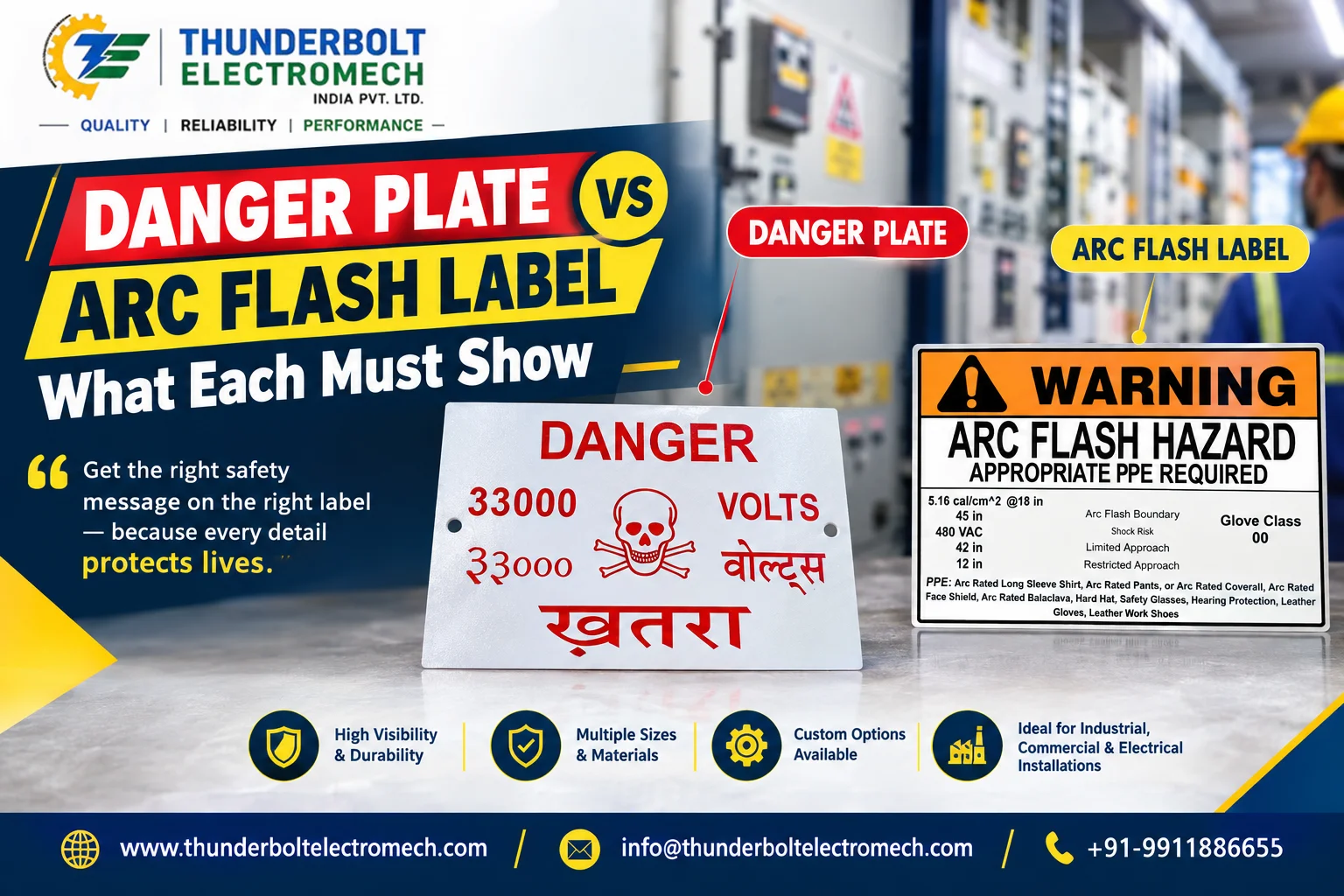
Quick Answer: A danger plate warns of shock. It fixes the voltage and the lightning symbol under IS 2551, and it stays valid until the voltage changes. An arc flash label adds study data: nominal voltage, the arc flash boundary, and one PPE method, either incident energy with working distance or a PPE category. NFPA 70E 130.5(H) sets that content. Most sites need both. Searching for a danger plate supplier India wide? Confirm the voltage legend first and then ask your safety officer who owns the arc flash study.
Why Teams Treat a Danger Plate as an Arc Flash Label
Walk into a substation near Delhi and you will find a red and white danger plate on almost every panel door. It went up at commissioning. Nobody questions it. So when a multinational parent company sends an audit checklist asking for “arc flash labels on all energised equipment,” the plant team points at the plate and calls the item closed.
The item is not closed. The two markers answer different questions.
A danger plate answers: is this live, and at what voltage? An arc flash label answers: if this equipment fails while I work on it, how far back must I stand, and what must I wear? The first answer comes from a rule and rarely changes. The second comes from a calculation, and it changes whenever your protection settings, fault level or network configuration change.
That gap drives everything in this guide. When you buy signs from a danger plate dealer Delhi NCR plants can reach easily, such as Thunderbolt Electromech at Chawri Bazar, you get a plate that does its job for decades. It will not tell an electrician which arc-rated clothing to put on. It was never meant to.
We wrote this page for electrical safety managers and for the engineers who inherit audit findings from a head office abroad. Each section answers one question you are likely to face:
- What does a danger plate fix, and under which standard?
- What must an arc flash label show under NFPA 70E, and why only one PPE method?
- Where does the 1.2 cal/cm² boundary come from, and why does 33 kV sit outside the usual study method?
- Which of your enclosures need both markers?
A note on sourcing. NFPA 70E is a US standard. We found no Indian rule that prescribes arc flash label content, so we treat the label as best practice and as a client requirement. Confirm the position with your site safety officer or your electrical inspector. Where a statement is our own engineering reading and not a quoted standard, we say so.
What a Danger Plate Must Show: A Danger Plate Supplier’s Reading of IS 2551
IS 2551 is titled Danger Notice Plates. The Bureau of Indian Standards preview states its scope: plates displayed to meet the old Rule 35 of the Indian Electricity Rules, 1956. Those Rules have since given way to the Central Electricity Authority’s safety regulations, which carry the same duty in newer wording. Inspectors and buyers still point to IS 2551 when they judge the plate itself. Check clause numbers with your inspector, because they have moved between regulation editions.
The plate fixes three things: the word DANGER, the voltage legend, and the lightning flash symbol. Our reading of the standard for buyers is simple. The plate exists to stop an unauthorised person from touching or approaching a live conductor. It tells that person one fact (this equipment carries a voltage of this class) and gives one instruction (keep away).
Notice what that design leaves out. The plate carries no distance, no energy figure and no clothing instruction. It could not. A danger plate depends on a single variable, the system voltage. That variable changes only when someone rebuilds the supply, so the plate does not go stale. An 11 kV plate hung in 2009 still tells the truth today if the busbar still runs at 11 kV.
This stability explains why a danger plate supplier should sell durability before information. Three choices matter:
- Material and finish. Powder-coated mild steel suits panel rooms and covered yards. Aluminium resists corrosion near coastal air and chemical plants. A sticker suits a clean indoor panel door and nothing harsher.
- Size against first sighting distance. A 200 x 250 mm plate carries larger lettering than a 150 x 75 mm plate. Pick the size by the distance from which a person first sees the door, not by what looks neat on the drawing.
- Voltage legend accuracy. A wrong legend is worse than a missing plate. Read the legend against the single line diagram before you order a batch.
We cover the buying side, including finishes and sizes, in our pillar guide: Danger Plate Supplier in India: Complete Buying and Safety Standards Guide. Read your own copy of IS 2551 for the exact dimensions and finish requirements, because a blog post cannot replace the clause text.
What an Arc Flash Label Must Show Under NFPA 70E 130.5(H)
NFPA 70E 130.5(H) governs equipment labelling for gear that workers may service while energised. The required content has stayed stable since the 2015 edition. Every label carries:
- The nominal system voltage.
- The arc flash boundary.
- At least one PPE statement, drawn from this menu: available incident energy with the corresponding working distance, or the arc flash PPE category from the standard’s tables, or the minimum arc rating of clothing, or a site-specific PPE level.
The rule that surprises most readers is the “never both.” A label may show incident energy with working distance, or a PPE category. It must not show both for the same equipment.
Why ban the pair? Because the two methods answer different questions, and mixing them invites a wrong pick. The category method is a table lookup. It applies only while the equipment stays inside the table’s limits for fault current and clearing time. Category 2 starts at an 8 cal/cm² arc rating and Category 3 starts at 25 cal/cm². Two Category 2 tasks on different equipment can carry very different real energies anywhere between those two values. The incident energy method skips the lookup and gives the calculated number for that exact equipment. When a label prints both, a worker may read the friendly category number and ignore the harder one.
The four category minimums are 4, 8, 25 and 40 cal/cm² for Categories 1 to 4.
Other points worth knowing:
- Format. ANSI Z535.4 guides the layout: signal word, colour, text size and symbols. Supplier guidance commonly reserves the DANGER header for systems above 600 V or incident energy above 40 cal/cm², and uses WARNING below those levels. Treat that as practice, not a clause.
- Supervised industrial exception. 130.5(H) allows other documentation where only qualified persons monitor and service the system. Read the exception text before you lean on it.
- Review cycle. NFPA 70E expects the incident energy analysis to be reviewed at intervals not exceeding five years, and to be updated when changes to the distribution system could alter the result.
- Date and reference. The standard’s minimum list omits them. Add the study date and a study reference anyway. A label without a date cannot prove its own age.
- Installation rule. The US National Electrical Code carries its own marking rule in 110.16. Trade summaries report that the 2026 edition revised it and added an assessment date. That is a US installation rule, so treat it as context for multinational clients and not as Indian law.
The label is a data sheet frozen at the study date. Everything on it comes from the study, and everything the study assumed can move.
Arc Flash Label India: Where the 1.2 cal/cm² Boundary and the Numbers Come From
The boundary on an arc flash label is a distance, and it has a physical meaning. It marks the point where incident energy drops to 1.2 cal/cm², the level linked to the onset of a second-degree burn on bare skin. Step inside that line with the equipment energised and you need arc-rated protection. Stay outside and a bare-skin burn is not expected.
The engineering behind that line sits in IEEE 1584, the guide NFPA 70E points to for the calculation. The 2018 edition rewrote the method after close to 2,000 additional tests. Four changes matter for anyone reading a label:
- Five electrode arrangements. The model separates vertical and horizontal conductors, in open air and inside boxes: VCB, VCBB, HCB, VOA and HOA. Horizontal conductors in a box (HCB) aim the plasma out of the enclosure and give the highest energy for the same inputs.
- Enclosure size correction. The calculation now adjusts for height, width and depth, including shallow boxes. The same fault current gives different numbers in a compact LV panel and a large switchgear cubicle.
- Arcing current variation. The method calculates a lower arcing current and checks whether slower protection makes the result worse.
- Voltage window. The model covers 208 V to 15 kV. The medium voltage range runs from 601 V to 15 kV, with bolted fault current from 200 A to 65 kA.
That last point has a direct Indian consequence, and it is our own engineering reading. A 415 V motor control centre and an 11 kV breaker panel both sit inside the model. A 33 kV yard or switchgear room does not. Anyone who prints a 33 kV arc flash label from the standard IEEE 1584-2018 equations has stepped outside the model’s stated voltage range. Ask your study engineer which method covered the 33 kV equipment, and ask that the method name appear in the study report that the label cites. A conservative theoretical method is common above 15 kV, and the label should not hide that choice.
Five inputs drive the answer: bolted fault current, working distance, arc duration, electrode gap and enclosure size. Arc duration deserves more attention than it gets. In the model, incident energy rises in direct proportion to arcing time. Fault current stays the same, so a feeder relay that clears in 0.1 seconds delivers about one fifth of the energy of the same relay set to clear in 0.5 seconds. This is why a protection setting change can rewrite a label without a single cable moving.
Two habits keep label data honest. First, record the working distance on the label, because the energy figure applies to that distance only. A person who leans closer takes more heat than the label states. Second, tie every label to a study reference and a date. The study engineer should run it on software updated for IEEE 1584-2018, since results from the 2002 method can differ in either direction.
Danger Plate vs Arc Flash Label: Side-by-Side Comparison
Use this table when you brief a purchase team or answer an audit query. Rows follow the questions an auditor asks first.
| Point of comparison | Danger plate | Arc flash label |
| Question it answers | Is this live, and at what voltage? | How far back do I stand, and what do I wear? |
| Hazard communicated | Shock from contact or close approach | Thermal burn and blast from an arcing fault |
| Governing document | IS 2551 for the plate, tied to the CEA safety regulations | NFPA 70E 130.5(H), with IEEE 1584 for the numbers |
| Fixed content | DANGER, voltage legend, lightning flash symbol | Nominal voltage, arc flash boundary, one PPE method |
| Source of the content | A rule and the system voltage | An engineering study of that equipment |
| Prepared by | Safety team or supplier, from the single line diagram | Study engineer, from protection and fault data |
| Changes when | The voltage class changes | Fault level, protection settings or network layout change |
| Review rhythm | Inspect for damage and fading | Study review at intervals not exceeding five years |
| Format guide | IS 2551 layout | ANSI Z535.4 guides the layout |
| Typical build | Powder-coated steel, aluminium or sticker | Printed durable label, often vinyl or polyester |
| Standing in India | Expected by the safety regulations | No Indian rule found that prescribes content; best practice and client requirement |
| Typical owner of the request | Plant electrical department | Multinational parent, insurer or EHS audit |
| Thunderbolt supplies | Yes, in three formats | No, the study engineer or a label printer supplies it |
One column is not better than the other. They work as a pair. The plate stops the wrong person from coming near. The label tells the right person how to work safely once the work is authorised.
Customer Problems and Solutions
These six problems come up again and again when a plant team meets an arc flash audit for the first time. Each fix is short, and each one costs less than a failed audit.
Problem 1: “The auditor wants arc flash labels. We already have danger plates.”
The plate covers shock and nothing else. Keep it, because the safety regulations still expect it. Then commission the arc flash study and print labels from its results. Do not send the auditor a photo of the plate and hope.
Problem 2: “Our label shows incident energy and a PPE category.”
NFPA 70E allows one method per label. Choose the incident energy method for equipment that falls outside the category table limits, and the category method only where the table limits apply. Remove the other figure at the next relabelling round.
Problem 3: “We upgraded the supply from 6.6 kV to 11 kV, but the plates still say 6,600 volts.”
This is the plate failure that matters most. A plate with the old voltage misleads every person who reads it. Treat any voltage change as a plate replacement trigger and match each legend to the revised single line diagram before you order.
Problem 4: “We changed relay settings last year. Do the labels still hold?”
Probably not. Arc duration drives incident energy, so a slower setting raises the number and a faster one lowers it. Keep a change register. Any protection setting change, transformer swap or new source triggers a study review.
Problem 5: “The panel door has room for one marker.”
Put the danger plate or a small sticker where an unauthorised person first meets the equipment, and put the arc flash label at the point of work, where the qualified person opens the door. A 75 x 150 mm sticker fits most LV panel frames. Larger plates belong on room doors, fences and transformer bays.
Problem 6: “The vendor printed a 33 kV label from a standard LV and MV tool.”
Ask which method covered the voltage. IEEE 1584-2018 stops at 15 kV. A conservative method may be fine, but the study report should name it, and the label should cite that report.
Send plate questions to your supplier. Send label questions to the study engineer, because the numbers belong to the study and not to a sign shop.
Case Study: One Plant, Two Markers, a Worked Example
Read this first. Thunderbolt Electromech has not published a named client record for this topic. The case below is a worked scenario built from typical plant data. Its round numbers show the method. Replace them with the figures from your own study.
The plant. A forging unit near the NCR runs an 11 kV incomer, a 1,600 kVA 11/0.415 kV transformer with 6.25% impedance, and a main LV board feeding 13 motor control panels. Its parent company, based in Europe, adds “arc flash labels on all energised equipment” to the annual audit.
Step 1: check the plates. The team walked every door. The 11 kV panels carried plates with the right legend. Two LV panels had none, and one transformer fence plate still showed the old 6,600 volt legend from a past upgrade. The plant replaced those three plates first, because they were quick and cost little.
Step 2: size the fault. The transformer’s full-load current at 415 V is about 2,226 A. Dividing by the 6.25% impedance gives an LV bus fault level near 35.6 kA, assuming a strong upstream source. That figure sits well inside the LV window of the IEEE 1584-2018 model, so a standard study could cover the LV board.
Step 3: find the 11 kV gap. The 11 kV breaker panel sits inside the 15 kV limit as well. But the plant’s 33 kV supply yard, owned jointly with the utility, does not. The study engineer named a separate method for that yard and recorded it in the report.
Step 4: see what duration does. The study found that the LV main’s protection took 0.5 seconds to clear a bus fault. Incident energy scales with arcing time, so a faster setting during maintenance could cut the value to roughly one fifth. The engineer reran the model with a maintenance switch setting, and the label for that board now carries the lower figure only while the switch is on. The plant wrote a procedure for it.
Step 5: label and lock the change process. Each panel received a label with nominal voltage, boundary, one PPE method (incident energy with working distance), the study date and a report number. The electrical department opened a change register. A relay setting edit, a transformer swap or a new source now reopens the study.
What the plant learned. The plates cost a small fraction of the study, yet they caught the one error that could mislead a visitor: the stale 6,600 volt legend. The labels cost more, and they answered the audit. Neither marker could have done the other’s job. Treat these figures as an illustration of sequence, and run your own numbers.
Latest Trends in Arc Flash Labelling and Danger Signage
Four shifts shape what auditors ask for in 2026. We list what we confirmed in published sources, and we mark the rest as our own view.
1. Labels now carry more than a warning.
Trade summaries of the 2026 National Electrical Code report a revised Article 110.16. It treats the label as an information tool, with specific data and a visible assessment date, and it points to durability rules in 110.21(B). The code is a US installation rule. Multinational clients often copy its intent into their own audit lists, so Indian plants meet the demand second-hand.
2. NFPA 70E has a 2027 edition.
The new edition is out, and trade magazines began running chapter-by-chapter coverage of Article 130 in mid-2026. We did not find a change to the 130.5(H) label content in the material we read. Read the 2027 text yourself before you tell a client that the content list changed or stayed put.
3. IEEE 1584-2018 is now the working method.
Studies run on the 2002 method produce outdated figures, and the newer model changes results in both directions. The practical effect is that old labels drift away from truth. A plant with a study older than five years, or one that predates the 2018 method, should plan a refresh.
4. Arc energy reduction moves up the list.
The hierarchy of controls puts engineering fixes ahead of clothing. Faster clearing, maintenance mode switches and better relay coordination cut incident energy at the source, and the label then shows a lower number. Our view: this trend will push more Indian plants to ask for labels that carry two states, normal and maintenance, each tied to a documented switch position.
A fifth idea sits at the edge of the evidence, so read it as opinion. Some sites print a QR code on the label that links to the live study record. That keeps the printed figure and the study from drifting apart. NFPA 70E does not require it, and a code cannot replace the required printed content.
What should an Indian plant do this quarter? Audit plates against the single line diagram, list the equipment that needs labels, and book the study. Then build the change register. In that order, the cheapest fix comes first and the longest lead item starts early.
How to Choose a Danger Plate Supplier in India: Products and Sizes
A danger plate supplier India wide can print the word DANGER on steel. The test of a good one is accuracy and fit for the place. Before you order, run through this short checklist:
- Send the voltage legend in writing and ask for a proof before print.
- Match the finish to the place: indoor panel, open yard, coastal site or chemical zone.
- Choose the size by first sighting distance, and count the plates by door, fence and bay.
- Ask for a single batch for each substation, so the colour and lettering match.
- Ask the supplier to say plainly what it does not make. A sign shop should not sell you an arc flash label that needs a study behind it.
Thunderbolt Electromech supplies danger plates in three formats:
| Format | Sizes | Where it fits best |
| Powder Coated Danger Plate | 200 x 150 mm and 200 x 250 mm | Panel rooms, substation doors, covered yards |
| Aluminium Danger Plate | 150 x 75 mm, 200 x 150 mm and 200 x 250 mm | Coastal air, humid plants, outdoor poles and fences |
| Danger Sticker | 75 x 150 mm, 150 x 200 mm and 200 x 250 mm | Clean indoor panel doors and enclosures |
Electrical Safety Sign Board: Match the Format to the Place
Pick the format after you pick the place. The 200 x 250 mm size reads best on a room door or a fence, where people first see it from several metres away. The 200 x 150 mm size suits switchgear doors. The 75 x 150 mm sticker and the 150 x 75 mm plate suit narrow panel frames, where a larger plate would cover a nameplate or a handle.
For wider reading on finishes, voltage legends and how to compare quotes, see the pillar guide to buying danger plates in India. For related topics such as sign fatigue, liability for a missing plate and finish choice, browse our danger plate blog category.
When the same panel needs an arc flash label, order the plate from us and the label from the engineer who ran the study. The two items meet on the panel door and not before.
Frequently Asked Questions
Does a danger plate satisfy an arc flash label requirement?
No. A plate fixes the voltage and the shock warning. A label carries the arc flash boundary and a PPE method from a study.
Can one label show incident energy and a PPE category?
No. NFPA 70E expects one approach on the label for the same equipment.
What is the arc flash boundary?
It is the distance from the arc source at which incident energy equals 1.2 cal/cm², the level linked to a second-degree burn.
How often should the study be reviewed?
NFPA 70E sets intervals not exceeding five years, and sooner when the system changes in a way that could alter the result.
Is an arc flash label mandatory in India?
We found no Indian rule that prescribes arc flash label content. Treat it as best practice and as a client requirement, and confirm with your safety officer or electrical inspector.
Does an arc flash study change the voltage legend on a danger plate?
No, the plate legend follows the system voltage. The study changes the label, not the plate.
Which standard guides the layout of an arc flash label?
ANSI Z535.4 guides the format, including signal word, colour and text size. NFPA 70E 130.5(H) sets the content.
Does IEEE 1584-2018 cover 33 kV equipment?
No, the model covers 208 V to 15 kV. Ask your study engineer which method covered 33 kV and have the report name it.
Which danger plate size suits a panel door and which suits a fence?
A 75 x 150 mm sticker or a 150 x 75 mm plate fits narrow panel frames. A 200 x 250 mm plate reads better on room doors and fences.
Who supplies the data for an arc flash label?
The study engineer supplies it, from fault levels and protection settings. Thunderbolt Electromech supplies the danger plates and stickers.
Danger Plate Supplier Delhi: Trust and Contact Details
Thunderbolt Electromech India Pvt. Ltd. is a Delhi-based supplier of electrical safety equipment. We supply danger plates and danger stickers, the markers that carry the IS 2551 shock warning. We do not prepare arc flash studies and we do not print study-based labels. A study engineer owns those numbers.
For an electrical safety sign Delhi plants can order from, or for a danger plate supplier Delhi project teams can call before a shutdown, reach us here:
- Company: Thunderbolt Electromech India Pvt. Ltd.
- Registered office: Shop No. 3538, Sitaram Bazar Rd, Bazar Sirkiwalan, Chawri Bazar, Chandni Chowk, Delhi, 110006
- Phone: +91-9911886655
- Email: info@thunderboltelectromech.com
Send your voltage legends and the size list with your enquiry. We will confirm the format, finish and quantity for each location against your single line diagram.
Conclusion: Buy the Danger Plate, Commission the Study
A danger plate and an arc flash label do different jobs. The plate says the equipment is live and names the voltage under IS 2551. The label states the boundary and one PPE method, from a study built on IEEE 1584 and presented per NFPA 70E 130.5(H). Neither marker replaces the other, and many sites need both.
Start with what is cheap and quick: check every plate against the single line diagram and replace the wrong ones. Then book the study, keep a change register, and review the labels whenever protection settings or sources change. India has no rule we could find that prescribes label content, so confirm your obligations with your safety officer and your client.
A reliable danger plate supplier will sell you the plate and tell you plainly where its job ends. Thunderbolt Electromech supplies powder-coated plates, aluminium plates and stickers from Chawri Bazar, Delhi. Call +91-9911886655 or write to info@thunderboltelectromech.com, and read the pillar guide before you place a large order.