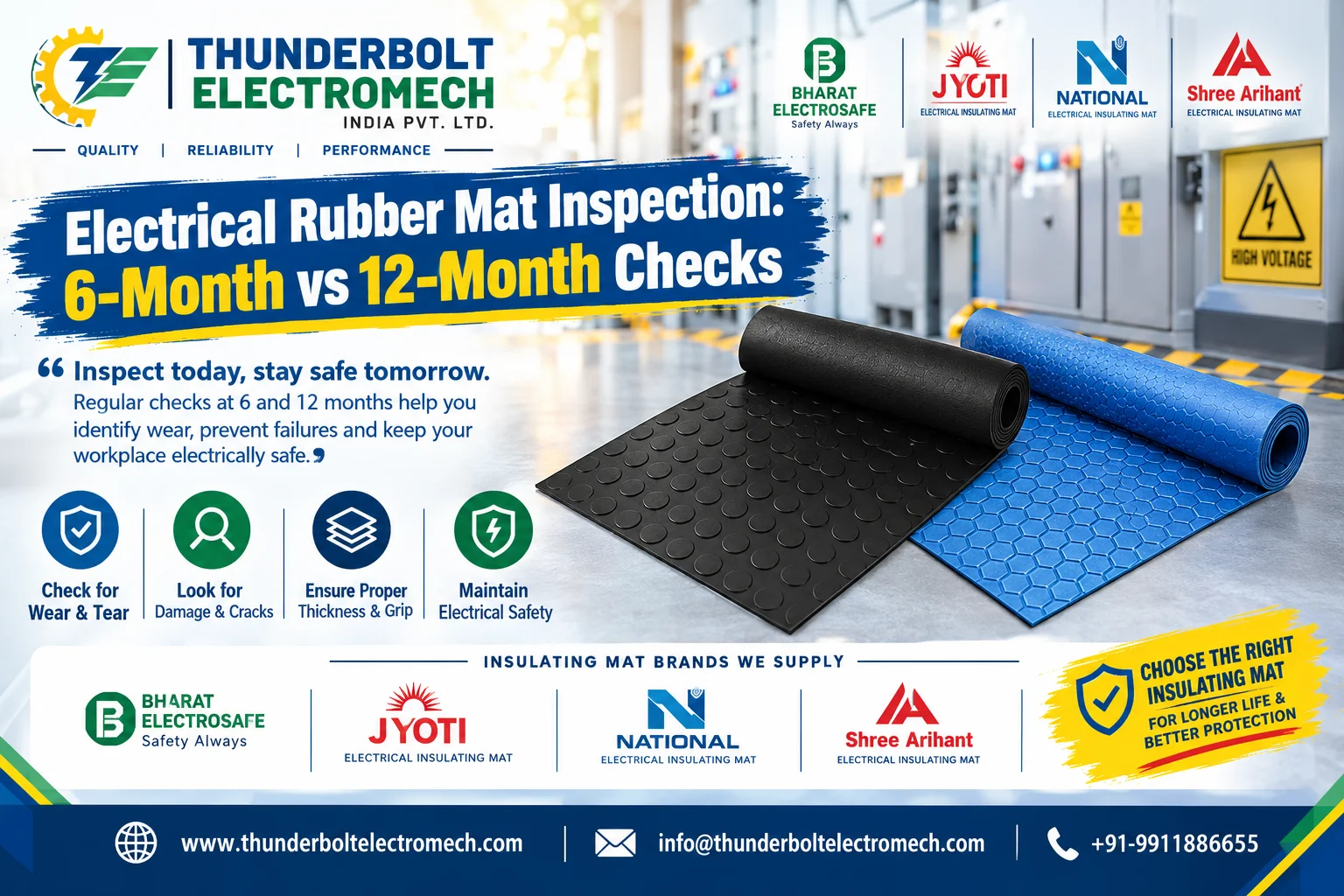
Quick Answer: Look at the mat before every use. Run a documented inspection every 6 months, as some makers advise. Retest it electrically at least every 12 months, or at the interval your standard or client sets. Class 0 mats need only visual checks under most maker sheets. Pull any mat with cuts, swelling, hardening, oil contamination or surface cracks. Looking for an Electrical Rubber Mat Supplier India wide? Thunderbolt Electromech supplies Bharat, Jyoti, National, Vardhman and Shree Arihant mats, and this insulating mat inspection routine applies to all of them.
Why Teams Miss the Due Date on an Insulating Mat
A mat lies on the floor. It does not hum, trip or alarm. That is exactly why plants forget it.
Ask a maintenance team in Delhi NCR when the last mat was checked, and you often get a pause. Gloves carry tags and dates. The mat carries a roll mark on the back and a memory that it looked fine last year. Any electrical rubber mat dealer Delhi NCR buyers visit hears the same story. A mat outlives three shift supervisors, and nobody owns it.
The title asks a sharp question, and the answer is not “pick one.” Six months and twelve months measure different things. A six-month check is an inspection. You do it by eye and by hand. A twelve-month check is a retest. You do it with a high-voltage tester. The first finds damage. The second finds weakness that you cannot see.
This guide sets out a two-level routine. It compares what makers print in their manuals, what IEC 61111 and IS 15652 say, and what works on an Indian plant floor. We tag the source of each point where it matters: maker (a product manual or data sheet), standard (a published standard or a document quoting it) and our reading (engineering judgment, not a quoted rule).
Two cautions before we start. First, we found no public Indian rule that fixes one retest interval for every mat, so confirm the interval with your safety officer, your client or your electrical inspector. Second, a blog cannot replace the manual that came with your mat. Where the two disagree, follow the manual and the standard.
Electrical Rubber Mat Supplier India: What Makers and Standards Say About Inspection Intervals
Most buyers hear two numbers and assume they conflict. Six months. Twelve months. They do not conflict. They sit side by side in the same documents.
Maker guidance on 6 months. One BS EN 61111 matting manual states that mats must be inspected every 6 months. The same manual then says mats must be tested every 12 months to comply with BS EN 61111:2009. That test is a visual inspection plus a proof dielectric test. Class 0 gets the visual inspection alone. The manual also bans use of any mat, even one kept in storage, unless it was inspected or tested in the previous 12 months. Maker.
Maker guidance on 12 months. The Notrax switchboard matting range carries a replacement note on its product pages: replace every 12 months for optimum safety, worded as highly recommended on some listings. Read the material before you copy the rule. Those products are PVC compound tested to ASTM D-178. A replacement rule for a PVC mat and a retest rule for an elastomer mat are different tools. Maker.
The installation sheet warning. An insulating mat installation manual and several data sheets from European makers carry one line that matters most: do not use a mat that has not been electrically tested within the previous twelve months. Class 0 is the exception, and only a visual inspection applies to it. Maker sheets quoting the standard.
What the standards add. IEC 61111 and BS EN 61111 are the same standard in two national dress codes. The type tests behind a compliant mat cover puncture, flame retardance, dielectric strength, acid resistance, ageing and oil resistance. Annex B of IEC 61111 holds the rules for use and maintenance, which makers repeat on the marking strip. Standard.
IS 15652:2006 is the Indian standard for insulating mats. It replaced IS 5424:1969 and follows IEC 61111 closely. It defines four classes, and published summaries list Class A at 2.0 mm for up to 3.3 kV, Class B at 2.5 mm for 11 kV, Class C at 3.0 mm for 33 kV and Class D at 3.5 mm for 66 kV. Check Table 1 in your copy for the exact figures. In the parts we could read, we did not find an in-service retest interval. That is why the interval usually comes from your client, your insurer or your own safety procedure. Our pillar guide uses a 12-month retest: Electrical Rubber Mat Supplier: The Complete Guide to IS 15652 Classes, Thickness and Buying in India 2026. Standard, with a gap.
A useful parallel. Rubber insulating gloves follow a 6-month test cycle in common US practice, while blankets and sleeves follow 12 months. Mats sit outside that table. Our reading: borrow the logic, not the number. Items that people handle and bend wear faster and earn a shorter cycle. Items that lie flat last longer between tests, yet they still need a regular look.
Put together, the sources give you a clean picture. Inspect often. Retest at 12 months at most. Replace when the mat fails either one.
The Two-Level Routine: Visual Inspection and Electrical Retest
Treat the mat like a fuse with two tests. One test is quick and frequent. The other is slow and exact.
Level 1: inspection. The user checks the mat before every use. That takes thirty seconds. Every six months, a competent person runs a documented inspection with a checklist, a bend test and a record. This level finds what the eye and hand can find: cuts, swelling, hard patches, oil, cracks and edge damage.
Level 2: retest. At least every twelve months, a competent lab or the maker applies the proof voltage for the mat’s class. The test finds what the eye cannot find: a pinhole, a thin spot, a buried metal chip, or slow ageing of the compound.
Why do you need both? Our reading is that each level has a blind spot. A mat can look perfect and fail the proof test. A mat can pass the proof test and still carry a deep gash that will tear on the next trolley move. A test is a snapshot. It says nothing about the next ten months. An inspection fills that gap.
The margin that explains why Class 0 is special
Published figures from maker sheets show how much headroom each class keeps between working voltage and proof voltage:
- Class 0: 1 kV working, 5 kV proof. That gives five times the headroom.
- Class 1: 7.5 kV working, 10 kV proof. About 1.3 times.
- Class 2: 17 kV working, 20 kV proof. About 1.2 times.
- Class 4: 36 kV working, 40 kV proof. About 1.1 times.
We worked out those ratios ourselves from maker figures, so treat them as an engineering illustration and not a code rule. The pattern is useful. A low-voltage Class 0 mat has so much margin that slow ageing rarely brings it near failure, which fits the maker rule of visual checks only. A Class 2 or Class 4 mat has little margin. A modest loss of thickness or a small contamination path can eat it. For those classes, the electrical retest earns its cost.
Pick dates that fit Indian weather
Our reading again. Set the two six-month inspections before and after the monsoon, roughly April to May and October to November. Pre-monsoon, you catch heat damage, hardening and dust. Post-monsoon, you catch moisture marks, mould and floor-level damage from damp. Tie the annual retest to your planned shutdown, when the panel room is quiet and a test lab can work.
Out-of-cycle triggers
Do not wait for the calendar after any of these events:
- An electric shock or flashover near the mat. One maker guide says to replace the mat at once after a shock.
- An oil, acid or solvent spill.
- A cut, a repair or a relocation.
- A trolley or tool that dragged across the surface.
Record it on the mat
Tag every mat with the test date and the next due date. The marking strip on many mats already shows class, working voltage and the manufacture month and year, repeated at each metre. When you cut a roll to length, keep that marking visible. It gives you the age of the mat without a file search.
Reject Criteria: When an Insulating Mat Inspection Ends in Replacement
Some faults allow a repair or a clean. Others end the mat’s service. Use this table at your six-month inspection.
| Defect | How to find it | Why it matters | Action |
| Cut, tear or puncture | Run a gloved hand over the surface and flex the mat | A cut shortens the insulating path, and the edge of a cut grows under foot traffic | Remove from service |
| Swelling or blistering | Look for raised patches and soft spots | Often points to chemical or oil contamination | Remove from service |
| Hardening | Bend a corner gently and press with a thumb | The compound has lost flexibility from heat or age | Remove from service |
| Oil contamination | Look for a glossy film, dark stains or a tacky feel | Oil softens elastomer and holds conductive dust | Remove if the rubber has changed; clean only if it has not |
| Surface cracks | Flex the mat at folds and near edges | Cracks collect moisture and dirt, and they spread | Remove from service |
| Thickness loss | Measure with a caliper at worn spots | Less rubber means less margin to the proof voltage | Remove if below the maker’s tolerance |
| Tracking marks | Look for dark, branching lines | These point to a discharge path on the surface | Remove from service |
Two notes on the table. First, the thickness row follows our reading of the standard. IS 15652 lists a tolerance of plus or minus 10 percent on thickness, so a 2.5 mm Class B mat has a band of roughly 2.25 to 2.75 mm. A worn patch well under the lower figure has left the band the mat was made to. Second, you may clean a dirty mat with mild soap and water and dry it fully. Makers say to avoid petrol, paraffin and white spirit, because solvents attack the compound.
Electrical Mat Retest Failures: What a Fail Tells You
When a mat fails the proof test, ask where it failed. A puncture at one point often traces to a cut or a pinhole. A failure spread across the surface points to ageing, moisture in the compound or a conductive filler problem. Both outcomes lead to the same action: scrap the mat. The cause still matters, because it tells you which part of your routine missed the warning.
A mat that passes the retest is not a mat that you may ignore. Pass or fail, the next inspection falls six months later. Store spare mats rolled, not folded, in a cool, dry place away from direct sunlight. Maker sheets give a storage range of roughly 10 to 21 degrees Celsius.
Electrical Rubber Mat Supplier India Comparison: 6-Month vs 12-Month Checks
This table sets the three common approaches side by side. Brief it to a purchase team or paste it into your safety procedure.
| Point of comparison | 6-month inspection | 12-month electrical retest | 12-month scheduled replacement |
| Source of the number | Maker manual advice | IEC 61111 and BS EN 61111 practice, maker sheets | Notrax-style product notes for PVC matting |
| What it is | Documented visual and hands-on check | Proof voltage test for the mat’s class | Swap the mat for a new one |
| Who does it | Trained maintenance person | Competent HV lab or the maker | Store and maintenance team |
| Equipment needed | Checklist, caliper, torch | High-voltage tester, test record | None beyond a purchase order |
| Finds | Cuts, swelling, hardening, oil, cracks, wear | Pinholes, thin spots, conductive contamination, ageing | Everything, by removal |
| Misses | Faults you cannot see | Damage that arrives after the test | Early failure inside the year |
| Class 0 | Yes, this is the main check | Visual check only, per most maker sheets | Optional |
| Class 1 and above | Yes, as the middle check | Yes, required by most maker sheets | Optional, and costly for high classes |
| Record to keep | Date, checker, findings, photo | Test certificate, date, next due date | Purchase date, disposal note |
| Typical cost and time | Low, minutes per mat | Higher, needs lab time and transport | Highest at scale |
| Best fit | Every plant, as a base routine | Mats in Class 1 to Class 4 service | Sites that cannot arrange retests |
Read the columns as layers, not rivals. The inspection runs most often and costs least. The retest gives the electrical proof. Scheduled replacement works as a fallback for sites that cannot arrange a lab test, and it fits PVC products whose maker sets that rule.
You can see more mat types, classes and thicknesses in our electrical rubber mat category. Match the class to the highest nominal voltage on your network before you worry about intervals. A mat of the wrong class fails the job on day one, whatever your schedule says.
Real Use Cases: Where the Interval Changes on the Floor
These are typical site types, not named clients. Each one shows how the same two-level routine bends to the place.
1. The 11 kV switchgear room with withdrawable breakers.
The breaker truck rolls over the mat edge every time someone racks a breaker in or out. Wheels crush and tear that edge first. Inspect along the racking path and at the mat’s leading edge at every six-month check. Retest yearly. This is where a Class B mat under IS 15652 (rated to 11 kV) earns its keep, and where a cut edge shows up before anything else does.
2. The DG set room or transformer bay with oil mist.
Oil is the quiet enemy of elastomer. It swells the compound, softens it and holds dust. Our reading: shorten the inspection to every three months here, and reject at the first sign of swelling or a tacky surface. A retest will not rescue a mat that oil has already changed.
3. The 415 V motor control centre beside a machine shop.
A low-class mat in front of an MCC has plenty of headroom, so a visual routine suits it. The risk here is not the voltage. It is metal swarf and grinding dust. Chips can press into the surface and bridge the thickness. Brush and inspect the surface every month and look for bright, embedded specks.
4. The 33 kV yard control building entrance.
Sun, dust and heat work on a mat that sits near an open door. Hardening and surface cracks come early. Schedule the six-month inspection before the monsoon, and flex the corners. A mat that cracks when you bend it a little has finished its life. Class C mats, listed at 3.0 mm for 33 kV in published IS 15652 summaries, need a retest at the twelve-month mark.
5. The relay and test room with light traffic.
These mats stay clean, and that fools people. A spare mat in a cupboard still ages. Read the manufacture date on the marking strip, and treat the twelve-month rule as applying to stored mats too. One maker manual says not to use even a stored mat that has missed its inspection or test window.
The pattern across all five: the place sets the inspection rhythm, and the class sets the need for a retest.
Customer Problems and Solutions
These are the questions maintenance and safety managers ask when they build a mat routine for the first time.
Problem 1: “We have no record of when this mat was installed or tested.”
Treat it as untested. Read the marking strip for the manufacture month and year, inspect it today, and book a retest or buy a replacement. Tag it with the new date.
Problem 2: “The maker says 6 months and the vendor says 12. Which is right?”
Both. One is an inspection and the other is an electrical retest. Do both, on separate calendars.
Problem 3: “The mat passed its retest, but I see a cut.”
Remove it. A pass tells you the mat held the proof voltage on test day. It does not tell you the cut will stay small under foot traffic.
Problem 4: “Our parent company wants IEC 61111 retest certificates, but our mats follow IS 15652.”
IS 15652 follows IEC 61111 closely, but the two are separate documents. Ask the client which standard governs the audit, and ask the mat maker to confirm in writing how your mat’s class maps across. Do not assume a match.
Problem 5: “We cannot pull the mat for a lab test without leaving the panel unprotected.”
Keep a spare set. Rotate the mats so that one set is on the floor while the other is at the lab. This also gives you a ready replacement when a mat fails.
Problem 6: “Someone cleaned the mat with petrol.”
Treat it as suspect. Solvents attack the compound. Inspect for swelling, softness and tackiness, and replace it if the surface has changed. Clean mats with mild soap and water from now on, and dry them fully.
Problem 7: “A mat failed. We need a replacement fast.”
Order the same class, thickness and width as the failed mat, or higher if the network voltage has risen. A mat replacement Delhi plants can collect or receive by courier saves downtime. Thunderbolt Electromech supplies electrical rubber mats from Chawri Bazar, and our team will help you match the class to your single line diagram. Send us the old mat’s marking details with your enquiry.
Electrical Rubber Mat Supplier India: Bharat, Jyoti, National, Vardhman and Shree Arihant Mats
Thunderbolt Electromech sells a complete range of electrical rubber mats. Our brands include:
- Bharat electrical rubber mat
- Jyoti electrical rubber mat
- National electrical rubber mat
- Vardhman electrical rubber mat
- Shree Arihant electrical rubber mat
The inspection routine in this guide does not change with the brand. The paperwork does. Each maker writes its own care sheet, and as the sources above show, those sheets differ on wording and on intervals. Follow three habits when you stock more than one brand.
- Keep one register for all brands. List the maker, class, thickness, width, manufacture month and year, location, last inspection date and last retest date. One sheet beats five.
- Ask each maker for its maintenance sheet and test report. Store both with the register. When an auditor asks for the basis of your interval, you can point to a document, not to a habit.
- Replace like with like. When a mat fails, order the same class and thickness. Go up a class only if the network voltage has risen. Never go down.
If you plan to buy electrical rubber mat stock for a new 11 kV or 33 kV panel room, send us your voltage, room size and the number of work positions. We will suggest the class and thickness, quote the brands we hold and note the retest dates to tag on delivery. For a deeper look at classes and thickness under IS 15652, read the pillar guide: Electrical Rubber Mat Supplier: The Complete Guide to IS 15652 Classes, Thickness and Buying in India 2026. To compare more mats and related guides, browse the electrical rubber mat category.
Send mats to a competent high-voltage test lab for the retest step. Thunderbolt Electromech helps you choose, supply and replace the mat.
How to Choose an Electrical Rubber Mat Supplier India Buyers Can Audit
A mat supplier is part of your inspection routine. The supplier decides what you can verify later. Use this checklist before you place an order.
- Class and standard on the paperwork. Ask which standard the mat meets, IS 15652 or IEC 61111, and which class. Write the answer into your purchase order.
- Marking on the mat. Look for class, working voltage and manufacture month and year printed along the length. A mat with no marking leaves you blind at the first inspection.
- A maker care sheet. Ask for the maintenance sheet. It tells you the interval the maker stands behind and the cleaning method it allows.
- A test certificate for the batch. Keep it with the register. It gives you the starting point for your retest history.
- Honest lead times for replacement. A failed mat leaves a panel unprotected. Ask how fast the supplier can send the same class again.
- Roll or cut-to-size. When you buy rolls, keep the marking visible after you cut. A mat cut so that the strip disappears loses its record.
Insulating mat inspection starts before delivery
Inspect a new mat on the day it arrives. Unroll it, flex it, read the marking and compare the class with your purchase order. That first check is cheap, and it catches transport damage and wrong supply early.
Local help for Delhi NCR plants
If you manage a plant, a warehouse or a contractor crew in Delhi NCR, a nearby supplier shortens the gap between a failed inspection and a safe floor. Thunderbolt Electromech works from Chawri Bazar as an electrical rubber mat supplier Delhi buyers can reach by phone or in person. You can also use us as a first stop for mat replacement Delhi sites need after a failed inspection.
Electrical Rubber Mat Supplier Delhi: Trust and Contact Details
Thunderbolt Electromech India Pvt. Ltd. is a Delhi-based supplier of electrical safety equipment. We sell electrical rubber mats from the Bharat, Jyoti, National, Vardhman and Shree Arihant brands. Plant teams searching for an electrical rubber mat dealer Delhi NCR can call, write or visit us:
- Company: Thunderbolt Electromech India Pvt. Ltd.
- Registered office: Shop No. 3538, Sitaram Bazar Rd, Bazar Sirkiwalan, Chawri Bazar, Chandni Chowk, Delhi, 110006
- Phone: +91-9911886655
- Email: info@thunderboltelectromech.com
Send the class, thickness, width and marking details of your current mat, and tell us what failed. We will help you match the replacement to your network voltage. For high-voltage retests, use a competent test lab.
Frequently Asked Questions
1. How often should I inspect an electrical rubber mat?
Look at it before every use, and run a documented inspection every 6 months. Shorten that interval in oily, dusty or hot rooms.
2. How often should I retest it electrically?
At least every 12 months, or at the interval your standard, client or inspector sets.
3. Does a Class 0 mat need an electrical retest?
Most maker sheets say visual inspection is enough for Class 0. Higher classes need the proof test.
4. Is IEC 61111 the same as BS EN 61111?
Yes. BS EN 61111 is the UK adoption of the international IEC standard, with the same requirements.
5. Does IS 15652 fix a retest interval?
In the parts we could read, we found no in-service retest interval. Check your copy and confirm with your safety officer.
6. Which defects mean I must remove the mat?
Cuts, swelling, hardening, oil contamination, surface cracks, thickness loss and tracking marks.
7. Can I clean a mat with petrol or white spirit?
No. Makers advise against solvents. Use mild soap and water, then dry the mat fully.
8. Should I replace a mat after an electric shock?
Yes. One maker guide says to replace the mat as soon as a shock has occurred.
9. How do I find a mat’s age?
Read the marking strip. Many mats print the manufacture month and year along the length, so keep the strip visible when you cut a roll.
10. Which mat brands does Thunderbolt Electromech supply?
We supply Bharat, Jyoti, National, Vardhman and Shree Arihant electrical rubber mats. Call +91-9911886655 or write to info@thunderboltelectromech.com.
Conclusion: Inspect Often, Retest Yearly, Replace Without Debate
The six-month and twelve-month figures do not compete. They describe two different jobs.
Here is the whole guide in short form. Look at the mat before every use. Run a documented inspection every six months, as some makers advise. Retest the mat electrically at least every twelve months, or at the interval that your standard, your client or your inspector sets. Class 0 mats usually need visual checks only, because their proof voltage leaves wide headroom. Higher classes leave far less room, so their retest matters more. Set the six-month dates around the monsoon, shorten the interval in oily or dusty rooms, and tag every mat with its test date and next due date. Remove any mat with cuts, swelling, hardening, oil contamination, surface cracks, thickness loss or tracking marks. Replace after a shock or a solvent spill without waiting for the calendar.
IS 15652 follows IEC 61111 closely, but we found no public Indian rule that fixes a single retest interval. Confirm yours with your safety officer.
Why choose Thunderbolt Electromech for your electrical rubber mat
Choose Thunderbolt Electromech India Pvt. Ltd. as your Electrical Rubber Mat Supplier India wide for five reasons:
- One source for five brands. We supply Bharat, Jyoti, National, Vardhman and Shree Arihant electrical rubber mats, so one order and one register cover a mixed room.
- Class guidance tied to your voltage. We match class and thickness to your network, using IS 15652 and IEC 61111 as the base.
- Plain advice on intervals. We tell you what an inspection can do, what a retest can do, and where each one stops.
- A Delhi base you can reach. Our Chawri Bazar office answers on +91-9911886655 and info@thunderboltelectromech.com.
- Replacement help. When an inspection fails a mat, we help you replace it with the right class.
Read the pillar guide for classes and thickness, browse the electrical rubber mat category for related guides, then call us with your list.