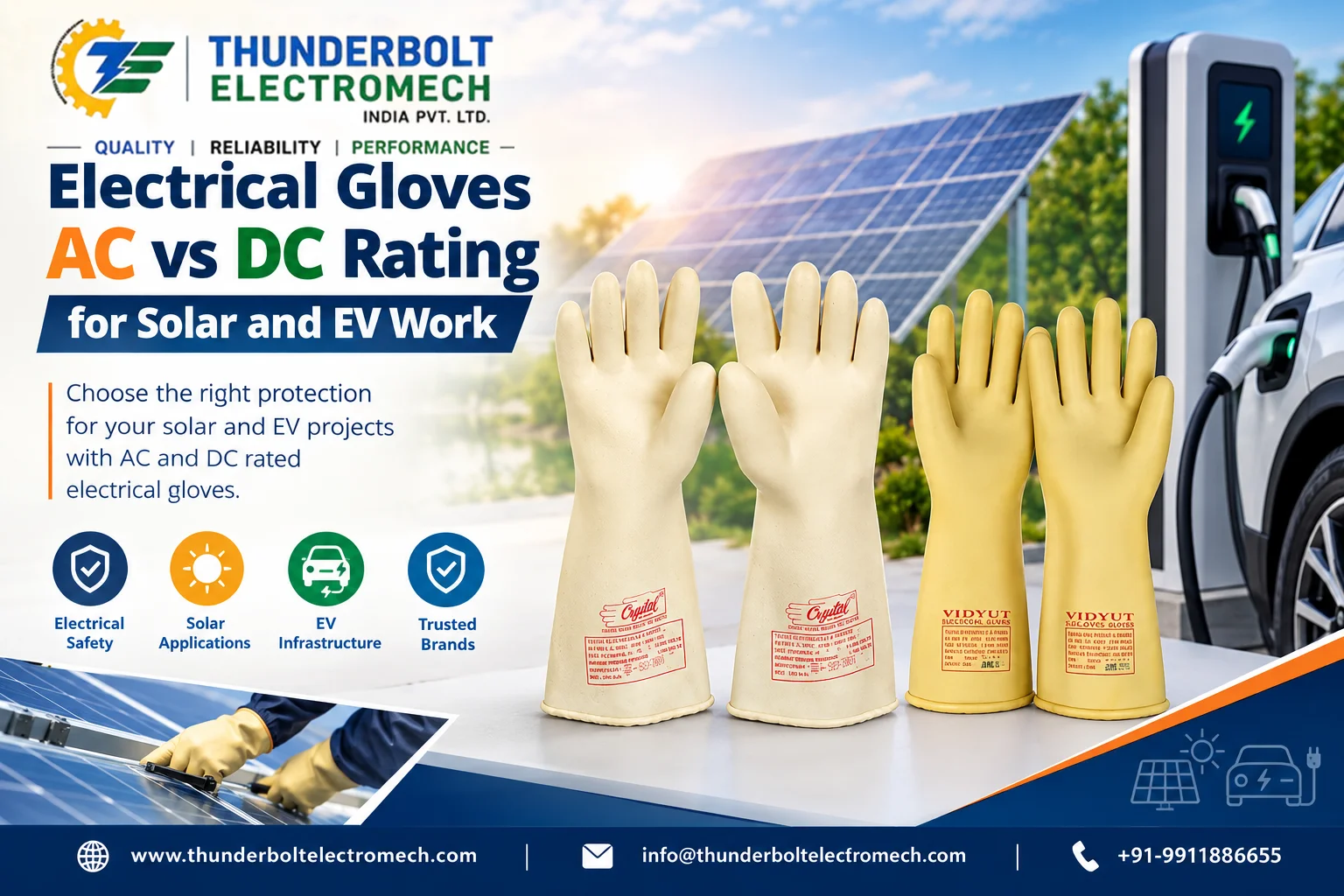
Quick Answer: IEC 60903 gives every glove class two maximum working voltages. One is for AC. A higher one is for DC. On solar strings, battery banks and EV chargers, read the DC column. Class 0 allows 1,500 V DC. Class 1 allows 11,250 V DC. Never size gloves by the AC figure alone. Compare the class against your system’s real maximum voltage. Thunderbolt Electromech, an electrical hand gloves supplier India relies on, stocks Raychem, Vidyut and Crystal gloves.
Introduction
A solar crew in a Delhi NCR warehouse rooftop plant opens a combiner box. The string meter reads 1,180 V DC. Somebody hands over a pair of gloves marked “1,000 V.” Everyone nods. Nobody checks whether that 1,000 V is an AC number or a DC number.
That small gap causes real mistakes. As a working electrical hand gloves supplier Delhi contractors call every week, we hear the same confusion again and again. Teams buy gloves by the AC class they know from switchgear work. Then they carry those gloves to a DC job.
This guide fixes that. You will see how the AC and DC ratings differ, why the difference exists, and how to read it for solar, EV and battery storage work. We cover every class from 00 to 4. We also share field rules, a case study and a buying checklist. If you want the wider picture first, read our complete electrical hand gloves buying and safety guide. For related topics, browse the electrical hand gloves category.
Why an Electrical Hand Gloves Supplier Must Explain AC vs DC Ratings
What the two numbers actually mean
IEC 60903 sets out the requirements for live-working gloves made of insulating material. Each class carries a maximum working voltage. The standard states it twice. One value applies to AC. The other applies to DC.
The DC value is always higher. Look at Class 0. It is rated for 1,000 V AC and 1,500 V DC. Class 1 is rated for 7,500 V AC and 11,250 V DC. The DC figure is 1.5 times the AC figure in every class.
Why the factor of 1.5? Think about what the glove rubber feels.
An AC rating quotes the RMS value. RMS is a kind of average. The actual voltage swings up to a peak that sits about 41 percent above the RMS figure. A 1,000 V AC circuit peaks near 1,414 V. The glove already has to survive that peak many times per second.
DC does not swing. It holds one steady value. So the standard allows a higher DC number whose steady stress stays close to the AC peak. The DC rating for Class 0, at 1,500 V, sits just above that 1,414 V peak. The two ratings describe roughly the same electrical stress on the rubber.
That is the engineering reason. It is not a marketing trick, and it is not a loophole.
Why teams misread the rating
Most people learn glove classes on AC work. Substations, motor control centres and distribution boards all run on AC. The class chart in their heads is the AC column. When they move to solar or EV work, they carry the same chart along.
The mistake runs in two directions.
The first direction is dangerous. A technician sees “Class 0, 1,000 V” and assumes a 1,200 V DC string is out of range. They either refuse the job or climb to a higher class than needed. That wastes money and dexterity, but it stays safe.
The second direction is worse. A technician sees a number printed on a cuff and assumes it covers any voltage below it, in any circuit type. They never check whether the marking refers to AC. On a 1,500 V DC system, that assumption can put a glove at or beyond its limit.
We have seen both. Neither comes from carelessness. Both come from a chart that lists one column when the standard lists two.
What DC changes beyond the number
The rating is only part of the story. DC behaves differently when something goes wrong.
AC current crosses zero a hundred times every second on a 50 Hz supply. An AC arc gets a chance to die out at each zero crossing. DC never crosses zero. A DC arc, once struck, sustains itself until something breaks the path. It burns hotter and longer.
A DC string also behaves like a stubborn power source. You cannot turn it off at the panel while daylight reaches the modules. Disconnecting the inverter does not de-energise the cable. The string stays live between the modules and the disconnect.
So a glove on a DC job faces three things at once. It faces a steady voltage. It faces a source that will not switch off. And it faces an arc that does not extinguish itself. The class rating addresses only the first. We cover the other two later in this guide, because skipping them leads to injuries that no glove class prevents.
Standards in India
Indian buyers often meet two naming styles. IEC 60903 uses Class 00, 0, 1, 2, 3 and 4. Older Indian practice, linked to IS 4770, often labels gloves by test voltage, such as 11 kV or 33 kV. Those labels describe test levels. They do not map one-to-one to the IEC working voltages.
If a glove carries only a test-voltage label, ask the supplier for the test certificate. Ask which standard applies. Ask for the AC and DC working limits in writing. A good supplier answers this in one email. A weak one changes the subject.
Class-by-Class Guide From an Electrical Hand Gloves Supplier
The full class table
Here is every class in IEC 60903, with both voltage columns side by side.
| Class | Max working voltage, AC (RMS) | Max working voltage, DC | Proof test voltage, AC | Max glove thickness | Typical use |
| 00 | 500 V | 750 V | 2.5 kV | 0.50 mm | Low-voltage panels, EV workshops, small battery packs |
| 0 | 1,000 V | 1,500 V | 5 kV | 1.00 mm | Solar strings, BESS racks, DC fast chargers, LT switchgear |
| 1 | 7,500 V | 11,250 V | 10 kV | 1.50 mm | 3.3 kV and 6.6 kV motors, high-margin DC work |
| 2 | 17,000 V | 25,500 V | 20 kV | 2.30 mm | 11 kV and 15 kV distribution |
| 3 | 26,500 V | 39,750 V | 30 kV | 2.90 mm | 22 kV and 25 kV lines |
| 4 | 36,000 V | 54,000 V | 40 kV | 3.60 mm | 33 kV and above live-line work |
The proof test voltage matters more than most buyers realise. A Class 0 glove must survive a 5 kV test. Its DC working limit is 1,500 V. That gives a margin above three to one. The margin exists because rubber ages, flexes and picks up microscopic damage in the field.
Always confirm numbers against the markings and certificate on the product you actually receive. Manufacturers and testing laboratories may state limits with small differences in presentation.
Class 00: dexterity first
Class 00 gloves are thin. The wall stays below half a millimetre. That thinness lets a technician feel a small terminal screw or thread a ferrule.
The limits are 500 V AC and 750 V DC. Many EV service tasks fall inside this. A 400 V battery pack, including charging voltage, usually stays below 750 V DC.
Here is the catch that most buyers miss. Modern passenger vehicles are moving to 800 V architectures. A pack at 800 V nominal sits above the Class 00 DC limit. Technicians who used Class 00 gloves on 400 V packs for years will pick up the same gloves on a new 800 V platform. They need to stop and check.
Class 0: the solar and storage workhorse
Class 0 is the class most solar and storage teams need. The limits are 1,000 V AC and 1,500 V DC. A modern 1,000 V DC string fits comfortably. A 1,500 V DC system fits barely, and we cover that tight case below.
Class 0 walls are thicker, up to 1 mm. You lose some fingertip feel. Most electricians adapt within a day or two.
Class 1: margin for modern DC
Class 1 allows 7,500 V AC and 11,250 V DC. Many people think of Class 1 as an AC distribution glove. For DC work it has another job. It gives real headroom above 1,500 V DC systems.
Higher cost and lower dexterity come with it. A Class 1 glove is thicker, up to 1.5 mm. But for a 1,500 V utility-scale solar plant or a large battery energy storage system, the extra margin often earns its place.
Class 2, 3 and 4: high-voltage live work
Class 2 covers up to 17,000 V AC and 25,500 V DC. It serves 11 kV distribution work. Class 3 steps up to 26,500 V AC and 39,750 V DC. Class 4 tops the range at 36,000 V AC and 54,000 V DC.
These three classes mostly belong to utility line crews. A solar or EV engineer rarely needs them. But a few cases justify them. A high-voltage DC link on a large grid-tied inverter station sometimes reaches into this territory. If your system voltage climbs that high, treat the job as utility work, with utility procedures and utility-trained staff.
Reading the cuff: more than a class number
The class number does not stand alone. IEC 60903 also marks special properties with category letters.
- A: resists acid.
- H: resists oil.
- Z: resists ozone.
- R: resists acid, oil, ozone and mechanical damage together.
- C: works at extremely low temperatures.
A solar plant in Rajasthan sees fierce heat, UV and dust. A battery storage room may see electrolyte vapour or oil from nearby equipment. Category letters tell you whether the glove can tolerate those conditions. Ask for them.
The cuff also carries the manufacturer’s name, size, date of manufacture and the double-triangle symbol for live working. If a pair arrives without that marking, return it.
Why “just buy the highest class” fails
A common shortcut says: buy Class 2 for everything and stop worrying. It sounds safe. It is not.
Thick gloves reduce touch. A technician fumbling with a MC4 connector in a Class 2 glove is more likely to drop a tool, slip a screwdriver or pull a connection loose. Poor dexterity creates its own hazards. The right glove is the lowest class that keeps a proper margin above the real maximum voltage. No more, no less.
Solar, EV and Battery Storage: Field Rules From an Electrical Hand Gloves Supplier
Solar strings: read the cold-morning voltage
A solar string’s voltage is not a fixed number. It moves with temperature.
Crystalline silicon modules raise their open-circuit voltage (Voc) as they cool. A typical temperature coefficient runs near minus 0.28 percent per degree Celsius. Cold modules produce more voltage. Cold modules at sunrise, with no load connected, produce the most.
Take a worked example. A designer builds a 1,500 V DC string with a Voc of 1,380 V at standard test conditions (25°C). On a winter dawn in a hill-station plant, module temperature drops to minus 5°C. That is a 30°C swing. The Voc rises by roughly 30 × 0.28 = 8.4 percent.
1,380 V × 1.084 ≈ 1,496 V.
That figure sits four volts below the Class 0 DC limit of 1,500 V. There is no practical margin. A technician in Class 0 gloves would work at the very edge of the rating. Class 1 gloves, rated to 11,250 V DC, remove that concern.
This example uses illustrative numbers. Your plant will differ. Read the design Voc from the string diagram. Apply the cold-temperature correction for your site. Then pick the class.
For a 1,000 V DC rooftop string, the same cold correction might push Voc to around 1,090 V. Class 0 handles that with real margin. So the rule is simple. A 1,000 V DC system takes Class 0. A 1,500 V DC system should take Class 1.
EV chargers and vehicle packs
EV work brings a different pattern.
A DC fast charger converts grid AC to DC inside the cabinet. The DC output rail can run between 400 V and 1,000 V, depending on the charger. Technicians open the cabinet for contactor replacement, cable inspection and connector service.
For most chargers with an output below 750 V, Class 00 works on paper. For 800 V and 1,000 V chargers, Class 0 is the starting point. Even on lower-voltage chargers, many workshops standardise on Class 0. A single class simplifies stock and training, and the thicker rubber resists the sharp edges inside cabinets.
Vehicle packs add a second concern. An EV battery does not turn off when the key goes off. Pack contactors open, but the cells stay charged. Service procedure removes the service disconnect and then verifies zero voltage with a rated meter. Gloves protect the technician during that verification step, when the pack might still be live behind a failed contactor.
Battery energy storage: low voltage, high current
A battery energy storage rack looks modest. A single module may sit at only 50 V. Racks, however, string many modules in series. A full DC bus in a containerised BESS often runs between 1,000 V and 1,500 V DC.
The voltage matches the solar logic above. But storage adds a second hazard. Batteries deliver enormous short-circuit current. A fault can release tens of kiloamps in milliseconds. The danger moves from shock to arc flash.
IEC 60903 rates gloves for shock protection. It does not rate them for arc flash. Class numbers tell you nothing about arc energy. For BESS work, pair insulating gloves with leather protectors and arc-rated clothing, face shield and other PPE. Your arc flash study sets the PPE category. Do not skip the study.
Customer problems and solutions
Our sales desk hears these complaints regularly. Here is how we answer each one.
Problem: “My gloves say 1,000 V. My string reads 1,180 V DC. Am I over the limit?”
Solution: No, not if the marking refers to AC working voltage on a Class 0 glove. The DC limit for Class 0 is 1,500 V. Check the certificate to confirm the 1,000 V marking refers to AC. Then confirm your cold-morning Voc.
Problem: “We bought Class 00 gloves for our EV workshop. A new model arrived with an 800 V pack.”
Solution: Class 00 allows 750 V DC. An 800 V pack exceeds it. Move to Class 0 for that platform.
Problem: “The gloves feel too thick. My team removes them to work faster.”
Solution: Match the class to the job. Move low-voltage tasks to Class 00 where the voltage allows it. And train technicians on glove handling, since poor technique causes more discomfort than the rubber itself.
Problem: “Our gloves look fine, but nobody knows their age.”
Solution: Check the manufacture date on the cuff. Keep a register. Send gloves for periodic electrical retesting at an accredited laboratory. Six-month intervals are common in utility practice. Follow your own safety policy and the manufacturer’s guidance.
Problem: “The supplier gave us a glove with only a test-voltage label.”
Solution: Ask for the certificate and the governing standard. Ask for AC and DC working limits in writing. If the supplier cannot provide them, change the supplier.
Real use cases
These field situations come up often on Indian solar, EV and storage projects.
Use case 1: Combiner box fuse replacement.
A technician replaces a blown string fuse. The string stays live even with the inverter off. The technician wears Class 0 gloves with leather protectors, opens the box, tests for voltage and swaps the fuse. For a 1,500 V system, the same job calls for Class 1.
Use case 2: Connector disconnection.
MC4 connectors should never come apart under load. Even so, crews occasionally disconnect a string with current still flowing. A DC arc forms across the contacts. Insulating gloves protect against shock. A face shield and arc-rated sleeves protect against the arc. The lesson: isolate first, then disconnect.
Use case 3: EV depot charger maintenance.
A fleet depot runs twelve DC chargers. The maintenance team replaces a cooling fan inside a 150 kW cabinet while the cabinet is locked out. Before touching anything, the technician verifies zero voltage on the DC bus with a rated meter. Class 0 gloves cover the verification step.
Use case 4: Rooftop inspection.
An inspector walks a 400 kW rooftop plant to find a ground fault. The inspector wears Class 0 gloves and carries a clamp meter. The gloves protect against contact with exposed conductors where cable insulation has cracked in the heat.
Use case 5: Battery rack commissioning.
A commissioning team closes the DC breaker on a new storage container. Insulating gloves go on first. Arc-rated gear goes over them. The team stays outside the arc boundary for the closing step wherever the design allows.
Case study: a solar EPC team and a winter voltage surprise
The figures below are illustrative. They reflect typical project conditions in northern India.
A mid-sized solar EPC company was commissioning a 6 MW ground-mount plant in northern India. The design used 1,500 V DC strings. The crew carried Class 0 gloves because they matched the “1,000 V” figure their safety officer remembered from AC switchgear training.
During a pre-commissioning review, an engineer compared the string design with the glove certificates. The design Voc at standard test conditions was 1,372 V. The site’s recorded winter minimum module temperature was minus 4°C. A cold correction of roughly 8.1 percent brought the worst-case Voc to about 1,483 V.
Class 0 gloves allow 1,500 V DC. The crew would have worked with a 17-volt margin. Thin, aged gloves with minor surface flaws would leave very little protection against any transient overshoot.
The engineer made three changes.
- The company moved all string-level work to Class 1 gloves.
- It kept Class 0 gloves for low-voltage control cabinets, where they gave better dexterity.
- It added a cold-Voc line to every method statement, so each job card showed the real maximum voltage.
The change cost a few thousand rupees per crew. It removed a rating gap that nobody had noticed. The lesson is not that Class 0 gloves are weak. The lesson is that a rating means little until you compare it with your actual maximum voltage.
Original engineering checks you can run in five minutes
Use these checks on any DC job.
- Find the design Voc. Read it from the string diagram or module datasheet.
- Apply the cold correction. Multiply the temperature swing by the module’s Voc coefficient. Add it to the Voc.
- Add a margin. Leave at least 10 percent below the glove’s DC limit as a working rule.
- Check the DC column. Do not use the AC figure.
- Check the date and the air test. An old glove holds less margin than a new one.
Our guide on the electrical gloves air test explains the pre-use inflation check in detail. Do the air test every time. It takes thirty seconds.
Why gloves are never the only barrier
Gloves work as the last line of defence. They do not replace isolation, lockout, testing and proper procedure.
A strong DC job follows a fixed order. Isolate the source. Lock it out. Test for absence of voltage with a rated tester. Prove the tester on a known live source before and after. Then work. Insulating gloves sit in the plan as a backup for the case where the first steps fail.
Mark the area with proper signage too. A clear danger plate at every combiner box, battery container and charger cabinet warns visitors. Thunderbolt supplies danger plates alongside gloves, so one order covers both. A faded or missing danger plate removes a cheap warning that costs very little to replace.
How to Buy From an Electrical Hand Gloves Supplier in Delhi NCR
What to ask any supplier
Before you place an order, ask these questions. A reliable electrical hand gloves supplier answers each of them quickly.
- Which standard does the glove meet? IEC 60903, IS 4770 or both?
- What are the AC and DC maximum working voltages for this exact product?
- Can you share the test certificate and batch number?
- What is the manufacture date?
- What category letters does it carry?
- What sizes do you stock?
- Do you supply leather protectors that fit these gloves?
Gloves from different manufacturers differ in cuff length, fit and rubber compound. Ask which leather protector matches which glove. A mismatched protector bunches up and reduces grip.
Raychem, Vidyut and Crystal gloves
Thunderbolt Electromech supplies three glove lines: Raychem, Vidyut and Crystal. Each suits a different buyer.
Raychem gloves serve teams that want a well-known brand with a strong record in utility and industrial work. Vidyut gloves serve buyers who want a dependable option at a sharper price. Crystal gloves serve crews that value a clear rubber look, which makes surface flaws and pinholes easier to spot.
You can browse the electrical hand gloves product page to see current models. Ratings, class and test details vary by product. Always read the datasheet for the exact pair you plan to buy, and confirm the DC working limit before you order.
A comparison to guide your purchase
| Factor | Class 00 | Class 0 | Class 1 |
| DC limit | 750 V | 1,500 V | 11,250 V |
| AC limit | 500 V | 1,000 V | 7,500 V |
| Dexterity | Highest | High | Medium |
| Best for | Small packs, LV panels | 1,000 V solar, BESS, DC chargers | 1,500 V solar, large BESS |
| Cold-Voc margin on 1,500 V string | None, fails | Near zero | Large |
| Typical risk of over-specifying | Low | Low | Lower dexterity |
Use the table as a starting point. Then confirm against your real system voltage.
Storage, care and retesting
Even the right class fails if you treat the gloves badly.
Store gloves flat or hung loosely, away from sunlight, heat, ozone sources and chemicals. Keep them in a glove bag. Do not fold them into a toolbox with screwdrivers.
Inspect them before every shift. Stretch each glove slightly and look for cuts, cracks, blisters and swelling. Run the air test. Replace any glove that fails. Do not patch rubber gloves.
Retest at intervals set by your safety policy and the manufacturer. Keep a register that links each pair to its serial number, issue date and test date. Our heat-shrink and cable accessory customers keep similar registers for their jointing tools. The same discipline pays off here.
Delhi NCR buyers and local supply
Solar and EV projects around Delhi NCR move fast. Rooftop plants in Noida, Gurugram and Faridabad often need gloves within days. Charging hubs along the expressways open on tight schedules.
As an electrical gloves supplier Delhi NCR teams call for urgent orders, we hold stock of common sizes. Our Chawri Bazar location puts us in the heart of Delhi’s electrical market. Contractors collect orders from the shop or ask for dispatch across India. If you search for solar safety gloves Delhi, you will find our team ready to help match class to system voltage.
We also supply danger plates for solar plants, battery rooms and charger bays. One call covers gloves and signage together.
Frequently asked questions
Can I use AC-rated gloves on a DC circuit?
Yes, if the glove’s DC working voltage covers your system. Read the DC column of the rating, not the AC one.
Are 1,000 V gloves enough for a 1,000 V DC string?
Often yes. Class 0 allows 1,500 V DC. Still, apply the cold-temperature correction to the string’s Voc and confirm the margin.
Do I need Class 1 for a 1,500 V solar plant?
In most cases, yes. A 1,500 V design can reach the Class 0 DC limit on a cold morning. Class 1 gives real headroom.
Do insulating gloves protect me from arc flash?
No. IEC 60903 covers shock protection. Arc flash needs arc-rated clothing, face protection and leather protectors chosen from an arc flash study.
How often should I retest gloves?
Follow your safety policy and the manufacturer’s guidance. Six-month intervals are common in utility practice.
Can I wear Class 00 gloves on an 800 V EV pack?
No. Class 00 allows 750 V DC. Use Class 0 or higher.
Trust and contact block
Thunderbolt Electromech India Pvt. Ltd. is a Delhi-based supplier of electrical safety equipment. We supply gloves, danger plates and related products to contractors, solar EPC firms, EV service teams and industrial plants across India. As an electrical hand gloves supplier in Delhi, we answer rating questions before you buy, not after.
- Address: Shop No. 3538, Sitaram Bazar Rd, Bazar Sirkiwalan, Chawri Bazar, Chandni Chowk, Delhi, 110006
- Phone: +91-9911886655
- Email: info@thunderboltelectromech.com
Send us your system voltage, your site’s coldest recorded temperature and your job type. Our team will suggest a class and share the certificates for the pair we propose. If you need an electrical gloves supplier Delhi NCR crews can reach in person, visit the shop in Chawri Bazar.
Conclusion: Choose an Electrical Hand Gloves Supplier Who Reads the DC Column
Here is the whole guide in short form.
IEC 60903 rates every glove class twice. Class 00 allows 500 V AC and 750 V DC. Class 0 allows 1,000 V AC and 1,500 V DC. Class 1 allows 7,500 V AC and 11,250 V DC. Class 2 allows 17,000 V AC and 25,500 V DC. Class 3 allows 26,500 V AC and 39,750 V DC. Class 4 allows 36,000 V AC and 54,000 V DC. The DC figure is always 1.5 times the AC figure, because AC rating describes an RMS average while the rubber feels the higher peak.
On solar, EV and battery storage work, read the DC column. Never size gloves by the AC number alone.
Check the real maximum voltage of your system. On solar strings, apply the cold-temperature correction to the open-circuit voltage. A 1,500 V string can reach the Class 0 limit on a winter morning. Choose Class 1 for those systems. Use Class 0 for 1,000 V strings, DC fast chargers and most storage racks. Use Class 00 only where the voltage stays under 750 V DC, and watch for 800 V EV platforms that exceed it.
Remember what a glove cannot do. It does not stop an arc. It does not replace isolation, lockout and testing. Pair it with leather protectors, arc-rated clothing and a proper procedure. Run the air test before every shift. Keep a register. Retest on schedule.
Finally, choose your electrical hand gloves supplier carefully. Ask for the standard, the AC and DC limits, the certificate and the manufacture date. Thunderbolt Electromech supplies Raychem, Vidyut and Crystal gloves, plus danger plates, from Chawri Bazar in Delhi. Call +91-9911886655 or write to info@thunderboltelectromech.com. For more reading, explore our pillar guide on electrical hand gloves and the electrical hand gloves blog category.