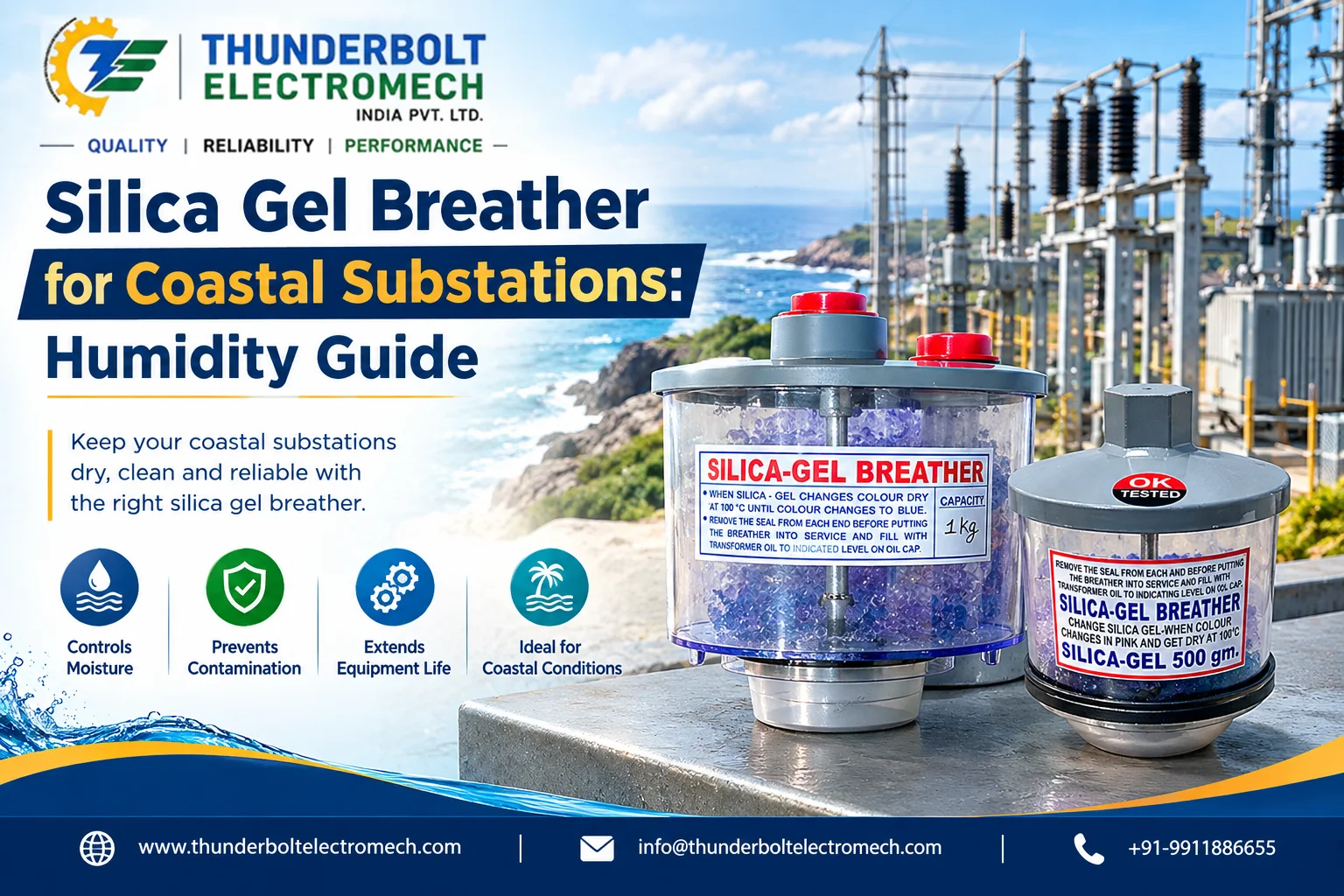
Quick Answer: Humid coastal air saturates silica gel several times faster than a fixed maintenance calendar assumes. A transformer inhales its heaviest moisture load at night, when oil cools and humidity peaks. Size the breather for the wet season, not the annual average. Use cobalt-free orange indicating gel and inspect it monthly in monsoon. As a silica gel breather supplier, Thunderbolt Electromech offers 500g, 1Kg and 2Kg empty breathers for transformer sites across India.
Introduction
A substation engineer in Mumbai opens the breather on a 6 MVA transformer in late July. The gel is pink. It was filled in June. The schedule said “replace every six months.”
That story repeats on every coast and in every river city that gets a hard monsoon. The maintenance plan came from a dry-climate manual. The air did not read the manual.
This guide explains why humid air breaks the schedule, how to estimate the real saturation rate, and how to size a silica gel breather for coastal substations in India. It also covers Delhi, where a silica gel breather Delhi monsoon problem looks different but hurts just as much. We write from the counter of a working silica gel breather supplier in Chawri Bazar, so expect numbers and field habits, not brochure language.
If you want the full buying picture first, read our complete transformer breather buying and safety guide. More topics sit in the silica gel breather blog category.
Why Humid Air Beats the Schedule: A Silica Gel Breather Supplier’s View
The transformer breathes on a thermal clock
A transformer conservator holds a pocket of air above the oil. When the oil heats, it expands and pushes air out. When the oil cools, it contracts and pulls air in. The breather sits on that air path. Its job is to dry every breath before the air touches the oil.
Mineral oil expands by roughly 0.065 percent per degree Celsius. The exact figure depends on the oil grade, so treat it as a working value. A transformer with 6,000 litres of oil that cools by 25°C draws in about 98 litres of air.
That number surprises people. It is small compared with the room around the transformer. But the air carries water, and water adds up.
A back-of-envelope moisture budget
Take that 6,000-litre transformer and run two cases. These are my own estimates, built from textbook values, not lab measurements.
Dry-season day. Oil swings by 12°C. The air at 25°C and 50 percent humidity holds about 11.5 grams of water per cubic metre. The transformer inhales roughly 47 litres. That is 0.047 cubic metres, or about 0.5 grams of water per day.
Monsoon day. Oil swings by 25°C because load changes and rain cooling stretch the cycle. The air at 30°C and 90 percent humidity holds about 27 grams per cubic metre. The transformer inhales roughly 98 litres. That is 0.098 cubic metres, or about 2.6 grams of water per day.
The monsoon day moves nearly five times more water through the breather. Two things drive the jump. The air holds more water, and the oil breathes deeper.
Now add gel capacity. Silica gel can hold up to about 36 percent of its own weight at very high humidity, according to one desiccant maker’s technical notes. In a breather you never reach that. Indicator colour changes earlier, and a bed that has stopped drying the air well is already past useful service. As a planning assumption, let us count on 20 grams of water per 100 grams of gel. Your gel supplier’s datasheet may give a better figure. Use theirs when you have it.
| Breather size | Usable water capacity (assumed 20%) | Days to saturate, dry season (0.5 g/day) | Days to saturate, monsoon (2.6 g/day) |
| 500g | 100 g | about 185 | about 38 |
| 1Kg | 200 g | about 370 | about 77 |
| 2Kg | 400 g | about 740 | about 154 |
Read the right-hand column twice. A 500g breather on a 6,000-litre unit in monsoon runs out in about five and a half weeks. The six-month schedule fails inside the first quarter.
Real units also breathe through small leaks, loose gaskets and pressure changes from weather fronts. Those add water. So the monsoon column is a floor, not a ceiling.
The worst air arrives at the worst time
Here is the detail most guides skip.
Oil cools at night. Cooling pulls air inward. Night is also when relative humidity climbs, because the air temperature drops toward the dew point. On a coast, the sea breeze adds salt and moisture to the same hours.
So the transformer inhales its heaviest load exactly when the air is wettest. The gel does not see an average day. It sees a series of humid nights.
Delhi shows a similar pattern in July and August. Daytime temperature stays high, load stays high, then a thunderstorm cools the oil fast. The transformer inhales storm air. A silica gel breather Delhi monsoon season check in late June takes ten minutes and saves a lot of trouble.
What wet gel does inside the transformer
Moisture is not a cosmetic problem. Water in the insulation paper speeds up ageing. A published industry discussion on breathers notes that doubling the water content of the paper roughly halves its mechanical-strength life. The same source says moisture lowers bubble inception temperature and dielectric strength.
Atmospheric air drawn in as the oil cools is one of the main moisture sources. The others are residue from manufacturing and moisture that cellulose ageing releases. You can control the first one at the breather. That makes the breather a cheap guard for an expensive asset.
For oil moisture limits and sampling practice, follow the maintenance guides your utility uses, such as IEC 60422 or IEEE C57.106. This article does not replace them.
Why a saturated breather can do harm
A saturated gel bed does not just stop working. Once the bed holds as much water as it can, dry air stops coming out of it. Worse, if the bed sits wet while the transformer warms, it can give some moisture back to passing air. That is the reverse of what you want.
An overdue breather therefore carries more risk than a missing one in some cases, because it fools the crew. Everyone sees a breather in place and assumes protection is in place.
Coastal air is more than damp air
Coastal sites add salt to the problem. Salt-laden air eats through unprotected steel. Flanges, clamps and brackets corrode. Gasket seats pit. A pitted seat leaks, and a leaking breather lets air bypass the gel.
Check three things on every coastal breather:
- Mounting hardware. Look for rust bloom at the flange and clamps.
- The oil seal cup. Salt and dust collect on it. Wipe it and refill to the mark.
- The body. UV and heat can craze plastic and cloud glass, which hides the colour change.
The oil seal cup deserves its own note. It does more than filter dust. When the transformer is not breathing, the oil seal keeps ambient air away from the gel. Without a seal, the gel adsorbs moisture by slow diffusion even when no air flows. A dry cup or a cracked seal ages the gel for free.
Customer problems and solutions
Our sales desk hears these questions every monsoon.
Problem: “The gel turned pink in six weeks. Is the gel bad?”
Solution: Probably not. Check the size against the oil volume and the season. A small breather on a large unit saturates quickly in humid weather. Move to a larger size, or shorten the inspection interval in monsoon.
Problem: “We replaced the gel, and it turned pink again within days.”
Solution: Look for a leak. A cracked body, a dry oil cup or a bad gasket lets moist air bypass the seal. Test the joints before you refill.
Problem: “The colour change is hard to see on cloudy glass.”
Solution: Clean or replace the body. Keep a spare sight glass or a fresh breather in stock for coastal sites.
Problem: “Our crew regenerates gel in an ordinary oven, and it works for a while, then fails.”
Solution: Gel that cools in open humid air picks up water before it reaches the breather. Fill the hot gel into the breather straight away, or store it in a sealed container.
Problem: “We cannot visit remote coastal substations monthly.”
Solution: Pick the larger size, 2Kg, and schedule one visit just before monsoon and one mid-season. Match the interval to the budget in the table above.
Sizing Logic From a Silica Gel Breather Supplier: 500g, 1Kg or 2Kg
Start from oil volume and temperature swing
Sizing a breather is a small calculation. You need three numbers.
- Oil volume in the conservator circuit, from the nameplate.
- Daily oil temperature swing at your site, from the winding or top-oil temperature log.
- Wet-season air condition, meaning temperature and humidity at night.
Multiply oil volume by 0.00065 and by the swing. That gives litres of air per day. Convert to cubic metres. Multiply by the water content of the air. That gives grams of water per day.
Divide the usable capacity of the gel by that rate. You get days between refills. Pick the size that gives you an interval you can actually maintain.
Always check the transformer manufacturer’s manual. It may specify a breather size, and you should treat that as a minimum.
The cost of choosing too small
A small breather looks cheaper on the purchase order. It costs more over a year.
A 500g breather that saturates every 38 days needs nine or ten refills a year in monsoon-heavy regions. Each refill needs a technician, a lift or a ladder, and sometimes a switching permit. Labour and risk dwarf the price gap between 500g and 2Kg.
Compare that with the larger option. A 2Kg breather in the same conditions lasts about 154 days on the assumptions above. That gives two refills in the wet season.
Comparison of the three sizes
| Factor | 500g | 1Kg | 2Kg |
| Typical fit | Small distribution transformers, dry sites | Mid-size distribution units, mixed climates | Larger units, coastal and high-humidity sites |
| Monsoon refill interval (example unit) | about 5 weeks | about 11 weeks | about 22 weeks |
| Visit load | Highest | Medium | Lowest |
| Gel cost per refill | Lowest | Medium | Highest |
| Fits remote sites | Poorly | Fairly | Best |
| Our view for coastal sites | Only on small units | Acceptable with monthly checks | First choice for most |
The intervals come from the worked example above. Your unit will differ, so run your own numbers.
You can view the sizes on our product pages: silica gel breather 500g empty, silica gel breather 1Kg empty and silica gel breather 2Kg empty.
Why we sell the breather empty
An empty breather gives you control over the gel. You choose the grade, the indicator type and the quantity. You can also reuse the body for several refills.
That control matters on coastal sites. You can fill with cobalt-free orange indicating gel, which we cover below. You can also keep a sealed drum of dry gel in the store room and refill on the spot.
Check the body material, the gasket and the oil cup design on each product page before you order. If you need a specific connection size, send us the drawing.
Real use cases
Use case 1: Port-area substation.
A 33/11 kV substation near a harbour runs two transformers. Salt air rusted the breather brackets within two years. The team moved to 2Kg breathers with corrosion-resistant fasteners and added an oil cup check to the monthly round.
Use case 2: Delhi NCR industrial feeder.
A factory in the NCR runs a 1,600 kVA unit on a variable load. Monsoon storms cool the oil quickly. The plant electrician now checks the breather every two weeks from July to September and moves to quarterly in winter.
Use case 3: Solar plant transformer.
A coastal solar farm in Gujarat steps up through a unit that cools sharply every evening as irradiance falls. The daily swing is large and regular. The operator picked 2Kg breathers and logs the colour on a phone form.
Use case 4: Standby unit.
A spare transformer sits idle in a coastal yard. It breathes little, but the breather still ages if the oil seal is dry. The yard keeps the oil cups filled and checks the gel before any energisation.
Case study: a coastal substation and a monsoon pattern
The scenario below is illustrative. The numbers reflect typical project conditions on India’s west coast, not a documented client record.
A utility maintained a group of 11 kV distribution substations within five kilometres of the sea. Each transformer held roughly 6,000 litres of oil. Each carried a 500g breather. The schedule called for gel replacement every six months.
The maintenance engineer reviewed the logs after the 2025 monsoon. Five of eight units showed fully pink gel by mid-August. The last replacement had been in May. Three of those five also showed elevated moisture in the oil sample.
He ran a calculation like the one in this article. The monsoon rate came to about 2.6 grams of water per day against 100 grams of usable capacity. That predicted saturation in about 38 days. The logs matched the prediction.
He made four changes.
- He moved the coastal units to 2Kg breathers, which stretched the monsoon interval to about 22 weeks.
- He added an oil cup and gasket check to every visit.
- He switched to cobalt-free orange gel with a sealed refill kit.
- He moved inspections from “every six months” to “once before monsoon, once mid-season, once after.”
The following year, no unit showed saturated gel before the mid-season visit. The crew made fewer emergency trips. The lesson is not that larger breathers fix everything. The lesson is to calculate the interval from the climate, then size the breather to fit.
Cobalt-Free Gel and Field Practice From a Silica Gel Breather Supplier
Blue gel and the move to orange
Traditional breather gel uses cobalt chloride as the colour indicator. Dry gel looks dark blue. Saturated gel turns pink.
Cobalt chloride is classified as hazardous under European chemical rules. That has pushed many buyers to ask for cobalt-free alternatives. Orange indicating gel uses a different indicator dye. Dry gel looks orange. As it takes up water, the colour changes toward colourless or green, depending on the formulation.
The change is easy to see in daylight. It also removes a hazardous chemical from your store room and your waste stream. Check the datasheet from your gel supplier for the exact colour sequence and the humidity level at which the change occurs. Different makers use slightly different dyes.
If your utility specification still names blue gel, check whether an orange equivalent is accepted. Many specifications are open to it. Ask before you switch.
A colour is a signal, not a measurement
The colour tells you the gel has reached a moisture state. It does not tell you how fast it got there.
A bed that turned pink in three weeks and a bed that turned pink in six months look the same on the day you inspect them. Log the date every time you refill. Then you can compare intervals across seasons and across sites.
A simple log has five columns: site, transformer, fill date, colour check date and colour state. Ten minutes of record keeping turns guesswork into a trend.
Reading the bed
The bed does not change colour all at once. In most designs, the gel nearest the air entry saturates first. A colour front moves through the bed as moisture arrives.
Watch the front, not just the whole. If the lower third has turned and the rest is dry, you are maybe a third of the way through the interval. If the front has crossed the halfway point, plan the refill.
If the top of the bed changes first, suspect a leak. Moist air may be entering from the top or around the gasket, bypassing the oil seal.
Regenerating gel without wasting it
Saturated gel can be dried and reused. Heat drives the water out. The usual approach is oven drying at a controlled temperature for a few hours. Follow your gel supplier’s instruction on temperature, because indicator dyes can degrade if you overheat them.
Three habits protect the result.
- Spread the gel thin. A shallow tray dries evenly. A deep pile stays damp at the centre.
- Cool it sealed. Move the hot gel into an airtight container. Open air puts the water right back.
- Fill promptly. Load the breather within minutes of drying, and close it.
Many teams skip regeneration on coastal sites. They buy fresh gel instead. That choice makes sense when the labour cost of drying exceeds the gel cost. Decide by your own numbers.
Fill level and packing
Fill the breather to the mark on the body. Do not pack it hard. Compressed gel can choke airflow and may crush beads. Do not leave a large gap either. A gap lets the gel shift and channel the air through a narrow path.
Tighten the cap and flange to the torque your manual gives. Replace the gasket if it has flattened or cracked. A gasket costs little. A leak costs the whole interval.
The oil cup, step by step
The oil seal cup is the part crews forget. Handle it like this.
- Unscrew the cup from the base.
- Empty the old oil and wipe out dust and salt.
- Refill with clean transformer oil to the marked level.
- Refit the cup with its gasket and check for weeping.
- Note the date on the log.
A cup filled above the mark can block airflow. A cup below the mark breaks the seal. Stay at the line.
Comparison: standard blue gel and cobalt-free orange gel
| Factor | Cobalt chloride blue gel | Cobalt-free orange gel |
| Dry colour | Dark blue | Orange |
| Saturated colour | Pink | Colourless or green, per formulation |
| Chemical hazard | Cobalt chloride is classed as hazardous in the EU | No cobalt chloride |
| Visibility in daylight | Good | Good |
| Specification acceptance | Widely named in older specs | Increasingly accepted |
| Best for | Sites that must match an old spec | New purchases and coastal sites with waste controls |
More field rules
- Inspect on a fixed day. Tie it to the monthly substation round, and add a mid-month check in monsoon.
- Look before heavy rain, and after it. Storm cooling pulls hard on the breather.
- Keep a spare breather body. A cracked body can sit on a coastal site for months before anyone notices.
- Store gel sealed. An open bag in a humid store room is already half used.
- Check the pipe. A cracked breather pipe bypasses the gel altogether.
None of this is complicated. All of it gets skipped under pressure.
Buying From a Silica Gel Breather Supplier Delhi: Price, Dealer and Delivery
What drives silica gel breather price
People search for silica gel breather price first. We understand why. But price per piece hides the real costs.
Four things set the price of a breather:
- Size. 500g, 1Kg and 2Kg bodies use different amounts of material.
- Body and fittings. The material, the flange type and the seal parts matter.
- Gel grade. Standard indicating gel and cobalt-free orange gel differ in cost.
- Order quantity. Utilities and EPC firms buying in lots pay less per unit.
Send us your quantity and sizes, and we will quote against them. Please also share the connection thread or flange details when you have them.
Beyond purchase price, count the visits. A cheaper breather that needs three more trips a year is not cheaper.
Choosing a transformer breather supplier
A good transformer breather supplier answers technical questions before the sale. Ask these.
- Which sizes do you stock, and which ones can you ship this week?
- What is the body material, and what are the sealing parts?
- Is the breather supplied empty or filled?
- Which gel grades do you offer, and can you supply cobalt-free?
- Can you send the connection drawing?
- Can you supply spare gaskets and oil cups?
Vague answers to these questions predict vague service later.
Silica gel breather for transformer: who needs which size
Different buyers have different needs.
Utilities and DISCOMs. They run many sites and need consistent sizes and spares. They benefit most from a standard 2Kg or 1Kg pattern across a region.
Solar and wind EPC firms. They run pad-mount and step-up units in exposed locations. Daily load cycles are regular and deep. Larger breathers suit them.
Industrial plants. They run a handful of transformers and a small electrical crew. Match the size to the oil volume, and put the breather on the monthly round.
Panel builders and OEMs. They fit breathers on new units. They need the right thread and flange, and they want steady supply.
A silica gel breather dealer in Delhi, with a national reach
We sell as a silica gel breather dealer Delhi contractors can visit in person, and we ship across India. Our shop in Chawri Bazar sits in the heart of Delhi’s electrical market. Buyers from Delhi NCR collect orders the same day for stocked sizes. Buyers in Gujarat, Maharashtra, Tamil Nadu, Odisha and West Bengal order by phone or email.
Looking for a silica gel breather Delhi NCR buyers can trust for fast supply? Call us with your oil volume and your site location. We will suggest a size and share the product page.
Coastal customers ask us about silica gel breather for coastal substations India projects every year, so we plan stock ahead of monsoon. Ordering in April or May avoids the June rush.
Frequently asked questions
1. How often should I change silica gel in a transformer breather?
There is no single interval. It depends on oil volume, temperature swing and humidity. In humid coastal conditions, inspect monthly and expect refills several times faster than in dry regions.
2. Why does silica gel saturate faster near the coast?
Coastal air holds more water, and the transformer inhales its heaviest load at night when humidity peaks. Both effects speed up saturation.
3. Which size breather suits a coastal substation?
Run the calculation for your oil volume and temperature swing. For many coastal distribution transformers, a 2Kg breather gives a more manageable interval than a 500g unit.
4. What does pink gel mean in a breather?
In blue indicating gel, pink means the gel has taken up enough moisture that it needs replacing or drying. Orange gel shows a similar change toward colourless or green.
5. Is cobalt-free orange gel as effective as blue gel?
The drying ability comes from the silica gel itself. The dye only gives the colour signal. Check your gel maker’s datasheet for the colour change point.
6. Can I reuse silica gel?
Yes, you can dry it and reuse it. Follow the supplier’s temperature guidance, cool it in a sealed container and fill the breather quickly.
7. Why does my gel turn pink again within days of refilling?
Look for leaks. A dry oil cup, a cracked body, a flat gasket or a loose flange lets moist air bypass the gel.
8. What does the oil in the breather cup do?
It filters dust and seals the gel from ambient air when the transformer is not breathing. Keep it at the marked level and clean.
9. What affects silica gel breather price?
Size, body material, fittings, gel grade and order quantity all play a part. Send us your requirement for a quotation.
10. Do you supply breathers outside Delhi?
Yes. We ship across India from our Delhi shop. Contact us with your quantity, sizes and site location.
Trust and contact block
Thunderbolt Electromech India Pvt. Ltd. is a Delhi-based supplier of electrical safety and accessory products. As a silica gel breather supplier Delhi utilities and contractors call directly, we answer sizing questions before you buy. We also supply electrical hand gloves and danger plates for the same sites, so one order can cover several needs.
- Address: Shop No. 3538, Sitaram Bazar Rd, Bazar Sirkiwalan, Chawri Bazar, Chandni Chowk, Delhi, 110006
- Phone: +91-9911886655
- Email: info@thunderboltelectromech.com
- Website: thunderboltelectromech.com
Send us the transformer’s oil volume, your site’s wet-season humidity and your refill interval target. We will suggest a size and a gel grade, and we will quote.
Conclusion: Size Your Silica Gel Breather Supplier Order to the Wet Season
Here is the whole guide in short form.
A transformer breathes with its oil temperature. Cooling oil pulls air through the breather. In humid coastal air, that air carries several times more water than dry-season air. Deeper daily swings in monsoon add to the load. My worked example showed about 2.6 grams of water a day against 0.5 grams in the dry season, a gap of nearly five times.
The transformer also inhales its heaviest load at night, when humidity peaks. The gel sees the worst air, not the average. A schedule written for dry weather then fails in the first quarter of the wet season.
Moisture matters because water in the insulation paper speeds up ageing. Doubling the paper’s water content roughly halves its mechanical life. A saturated or leaking breather gives no real protection, and it can give crews false comfort.
To fix it, calculate the interval. Multiply oil volume by the expansion rate and the swing, convert to air volume, then multiply by the water content of the air. Divide the gel’s usable capacity by that rate. Pick the size that gives an interval your crew can keep. On many coastal units, that points to a 2Kg breather. Smaller sites on drier ground can run 500g or 1Kg with closer checks.
Then protect the interval. Fill the oil cup to the mark. Replace tired gaskets. Check coastal brackets for rust. Log every refill. Choose cobalt-free orange gel if your specification allows it, and dry gel in a sealed way if you regenerate.
Thunderbolt Electromech supplies 500g, 1Kg and 2Kg empty breathers from Chawri Bazar, Delhi, to sites across India. Call +91-9911886655 or write to info@thunderboltelectromech.com for a size recommendation and price. For deeper reading, visit our pillar guide on transformer breathers and the silica gel breather blog category.