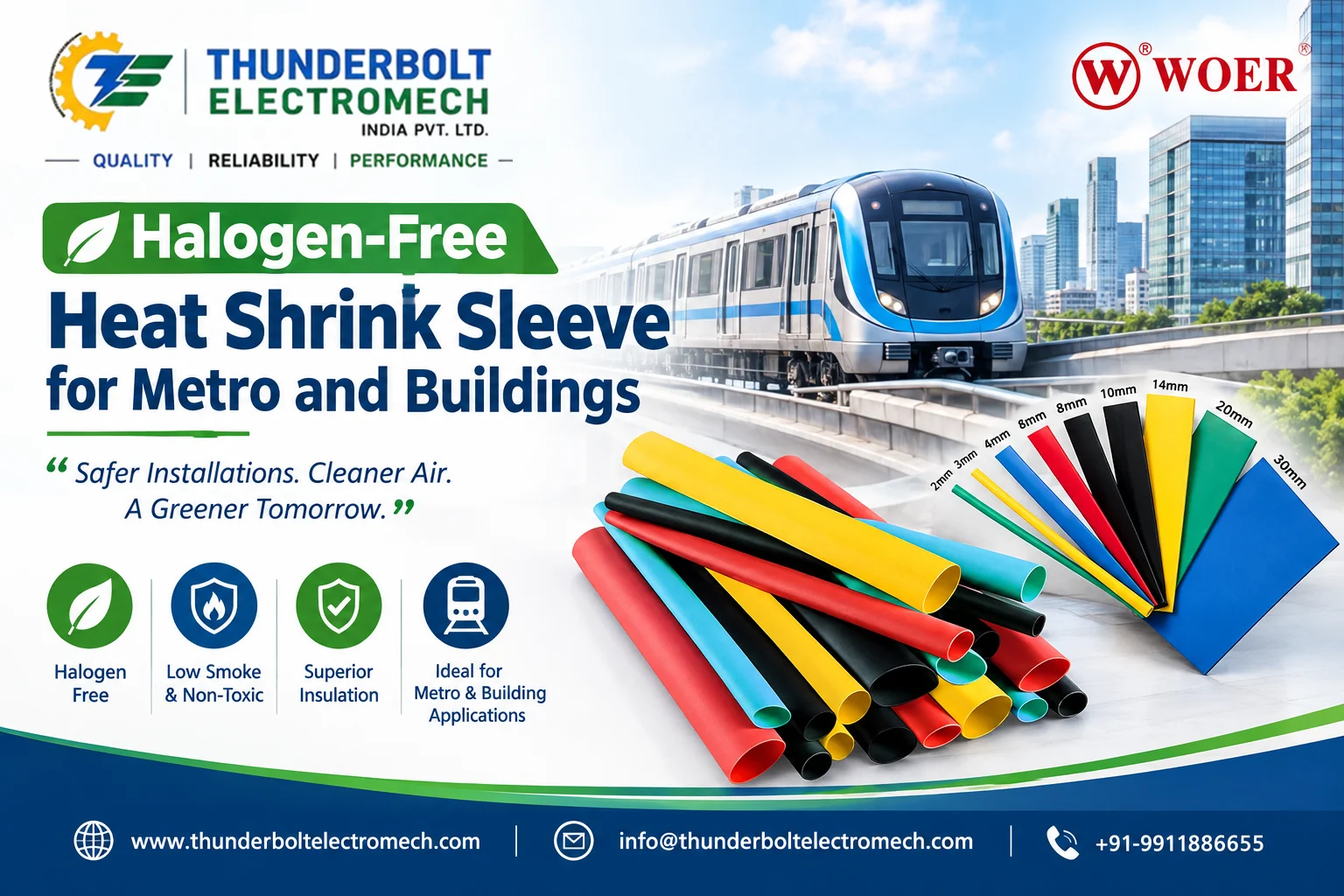
Quick Answer: Use halogen-free, flame-retardant heat shrink sleeves in tunnels, hospitals, public buildings and rolling stock, where smoke has nowhere to go. Ask your heat shrink tubing supplier India for the exact test reports your specification names. RoHS compliance alone does not prove a sleeve is halogen-free, and a “flame retardant” label says nothing about toxic gas or smoke density.
Introduction
A fire in an enclosed space rarely kills with flames. It kills with smoke. A metro tunnel, a hospital riser or a basement car park traps whatever the burning material gives off, and halogenated plastics give off a nasty mix: dense black smoke and acid gas that wrecks lungs, eyes and electronics within minutes. A good Heat Shrink Sleeve Supplier helps you avoid that mix before the first cable joint is made. We work from Chawri Bazar as a distributor of WOER heat shrink sleeves, and many contractors ask us for a halogen free heat shrink sleeve Delhi site teams can actually verify, not just one that carries a green leaf on a carton.
The trouble starts on paper. Spec sheets mix three different ideas: flame retardant, RoHS compliant and halogen-free. Buyers treat them as one. They are not. Each term describes a different property, each has its own test, and a sleeve can pass one while failing the other two.
This guide explains the differences from an engineering angle. You will see which standards matter, which reports to request, where sleeves fail in real installations, and how to write a specification line that a consultant cannot misread. If you want sizing and shrink ratio basics first, read our pillar guide on how to choose the right diameter and shrink ratio, then come back here for the fire-safety side. More articles sit in our heat shrink sleeve category.
Why Halogens Become a Problem in Tunnels, Hospitals and Rolling Stock
Halogens are fluorine, chlorine, bromine and iodine. Plastics use them for one reason: they make a material hard to ignite. Chlorine in PVC and bromine in many flame-retardant additives interrupt the burning reaction in the gas phase. That helps in an open workshop. It hurts in a closed one.
When a halogenated sleeve burns or smoulders, it releases hydrogen chloride or hydrogen bromide. These gases mix with moisture in the air and on the lungs and turn into hydrochloric or hydrobromic acid. Three things follow.
First, people cannot see. Halogenated materials tend to produce dense, dark smoke. Exit signs disappear. Evacuation slows.
Second, people cannot breathe. Acid gas irritates eyes and airways at low concentrations. A crowd in a metro station platform has no time for that.
Third, equipment dies after the fire. Acid gas condenses on circuit boards, switchgear contacts and signalling relays. Corrosion keeps working for weeks after the flames go out. We have seen restoration budgets exceed the cost of the fire damage itself, simply because chloride residue got into control panels.
So the places where a halogen-free sleeve earns its price are the same places where people and critical equipment share a sealed volume:
- Metro tunnels, underground stations and cable galleries
- Rolling stock, including coaches, under-frame boxes and traction cabling
- Hospitals, especially operation theatres, ICUs and diagnostic rooms
- Airports, malls, data centres and high-rise buildings with long vertical risers
- Basements, car parks and service shafts with limited ventilation
A short rule helps here. If people cannot leave quickly, or if the equipment cannot be replaced quickly, specify low smoke and halogen-free.
Flame Retardant, RoHS and Halogen-Free: Three Claims, Three Different Tests
This is the section that saves projects from rejected submittals. Read it twice.
Flame retardant
Flame retardant means the material resists ignition and limits flame spread. Tests such as VW-1 (a vertical wire flame test in UL 224) check how the sleeve behaves when you hold a flame to it. A sleeve can pass and still contain chlorine or bromine. In fact, many older flame-retardant sleeves pass precisely because they contain halogens.
RoHS compliant
RoHS restricts a short list of substances: lead, mercury, cadmium, hexavalent chromium, two brominated flame retardants (PBB and PBDE) and, in the current version, four phthalates. That is all. RoHS says nothing about total halogen content, acid gas output or smoke density. A sleeve can carry a different brominated or chlorinated flame retardant that RoHS does not list and still receive a RoHS declaration. This point comes from general engineering knowledge and from how the directive is written, not from a vendor datasheet. Treat a RoHS certificate as proof of one thing only: the restricted substances stay under their limits.
Halogen-free
Halogen-free describes chemistry. The polymer and its additives contain no meaningful level of fluorine, chlorine, bromine or iodine. Labs check this through tests on the combustion gases, most often under the IEC 60754 series:
- IEC 60754-1 measures the amount of halogen acid gas released.
- IEC 60754-2 measures acidity (pH) and conductivity of the gas dissolved in water.
The commonly quoted limits for low-smoke halogen-free materials are under 0.5 percent halogen acid gas by weight, pH of at least 4.3 and conductivity of no more than 10 microsiemens per millimetre. Confirm the limits against the standard version your specification cites.
Low smoke
Low smoke is a fourth claim that buyers forget. IEC 61034 measures smoke density in a three-metre cube. A material can be halogen-free and still produce a lot of smoke. Rail and metro specifications ask for both.
The practical result
A datasheet that says “flame retardant, RoHS compliant” tells you nothing about toxic smoke. A datasheet that says “halogen-free” without a report tells you only what the marketing team believes. Ask for the report with the test method, the result and the batch or product code it covers.
Standards to Name in Your Specification
Vendor datasheets for halogen-free polyolefin tubing aimed at rail, transit vehicles and buildings commonly cite a cluster of standards. Here is what each one tells you and what it does not.
ASTM D2671. This is the test method standard for heat-shrinkable tubing used in electrical insulation. It covers properties such as longitudinal change, tensile strength, elongation, dielectric strength and low-temperature flexibility. It defines how to test, not what pass looks like. Your specification needs to name the limits too.
UL 224 and VW-1. UL 224 is the standard for extruded insulating tubing. A listing to this standard, with the VW-1 flame rating, tells you the tubing resists flame in a vertical test. It gives confidence on flame behaviour. It does not prove halogen-free chemistry.
IEC 60684-3-216. The IEC 60684 series covers flexible insulating sleeving. The 3-216 part is a specification sheet for heat-shrinkable, flame-retarded, halogen-free polyolefin sleeving. Some vendors cite it for halogen-free products. Because it is a material specification, it gives you a clear target to put in a purchase order.
London Underground requirements. Some products cite London Underground fire-safety requirements. Metro operators in many countries borrowed this approach, which sets limits on smoke and toxicity. If your client is a metro authority, check whether the tender document names an equivalent.
EN 45545. This is the European railway fire-protection standard. Rail-grade dual wall tubing is built to this standard for flame retardancy, smoke and toxicity. It sorts materials by hazard level (HL1 to HL3) and by the place where the part is installed. The higher the hazard level, the stricter the limits. Part 2 of the standard defines the requirements. If you work on rolling stock, ask which requirement set applies to the component, because the sleeve falls under the rules for its location and size.
IEC 60754 and IEC 61034. These are not sleeve standards, but they provide the gas and smoke test methods that many halogen-free claims lean on. When a vendor says “tested to IEC 60754”, ask which part and ask for the report.
A specification line that works
Vague lines produce vague deliveries. Try wording like this:
Heat shrink sleeves shall be halogen-free, cross-linked polyolefin, flame retarded, with test reports for halogen acid gas content and acidity (IEC 60754-1 and -2), smoke density (IEC 61034) and flame test (UL 224 VW-1 or equivalent), submitted per product code before approval.
Adapt it to your project. The point is simple: name the property, name the test, name the document.
How to Choose a Halogen-Free Heat Shrink Sleeve Supplier for Metro Projects
The right Heat Shrink Sleeve Supplier does more than ship cartons. On a metro or building project, the supplier sits between your submittal and the consultant’s approval. Judge them on five points.
1. Reports that match the product code. A test report for a different wall thickness or a different material grade is not a report for your sleeve. Ask the supplier to map each report to the exact product you will receive.
2. Clarity on what the sleeve contains. Ask for the base polymer, the flame-retardant system and whether the sleeve is plain wall or dual wall with an adhesive lining. The adhesive matters, and we explain why in the next section.
3. Batch traceability. If a consultant asks for a retest, the supplier should trace the batch back to the manufacturer.
4. Honest answers about limits. A trustworthy supplier says “this series is flame retardant but not rated for your hazard level” when it is true. Walk away from anyone who says yes to every question.
5. Stock and support nearby. Site work stops when a sleeve size runs out. A supplier close to your project can deliver a missing size the same week.
As a distributor of WOER heat shrink sleeves, we ask each buyer for the specification clause first, then we match the product and the paperwork to it. That order avoids most rejections.
Engineering Details That Spec Sheets Rarely Mention
Most blogs stop at the standards list. Site failures come from details one level lower. Here are the ones we see most often.
The adhesive can break your halogen-free claim
Many sleeves for cable joints and busbars use an inner layer of hot-melt adhesive to seal against moisture. The outer tube may be halogen-free polyolefin while the adhesive is a different polymer with its own chemistry. A report that covers only the outer wall leaves the adhesive layer unexamined. If your specification demands halogen-free, ask whether the report covers the whole assembly, tube and adhesive together.
Wall thickness changes the fire result
A thicker wall holds more fuel. It can also insulate the cable better and resist flame longer. Test reports usually apply to a defined thickness range. A sleeve in a different size family may fall outside the tested range. Match the report to the size you buy, not just the series name.
Shrink ratio and recovered wall
A 3:1 sleeve shrinks to one third of its supplied diameter, and its wall grows thicker as it does. Engineers often check the supplied diameter against the cable and forget the recovered diameter and wall. Choose a size where the sleeve recovers fully with room to spare over the largest cable diameter in the joint, including any lug barrel or tape build-up. Our sizing guide walks through the arithmetic.
Installation heat can damage the cable first
Halogen-free polyolefin sleeves recover at temperatures that the cable sheath often tolerates, but a long dwell with a hot gas torch in a confined tunnel can scorch an LSZH cable sheath, which is also fire-retardant but sensitive to local overheating. Use a gas torch with a soft flame, keep it moving, and start the shrink from the centre. Work toward the ends so the air escapes. A trapped air pocket becomes a moisture path.
Hot work in enclosed spaces needs a permit
A naked flame in a tunnel or cable gallery needs a hot work permit on most sites. Many contractors discover this on the day of installation. Plan for it. Where a flame is not allowed, ask about heat guns with the right output and about cold-applied alternatives for the joint design.
Smoke from the installation itself
Sleeves give off small amounts of fumes while shrinking for the first time, especially adhesive-lined ones. In a closed room, ventilate. Keep this in mind in hospitals, where the area around a live ward needs extra care.
Fluoropolymer sleeves are a special case
Some sleeves, such as PTFE, FEP or PVDF types, contain fluorine on purpose. They serve high-temperature and chemical-resistance jobs. They are halogenated by definition, so they do not satisfy a halogen-free clause. Do not mix them up when someone asks for a quick substitute.
Storage and ageing
Cross-linked polyolefin sleeves keep their properties well, but heat and sunlight in a site store can age the adhesive and the surface. Keep cartons shaded, dry and off the floor. We cover this in more depth in other posts in the heat shrink sleeve category.
Customer Problems and Solutions
Contractors and consultants bring us the same handful of problems. Here are the problems and what works.
Problem: The datasheet says RoHS compliant, and the consultant wants halogen-free proof.
Solution: Request the IEC 60754-1 and -2 reports for the exact product code. Add them to the submittal. Do not argue the point with a RoHS certificate.
Problem: The tender names EN 45545, but the sleeve datasheet does not mention it.
Solution: Ask the supplier whether the product has been tested to the relevant requirement set for your hazard level and component location. If the answer is no, choose a product that has been.
Problem: The site uses LSZH cable, and someone proposes a PVC sleeve to save money.
Solution: Explain the weakest-link point. A single PVC component in an LSZH system adds chlorine back into the fire scenario. The cost saved on sleeves is tiny compared with the rework after a failed inspection.
Problem: The sleeve passed the flame test, so the team assumed it was low smoke.
Solution: Flame and smoke are separate tests. Ask for smoke density (IEC 61034) results as well.
Problem: The joint failed a moisture test after installation.
Solution: Check the sleeve type. A plain wall sleeve has no adhesive and does not seal against moisture. Use an adhesive-lined sleeve where sealing matters, and confirm the adhesive meets the project’s fire requirement.
Problem: A size ran out, and the site wants a substitute from another series.
Solution: Do not swap series without checking the report coverage. A different series may have different tested thickness and chemistry.
Problem: The consultant rejects a datasheet that is only a brochure.
Solution: Ask for the laboratory report, with test date, method and sample description. Brochures are marketing. Reports are evidence.
Comparison Table: Sleeve Types for Enclosed Spaces
This table compares three common sleeve families on the points that matter in tunnels and buildings. Values are general guidance. Always confirm against the product’s own datasheet and reports.
| Property | PVC-based sleeve | Halogenated flame-retardant polyolefin | Halogen-free flame-retardant polyolefin |
| Halogen content | High (chlorine) | Present (usually bromine or chlorine additives) | Not intentionally present; verify by IEC 60754 report |
| Acid gas on burning | High | Moderate to high | Low |
| Smoke density | Typically heavy | Often heavy | Low when tested to IEC 61034 |
| Flame test (for example VW-1) | Often passes | Often passes | Passes when designed for it |
| Suitable for tunnels and metro | No | Usually no | Yes, with the right reports |
| Suitable for hospitals and public buildings | Poor choice | Poor choice | Yes |
| Passes a RoHS declaration | Possible | Possible | Possible |
| Cost | Lowest | Medium | Higher per metre, lower lifecycle risk |
| Main risk | Toxic smoke, corrosion | Hidden halogens behind a flame-retardant label | Mismatched report, wrong thickness or adhesive |
Notice the RoHS row. All three can carry a declaration. That is the whole argument of this article in one line.
Case Study: A Metro Station Fit-Out and the Datasheet That Did Not Match
Note: the figures and details below describe a typical situation we meet on MEP and metro projects. Replace them with your own project data before publishing, and add the client’s permission where needed.
An MEP contractor was fitting out an underground station for a metro corridor. The cable schedule called for LSZH power and control cables. The tender clause for accessories said “flame retardant, low smoke, halogen-free”. The procurement team sourced heat shrink sleeves for terminations and for repair of cable sheaths in the cable galleries.
The first submittal carried a brochure with the words “flame retardant” and “RoHS compliant”, plus a VW-1 listing. The consultant rejected it for one reason: no report for halogen acid gas content, and no report for smoke density. The brochure answered the wrong question.
The contractor lost two weeks while the team chased paperwork. During that time the installation crew had already started laying cable, and the schedule slipped.
We stepped in with a short process:
- We read the exact tender clause and listed the properties it named: halogen-free, flame retarded, low smoke.
- We matched those properties to WOER halogen-free sleeve products and asked for the test reports tied to each product code.
- We checked that the reports covered the sizes on the cable schedule, not just a sample size.
- We asked whether any adhesive-lined sleeve in the list met the same requirement as the outer tube.
- We packaged datasheets, reports and a short compliance table into one submittal.
The consultant approved the second submittal without comments on the sleeve section. The contractor saved the cost of a second rejection and avoided buying a stock of non-compliant material.
The lessons apply to any project:
- Start from the clause, not the catalogue. Write down what the specification demands, then look for a product.
- Keep reports with the product code. A report without a code is a brochure with extra steps.
- Check the adhesive. The weakest layer decides the answer.
- Submit early. Submittals that include the right reports on day one cut weeks from the approval cycle.
Heat Shrink Sleeve Supplier Checklist: What to Request Before You Order
Use this checklist when you request quotes. A responsible Heat Shrink Sleeve Supplier will answer each line without delay.
Documents
- Product datasheet with material type, shrink ratio, recovered wall thickness and temperature range
- Test report for halogen acid gas content and acidity (IEC 60754-1 and -2)
- Test report for smoke density (IEC 61034)
- Flame test evidence (UL 224 VW-1 or the IEC equivalent your tender names)
- Reference to ASTM D2671 test results for physical properties
- Reference to IEC 60684-3-216 where your specification asks for it
- EN 45545 test evidence and hazard level for rolling stock work
- RoHS declaration, treated as a separate item
Product questions
- Does the halogen-free claim cover the adhesive layer?
- Which size range does each report cover?
- What is the minimum and maximum cable diameter for each size?
- What recovery temperature and installation method does the maker recommend?
- What shelf life and storage conditions apply?
Commercial questions
- Which sizes are in stock in Delhi/NCR?
- What is the delivery time for a full project quantity?
- Can the supplier help with a submittal package?
A supplier who cannot answer these questions probably does not hold the paperwork. Better to find out before you place the order.
Why Buy From a Heat Shrink Sleeve Supplier in Delhi/NCR
Project work in Delhi, Gurugram, Noida, Ghaziabad and Faridabad moves fast, and metro extensions, hospitals and commercial towers all need accessories on short notice. A nearby Heat Shrink Sleeve Supplier cuts transit time, helps with urgent size requirements and allows physical checking of the sleeve before the order closes.
Suppliers in the Chandni Chowk and Chawri Bazar electrical market have served contractors for decades because buyers can see stock, compare sizes and collect material the same day. We combine that local access with a full range of WOER heat shrink sleeves.
Buyers search in different ways. Some look for a flame retardant heat shrink sleeve Delhi NCR because their project is in the region. Others look for a heat shrink sleeve dealer Delhi so they can visit and pick up material. We serve both.
Heat Shrink Tubing Supplier India: Supply Beyond Delhi
Metro lines and building projects run across states. Contractors outside Delhi often ask us for halogen free heat shrink tubing supplier India support: datasheets by email, reports by product code and dispatch by transport. We handle outstation orders the same way as local ones. You send the specification, we reply with matching products and papers.
Projects may use different names for the same product class. You may see LSZH heat shrink sleeve, low smoke zero halogen sleeve and halogen-free polyolefin tubing in tenders. They point at the same idea, but the report still decides the outcome. Likewise, a tender for flame retardant heat shrink tubing India may mean halogen-free or may not. Read the clause carefully and ask us if the wording is unclear.
Trust and Contact: Your Heat Shrink Sleeve Supplier in Chawri Bazar, Delhi
We are Thunderbolt Electromech India Pvt. Ltd., a Delhi-based supplier of electrical safety and cable accessory products, and a distributor of WOER heat shrink sleeves in Delhi/NCR. If you need a heat shrink sleeve dealer Delhi contractors can reach by phone and visit in person, these are our details.
Company: Thunderbolt Electromech India Pvt. Ltd.
Registered office: Shop No. 3538, Sitaram Bazar Rd, Bazar Sirkiwalan, Chawri Bazar, Chandni Chowk, Delhi, 110006
Phone: +91-9911886655
Email: info@thunderboltelectromech.com
What to send us for a fast reply:
- The tender or specification clause for the sleeve
- Cable type and outer diameter at the joint
- Quantity and delivery location
- The reports your consultant expects
Send these details by email or call us. We reply with matching products and the supporting documents.
Frequently Asked Questions
Is a flame-retardant sleeve the same as a halogen-free sleeve?
No. Flame retardant describes how the material resists fire. Halogen-free describes its chemistry. A sleeve can be one without the other.
Does a RoHS certificate prove a sleeve is halogen-free?
No. RoHS limits a short list of substances and does not set a halogen limit. Ask for IEC 60754 reports.
Which standards do rail projects cite?
Rail-grade tubing is built to EN 45545 for flame retardancy, smoke and toxicity. Some products also cite London Underground requirements. Always follow the standard named in your own contract.
Can I use a halogen-free sleeve with an ordinary PVC cable?
Yes, but the system is only as safe as its weakest part. For enclosed spaces, match the cable and accessories.
Do I need a hot work permit to install heat shrink in a tunnel?
Most sites require one for a gas torch. Check the site rules and plan the heat source before the crew arrives.
Conclusion: Choose the Right Heat Shrink Sleeve Supplier and the Right Paperwork
Smoke decides how a fire ends in a tunnel, a hospital or a train. Halogen-free, flame-retardant sleeves reduce acid gas and dense smoke at the exact points where cables are joined and repaired. Choosing them is a small change in the cable accessory list and a large change in the fire scenario.
Three points matter most. Use halogen-free, flame-retardant sleeves in tunnels, hospitals, public buildings and rolling stock. Ask for the specific reports your project specification names, matched to the product code and size. And never accept RoHS compliance alone as proof that a sleeve is halogen-free.
A careful Heat Shrink Sleeve Supplier turns those three points into a clean submittal. Thunderbolt Electromech India Pvt. Ltd. supplies the WOER range from Chawri Bazar, Delhi, and supports contractors and consultants across India. Call +91-9911886655 or write to info@thunderboltelectromech.com with your specification, and we will match the sleeve and the reports to it. For sizing help, read our pillar guide, and browse more articles in the heat