
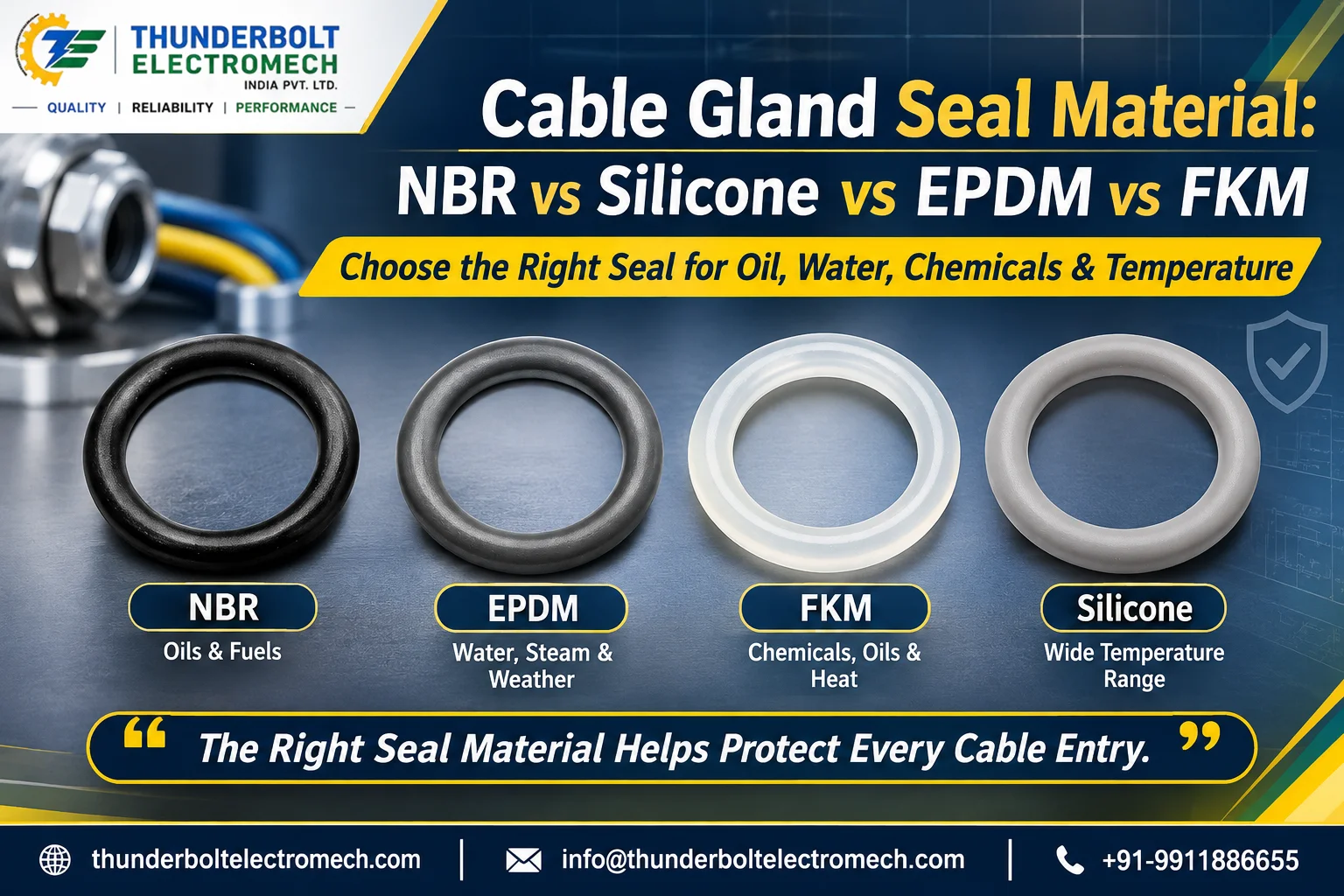
Quick Answer: Match the elastomer to the exposure. Choose NBR where oil touches the gland, EPDM for weather, ozone and steam, silicone for a very wide temperature span, and FKM for aggressive chemicals and sustained heat. Cable gland seal material matters more than the IP number on the carton. A good Cable Gland Supplier India will show you the datasheet temperature range, not just the rating. Ask for oil resistant cable gland India options by exposure.
Introduction
A gland seal does one quiet job for years. It squeezes a cable sheath and keeps dust, water and oil out of an enclosure. Then a hot summer arrives, the seal goes hard, and the enclosure starts to breathe. We hear about this every month as a Cable Gland Supplier India serving Delhi NCR plants, and the pattern repeats: the gland body is fine, the thread is fine, the seal gave up. Maintenance heads who search for an oil resistant cable gland supplier Delhi usually describe the same scene. A pump room at 50 degrees. A terminal box too hot to touch. A gland that passed IP68 on the day it was bought and now weeps oil.
This guide explains why that happens and how to pick between the four elastomers that dominate industrial glands: NBR, silicone, EPDM and FKM. You will see where each one wins, where each one fails, and why a room-temperature IP rating says little about a seal that has aged in the heat. For the wider buying checklist, read our pillar guide on how to choose the right cable gland for industrial projects. More articles sit in the cable gland category.
What a Gland Seal Actually Does (and Why It Fails Quietly)
A compression gland works like a clamp made of rubber. You tighten the dome nut, the nut squeezes the seal insert, and the insert flows against the cable sheath and the gland body. The seal keeps sealing only while it pushes back. That push comes from the rubber’s elastic recovery.
Heat attacks exactly that property. Over months at high temperature, the polymer network relaxes and the rubber stops springing back. Engineers measure the loss as compression set: squeeze a rubber sample to a fixed percentage, hold it hot for a fixed time, release it, and see how much thickness it fails to recover. Test methods such as ASTM D395 (method B) and ISO 815 describe the procedure. A set of 0 percent means the rubber fully recovered. A set of 100 percent means it stayed flat, and a flat seal has no push left.
This explains a puzzle that confuses many buyers. The gland leaks even though nobody loosened it. The seal still sits in place. It just no longer presses.
Why a room-temperature IP rating says little after heat ageing
IP ratings under IEC 60529 describe an enclosure at the time of the test, normally at room conditions and with new parts. The test does not age the seal for 2,000 hours at 90 degrees and then retest. So an IP68 gland tells you the design can seal when the rubber is fresh. It does not tell you how long the rubber keeps its spring in a hot pump room.
Two more details sharpen the point:
- Static and dynamic ranges differ. Several gland datasheets we reviewed from European and Asian makers list a static range such as -40 to +100 degrees, with a short-time peak of 120, and a narrower dynamic range such as -20 to +80, with a short-time peak of 100. The cable sits in the gland, vibrates and moves, so the dynamic figure often describes the real world better.
- The listed range may belong to the whole gland, not the seal. A nylon body, an NBR seal and an EPDM O-ring can sit in one product, each with its own limit. The lowest limit wins.
So confirm the temperature range on the datasheet, and ask which part of the assembly that range covers.
Cable Gland Seal Material: The Four Elastomers in Plain Engineering Terms
Before the head-to-head, here is what each rubber is and why it behaves the way it does.
NBR (nitrile butadiene rubber)
NBR is a copolymer of acrylonitrile and butadiene. The acrylonitrile (ACN) fraction sets the balance. More ACN improves oil resistance and hurts low-temperature flexibility. Gland makers commonly use medium-ACN grades. Datasheets for NBR seals typically quote roughly -20 to -40 degrees at the cold end and about 100 degrees at the hot end, with short peaks a little higher.
NBR swells little in mineral oils, hydraulic fluids and greases. It handles water well. Its weak points are ozone and sunlight, which crack the surface unless the compound carries protective additives, and sustained heat above its rating, which drives hardening.
EPDM (ethylene propylene diene monomer)
EPDM has a saturated polymer backbone, so ozone, UV and weathering barely touch it. Datasheets commonly list about -40 to +90 or +100 degrees, and some metal compression glands quote up to +120. Peroxide-cured grades show lower compression set than sulphur-cured grades, which matters in hot service.
EPDM tolerates hot water and steam far better than NBR. Its big weakness is hydrocarbon oil. Mineral oil, diesel, grease and many cutting fluids make EPDM swell and soften. That single fact causes more gland failures in factories than any temperature figure.
Silicone (VMQ)
Silicone has a backbone of silicon and oxygen, which gives it the widest temperature span of the four. Datasheets quote about -60 to +180 degrees for gland seals, and some inserts reach 200. It stays soft in the cold, resists UV and ozone, and shows low compression set at high temperature.
Its weaknesses are mechanical and chemical. Silicone tears easily, so a sharp armour edge or a rough cable lay can cut it during tightening. It swells in many oils and fuels. Hot steam can degrade it in closed spaces. And it costs more than NBR and EPDM.
FKM (fluoroelastomer, often called Viton type)
FKM carries fluorine in its structure, which gives it strong resistance to oils, fuels, acids and many solvents, plus good heat stability. Gland datasheets for FKM-sealed plastic glands often quote an upper limit near 150 degrees, with metal glands going higher. Standard grades stiffen in the cold, and many lose their sealing ability somewhere near -20 degrees unless the compound is a low-temperature type.
FKM resists ozone well. It suffers in hot water, steam, strong amines and ketones such as acetone. It also costs the most.
Quick Selection Rules by Exposure
Start from the exposure, not the material name.
- Oil contact, hydraulic mist, lubricant drip: NBR first, FKM when heat or chemicals join in.
- Outdoor, sunlight, ozone, monsoon, steam wash: EPDM.
- Wide swings from very cold to very hot, or high steady heat without oil: silicone.
- Hot oil, acids, solvents or fuels at high temperature: FKM.
- Food and pharma areas: ask for the food-grade or FDA-compliant seal grade, often a coloured silicone, and confirm it on paper.
The next sections test these rules against real plant conditions.
Cable Gland Supplier India: Oil Resistant Cable Gland India Choices for Pump Rooms and Machine Shops
Oil is the most common reason we replace seals in Delhi NCR plants. Hydraulic presses, gearboxes, compressors, lubrication skids and CNC coolant mists all coat glands with hydrocarbons. A Cable Gland Supplier India serving factories in Faridabad, Manesar, Bawal, Noida and Ballabgarh sees EPDM seals in these places more often than anyone would like, because the gland arrived as a general-purpose item and nobody checked the exposure.
Here is the problem in numbers a maintenance head can relate to. A swollen seal grows in volume. The nut that was tight on day one is now squeezing a seal that has changed shape, and when the oil film dries or the plant cools, the seal shrinks again and leaves a gap. Swelling and shrinking cycles loosen glands faster than any vibration.
Use NBR when the oil is mineral-based, the temperature stays at or below about 100 degrees at the gland, and the cable jacket resists oil too. Use FKM when the temperature climbs past that limit or the fluid includes synthetic esters, aggressive coolants or fuel.
Two practical checks:
- Check the cable, not just the seal. Oil-resistant glands do little good on a plain PVC sheath that softens in oil. Ask for oil-resistant cable or sleeve the exposed section.
- Check the compound grade. Not every NBR performs the same. Ask for the datasheet range and the oil test basis, for example immersion in a standard reference oil under ASTM D471.
We stock glands from Dowells, Comet and HMI in the high range, and Diamond and MIC in the medium range. The seal options differ between series and sizes, so send us the exposure and we confirm the available elastomer on the datasheet before you order.
High Temperature Cable Gland India: Heat, Hot Pump Rooms and Real Seal Temperature
A hot pump room does not mean hot seals at ambient temperature. It means hotter seals. Consider the heat sources that reach a gland in a typical NCR plant:
- Ambient air. Summer peaks in Delhi NCR run past 45 degrees outdoors, and enclosed pump rooms and plant rooms climb higher.
- The enclosure itself. A motor terminal box often runs close to winding temperature on a loaded motor. The box wall can exceed the room air by tens of degrees.
- The cable. A conductor loaded near its rating carries heat into the gland along the cable. The seal sits against a sheath that may already reach 70 to 90 degrees.
- Radiation and conduction. Steam lines, hot pipework and sun-baked metal panels add heat that ambient thermometers miss.
Temperature also works on a curve, not a line. A common engineering rule of thumb says that ageing reactions in rubber roughly double in speed for each 10-degree rise. Treat it as a rule of thumb, not a guarantee, but it explains why a seal rated to 100 degrees may last years at 70 and only months at 95.
How to measure instead of guess
Take a contact thermometer or an infrared gun to the gland body at full load in peak season. Add a margin for the seal sitting inside the metal, where it usually runs hotter than the outer surface. Then compare the reading with the datasheet range of the actual seal. If the reading sits within about 15 to 20 degrees of the limit, move up one material class.
For continuous heat above about 100 degrees, silicone or FKM become the practical options. Silicone handles dry heat and wide temperature swings without oil. FKM handles heat with oil or chemicals. If you are looking for a high temperature cable gland Delhi NCR factories can rely on, send us the measured temperature and the fluids in the area, and we match a gland series and seal grade to them.
Weather, Ozone and Steam: Where EPDM and Silicone Earn Their Place
Outdoor sites punish rubber in a different way. Sunlight, ozone and moisture attack the polymer chain rather than the sealing surface. Cracks start on the outside and creep inward, and a seal with fine surface crazing still looks fine from a metre away.
EPDM and silicone resist ozone and UV well. NBR resists them poorly unless the compound has protective additives, and even then it ages faster outdoors. In solar plants, roof-top panels, cooling-tower areas and street lighting feeders, choose EPDM or silicone for the gland seal.
Two cautions apply:
- Steam. EPDM copes with steam and hot water well. Silicone copes less well in closed, hot, wet environments. FKM does poorly in many steam conditions. If the gland sits near steam tracing or steam wash-down, EPDM is the safe starting point.
- Ozone near switchgear. Electrical discharge produces ozone in small enclosures. NBR seals inside such enclosures sometimes crack earlier than their outdoor cousins. Keep this in mind when you pick seals for switchrooms with partial discharge activity.
Comparison Table: NBR vs Silicone vs EPDM vs FKM
Values below are typical ranges from gland datasheets and elastomer references. Compounds vary by grade, so always confirm against the datasheet of the exact seal.
| Property | NBR | Silicone (VMQ) | EPDM | FKM |
| Typical temperature range in glands | About -20 to +100 °C | About -60 to +180 °C (some to 200 °C) | About -40 to +90 or +100 °C (up to +120 °C in some designs) | About -20 to +150 °C or higher; low-temperature grades extend the cold end |
| Mineral oil and grease | Good | Poor to fair (swells) | Poor (swells badly) | Excellent |
| Hot water and steam | Fair | Fair, limited in closed hot wet spaces | Excellent | Poor to fair |
| Ozone and UV | Poor unless protected | Excellent | Excellent | Excellent |
| Compression set at heat | Fair; worsens near upper limit | Good at high temperature | Good with peroxide cure | Good to excellent |
| Tear and cut resistance | Good | Poor | Good | Good |
| Acids and solvents | Limited | Limited | Good with polar fluids, poor with hydrocarbons | Excellent with most, weak with ketones and amines |
| Relative cost | Lowest | Higher | Low | Highest |
| Best fit | Oil contact, general industry | Wide temperature span, dry heat, UV | Outdoor, steam, ozone | Hot oil, chemicals, high heat |
One column carries the most important lesson: EPDM scores best on weather and worst on oil. Do not move it from an outdoor panel to an oily pump skid.
Customer Problems and Solutions
These are the cases that reach our counter in Chawri Bazar and our phone lines.
Problem: The gland leaks oil at the cable entry after one summer.
Solution: Check the seal first. If it is EPDM in an oily area, swap to NBR, or to FKM when the gland runs above about 100 degrees. Also check whether the cable sheath itself has swollen.
Problem: The seal looks fine but the enclosure fails an ingress check.
Solution: Measure the seal’s recovery. Remove the dome nut, press the insert out and compare its length with a new one. A seal that stays flattened has a high compression set. Replace it and pick a material with a higher temperature margin.
Problem: Seals crack on an outdoor panel after two monsoons.
Solution: Move from NBR to EPDM or silicone. Ozone and UV had probably been cutting fine cracks into the NBR surface.
Problem: A new gland rated IP68 fails in a hot terminal box.
Solution: Read the datasheet for the temperature limit of the seal, not the body. Measure the box temperature at full load. If it exceeds the dynamic range, move to silicone or FKM.
Problem: Silicone seals tear during installation on armoured cable.
Solution: Dress the armour cleanly, deburr the edges and tighten gradually. If the cable edge is sharp, use a harder seal grade or a gland designed for armoured cable. Do not over-tighten.
Problem: The cable jacket and seal stick together or the seal goes soft.
Solution: Plasticiser from some PVC jackets can migrate into the seal and change its hardness. Ask for compatibility between the jacket and the seal, and prefer a cable compound suited to the exposure.
Problem: The plant mixes oil and steam in the same room.
Solution: Split the exposures. Use NBR or FKM glands near oil points and EPDM near steam points. A single material for the whole room usually fails one of the two.
Problem: A purchase order says only “cable gland, IP68”.
Solution: Add seal material, temperature range, fluid exposure and cable type to the order line. A vague line gets the cheapest item that matches the thread.
Case Study: Hot Lube-Oil Pump Motors in an NCR Process Plant
Note: this case study is an illustrative scenario that reflects typical site conditions. Replace it with your own project details and client approval before publishing.
A process plant in the Delhi NCR belt ran lube-oil pumps in a closed pump house. Motor terminal boxes carried glands with standard NBR seals. During summer, glands began to weep a light film of oil, and the maintenance team tightened them. The leaks returned within weeks.
The team measured temperatures during peak load. Ambient inside the pump house reached the mid-40s. The terminal box wall sat near 90 degrees, and the gland body showed readings close to the upper limit of the NBR seal. Oil mist added a second load. The seals were not just hot, they were hot and wet with oil.
The maintenance team removed a failed seal and compared it with a spare. The old seal was shorter, stiff and glossy, and it had lost most of its rebound. That behaviour points to compression set from heat ageing, not to a loose nut.
The fix followed three steps:
- Reclassify the exposure. The glands saw oil and sustained heat, which moved them from the NBR class to the FKM class.
- Match the whole assembly. The team confirmed that the gland body, the O-ring and the seal insert all had datasheet ranges above the measured peak, with margin.
- Set an inspection point. The team marked a simple rule: pull one gland per pump bank each shutdown, and compare the seal length and hardness with a spare.
After the change, the glands stayed dry through the next summer cycle in the pump house. The cost per gland rose, but the repeat labour for re-tightening and cleaning fell away.
Three lessons carry over:
- Measure the temperature at the gland. Ambient readings mislead.
- Treat oil and heat as a combined load. A material that handles one often fails the other.
- Inspect the seal, not only the nut. Seal length against a new spare reveals set early.
Cable Gland Supplier India Checklist: What to Ask Before You Order
A dependable Cable Gland Supplier India answers these questions quickly and in writing.
About the seal
- Which elastomer sits in the seal insert, and which sits in the O-ring or flat gasket?
- What is the static and dynamic temperature range for that exact seal?
- Does the datasheet quote short-time peaks separately from continuous ratings?
About the evidence
- Is there data on heat ageing (for example ASTM D573), oil immersion (ASTM D471), ozone resistance (ASTM D1149) or compression set (ASTM D395)?
- Does the IP rating come from a test on new parts only?
- Do the approvals, such as hazardous-area certificates, cover the seal grade you plan to buy?
About your site
- Which fluids touch the gland: oil, coolant, steam, acid vapour or washdown chemicals?
- What temperature does the gland body reach at full load?
- Does the cable jacket suit the same exposure?
About supply
- Does the supplier hold the sizes and seal grades in stock?
- Can the supplier supply spare seal inserts, so you do not scrap a whole gland?
- Does the supplier give written confirmation of the seal material?
We answer these questions for the Dowells, Comet and HMI high-range series, and for the Diamond and MIC medium-range series. If you send the exposure details, we reply with the seal options for the series that fits.
Frequently Asked Questions
These questions reflect the searches and forum threads we meet most often from maintenance engineers, panel builders and buyers.
Which cable gland seal material is best for oil?
NBR is the standard answer for mineral oil, grease and hydraulic fluid. When oil comes with high temperature or aggressive chemicals, FKM performs better. EPDM is the wrong choice in oil because it swells.
Can I use an EPDM seal in an oily area?
Only for incidental contact with certain polar fluids. In mineral oil, EPDM swells and softens, then leaks when it shrinks again. If the exposure is oil, pick NBR or FKM.
What temperature can a silicone gland seal handle?
Most datasheets quote about -60 to +180 degrees, and some inserts go to 200. Silicone suits dry heat and wide swings. It tears more easily and swells in many oils, so check the fluid and the cable edge.
Why does my IP68 gland leak after a year?
IP68 describes new parts under test conditions. Heat, oil and ozone age the seal over time, and compression set removes its spring. The gland body stays intact while the seal loses its push.
Is NBR or FKM better for cable glands?
It depends on the load. NBR costs less and works well to about 100 degrees in oil. FKM handles hotter oil and chemicals, but it costs more and stiffens in the cold.
Does EPDM handle steam?
Yes, better than NBR, silicone or FKM in most cases. EPDM is the first choice near steam lines, as long as no mineral oil is present.
Can FKM seals work in winter?
Standard FKM stiffens as temperature drops, and many grades lose sealing ability near -20 degrees. Low-temperature FKM grades exist. Check the datasheet if the site sees sub-zero temperatures, for example in high-altitude installations.
How do I identify the seal material in an old gland?
Colour is not a reliable guide, since black rubber can be NBR, EPDM or FKM. Look for markings or the original datasheet, and check the supplier’s records. A lab test on a spare seal gives a firm answer.
Can I replace only the seal and keep the gland?
Often yes, when the same size and series insert is available. That saves cost and downtime, and it lets you upgrade the material. Confirm the insert fits the gland body and the cable range.
Do rubber seals expire in storage?
Yes. Heat, sunlight and ozone age rubber on the shelf. Store seals and glands in a cool, dry, shaded place away from motors and welding areas, and rotate stock on a first-in, first-out basis.
Is a nylon gland seal as good as a metal one?
The elastomer matters more than the body. Nylon bodies carry their own temperature limit, often near 100 degrees, so a heat-rated seal in a nylon body does not lift the ceiling. For hot areas, a metal gland gives the seal more room.
Where can I buy oil resistant glands near Delhi?
A local cable gland dealer Delhi buyers trust can show stock, datasheets and seal options before you pay. Our Chawri Bazar counter offers exactly that.
Why Buy From a Cable Gland Dealer in Delhi NCR
Project schedules in Delhi NCR leave little room for waiting. A missing gland size can hold up a panel dispatch, and a wrong seal can bring a crew back to site. A nearby Cable Gland Supplier India that holds stock and documents saves days.
Chawri Bazar has served the electrical trade for decades because buyers can compare parts in person, check threads and seal inserts, and carry material away the same day. We pair that local access with brands you can ask for by name: Dowells, Comet and HMI for demanding service, Diamond and MIC for general industrial work.
Buyers search in different ways. Some type oil resistant cable gland supplier Delhi because the plant sits in Okhla or Faridabad. Others type high temperature cable gland Delhi NCR because a boiler house or pump room keeps killing seals. Others search for a cable gland dealer Delhi to pick up urgent stock. We serve all three, and we ship outstation orders across India with the same paperwork.
Trust and Contact: Your Cable Gland Supplier in Chawri Bazar, Delhi
We are Thunderbolt Electromech India Pvt. Ltd., a Delhi-based supplier of electrical safety and cable accessory products. If you need a cable gland dealer Delhi plants can call, visit and rely on for written seal specifications, these are our details.
Company: Thunderbolt Electromech India Pvt. Ltd.
Registered office: Shop No. 3538, Sitaram Bazar Rd, Bazar Sirkiwalan, Chawri Bazar, Chandni Chowk, Delhi, 110006
Phone: +91-9911886655
Email: info@thunderboltelectromech.com
What to send for a quick reply:
- The gland size and thread type
- The cable type and outer diameter
- The fluids and temperature at the gland
- Indoor or outdoor location, and any hazardous-area requirement
Send these details by phone or email, and we reply with the right gland series and seal material.
Conclusion: Choose the Seal First, Then Choose Your Cable Gland Supplier India
A gland fails where its rubber fails. The body, the thread and the IP number get the attention, but the elastomer decides how the gland ages. NBR serves oil. EPDM serves weather, ozone and steam. Silicone serves wide temperature spans. FKM serves hot oil and chemicals. No single material wins everywhere, and every swap in the wrong direction has a visible cost.
Three habits prevent most failures. Read the datasheet temperature range, and ask which part it covers. Measure the heat at the gland, not in the room. And treat compression set as the measure of real service life, since a room-temperature IP rating says little about a seal after heat ageing.
A careful Cable Gland Supplier India puts the exposure first and the catalogue second. Thunderbolt Electromech India Pvt. Ltd. supplies Dowells, Comet and HMI glands in the high range, and Diamond and MIC in the medium range, from Chawri Bazar, Delhi. Call +91-9911886655 or write to info@thunderboltelectromech.com with your exposure details, and we will match the seal to the site. For the full buying checklist, read our pillar guide, and browse more articles in the cable gland category.