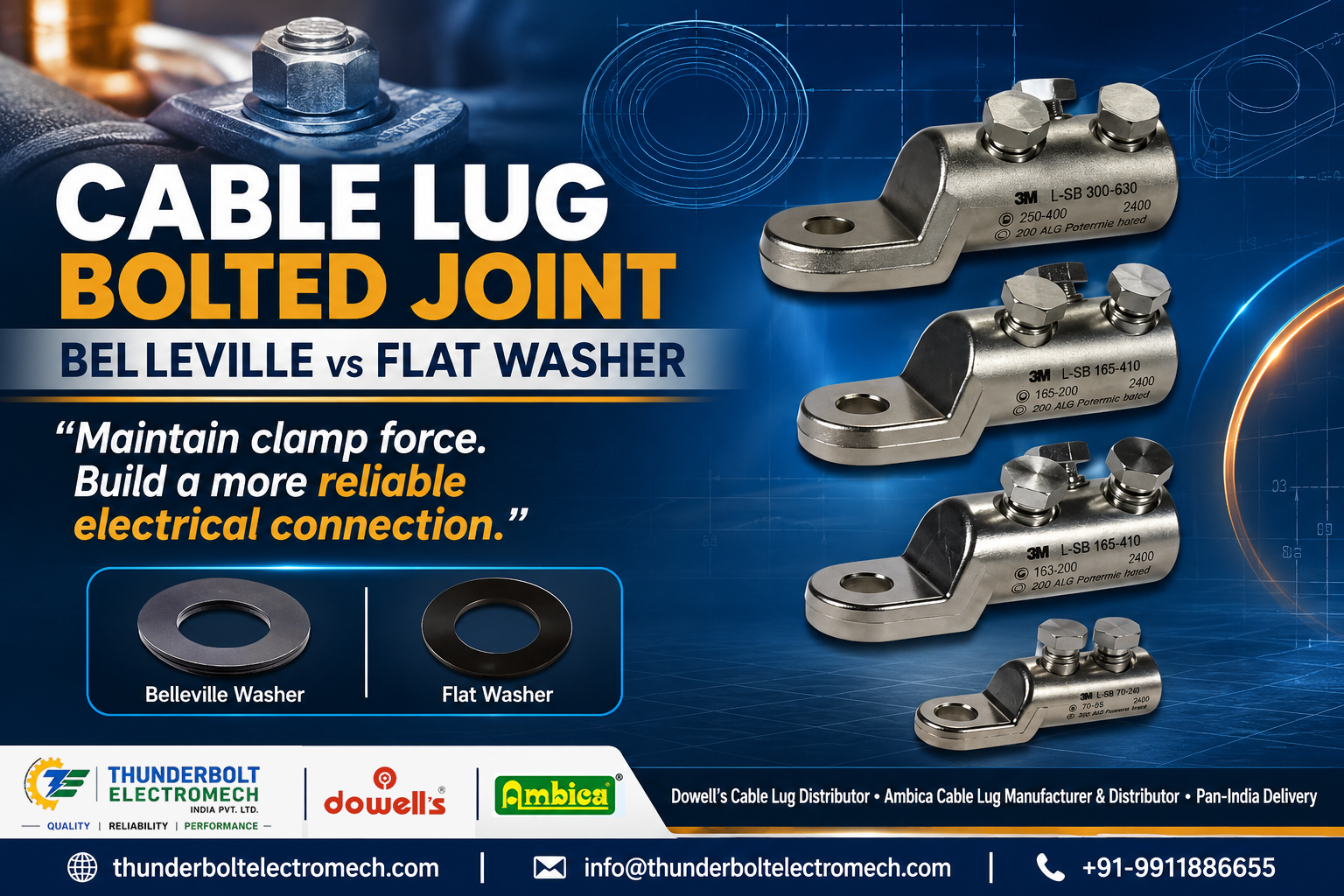
Quick Answer: A flat washer spreads load but cannot follow joint relaxation. A Belleville washer cable lug assembly can, provided you size the spring so it never bottoms out at your target torque. Soft aluminium bars embed more than copper, so they need a wide flat washer under the spring. Tighten to the washer maker’s data, run the load for several heat cycles, then re-check the cable lug bolted joint with a calibrated wrench and a thermal camera. Thunderbolt Electromech, a Cable Lug Supplier India, explains the sizing below.
Ask a maintenance engineer in Delhi NCR where a lug failed and you rarely hear “the crimp.” You hear “the palm.” The crimp passed its pull test. The lug looked perfect on commissioning day. Six months later a thermal camera shows the bolted face running far hotter than the identical joint on the next phase.
Thunderbolt Electromech works as a Cable Lug Supplier India panel builders reach from Delhi, and as a cable lug supplier Delhi teams call when a lug has to be swapped fast. The joint behind that hot palm is the subject of this guide. A cable lug bolted joint is a pressure contact. It works only while clamp force stays above a threshold, and that force shifts every time the busbar heats and cools.
Here is what you get: the physics of why force fades, an honest comparison of flat and Belleville washers, a worked numerical example with the arithmetic shown, a torque and re-check routine, and a field troubleshooting table. Where a figure comes from a washer maker and not from an independent test, the text says so.
Why a Crimped Lug Still Heats Up: What a Cable Lug Supplier India Wants You to Know About the Joint
Every lug connection holds two joints. The crimp is permanent: barrel and strands deform together and stay that way. The bolted palm is different. It is a pressure contact, and it holds only while someone keeps force on it.
Current does not cross a clamped interface evenly. It squeezes through tiny metallic spots where the surfaces truly touch, and clamp force sets how many spots form and how large they grow. Burndy’s reference section on pressure connections places total contact force at the centre of the design, and it treats oxide films as insulators that force must break (Source: Hubbell Burndy master catalog, section O).
Here is the finding most buyer guides skip. Burndy’s curves show that the relaxation path sits apart from the tightening path. Once a joint is tight, contact resistance rises only slightly as force relaxes. So a joint that loses some clamp force has not failed. Trouble starts when force slides below the knee of that curve, where resistance climbs fast. A good washer scheme does not chase a perfect preload. It keeps force above the knee for the life of the joint.
Three mechanisms push force down, and they work together.
- Differential expansion. Aluminium expands about 23 × 10⁻⁶ per kelvin, copper about 17, and a high-tensile steel bolt about 11. The bars and lug carry the current, so they run hotter than the bolt. That widens the gap, and bolt load swings on every cycle (Source: Solon Manufacturing; expansion values from a busbar-hardware guide, treat as typical handbook figures).
- Creep and stress relaxation. Aluminium creeps at ordinary ambient temperature under load. Copper needs roughly 150 °C to creep at a comparable rate, according to the same hardware guide, so read that number as approximate. Time, temperature and starting stress all drive the loss.
- Embedment. Microscopic high spots on threads, washers and mating faces flatten out. NECA’s Belleville installation notes list this as its own loosening source, alongside vibration.
Then the loop closes. Force drops. Resistance rises. The joint runs hotter, and the extra heat speeds up creep, especially in aluminium. Efficient Plant magazine described a condition that feeds on itself.
Scale makes it worse. Solon notes that the bolt in a typical grounding lug stretches only about 0.0005 in under preload, roughly 13 µm. Against a stretch that small, a few microns of settling is a big share of what the bolt had to give.
Delhi NCR adds its own cycle. Picture an outdoor kiosk panel on a January night, then the same panel after a May afternoon with a loaded feeder behind it. The busbar swings through that range every day.
Independent testing backs the washer as a real lever. Braunovic’s current-cycling work on high-ampacity aluminium connectors found that Belleville washers, plating and lubrication each improved joint performance. An Auburn University study of busbar material combinations found that surface roughness, torque and the presence of a Belleville washer were statistically significant variables.
Flat Washer Physics: Where Clamp Force Goes Missing, According to a Cable Lug Supplier India
A flat washer does one job well. It spreads bearing load, so the bolt head or nut does not bite into the lug palm or the bar. On soft aluminium that matters, and one aluminium busbar reference suggests a washer outside diameter near three times the bolt diameter (Source: Industrial Monitor Direct). For an M12 bolt, that means about 36 mm.
It cannot do a second job. A flat washer is stiff. It gives nothing and returns nothing. Every micron the stack settles is a micron of bolt stretch the bolt no longer holds, and the bolt turns that lost stretch straight into lost force. Because bolt and stack are both stiff, the loss per micron runs high. The worked example later in this guide puts it near 2.7% of preload per micron for an M12 joint with flat washers only.
Aluminium makes this worse. It embeds more under the washer than copper does, and the first few heat cycles do most of the damage. A joint that holds torque on installation day often reads low after its first loaded week.
The split lock washer deserves a blunt word, because many panels still carry one. It flattens at low load, then behaves like a flat washer with a notch cut in it. NECA/BICSI 607 speaks to this directly: where hardware faces thermal cycling, swap the lock washer for a flat washer plus a cupped spring (Belleville) washer (Source: Solon Manufacturing, quoting the standard). An industrial reference makes the same point from the torque side. A lock washer gives some anti-rotation, but it does not replace clamp force.
When does a flat washer alone make sense? In our engineering judgement, only when all of these hold:
- Both parts are copper, so expansion and creep stay modest.
- The load stays steady, without daily cycling from heaters, motors or chargers.
- The grip is short and stiff, and the bolt and nut are matched to the lug hole.
- Someone will check the joint with a torque wrench and a thermal camera on a schedule.
The moment aluminium enters the stack, the rule changes. NECA’s installation guidance for aluminium conductors on copper terminal lugs calls for a steel bolt with a Belleville spring washer, to absorb the different expansion rates. Bimetal and aluminium lugs on aluminium bars fall into the same group.
Belleville Washer Cable Lug Sizing: Rules From a Cable Lug Supplier India
A Belleville washer is a shallow cone of spring steel. Compress it and it stores energy. Let the joint settle by a few microns and it pushes back. DIN 6796 is the common metric standard for these washers, written for bolts of property class 8.8 to 10.9 (Source: Westfield Fasteners).
One rule governs everything else: the spring must still be a spring after the joint settles. Past roughly 95% deflection, a Belleville’s contact area grows and the washer bottoms out (Source: Wikipedia, Belleville washer). A washer driven flat gives no spring compensation (Source: Industrial Monitor Direct). Efficient Plant magazine frames the same idea for lugs: the spring must make up for creep and initial embedment, so joint reliability depends on how much deflection remains as the joint relaxes.
Size the spring with three questions
- How far will the stack settle? Add embedment, creep and thermal movement. Take the figure from test data or the washer maker. The worked example below assumes 8 µm.
- How much travel does your target preload use? Divide preload by the spring rate. That tells you how much of the washer’s deflection you spend on installation day.
- Does the remaining travel beat the settlement, with margin? If not, pick a taller cone, or stack two in series. Series stacking adds travel. Parallel stacking adds force.
Tolerances on spring rate and height are real, so leave margin. A spring sitting at 95% of flat has no room for error.
Stack order and orientation
NECA’s guidance puts the Belleville between the flat washer and the nut. One electrical-trade article adds two details: face the concave side of the cone toward the flat washer, and pick a flat washer whose outside diameter exceeds the flattened Belleville, at about twice its thickness (Source: EC&M, “Do bolted joints and connections get you uptight?”).
That large flat washer is not decoration. A DIN 6796 washer for M12 measures only 29 mm across (Source: Westfield Fasteners). Pressed directly on an aluminium bar, it concentrates the load. The worked example shows by how much.
For thick or soft stacks, such as a lug on a bar with a second lug behind it, one busbar-hardware guide recommends a spring at both the head and the nut, so each face absorbs its own settlement. That is a practitioner view and not a standard, but the logic holds: three interfaces can each settle.
Flat-to-feel or torque? Reading two instructions that seem to clash
The EC&M article tells installers to tighten until torque rises sharply, the sign that the Belleville has gone flat, and says no back-off is needed. Other sources warn that a flattened Belleville gives zero compensation. Both can be right. Our reading: the flat-to-feel method suits purpose-built electrical Bellevilles whose flat load equals the target preload. Stopping at flat leaves the spring at the top of its travel, and it still unloads as the joint relaxes. The failure is driving past flat. With a generic DIN 6796 washer, skip the feel method and follow the maker’s torque data.
Expect higher torque with a Belleville. Part of every turn goes into compressing the spring, and two references say so plainly. Verify against the washer maker’s chart for your bolt size.
Match the spring material to the real joint temperature too. One reference warns that springs in hot service must keep their temper, or the washer relaxes itself.
What about the “five times” claim?
Solon states that properly used Belleville springs can cut preload loss by five times or more. That is a vendor figure. Braunovic’s and Auburn’s independent work confirms the direction of the benefit. We found no public independent test that confirms the multiple. Treat it as a design hint and validate against your own joint.
Flat Washer vs Belleville Washer: Side-by-Side Comparison
Use this table to pick a hardware stack for a lug on an aluminium or copper bar. The modelled rows come from the worked example in the case study below. They are calculations from stated assumptions, not laboratory measurements.
| Factor | Flat washer only | Flat washer plus Belleville |
| Follows joint relaxation | No. The stack is rigid | Yes, while the spring keeps travel |
| Modelled force change per µm of settling (M12 example) | About 553 N, or 2.7% of preload | About 37 N, or 0.18% of preload |
| Modelled preload loss after 8 µm of settling | About 4.4 kN (21%) | About 0.3 kN (1.4%) |
| Best fit | Copper to copper, steady load, short grip | Aluminium or bimetal lugs, mixed metals, load cycling, vibration |
| Typical failure mode | Silent preload loss, then a hot palm | Spring driven flat, undersized spring, wrong stack order |
| Torque needed | Standard value for bolt size and plating | Higher, taken from the washer maker’s data |
| Bearing stress on aluminium (M12 at 20.8 kN) | 23.5 N/mm² under a 36 mm flat washer | 23.5 N/mm² if the flat washer stays under the spring; 39.5 N/mm² if a 29 mm Belleville bears directly |
| Re-check method | Torque wrench and thermal camera | Torque wrench, gap check and thermal camera |
| Added parts per bolt | None | One spring washer, or two on thick or soft stacks |
Cable Lug Torque and the Re-Check Routine: Field Rules From a Cable Lug Supplier India
Torque is an indirect way to buy clamp force. The usual relation is torque equals nut factor times preload times bolt diameter, with a nut factor near 0.2 for dry steel threads. That factor moves with plating, lubricant, oxide and thread condition, so two bolts at the same cable lug torque can carry very different preload. A busbar reference that cites ASME PCC-1 puts torque-method accuracy at roughly plus or minus 30 to 40 percent, against about 10 percent for stretch-based methods (Source: Industrial Monitor Direct).
That scatter explains why a spring helps twice. It forgives the installation error, and it forgives the later settling.
Reference points, not a substitute for your datasheet
- One aluminium busbar reference lists 34 to 41 N·m for 3/8 in and 68 to 75 N·m for 1/2 in Grade 5 bolts with flat and lock washers, and says Belleville assemblies need more.
- DIN 43 673, as summarised by the same reference, gives a busbar contact pressure range of 7 to 20 N/mm², with 10 N/mm² as the nominal design value.
- Smooth, polished aluminium faces can raise resistance, because an intact oxide film sits between two conformal surfaces. Brush the face, then apply oxide inhibitor within minutes, not hours.
For lug-specific values, use the datasheet for the lug in your hand. Our cluster post on cable lug torque specification covers the numbers by lug size.
A re-check routine we recommend
This schedule reflects engineering judgement built on the sources above. It is not a standard.
- Installation day. Clean, brush, coat aluminium faces, assemble in the right stack order, torque with a calibrated wrench, and paint a witness stripe across nut and bar.
- After the first loaded week. The first heat cycles do the embedment. Check the stripe, confirm the specified torque with the same wrench, and for Belleville stacks confirm the spring has not gone flat.
- After the first peak-load season. In Delhi NCR that means after the summer. Repeat the torque check and take a thermal image under steady load.
- Every year after that. Thermography first. Compare each joint with its twin on the neighbouring phase at similar load. A palm that runs hotter than its twin gets opened up.
One caution matters here. Re-check means returning to the specified torque, never exceeding it. An industrial reference warns that cranking a relaxed aluminium termination above specification raises stress and speeds cold flow, so the joint can end up looser after it cools. A bolt that turns a few degrees at the specified value is normal settling. A bolt that turns a full flat means the joint needs dismantling, cleaning and a new spring.
Case Study: Load Cycling on a Bolted Aluminium Joint, With Worked Numbers
This case study has two parts. The first is a documented incident. The second is a calculation we built, with every assumption stated, so you can rerun it with your own bolt and bar.
Part 1: a documented failure pattern
An EC&M article on a motor control centre meltdown traces the damage to load cycling. Electric resistance duct heaters switched on and off, and that cycle thermally cycled the aluminium busbars. Aluminium expands more than copper, so the bolted aluminium-to-copper connections took extra strain. Resistance rose, I²R heating rose with it, and heat built up at those connection points (Source: EC&M, “Motor Control Center Meltdown”). The article does not blame the crimp. It blames the cycle acting on the joint.
Part 2: a worked example for an M12 lug joint
This is a model with assumed inputs. It is not a field measurement, and it is not a record of a Thunderbolt customer site.
Assumptions
- M12 steel bolt, stress area 84.3 mm², modulus 210 GPa, grip length 24 mm.
- Nut factor 0.2 and 50 N·m of torque. Preload = 50 ÷ (0.2 × 0.012) = 20.8 kN.
- Aluminium stack runs 40 K hotter than the bolt. Expansion difference, aluminium minus steel: 12 × 10⁻⁶ per K.
- Stack stiffness set at three times the bolt’s stiffness.
- Belleville spring rate of 40 N/µm, in series with bolt and stack.
- The aluminium settles 8 µm over the first heat cycles through creep and embedment.
Step 1: bolt stiffness. 84.3 mm² × 210,000 N/mm² ÷ 24 mm = 738 N/µm.
Step 2: thermal movement. 24 mm × 12 × 10⁻⁶ × 40 K = 11.5 µm of extra growth in the stack.
Step 3: flat washer only. Bolt and stack in series give about 553 N/µm. Heating adds 11.5 µm × 553 = 6.4 kN, a 30% spike that can push soft aluminium into plastic flow. Then 8 µm of settling removes 8 × 553 = 4.4 kN. That is 21% of the preload gone, and each micron costs 2.7%.
Step 4: with a Belleville. Adding the 40 N/µm spring in series cuts the combined rate to about 37 N/µm. The same heating adds only 0.43 kN. The same 8 µm of settling removes 0.3 kN, or 1.4% of preload.
Step 5: travel check. At 40 N/µm, 20.8 kN compresses the spring by about 0.52 mm. A washer with 0.7 mm to flat leaves 0.18 mm in reserve, which is 22 times the 8 µm settlement. A washer with only 0.5 mm to flat would bottom out under the same load, behave like a rigid flat washer, and give back the 4.4 kN loss.
Step 6: bearing stress. A 36 mm flat washer on a 13 mm hole spreads 20.8 kN over about 885 mm², or 23.5 N/mm². A 29 mm Belleville bearing directly on the bar spreads it over 528 mm², or 39.5 N/mm², which is 68% higher. That is why the flat washer stays.
What the model says. The model predicts a 15-fold smaller loss with the spring. That is far above Solon’s “five times or more.” Real washers carry tolerance, friction and their own relaxation, so expect a smaller gain. The direction and the travel check hold up. Choose the spring by travel, not by catalogue size alone.
Customer Problems and Solutions: Hot Palms, Loose Bolts and Cable Lug Replacement in Delhi NCR
These are the failure reports panel builders and maintenance teams bring to a lug supplier most often, matched to the mechanism behind each and a fix you can act on this week.
| Problem | Likely cause | Solution |
| Crimp passes inspection, but the palm runs hot within months | Clamp force sank below the knee of the resistance curve on a flat-washer-only stack, usually with aluminium | Clean and brush the faces, coat aluminium with inhibitor, rebuild with a flat washer plus a correctly sized Belleville, torque and log it |
| A Belleville is fitted, yet the joint still loosens | Spring driven flat, or too little travel for the settlement | Measure the residual gap, pick a taller cone or a series stack, and follow the washer maker’s torque data |
| Bar surface dented under the washer | Washer too small for soft aluminium | Add a flat washer near three times the bolt diameter between the spring and the bar |
| Bolt turns again at every re-check | Over-tightened earlier, damaged threads, or a spring that has lost temper | Replace bolt, nut and spring, then return to the specified torque and never above it |
| Aluminium-to-copper joint discolours and heats | Oxide film left intact, or no inhibitor on the brushed face | Brush, coat promptly, and use a bimetal lug or compatible plating |
| Lug seems loose on the bolt, bearing area is small | Palm hole too large for the bolt | Order lugs with the palm hole matched to the bolt size |
| Panel sits next to a DG set, crusher or compressor | Vibration adds to settling | Spring washer, witness stripe, and a shorter inspection interval |
| Shutdown window is short and the right lug is not on the shelf | Mismatched stock for the bar and bolt size | Call Thunderbolt Electromech with bolt size, bar material and conductor size for cable lug replacement in Delhi NCR |
Matching the Lug to the Joint: Dowell’s and Ambica Cable Lugs From Thunderbolt
Washers cannot rescue a lug that does not fit the bolt, the bar or the conductor. Thunderbolt Electromech India Pvt. Ltd. distributes Dowell’s cable lugs and manufactures and distributes Ambica cable lugs, and we deliver across India. Our cable lug product range covers copper, aluminium and bimetal lugs. The complete industrial buying guide to copper, aluminium and bimetal cable lugs sets out the full selection logic, and this post zooms in on one part of it: the bolted face.
Before you place an order, send your supplier these five facts:
- Bolt size and class. The palm hole should match the bolt. A loose fit shrinks bearing area.
- Bar material. Aluminium bars call for a spring washer and a wide flat washer. Copper bars forgive more.
- Lug material and plating. Copper, tinned copper, aluminium or bimetal decides how the lug pairs with the bar.
- Duty pattern. Steady feeders and cycling loads need different hardware.
- Conductor size and barrel type. The crimp still has to be right before the palm matters.
Our cable lugs blog category carries the companion posts in this cluster: cable lug torque specification, HSN code and GST rate, lugs for battery storage and EV charging, shelf life and storage, and long barrel versus standard barrel lugs. If you source for a plant, a panel shop or a substation team, read the torque post next. If you buy for sites in several states, Thunderbolt Electromech delivers cable lugs pan India.
Buyers in Delhi NCR who need a cable lug dealer for urgent lots can call or email the Chawri Bazar office listed below with their bolt size, bar material and conductor size.
Trust Signals and Contact Details: Cable Lug Dealer Delhi NCR
Looking for a cable lug dealer Delhi NCR teams can call with a bolt size and a bar material, and get a matched lug back? Here is who we are and how to reach us.
- Company: Thunderbolt Electromech India Pvt. Ltd., a Delhi-based supplier
- Brands: Distributor of Dowell’s cable lugs. Manufacturer and distributor of Ambica cable lugs
- Delivery: Pan India
- Registered office: Shop No. 3538, Sitaram Bazar Rd, Bazar Sirkiwalan, Chawri Bazar, Chandni Chowk, Delhi, 110006
- Phone: +91-9911886655
- Email: info@thunderboltelectromech.com
- Website: thunderboltelectromech.com
Frequently Asked Questions
Does every cable lug bolted joint need a Belleville washer?
No. A copper-to-copper joint with steady load can run on a flat washer and a maintenance plan. Add the spring when aluminium, bimetal lugs, load cycling or vibration enter the picture.
Can a split lock washer replace a Belleville washer?
Not where the joint sees thermal cycling. NECA/BICSI 607 calls for a flat washer plus a cupped spring washer in that case.
How hard should I tighten a Belleville washer cable lug assembly?
Harder than a flat-washer stack, because part of the torque compresses the spring. Use the washer maker’s chart for your bolt size, and do not drive the spring past flat.
When should I re-check cable lug torque?
After the first loaded week, after the first peak-load season, and then yearly with a thermal image. Return to the specified torque and never go above it.
Conclusion: Keep the Joint Tight, Not Just the Crimp, With Cable Lug Supplier India Guidance
A correct crimp does not guarantee a cool lug. The bolted palm holds only as much force as the hardware can keep alive through months of heating and cooling. A flat washer spreads load but cannot follow relaxation. A Belleville spring can, as long as it keeps travel in reserve and a wide flat washer protects soft aluminium. Then re-check after the first heat cycles and return to specified torque, never beyond it.
Those three rules cost very little next to a burnt palm and a forced shutdown. If you want lugs matched to your bolt, bar and duty pattern, talk to Thunderbolt Electromech, your Cable Lug Supplier India partner in Delhi. Call +91-9911886655 or write to info@thunderboltelectromech.com, and browse the cable lug range and the buying guide.