Quick Answer: Standard nylon 6.6 cable ties carry a UL 94 V-2 rating. A V-2 tie stops burning within 30 seconds, and its burning drips may ignite material below. V-0 demands a stop within 10 seconds and no igniting drips, which usually means a fluoropolymer such as ETFE. A UL 94 V-2 cable tie suits most panels and trays. Specify rating, halogen-free status and temperature together.
Introduction
A tender line reads: cable ties shall be UL 94 V-0. The site store holds black nylon ties and nobody has checked the rating. That gap costs projects weeks, and a good Cable Ties Supplier India buyers can phone will tell you why it happens so often. Every cable tie supplier Delhi contractors visit in Chawri Bazar hears the same question at the counter: is this tie flame retardant, or just black?
The honest answer sits between the two ratings. Most nylon 6.6 ties are V-2. V-0 exists, but it costs more and it comes from a different material family. This guide explains the test, the materials, the paperwork and the mistakes we see on real jobs. It also links to our complete pillar guide to cable ties, our cable tie blog cluster and our cable tie product range, so you can move from theory to a purchase order in one sitting.
What UL 94 Measures, and What It Skips
UL 94 is a plastics flammability standard. It does not test a cable tie as a finished product. It tests the moulded material, in the form of a small bar, against a small flame.
The vertical test works like this. Technicians clamp a bar upright, place dry cotton about 300 mm beneath it, and touch a flame to the bottom edge for 10 seconds. They remove the flame and time the afterflame. Then they apply it a second time. Five specimens go through the routine.
The rating follows from three observations: how long the flame persists, how long the glow persists, and whether dripping material ignites the cotton. V-0 sits at the strict end. V-1 and V-2 sit looser.
Two details matter to buyers, and most datasheets bury them.
First, the rating belongs to a thickness. A material listed as V-2 at 0.75 mm earns that mark only at or above that thickness. A very slim tie that is thinner than the tested bar cannot borrow the rating. Ask which wall thickness the certificate covers.
Second, UL 94 never sees a bundle. A tie rated V-2 says nothing about how a 200-cable tray burns. Tray fire behaviour falls under cable standards such as IEC 60332-3. The tie rating answers a narrower question: will this small plastic part feed a fire or help stop one?
Cable Ties UL 94 V-2 vs V-0 at a Glance
| Parameter | UL 94 V-2 | UL 94 V-0 |
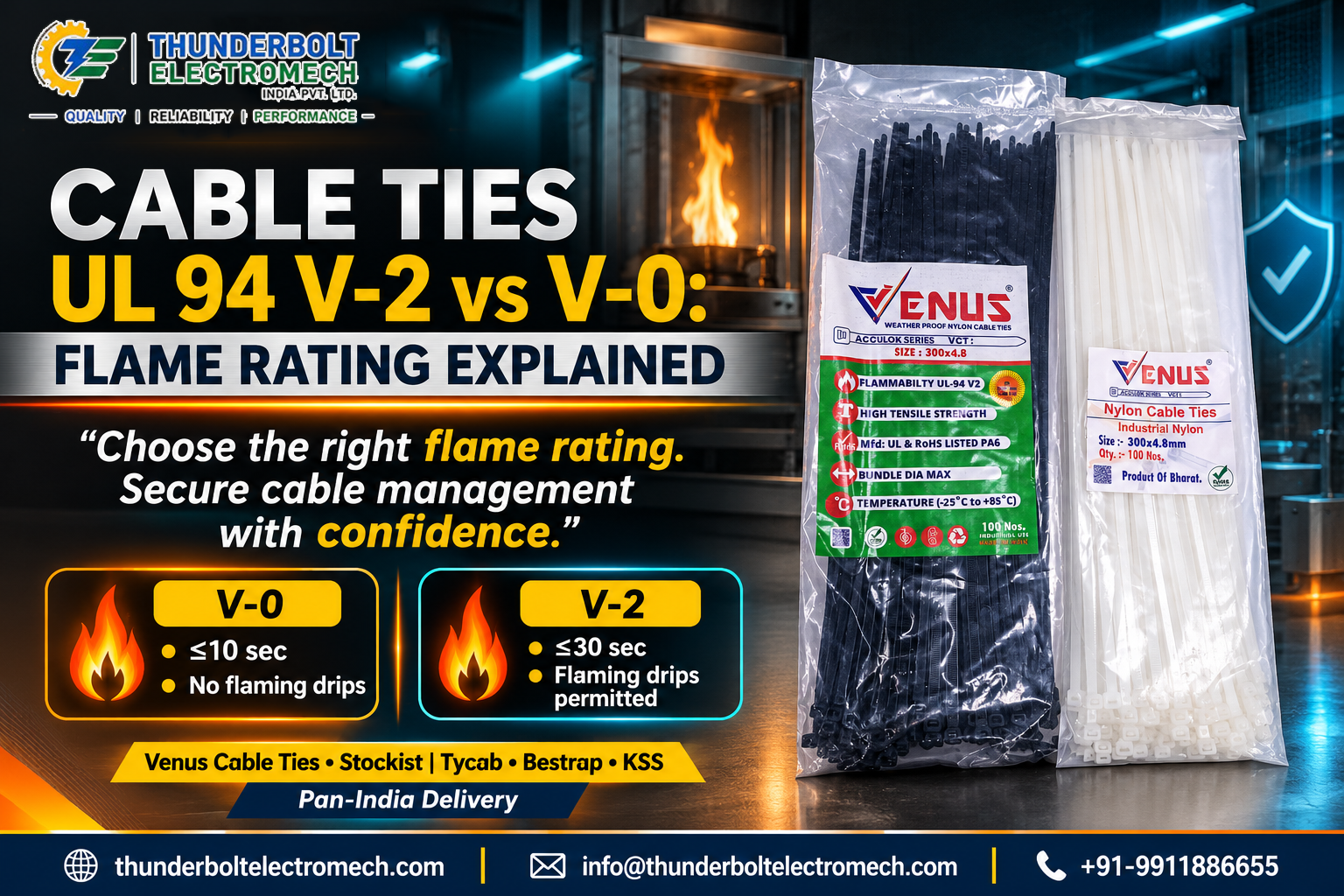
| Afterflame per flame application | 30 seconds or less | 10 seconds or less |
| Total afterflame, five specimens | 250 seconds or less | 50 seconds or less |
| Burning drips that ignite cotton | Allowed | Not allowed |
| Typical tie material | Nylon 6.6 (PA66), heat-stabilised or UV grades | ETFE, or specially modified flame-retardant grades |
| Typical continuous temperature | Around 85°C, some grades higher | Up to +170°C on ETFE grades |
| Typical home | Panels, MEP trays, general plant wiring | Tunnels, rail, hot zones, critical data halls |
| Relative price | Baseline | Several times higher |
The drip rule deserves a pause. A V-2 tie can melt, drip, and carry fire downward. In a vertical riser with open trays stacked below, that drip lands on cables. V-0 removes that behaviour. Many engineers focus on the 30-versus-10 seconds figure and miss the drip clause, which often matters more.
Why Nylon 6.6 Stops at V-2
Nylon 6.6 does not burn easily, which surprises people. It melts first. The polymer softens, sags, and pulls away from the flame. That retreat makes the flame starve, so the part self-extinguishes. Engineers call this behaviour self-extinguishing, and it earns the V-2 mark.
The same retreat creates the drip. Molten nylon falls, and a falling blob can still burn. That one trait separates V-2 from V-0.
Manufacturers can push nylon toward V-0 with flame-retardant additives. Those additives add cost, can reduce tensile strength, and sometimes change colour or ageing behaviour. Most stocked ties skip them. ETFE takes a different route. It is a fluoropolymer with a very high limiting oxygen index, so it resists ignition from the start. It also tolerates temperatures from deep cold to about 170°C, which nylon cannot match.
The trade-off is plain. ETFE ties cost far more and have a lower loop tension in some sizes. You buy them for a reason, not by default.
Choosing a Cable Ties Supplier India Buyers Can Trust for UL 94 Proof
A datasheet claim and a test certificate are different things. When we vet a brand for our shelves, we look for five items.
- The UL file number or equivalent third-party report. A name alone proves nothing.
- The rated thickness. See the point above.
- The material grade. PA66, heat-stabilised PA66, UV-stabilised PA66 and ETFE behave differently.
- A batch trace. If a lot fails in service, you must trace it.
- Plain language on halogen content. More on this next.
A reliable Cable Ties Supplier India project teams can lean on also admits when the standard tie is the right answer. We turn away V-0 orders from buyers who need V-2, because the money saved pays for other parts of the job. That honesty is part of what our Delhi NCR customers pay us for.
One Line, Three Numbers: Rating, Halogen Status and Temperature
A flame rating alone leaves the specification half written. Three parameters travel together.
Here is what published datasheets show. One HellermannTyton datasheet lists standard PA66 and UV-resistant PA66 as V-2. It lists E/TFE as V-0 and halogen-free, with a service range of −80°C to +170°C. A supplier guide we reviewed states the same split in simple terms: V-2 ties stop burning within 30 seconds, V-0 within 10. RS PRO lists its nylon 66 ties as V-2, low-smoke halogen-free, with an 85°C maximum.
Read those three entries side by side. The RS PRO tie is halogen-free and still only V-2. The E/TFE tie is V-0 and halogen-free, but sits in a different temperature league. So rating, halogen status and temperature move independently. You cannot infer one from another.
One caution from our own bench conversations. ETFE contains fluorine, which is a halogen in the chemical sense. When a datasheet calls it halogen-free, ask which test supports that wording. The usual answer points to acid-gas emission tests such as IEC 60754. Request the report. For metro stations and enclosed buildings, that report matters more than the label.
The temperature figure also deserves scrutiny. A switchgear panel that runs hot at the busbar chamber can push a nylon tie past its comfortable range. Heat ages nylon from the inside, and the tie turns brittle long before it melts.
Quick Reference Charts From a Cable Ties Supplier India Stockist
We stock four brands: Venus, Tycab, Bestrap and KSS. Specifications vary by grade and by size, so these charts tell you what to confirm for each brand rather than quoting numbers that change with the batch. Our Chawri Bazar counter team shares the datasheet and test report before dispatch.
Venus cable ties: quick reference
| Check item | What to confirm |
| Stocked scope | Complete Venus range available from Thunderbolt |
| Standard material | Nylon 6.6; ask for the grade on your size |
| Expected flame rating | UL 94 V-2 on standard nylon grades; request the report |
| Temperature | Confirm continuous and short-term limits for the grade |
| Best-fit use | Panel wiring, MEP trays, general plant bundling |
| Documents we share | Datasheet and rating proof on request |
Tycab cable ties: quick reference
| Check item | What to confirm |
| Standard material | Nylon 6.6; confirm the grade |
| Expected flame rating | V-2 on standard grades; ask for the thickness covered |
| Halogen-free wording | Request the supporting test report, not only the label |
| Temperature | Confirm the maximum continuous figure |
| Best-fit use | Cable management in commercial buildings and trays |
| Documents we share | Datasheet and batch details on request |
Bestrap cable ties: quick reference
| Check item | What to confirm |
| Standard material | Nylon 6.6; confirm the grade |
| Expected flame rating | V-2 on standard grades; confirm the rated thickness |
| Tensile and loop strength | Match the figure to your bundle diameter |
| Temperature | Confirm the continuous service limit |
| Best-fit use | Heavy bundles in industrial plants and utilities |
| Documents we share | Datasheet and rating proof on request |
KSS cable ties: quick reference
| Check item | What to confirm |
| Standard material | Nylon 6.6; confirm the grade |
| Expected flame rating | V-2 on standard grades; ask for the report |
| UV exposure | Choose a UV-stabilised grade for outdoor runs |
| Temperature | Confirm the continuous service limit |
| Best-fit use | Mixed industrial, electrical and outdoor bundling |
| Documents we share | Datasheet and batch details on request |
Need V-0? Tell us, and we will source an ETFE tie against your drawing rather than push a nylon tie with a hopeful label.
Real Problems a Cable Ties Supplier India Customer Meets on Site, and the Fix
Specification sheets stay tidy. Sites do not. These six problems show up again and again in Delhi NCR panel rooms, plants and data halls.
Problem 1: The tender says V-0, the store holds V-2.
Procurement panics and either delays the job or buys ETFE ties for everything. Neither helps. The fix is a short technical query to the consultant. Ask where V-0 truly matters: hot zones, vertical risers, tunnel sections. Accept a heat-stabilised V-2 tie elsewhere, in writing.
Problem 2: Ties turn brittle near heat.
A tie that snaps when a technician touches it six months later has aged, not failed in manufacture. Busbar chambers, transformer rooms and top-of-rack exhaust zones run hotter than the room average. Use a heat-stabilised grade, or ETFE where the temperature climbs past nylon’s comfort zone.
Problem 3: Outdoor ties fade and split.
Solar yards, substations and rooftop plant demand UV-stabilised black nylon. A flame rating does nothing against sunlight. Check both on the label.
Problem 4: Drip in vertical runs.
In a riser, a V-2 tie can melt and drop burning material onto cables beneath. Where trays stack tightly, specify V-0 or metal ties for the vertical section only.
Problem 5: Natural and black ties get mixed.
Natural-coloured nylon ties often carry no UV stabiliser and sometimes no listed flame rating. Store keepers pick whichever bag sits nearest. Label bins by rating and colour, and keep unrated ties out of the panel shop.
Problem 6: Over-tightening.
A tie pulled hard with a bare hand can deform the cable sheath, and a tail left long can scratch the next cable. A tension tool with a cut-off setting fixes both.
Illustrative case study: a Noida data hall specification
This scenario reflects a pattern we see in enquiries from data-centre contractors around Noida and Greater Noida. It is a representative composite, not a named client.
A contractor received a specification calling for V-0 cable ties across a new data hall. The first quote came back with ETFE ties priced for the full quantity, and the budget broke. The contractor called us.
We asked three questions. Which areas run hot? Where do cables run vertically with open trays below? Does the consultant’s fire strategy name the tie, or only the cable?
The answers narrowed the V-0 need. The hot-aisle containment penetrations and two vertical risers needed it. The rest of the hall, with cables resting on cool under-floor and overhead trays, did not. The contractor wrote a revised specification: ETFE ties at the penetrations and risers, heat-stabilised nylon 6.6 UL 94 V-2 ties everywhere else, with test reports attached for each. The consultant approved it. The V-0 quantity dropped to a small fraction of the original order, and the hall got its fire safeguards where they counted.
The lesson is simple. A rating works as a tool, not a badge. Place it where the risk lives.
Where Cable Ties Supplier India Specifications Are Heading Next
The next five years will change what buyers ask for. We see five shifts already.
Denser data halls. Higher rack power and liquid-assisted cooling raise the temperature in rear aisles. Ties that sat comfortably at 85°C in older halls will meet harsher conditions, so temperature will appear in more tender lines.
Low-smoke expectations. Metro stations, hospitals and enclosed buildings already demand low-smoke, halogen-free cabling. The accessories around those cables will follow, with test reports requested up front.
Battery storage and EV charging. Battery rooms and charging hubs raise fire-risk reviews. Consultants will scrutinise every plastic part, including ties.
Recycled and reprocessed nylon. Cheaper ties sometimes use reprocessed material. Reprocessing can alter flame behaviour and strength, so a rating on one batch does not guarantee the next. Batch-wise proof will matter more.
Fluoropolymer scrutiny. Regulators abroad are debating restrictions on fluorinated materials. That debate may affect ETFE supply and price. Buyers who need V-0 today should plan stock for long projects.
None of this raises alarm. It raises the value of a supplier who tracks the paperwork.
Write the Specification Line Once, Correctly
How to Buy a Flame Retardant Cable Tie Without Overpaying
Use a template like this and adapt it:
- Material: nylon 6.6, heat-stabilised, UV-stabilised for outdoor use.
- Flame rating: UL 94 V-2 minimum at the rated wall thickness. V-0 or ETFE at named locations only.
- Halogen status: halogen-free, with an IEC 60754 report on request.
- Temperature: continuous service of 85°C or higher; state the figure for hot zones.
- Documents: datasheet, rating proof and batch trace with each delivery.
Five lines. They save a week of emails.
Incoming Inspection: How to Check a Flame Retardant Cable Tie Before It Reaches the Tray
A certificate in an email proves little until the goods match it. Stores teams in Delhi NCR can run a ten-minute check on every delivery, and it catches most substitutions.
Read the bag, not only the invoice. A genuine flame-rated tie ships in a labelled pack that names the brand, size, material and, usually, the rating. If the bag shows no material and no rating, treat the lot as unrated until the supplier proves otherwise.
Compare the tie with the sample. Keep one tie from the approved sample in a labelled pouch. Match colour, surface finish, locking head shape and tail length against each new lot. Reprocessed material often shows a duller finish, small black specks or uneven colour.
Check the markings and dimensions. Measure width and thickness with a vernier caliper. Because UL 94 ratings attach to a wall thickness, a tie that measures thinner than the datasheet states may sit outside the certified range.
Pull a loop test. Fit a few ties around a mandrel of known diameter and load them with a hand tension gauge. A lot that fails well below the datasheet figure deserves a hold and a call to the supplier.
Do not use a lighter as a rating test. We see this on sites all the time. Someone holds a flame to a tie, watches it shrink, and declares it fire retardant. That experiment tells you nothing about UL 94. The standard controls specimen size, flame height, conditioning and timing for a reason. A lighter test can even mislead, because nylon melts away from the flame and looks harmless in both V-2 and unrated grades. Trust the paperwork, and trust the batch trace behind it.
Keep a retained sample. File one tie from each lot with the delivery note and certificate. If a question arises two years later during an audit or an incident review, you can show exactly what went into the tray.
What a useful certificate shows
A useful rating document names the manufacturer, the material grade, the flame class, the thickness covered and the test standard. It carries a date and a traceable reference. A one-line statement that says only “flame retardant” fails that test. When you ask us for paperwork at our Chawri Bazar counter, we send the datasheet and rating proof for the specific brand and size, so your quality team can file it with the purchase order.
Cost sense for buyers
V-0 ETFE ties cost several times more than V-2 nylon ties. That gap looks painful on a large order, yet the tie is a small share of the total cable installation cost. The real saving comes from placing V-0 only where the fire risk justifies it, as the case study above shows. Put the money into correct specification and clean paperwork, not into blanket upgrades.
Beyond V-2 and V-0: HB, V-1 and 5VA, and Where Ties Fit
UL 94 covers more than two grades, and buyers sometimes meet the others in a datasheet and freeze.
HB is the horizontal burn test. A specimen lies flat, a flame touches one end, and the test records how fast the flame travels. HB is the mildest class. A tie with only an HB mark has barely cleared the bar, and we would not accept it in a panel.
V-1 uses the same vertical method as V-0 and V-2. It allows up to 30 seconds of afterflame and forbids drips that ignite cotton. It sits between the two grades this article compares, yet few cable ties carry it, because manufacturers tend to land at V-2 with plain nylon or move straight to V-0 with a special material.
5VA and 5VB use a much stronger flame applied several times. They suit enclosures and housings, not small parts like ties. If a quote lists a tie as 5VA, ask for the proof twice.
The practical reading is short. For cable ties, the sensible range runs from V-2 to V-0. Anything lower deserves doubt, and anything higher deserves a question about what the supplier is actually selling.
The Standards Around the Standard: Tie, Cable and Smoke
Most confusion on site comes from mixing up which standard answers which question. UL 94 describes how a plastic material burns. It does not describe the tie’s strength, the cable’s fire behaviour or the smoke a fire produces.
| Standard | What it tests | What it tells you |
| UL 94 | Burning behaviour of a moulded plastic specimen | Whether the tie material self-extinguishes and drips |
| UL 62275 / IEC 62275 | Cable ties as finished products: loop tensile strength, installation temperature, environmental behaviour, flammability class | Whether the tie performs as a tie |
| IEC 60332-3 | Flame spread on bundled cables | How a full tray of cable behaves, tie or no tie |
| IEC 60754 | Acid gas released when materials burn | Whether the tie is truly low in halogen emissions |
| IEC 61034 | Smoke density in a fire | Visibility for people escaping a building or tunnel |
Read the table left to right and you see why one stamp never covers everything. A tie may be V-2 and strong, yet release more smoke than a metro project allows. Another may be low-smoke and weak at the loop. Ask each question separately, and ask for each answer in writing.
One point from our counter conversations: buyers often cite the cable standard when they mean the tie. A cable that passes IEC 60332-3 in the factory tells you nothing about the ties that bundle it in the field. The tie’s job is to hold that bundle in place long enough for the cable’s own fire behaviour to matter.
Specifying Ties by Sector Across Delhi NCR
No single tie suits every site. These are the patterns we see across the region’s building, plant and utility work.
Data centres in Noida, Greater Noida and Gurugram. Hot-aisle exhaust, dense overhead trays and strict audit trails drive the specification. Standard V-2 heat-stabilised nylon handles most tray runs. Penetrations through containment, rear-of-rack exhaust zones and vertical risers justify V-0 or ETFE. Insist on batch-wise reports, because auditors will ask.
Metro stations, hospitals and commercial buildings. Low smoke and halogen-free behaviour rank as high as flame rating. The specification should call for an IEC 60754 report, an IEC 61034 smoke result where the tender demands it, and a stated rating. Many Delhi Metro-style enclosed spaces treat the whole accessory chain as part of the fire strategy.
Switchgear and control panel builders in Okhla, Bawana and Bhiwadi. Panel wiring sits close to busbars and contactors, so temperature matters as much as rating. Use heat-stabilised V-2 ties for general loom bundling. Move to ETFE ties near high-temperature components, and keep sharp tails trimmed flush so they do not scrape insulation during vibration.
Solar plants and substations. Sunlight, dust and thermal cycling attack ties for years. A UV-stabilised black V-2 tie handles most yards. Add stainless steel ties for any run that must hold its position through a fire, since plastic ties of either rating will eventually give way in sustained heat.
Factories and auto clusters around Manesar and Faridabad. Vibration, oil and heat combine on machine floors. Pick a tie with proven loop strength, a stated temperature limit and a clear chemical resistance note. A flame rating helps, but a tie that cracks from oil exposure fails long before a fire.
One sentence sums up all five: write the environment into the specification, not only the rating.
Frequently Asked Questions
1. Are all nylon cable ties fire retardant?
No. Standard nylon 6.6 ties usually carry a UL 94 V-2 rating, which means self-extinguishing within 30 seconds, but natural and low-grade ties may have no listed rating. Always ask for the rating and the thickness it covers.
2. What is the difference between UL 94 V-0, V-1 and V-2?
All three measure how quickly a vertical specimen stops burning. V-0 requires 10 seconds or less per flame application, V-1 and V-2 allow up to 30 seconds. Only V-2 permits burning drips that ignite cotton below.
3. Can nylon cable ties be V-0?
Some nylon grades with flame-retardant additives reach V-0, but they are specialist products. Most stocked ties are V-2. When a project needs dependable V-0 and high temperature, ETFE is the common answer.
4. Does halogen-free mean flame retardant?
No. Halogen-free describes the chemistry and the gas released in a fire. Flame retardant describes how the material burns. A tie can be halogen-free and still V-2, as some commercial datasheets show.
5. Will cable ties melt in a hot server room or panel?
Standard nylon 6.6 suits about 85°C in continuous use. Near busbars, transformers or exhaust air, check the actual temperature. Heat ages nylon and makes it brittle before it melts.
6. Do plenum spaces need special ties?
Often yes. Air-handling spaces face stricter smoke and flame rules, and plenum-rated ties follow a separate listing. Check the local code and ask the supplier for the matching certificate.
7. Do black and natural ties share the same rating?
Not always. Black ties usually include carbon black for UV resistance, and the grade can differ from natural nylon. Read each product’s datasheet instead of assuming.
8. Where can I buy flame retardant cable ties in Delhi NCR?
Thunderbolt Electromech stocks Venus, Tycab, Bestrap and KSS ties from Chawri Bazar and supplies contractors across Delhi NCR, including Noida, Gurugram, Faridabad and Ghaziabad.
Trust Signals and Contact Details
Thunderbolt Electromech India Pvt. Ltd. works as a stockist and cable tie dealer for Delhi NCR panel builders, MEP contractors and plant maintenance teams. Need a flame retardant cable tie in Delhi NCR with a datasheet and rating proof? Send us your drawing or specification line, and our team replies with a matched recommendation.
- Company: Thunderbolt Electromech India Pvt. Ltd.
- Address: Shop No. 3538, Sitaram Bazar Rd, Bazar Sirkiwalan, Chawri Bazar, Chandni Chowk, Delhi, 110006
- Phone: +91-9911886655
- Email: info@thunderboltelectromech.com
- Local focus: cable tie supplier Delhi, cable tie dealer Delhi NCR
Explore more: Cable ties pillar guide | Cable tie articles | Cable tie products
Conclusion
UL 94 V-2 and V-0 are not good and better. They are two answers to two different risks. Standard nylon 6.6 ties earn V-2, and that suits most panels, trays and plant rooms. V-0 belongs in hot zones, risers and critical areas, usually through ETFE. Write the rating, the halogen-free status and the temperature in one line, and ask for the report behind each.
A dependable Cable Ties Supplier India project teams call early will help you place each rating where it earns its cost. Thunderbolt Electromech stocks Venus, Tycab, Bestrap and KSS ties for Delhi NCR and ships across India. Send us your specification, and we will match the tie to the job.