
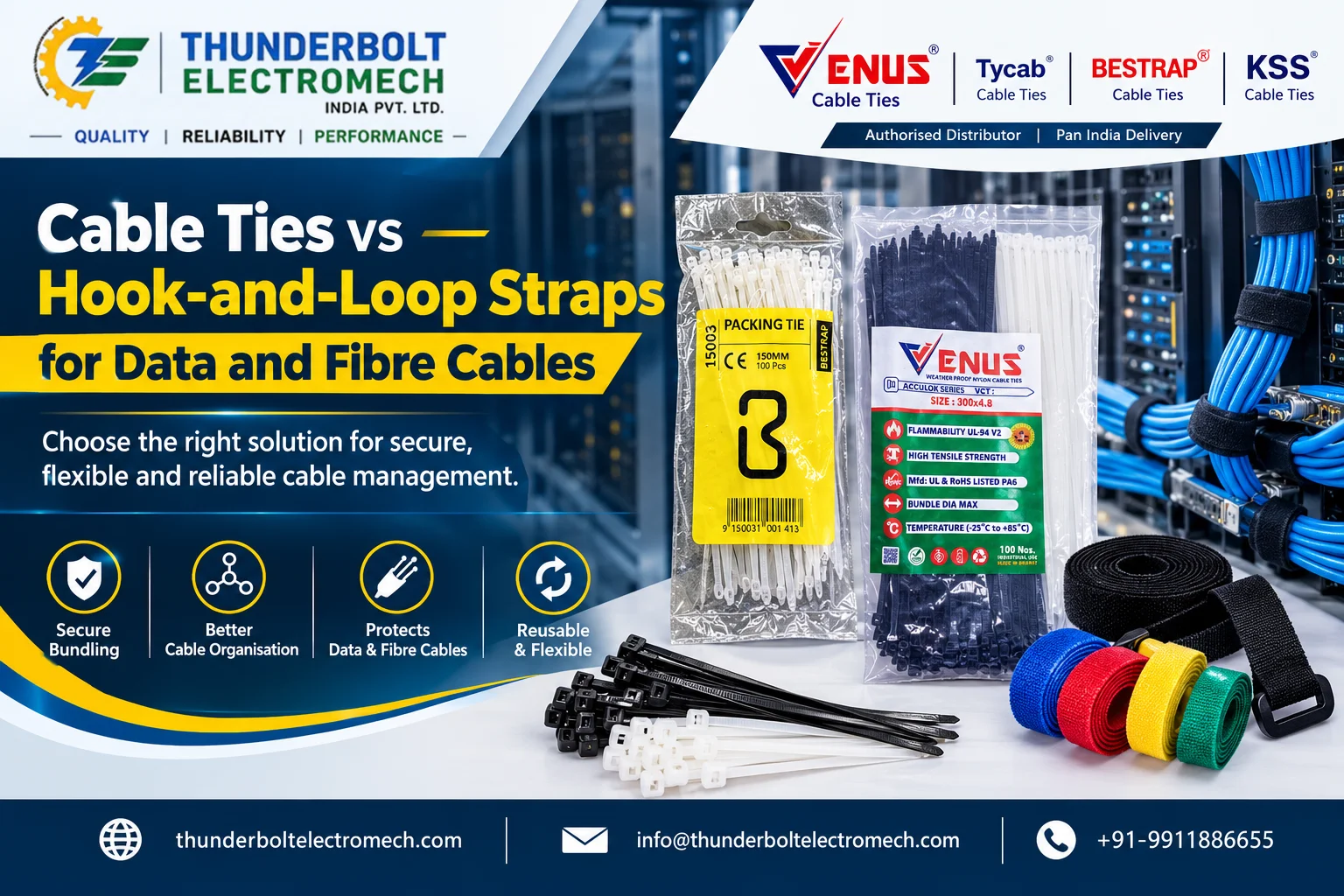
Quick Answer: Use hook-and-loop straps on fibre, Cat6 and other sensitive data cables. Use nylon cable ties on power and control cables, and tighten them with a tension tool. Never cinch a fibre bundle. As a Cable Ties Supplier India contractors rely on, Thunderbolt Electromech stocks both nylon ties and hook-and-loop options, so one call covers your whole cable-management list. A cable tie for fibre optic cable should never be your default.
Introduction
A data cable can pass every visual check and still fail at certification. The jacket looks clean. The tie looks neat. Then the tester reports a return loss or NEXT failure, and nobody can see why.
Often the answer sits in the tie. A narrow nylon strap pulled tight with a tool turns a round, evenly twisted cable into a slightly squeezed one. The damage lives inside the jacket, where the eye cannot reach.
We hear this story at our counter in Chawri Bazar, Delhi, from IT contractors, data-centre technicians and structured-cabling teams. As a cable tie supplier Delhi buyers visit when a cabling job is stuck at test stage, we sell both sides of the argument: nylon ties and hook-and-loop straps. So we have no reason to push one over the other. This guide explains where each product belongs, what the research says, and which mistakes cost the most money.
If you need the wider picture on sizes, materials and tensile strength, start with our complete cable ties buying guide. For a full view of our range, browse the cable tie product category.
Why Cable Ties Supplier India Buyers Keep Asking About Crush Damage
Three independent sources point in the same direction, and one of them adds a useful counterweight.
The Fiber Optic Association (FOA) warns that ties pulled tight with an installation tool can cause attenuation or even fibre breakage. It prefers hook-and-loop for fibre cable. It also gives the bend-radius rule that every fibre installer should memorise: ten times the cable diameter in service, and twenty times while the cable is under pulling tension.
A BICSI-based study guide describes the crush problem in plain terms. A tie that squeezes a copper data cable leaves no visible mark, and the fault stays hidden until return loss or NEXT fails at certification. That timing makes it costly. The cable is already pulled, dressed and labelled by then.
An IP-camera cabling review adds balance. It notes that BICSI effectively discourages zip ties, yet some professional data centres use them without trouble. It also reports that hook-and-loop can work loose in harsh environments.
The National Electrical Code (NEC) takes a practical line. It allows cable ties, provided the installer fits them so as not to damage the cable.
Read those four points together and a clear rule emerges. The tie itself is not the villain. Tension is. And tension is exactly what a hand-pulled nylon tie cannot control.
That rule shapes what we tell buyers who call us as their cable ties supplier India wide. We rarely say “never use nylon”. We say “never let a nylon tie touch a fibre bundle or a tightly twisted data pair, and tighten every time you do use with a tool that sets the tension”.
What Happens Inside the Cable: Pressure, Pair Geometry and Bend Radius
Pressure is force divided by width
A nylon tie around a cable bundle pulls with a certain force. The contact area is the tie width multiplied by the length of cable it touches. So a narrow strap packs the same pull into a much smaller footprint.
Compare a 2.5 mm tie with a 25 mm hook-and-loop strap. At equal tension, the wide strap spreads the load over roughly ten times the width. The pressure on the jacket falls by roughly the same factor. That single ratio explains most of the field experience.
Real life makes it worse. A nylon tie also bites into the jacket at its edges, and the locking head sits as a hard lump on one side. So the cable feels a line load plus a point load.
Twisted pairs depend on geometry
Cat6 and Cat6A cables work because each pair twists at a controlled rate. That twist cancels interference. Squeeze the cable and the pairs shift. The spacing between conductors changes, and impedance changes with it. Return loss rises. Crosstalk can rise too.
Cat6A adds a second trap. Large, tightly packed bundles of Cat6A raise alien crosstalk, because neighbouring cables sit too close for too long. A tight tie pulls the bundle even tighter. A loose hook-and-loop strap lets the cables keep a little air between them.
Fibre fails by bending, not just by crushing
Fibre loses light when it bends sharply. A crush from a tie creates a micro-bend, a tiny kink that the eye cannot see but the light meter can. Bend-insensitive fibre tolerates more, and it has earned its place in dense racks. It does not remove the problem. Crush a bundle hard enough and even bend-insensitive fibre leaks light.
The FOA figures give you a working rule. Keep the bend radius at ten times the cable diameter once the cable sits in service. During the pull, keep it at twenty times. A tie that forces a bundle around a tight corner breaks that rule even if the strap itself is gentle.
A field test that costs nothing: the spin test
Here is a rule we teach at the counter. After you fasten any tie around a data cable, grip the tie and try to rotate it around the bundle. It should turn freely with light finger pressure. If it grips the jacket and drags, it is too tight. Back it off, or switch to a hook-and-loop strap.
The spin test takes three seconds. It catches most of the damage that certification would find later.
Cable Ties vs Hook-and-Loop Straps: Side-by-Side Comparison
| Factor | Nylon cable tie | Hook-and-loop strap |
| Contact width | Narrow (a few millimetres) | Wide (often ten times broader or more) |
| Tension control | Poor by hand; good with a tension tool | Self-limiting; hard to overtighten |
| Reusable | No, cut to remove | Yes, open and refasten |
| Risk to fibre | High if tightened | Low |
| Risk to Cat6 / Cat6A pairs | Moderate to high | Low |
| Moves, adds and changes | Cut and replace each time | Open, adjust, close |
| Heat and dust resistance | Good, with the right grade | Can loosen in harsh sites |
| Outdoor UV exposure | Good with UV-stabilised grade | Depends on the product; check before use |
| Power and control cable | Excellent | Acceptable for light loads; weaker for heavy vertical drops |
| Cost per fastening | Low | Higher at first, lower over repeated use |
| Typical choice | Power, control, panel wiring, outdoor runs | Fibre, Cat6, Cat6A, patch panels, racks |
The table shows a pattern. Hook-and-loop wins where cables change often and sensitivity runs high. Nylon wins where loads run heavy, weather bites and the cable will not move for years.
How to Use Hook-and-Loop Straps Without Repeating the Tie Mistake
A wide strap can still crush a cable if you cinch it hard. The material forgives you, but it does not excuse you. Follow three habits.
Fasten to snug, not to tight. The strap should hold the bundle in shape, and you should still slide a finger under it. The spin test applies here too.
Space the straps by sag, not by habit. Place a strap wherever the bundle starts to droop. In horizontal trays that often means every few hundred millimetres, but follow your site specification where one exists.
Keep the bundle small. Ten to twenty cables in one strap hide a lot of pressure at the centre. Split large runs into smaller groups, and label each group. Future technicians will thank you.
Cable Ties Supplier India Guide to Where Nylon Ties Still Win
Hook-and-loop is not a cure for everything. Plenty of cables need a nylon tie, and the right one outlasts almost any alternative.
Power and control cables. These cables carry less risk of signal damage. They also carry more weight, and they hang in long vertical runs where a hook-and-loop strap can slip. A nylon tie, tightened with a tension tool, holds them in place for years.
Outdoor and high-UV sites. Rooftop cabling, solar plants and CCTV poles bake in the Indian sun. UV-stabilised black nylon ties resist that exposure. Ask for UV-stabilised grades, and avoid natural-colour ties outdoors.
Panel wiring. Inside a control panel, bundles of control wire need a fixed layout. Nylon ties with the correct width hold wire looms tight against the backplate, and a tension tool keeps the pull consistent from one tie to the next.
Temporary construction bundling. When the cable will move again next week, a cheap tie does the job.
Use a tension tool, not your hand
A tension tool does two things. It pulls the tie to a set force, and it cuts the tail flush with the head. Both matter. A consistent pull stops over-tightening, and a flush cut stops the sharp tail from slicing a neighbouring cable jacket during later work.
Choose width by load, not by habit
A wider tie spreads the pressure over more jacket. For power bundles, step up one width size over what you would normally use, and check the tie’s rated tensile strength against the bundle weight. Our pillar guide on cable tie sizes and strength gives the full size ladder.
Where nylon should never go
Never use a nylon tie as the primary support for fibre. Never use one inside a rack on Cat6A bundles bound for certification. And never use one on any cable that shows a visible dent after tightening, because a visible dent means the pressure already crossed the line.
Real-World Problems and Solutions
| Problem on site | Likely cause | Practical fix |
| Cat6 link passes continuity but fails return loss | Tight tie squeezed the pairs | Cut the ties, re-dress with hook-and-loop, retest |
| Fibre link shows high loss at one point | Micro-bend from a tie or a sharp turn | Replace with wide hook-and-loop; restore bend radius to ten times the diameter |
| Dented jacket under the tie | Overtightening by hand | Use a tension tool or switch to hook-and-loop |
| Tie tail scratches a nearby cable | Tail cut long or at an angle | Use a flush-cut tool; never leave a sharp tail |
| Hook-and-loop slips in a dusty plant | Fine dust fills the hooks | Use a nylon tie for fixed runs; keep hook-and-loop for clean racks |
| Cable ties turn brittle on a rooftop | Non-UV nylon | Switch to UV-stabilised black ties |
| Moves, adds and changes cost hours | Cut-and-replace ties | Standardise on hook-and-loop in patch zones |
| Large Cat6A bundle shows alien crosstalk | Bundle pulled too tight and too long | Split the bundle; loosen the straps; keep small groups |
| Mixed power and data bundle | Convenience bundling | Separate runs and follow your cabling standard’s separation guidance |
Most of these problems share a single root cause. Someone applied the same tie to every cable, because buying one product felt simpler.
Case Study: The Certification Failure Nobody Could Find
This is an illustrative scenario built from fault patterns structured-cabling teams report often. Replace it with a documented job from your own records, including site, date and test results, before publishing, because Google’s E-E-A-T guidance rewards first-hand evidence.
The setup. A cabling contractor finished a floor of Cat6 links for an office in Delhi NCR. The team dressed every cable bundle neatly with nylon ties, pulled tight with a hand tool for a clean look.
The symptom. The certification tester flagged a cluster of links. Wire map passed. Length passed. Return loss and NEXT margin failed on links that sat in the most heavily tied sections.
The investigation. The team re-terminated two links and retested. Both still failed. Then a senior technician noticed small flat dents in the jackets, one every thirty centimetres or so, where the ties sat. He cut the ties from one bundle. The same links retested clean.
The fix. The team replaced the nylon ties with wide hook-and-loop straps in the horizontal runs and kept nylon ties, applied with a tension tool and the spin test, only for the vertical riser and the power cables. All flagged links passed on the next test.
The cost. Re-terminating, re-testing and re-dressing took two extra working days. The straps themselves cost a small fraction of that.
The lesson. The cable and the connectors were never at fault. The contractor now lists the tie type in the method statement for every data job.
Cable Ties Supplier India Quick Reference: Venus, Tycab, Bestrap and KSS
Thunderbolt Electromech India Pvt. Ltd. sells the complete range of Venus cable ties as a stockist, and also supplies Tycab, Bestrap and KSS cable ties. Each chart below shows where that brand’s cable ties fit in a data, fibre or power job.
Always confirm width, length, tensile rating and colour on the current brand datasheet or with our team before you order. Ranges change.
Venus Cable Ties: Quick Reference
| Job | Tie to ask for | Tightening method | Notes |
| Power cable bundles in trays | Standard nylon, wider width | Tension tool | Step up one width for heavy bundles |
| Control wire inside panels | Standard nylon, narrow to medium width | Tension tool, flush cut | Keep tails short |
| Outdoor and rooftop runs | UV-stabilised black | Tension tool | Avoid natural colour in sun |
| Cat6 / fibre bundles | Do not use nylon as the main fastener | Not applicable | Choose hook-and-loop instead |
| Temporary bundling | Standard nylon | Hand pull | Remove before final dressing |
Tycab Cable Ties: Quick Reference
| Job | Tie to ask for | Tightening method | Notes |
| Industrial power and control cables | Standard nylon, correct width for the load | Tension tool | Match width to bundle weight |
| Cable-tray fixing | Medium to wide nylon | Tension tool | Tie at regular intervals set by site spec |
| Outdoor and CCTV poles | UV-stabilised black | Tension tool | Check UV grade on the datasheet |
| Data cable in racks | Use hook-and-loop instead | Not applicable | Use nylon only on the rack frame, not the cable |
| Mixed-site stock | Assorted lengths | Tension tool | Keep a standard length list per site |
Bestrap Cable Ties: Quick Reference
| Job | Tie to ask for | Tightening method | Notes |
| Control panel wiring looms | Narrow to medium nylon | Tension tool, flush cut | Keep each loom uniform |
| Power bundles | Medium to wide nylon | Tension tool | Check the tensile rating |
| Outdoor and solar runs | UV-stabilised black | Tension tool | Confirm UV resistance with our team |
| Cat6 / fibre bundles | Not recommended as the main fastener | Not applicable | Choose wide hook-and-loop |
| Light bundling | Standard nylon | Hand pull, spin test | Use only where cables stay inactive |
KSS Cable Ties: Quick Reference
| Job | Tie to ask for | Tightening method | Notes |
| Industrial and factory cabling | Standard nylon, suited to the load | Tension tool | Confirm width and strength |
| Cable-tray and conduit fixing | Medium to wide nylon | Tension tool | Space ties by site spec |
| Outdoor installations | UV-stabilised black | Tension tool | Verify UV grade before ordering |
| Data and fibre in racks | Choose hook-and-loop instead | Not applicable | Keep nylon off sensitive cable |
| Maintenance stock | Mixed pack sizes | Tension tool | Standardise lengths per site |
Not sure which row fits your job? Send us the cable type and the site conditions, and our team will match the tie. You can also browse the full cable tie range.
Future-Proofing Your Cabling: What the Research Points To
Cabling standards keep moving in one direction. Faster links, denser racks and thicker bundles all raise the cost of a small mechanical fault.
Higher speeds shrink the margin.
A fault that a 1-gigabit link tolerates can break a 10-gigabit link. Many Cat6 runs installed today will carry faster traffic within a few years. A crushed pair that works today may fail at the next upgrade, so dress cable as though the link will run faster than its current load.
Power over Ethernet adds heat.
Higher-power PoE heats copper in tight bundles. Heat raises insertion loss. Smaller bundles with loose, breathable fastening help the cable shed that heat.
Dense fibre trunks grow thicker.
Multi-fibre trunks carry many strands in one jacket, so one crush point can hit dozens of links at once. Wide hook-and-loop straps protect that investment.
Reuse will save money.
Racks change. Servers move, patch panels reorganise, and a cable that was dressed with a cut-to-remove tie costs labour each time. Hook-and-loop pays for itself the third time you open the bundle.
Environmental ratings will matter more.
Data rooms in India face heat, dust and monsoon humidity. Pick fasteners by environment, not by habit. Hook-and-loop suits clean, controlled racks. UV-stabilised nylon suits the outdoor and industrial runs.
Planning ahead costs little. Buy the right fastener now, and the next upgrade will not force a re-dress of the whole floor.
Cable Ties Supplier India With Delhi Stock: From Chawri Bazar to Every State
Thunderbolt Electromech India Pvt. Ltd. is a Delhi-based supplier. We carry the complete range of Venus cable ties as a stockist, and we supply Tycab, Bestrap and KSS cable ties alongside it. One call to our team covers nylon ties in several widths and lengths, UV-stabilised black ties and hook-and-loop options for data work.
For buyers in Delhi NCR. Many contractors search for a cable tie dealer Delhi NCR because they need stock today, not next week. Our location in Chawri Bazar, near the wholesale electrical market of Old Delhi, puts us close to contractors in Delhi, Gurugram, Noida, Faridabad and Ghaziabad. Those who want a cable ties supplier Chawri Bazar can visit our counter, check the product, and take it away the same day. If you need cable tie supplier Delhi delivery, call us with your quantity and location.
For buyers across India. As a cable ties supplier India wide, we dispatch to data-centre builders, system integrators and electrical contractors in Mumbai, Pune, Bengaluru, Hyderabad, Chennai, Kolkata and Ahmedabad. You send the cable type and site details. We confirm the tie, width and quantity, and we ship.
What to send us for a fast, correct quote
- Cable type: fibre, Cat6, Cat6A, power or control
- Bundle diameter and approximate length of run
- Indoor or outdoor, and any heat, dust or UV exposure
- Quantity and delivery location
- Whether you own a tension tool
Send those five items and you will usually hear back the same day.
Frequently Asked Questions
These questions follow what installers and buyers ask on search engines and in cabling forums.
Can I use zip ties on Cat6 cable?
You can, but you should treat it with care. Standards bodies such as BICSI effectively discourage zip ties on data cable, because crush damage stays invisible until certification. If you must use one, keep it loose enough to pass the spin test, and prefer hook-and-loop for the final dressing.
Are zip ties bad for fibre optic cable?
Yes, when tightened. The Fiber Optic Association warns that ties pulled with an installation tool can cause attenuation or fibre breakage, and it prefers hook-and-loop. A cable tie for fibre optic cable should never act as a primary support.
What is the bend radius for fibre optic cable?
The FOA figure is ten times the cable diameter in service, and twenty times under pulling tension. Check your cable’s datasheet, since specific products can carry different limits.
Do data centres really use Velcro-type straps instead of zip ties?
Many do, especially in patch zones where cables change often. Some professional data centres also use nylon ties without problems, so practice varies. The common thread is that they control tension.
Can hook-and-loop straps work loose?
In harsh, dusty or vibrating places, yes. Fine dust fills the hooks and weakens the grip. For those sites, use a nylon tie on the fixed run or choose a heavy-duty strap and inspect it on a schedule.
Is it legal to use cable ties under the NEC?
The NEC allows cable ties if installers fit them so as not to damage the cable. The rule rests on installation practice, not on the product alone.
How tight should a cable tie be on a data cable?
Tight enough to hold the cable, loose enough to spin around the bundle with light finger pressure. If it leaves a dent, it is too tight.
Can I bundle power and data cables together?
Avoid it. Interference from power cables can degrade data signals. Follow the separation guidance in your cabling standard or your site specification.
Do I need a tension tool?
For power and control cable, yes. It sets the pull and cuts the tail flush. For data cable, skip the tie and choose hook-and-loop.
Which is cheaper over time, nylon ties or hook-and-loop?
Nylon costs less per fastening. Hook-and-loop costs less in places where you reopen the bundle several times, because you reuse the strap and save the labour.
Where can I buy cable ties in Delhi?
Thunderbolt Electromech sells Venus, Tycab, Bestrap and KSS cable ties from our counter in Chawri Bazar, and we ship across India.
Trust and Contact: Thunderbolt Electromech India Pvt. Ltd.
Thunderbolt Electromech India Pvt. Ltd. is a Delhi-based electrical supplier and a stockist of the complete range of Venus cable ties. We also supply Tycab, Bestrap and KSS cable ties. If you need a cable ties supplier Chawri Bazar buyers can visit in person, or a cable ties supplier India wide who dispatches to your site, contact us.
- Registered office: Shop No. 3538, Sitaram Bazar Rd, Bazar Sirkiwalan, Chawri Bazar, Chandni Chowk, Delhi, 110006
- Phone: +91-9911886655
- Email: info@thunderboltelectromech.com
- Website: thunderboltelectromech.com
- Product page: Cable ties
- More guides: Cable tie blog category
- Pillar guide: Cable ties supplier India: complete guide
Conclusion: Choose the Right Fastener, and Choose a Cable Ties Supplier India Teams Can Call
Cable damage hides. A crushed pair or a micro-bent fibre looks fine until the tester says otherwise, and by then the cost has already grown.
Keep the rules short. Use hook-and-loop straps on fibre, Cat6 and other sensitive data cables. Use nylon ties on power and control cables, and tighten them with a tension tool. Run the spin test on every fastening. Never cinch a fibre bundle. And keep the FOA bend-radius rule in mind: ten times the cable diameter in service, twenty times under tension.
Do those few things, and certification day gets boring. That is the goal.
For nylon ties, hook-and-loop options and honest advice on which one fits your job, talk to a Cable Ties Supplier India team that sells both. Thunderbolt Electromech India Pvt. Ltd. stocks the complete range of Venus cable ties, and supplies Tycab, Bestrap and KSS cable ties from Chawri Bazar to sites across the country. Call +91-9911886655, write to info@thunderboltelectromech.com, or browse the cable tie range and the cable tie blog. For sizes, materials and strength, return to the pillar buying guide.