
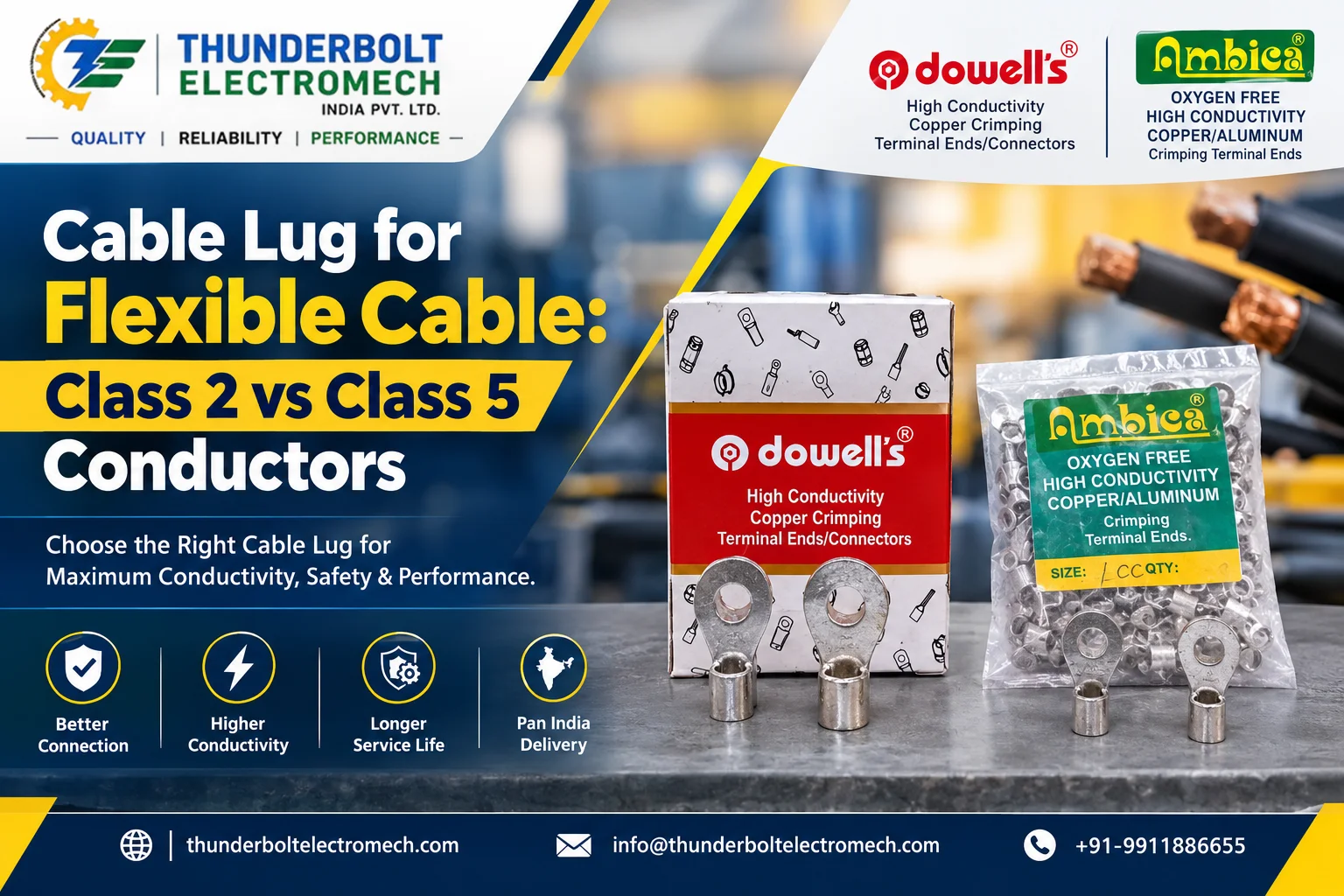
Quick Answer:Check the conductor class on the cable datasheet before you order any lug. Class 5 and Class 6 flexible conductors are copper only, and their fine strands need a barrel with the right bore, ideally a tinned copper cable lug made for fine-stranded wire. A trusted Cable Lug Supplier India should ask for the class, the cross-section and the crimp tool before quoting. Thunderbolt Electromech ships copper cable lugs across India.
Introduction
Two cables can both say “35 sq mm” and still behave very differently in your hands. One is stiff and holds its shape. The other bends around a finger like a rope. The first is probably Class 2. The second is Class 5. Pick the same lug for both, and one of them will fail.
We hear the same story every month from machine builders, welding contractors and panel shops. The lug arrives, the cable will not enter the barrel, and someone trims strands to make it fit. Or the lug fits easily, the crimp looks fine, and six months later the joint runs hot because the barrel was far too large for the fine wires inside it. Nominal size caused both problems. The conductor class would have prevented both.
This guide comes from the Thunderbolt Electromech counter and stores in Chawri Bazar, Delhi. As a cable lug supplier Delhi buyers and OEM teams call when a fit problem stops a line, we see the failures first. Below, we explain what IEC 60228 says about conductor classes, why Class 5 resistance differs from Class 2, how strand geometry decides barrel choice, and what to ask your supplier before you place an order. If you want the wider buying picture across copper, aluminium and bimetal lugs, read our complete cable lug buying guide.
Why a Cable Lug Supplier India Buyers Trust Starts With the Conductor Class
IEC 60228 is the standard that fixes conductor construction for electrical cables. It sorts conductors into classes, and each class describes how the metal is built, not just how much of it there is.
- Class 1 is a solid conductor. One piece of metal, no strands.
- Class 2 is a stranded conductor. Several round wires, often compacted, which gives a stiff and fairly rigid core.
- Class 5 is a flexible conductor. Many fine wires twisted together, built to bend repeatedly.
- Class 6 is an extra flexible conductor. Even finer wires, used where bending is constant, such as moving machine axes.
Two facts from the standard shape every lug decision.
First, aluminium exists only in Class 1 and Class 2. The standard does not define a Class 5 or Class 6 aluminium conductor. So every flexible cable you buy, whether it is a VFD cable, a welding cable or a robot cable, carries a copper core. An aluminium lug or a bimetal lug has no place on it. If a catalogue suggests otherwise, question it.
Second, Class 5 copper has a slightly higher resistance than Class 2 copper at the same nominal section. The reason is physical. Fine wires twist more tightly and travel a longer path along the cable, and they leave more air between them. The standard allows for this by setting a higher maximum resistance for Class 5.
| Nominal section | Class 2, plain copper (max Ω/km at 20 °C) | Class 5, plain copper (max Ω/km at 20 °C) | Class 5 higher by |
| 10 sq mm | 1.83 | 1.91 | about 4% |
| 16 sq mm | 1.15 | 1.21 | about 5% |
| 35 sq mm | 0.524 | 0.554 | about 6% |
| 95 sq mm | 0.193 | 0.206 | about 7% |
| 240 sq mm | 0.0754 | 0.0801 | about 6% |
Values follow the maximum conductor resistance figures tabulated in IEC 60228 for plain copper. Confirm against your cable’s datasheet, since tinned conductors carry slightly different limits.
Five or six percent looks small. In a lug, it matters for a different reason. The extra resistance sits in the cable. The real trouble starts in the barrel, where a Class 5 conductor with hundreds of fine wires must make contact through the crimp. We cover that next.
Why does this matter commercially? Because a purchase order that says “35 sq mm tinned copper lug” is incomplete. It leaves out the single most useful fact. A good Cable Lug Supplier India partner will stop you, ask which class, and refuse to quote until the answer comes in.
What Happens Inside the Barrel: Strand Geometry and Cable Lug Supplier India Selection
Take a lug apart in your mind. You have a palm for the bolt, a neck, and a barrel. The barrel does the electrical work. The crimp squeezes the conductor into a near-solid mass of metal and holds it with cold-welded contact points. Every wire that touches its neighbour and the barrel wall carries current. Every wire that does not, carries nothing.
Now compare the two conductors.
A Class 2 core of 35 sq mm typically holds seven or so round wires, sometimes compacted into a smooth, nearly circular shape. Each wire is thick. A crimp deforms a few large wires, and the metal flows into the gaps between them. The strands rarely escape.
A Class 5 core of 35 sq mm can hold more than two hundred fine wires, often 0.3 to 0.4 mm each. Air fills far more of the cross-section. The bundle is also slightly larger in diameter than a compacted Class 2 core of the same nominal section, because the wires have not been squeezed together at the factory.
That difference creates three failure routes.
1. The barrel is too small. A barrel designed for compacted Class 2 wire has a bore that matches a dense bundle. A Class 5 bundle, being bulkier, will not enter. Installers then cut strands off. Cutting ten percent of the wires cuts ten percent of the current path, and the remaining wires heat up.
2. The barrel is too large. A barrel sized generously “to let everything in” leaves too much void. The crimp tool closes the barrel, but it cannot close the air. Fine wires slide past each other, and some end up outside the compressed zone. Contact resistance climbs.
3. The wires spread. Fine strands behave like loose hair at the barrel mouth. Some fan out, bend back, or sit on the outside of the crimp. Installers call this birdcaging. The conductor loses cross-section at the exact spot where current density peaks.
We keep seeing a pattern that few catalogues mention. The failure rarely shows on day one. A cold crimp that looks perfect and passes a pull test can still run at higher temperature under load, because the contact area between wires is smaller than it looks. Heat expands the copper, the joint relaxes slightly, and vibration pulls the fine wires a little further apart. After a few hundred thermal cycles, a joint that passed commissioning starts to loosen.
That is why lugs for flexible cable use a different barrel geometry. The lug lines built for Class 5 and Class 6 conductors follow DIN 46237 dimensions, and the same product range carries markings for fine-stranded and superfine-stranded conductors. The barrel bore is larger, the wall is shaped to close evenly, and the inside is often smooth to avoid cutting fine wires during compression.
A practical rule from our counter: never judge a lug by the cable’s nominal section alone. Judge it by the conductor class and by the barrel bore the lug maker prints for that section.
You can see the available barrel ranges in our cable lug product range.
Cable Lug Supplier India Checklist: Five Questions Before You Order for Flexible Cable
Use these five checks every time. They take two minutes and save a shutdown.
1. What is the conductor class?
Read the cable datasheet or the printed sheath. Look for “Class 5”, “flexible”, “fine stranded” or a standard code such as H07RN-F, H01N2-D (welding cable) or a VFD cable designation. If the datasheet is missing, ask the cable maker. Do not guess from stiffness alone.
2. What is the barrel bore, in millimetres?
Ask your supplier for the inside diameter of the barrel, not just the size label. Then measure your conductor with a vernier caliper after stripping, with the strands lightly twisted but not compressed. The conductor should enter the barrel with a snug slide and no force. If you must push, the barrel is too small. If it rattles, the barrel is too large.
3. Is the lug made for fine-stranded conductors?
Look for the fine-strand or superfine-strand marking in the product line. Ask the supplier to confirm it in writing. Generic Class 2 lugs of the same section often have a smaller bore.
4. Which plating and base metal?
Flexible conductors are copper, so the lug must be copper too. Tinned copper cable lugs protect against oxidation and reduce corrosion in humid, dusty or coastal air, which suits most Indian plants, from Mumbai docks to Delhi NCR workshops. The tin layer is only a few microns thick. It does not replace a correct crimp, but it keeps the contact surface stable over years.
5. Which crimp tool and die?
Match the die to the lug, not to the cable. Hexagonal crimping dies suit most copper lugs. Hydraulic tools suit larger sections. Mechanical pliers suit small ones. A wrong die can under-crimp a fine-strand barrel and leave voids you cannot see. Ask your supplier which die profile and size the lug maker recommends.
For equipment with screw-clamp terminals, such as VFD terminals or contactor blocks, a wire-end ferrule often serves better than a ring lug. But for bolted busbar connections, welding cable ends and earthing points, you need a proper lug.
How to Check a Crimp on the Bench Before It Goes Into Service
A crimp that looks good tells you very little. Fine-strand joints hide their faults inside the barrel. So build a short bench routine and run it on the first lug of every new cable batch.
Look at the barrel mouth. You should see a clean, evenly closed opening with every wire inside the crimped zone. A stray wire outside the barrel means the joint has already lost cross-section.
Measure the crimp. Hexagonal dies leave a flat-to-flat dimension on the barrel. Compare that reading with the figure your lug maker publishes for the die. A barrel that measures larger than the figure was under-crimped. A barrel that measures smaller was over-crimped, and over-crimping can cut fine wires as surely as a knife can.
Pull the joint by hand, then with a tester. A hand tug catches gross failures. A pull tester gives a number you can record. Keep that number, because a falling trend across batches tells you the tool, the die or the operator has drifted.
Cut one sample open. Take a spare lug, crimp it, and saw the barrel across. A good crimp shows a dense, almost solid copper section with no visible air channels. A poor one shows a loose bundle with dark gaps. Ten minutes of sawing teaches an installer more than an hour of lecture.
Re-torque the bolted face after the first thermal cycle. Copper creeps under clamping load. A bolt that held perfectly on day one can lose preload after the cable heats and cools a few times. Check it once after the first week of operation, and note the result on the job card.
A Note on Class 6 and Superfine Strand
Class 6 conductors push the idea of Class 5 further. The wires are finer, the bundle is softer, and the conductor has even more air inside it. Robot cables, cable-chain cables and drag-chain feeders use this construction. These cables bend thousands of times a day, so the joint must resist both vibration and repeated flexing at the barrel mouth.
For Class 6, ask for the superfine-strand marking on the lug line, and ask for a barrel with a longer grip length. Add a heat-shrink or a strain relief boot behind the barrel so the bend begins away from the crimp, not at it. A sharp bend right at the barrel mouth will fatigue the outer wires, and they will snap one by one over months.
Customer Problems and Solutions
These are the problems we see most often from machine builders, welding teams and OEM panel shops.
| Problem on site | Likely cause | What fixes it |
| Cable will not enter the barrel | Class 2 lug chosen for a Class 5 cable | Order a lug made for fine-stranded conductors; confirm barrel bore before buying |
| Installers trimmed strands to fit | Barrel bore too small | Replace the lug; never cut wires to fit |
| Joint runs hot after weeks | Barrel too large, voids after crimp | Match bore to measured conductor diameter; use the correct die |
| Strands fan out at barrel mouth | Wrong crimp tool, or no wire-end bundling | Twist strands lightly before inserting; use a calibrated hex die |
| Joint loosens after vibration | Fine wires relaxed after thermal cycles | Use lugs with a long barrel; add a locking washer at the bolted face |
| Greenish deposits on the lug | Plain copper lug in humid air | Choose tinned copper cable lugs |
| Supplier says “any lug fits 35 sq mm” | Selection by nominal size only | Ask for class and bore in writing |
| Aluminium lug quoted for welding cable | Class 5 has no aluminium option | Insist on a copper lug |
Notice what the list shows. Almost every problem traces back to a missing data point, not to a bad product. A product page cannot fix that. A knowledgeable supplier can.
Comparison Table: Cable Lug for Class 2 vs Class 5 Conductors
| Feature | Class 2 (stranded) | Class 5 (flexible) |
| IEC 60228 definition | Stranded conductor | Flexible conductor |
| Typical wire count at 35 sq mm | Few, thick wires | Hundreds of fine wires |
| Metal options | Copper or aluminium | Copper only |
| Bending life | Limited | High |
| Typical use | Fixed power cable, panel feeders, plant wiring | Welding leads, VFD cable, machine wiring, moving equipment |
| Resistance at same nominal section | Lower | About 4–7% higher |
| Conductor bulk after stripping | Compact | Bulkier, softer |
| Barrel bore needed | Standard | Larger, made for fine strand |
| Lug standard reference | Standard crimp lug lines | Fine and superfine strand lines (DIN 46237 dimensions) |
| Bimetal lug option | Yes, for aluminium | Not applicable |
| Failure risk if mismatched | Loose crimp, uneven contact | Cut strands, hot joint, loosening |
Keep this table near your purchasing desk. It answers most questions before they reach the supplier.
Case Study: A Welding Cable Joint That Kept Running Hot
This is an illustrative scenario built from the fault patterns our team sees repeatedly. Replace it with a documented job from your own records, including date, site, cable and measured readings, before publishing, because Google’s E-E-A-T guidance rewards first-hand evidence.
The setup. A fabrication workshop near Delhi NCR ran several 35 sq mm welding cable runs from a distribution board to their welding stations. The cable was Class 5, rubber sheathed. The workshop had bought “35 sq mm copper lugs” from a general stockist, based on the cable’s nominal size.
The symptom. Within a month, two of the lugs showed discoloured insulation near the barrel. The team felt the joints warm even when the machines idled between jobs. One lug cracked at the neck after repeated cable movement.
The investigation. An engineer stripped one cable and measured the conductor with a vernier caliper. It read noticeably larger than the lug’s barrel bore. The installer had cut about a fifth of the outer strands to make it enter. A second joint showed the opposite problem: the barrel was oversized, the crimp left visible gaps, and fine wires had spread outside the crimped zone.
The fix. The workshop replaced the lugs with tinned copper cable lugs made for fine-stranded conductors, with a barrel bore matched to the measured Class 5 conductor. The team recrimped with a calibrated hexagonal die, checked each crimp visually, and recorded the measurement for each cable size.
What the team changed in its process. The purchase order now carries four fields: conductor class, nominal section, measured conductor diameter, and crimp tool. The store no longer accepts a lug order that leaves any of the four blank.
The lesson. The cable was never the problem, and neither was the lug brand. The problem was one missing word on the order: Class 5.
Choosing a Cable Lug Supplier India Buyers Can Call From Delhi
A supplier who stocks only the common sizes will quote quickly and fit rarely. A supplier who understands your cable will ask three more questions first. That small delay saves days later.
Thunderbolt Electromech India Pvt. Ltd. manufactures and distributes Ambica cable lugs and distributes Dowell’s cables, so we see the cable and the lug as one connection, not two separate purchases. Our team can match a Dowell’s flexible cable to the right Ambica lug barrel, tell you the plating, and name the crimp die.
We stock the lug families that machine builders, welding teams and OEM panel shops order most often:
- Tinned copper cable lugs for flexible and stranded copper conductors, including fine-strand barrels
- Tin plated copper lug India options for humid, coastal and dusty sites
- Copper cable lugs in ring, fork, pin and tubular styles
- Aluminium cable lugs for Class 2 aluminium feeders
- Bimetal cable lugs for copper-to-aluminium joints in power distribution
Remember the rule from earlier. Only the copper range belongs on Class 5 and Class 6 cables. The aluminium and bimetal lugs serve fixed Class 2 aluminium feeders, and you can read about them in the pillar buying guide.
For buyers inside Delhi NCR, our Chawri Bazar location puts us close to the electrical wholesale cluster of Old Delhi. Contractors in Delhi, Gurugram, Noida, Faridabad and Ghaziabad can collect from our counter or request same-day dispatch where stock allows. Many buyers searching for a copper cable lug dealer Delhi NCR or a tinned copper lug supplier Delhi come to us because they want one team to verify the lug, the cable and the tool in a single conversation.
For buyers outside Delhi, we deliver pan India. Panel shops in Pune, Chennai, Ahmedabad, Coimbatore, Kolkata and Rajkot place orders by phone or email, send the cable datasheet, and receive a lug confirmation before we dispatch. We also work as a copper cable lug supplier India wide for OEMs who order by the thousand and need consistent barrel dimensions batch after batch.
Application Notes for Welding, VFD and OEM Panel Buyers
Welding cable. Welding leads see high current in short bursts, heavy handling and sharp bends. Choose tinned copper lugs with a long barrel and a thick palm, crimp them with a hydraulic tool and the matching die, and cover the barrel with a boot. Inspect the lugs at the electrode holder and work clamp end first, because they take the most abuse.
VFD cable. Drive output cables carry fast-switching, high-frequency current, and they often run with a shield. Keep the lug barrel snug, keep the shield termination short, and avoid loose strands near the shield drain wire. A hot joint on a drive output often traces back to a loose fine-strand crimp, not to the drive itself.
OEM panel shops. Repeatability matters more than the single joint. Lock one lug part number to each cable class and section, record the die number on the build sheet, and ask your supplier for batch consistency on barrel bore. A panel that ships in fifty identical units needs fifty identical crimps.
What to send us for a fast, correct quote
- Cable make and conductor class (or the datasheet)
- Nominal cross-section and measured conductor diameter
- Lug style: ring, fork, pin or tubular, and bolt size
- Quantity and delivery location
- Crimp tool you own, or a request for tool advice
Send these five items, and you will usually get a clear answer the same day.
Frequently Asked Questions
Can I use a Class 2 lug on a Class 5 cable?
Sometimes the cable enters, but you should not do it by default. Class 2 lug barrels are often sized for compact conductors. A bulkier Class 5 bundle may need trimming to enter, and trimming removes current-carrying wires. Always check the barrel bore against the measured conductor.
Is there an aluminium Class 5 conductor?
No. IEC 60228 defines aluminium only in Class 1 and Class 2. Every flexible conductor in Class 5 or Class 6 is copper.
Why does Class 5 resistance run higher than Class 2?
Fine wires follow a longer, twisted path and leave more air in the cross-section. The standard allows for this by setting a higher maximum resistance for Class 5 at the same nominal section.
Do I need tinned copper cable lugs for flexible cable?
Not by law, but tinned copper suits humid, coastal, dusty and chemically active environments. The tin layer slows oxidation and keeps the contact surface stable.
Should I use a ferrule or a lug?
Use a wire-end ferrule for screw-clamp terminals, such as many VFD and contactor terminals. Use a lug for bolted connections: busbars, earthing points and welding cable ends.
Where can I buy the right lug in Delhi?
Thunderbolt Electromech’s counter in Chawri Bazar serves Delhi NCR buyers directly, and we ship across India.
Trust and Contact: Thunderbolt Electromech India Pvt. Ltd.
Thunderbolt Electromech India Pvt. Ltd. is a Delhi-based electrical supplier, a distributor of Dowell’s cables, and a manufacturer and distributor of Ambica cable lugs. If you need a cable lug supplier Delhi teams can reach in person, or a Cable Lug Supplier India partner who ships to your plant, contact us.
- Registered office: Shop No. 3538, Sitaram Bazar Rd, Bazar Sirkiwalan, Chawri Bazar, Chandni Chowk, Delhi, 110006
- Phone: +91-9911886655
- Email: info@thunderboltelectromech.com
- Website: thunderboltelectromech.com
- Product page: Cable lugs
- More guides: Cable lug blog category
Conclusion: Choose a Cable Lug Supplier India Buyers Can Trust by Asking for the Conductor Class
A flexible cable fails at the joint more often than it fails in the run. The cause is rarely mysterious. Somebody chose the lug by nominal size, and the fine wires of a Class 5 conductor never had a proper seat.
Hold on to four rules. Read the conductor class before you order. Remember that Class 5 and Class 6 conductors are copper only, so aluminium and bimetal lugs stay with fixed Class 2 feeders. Ask for the barrel bore and for lugs built for fine-stranded conductors, in line with DIN 46237 dimensions. And match your crimp die to the lug, not to the cable label.
Do these four things, and a Class 5 joint will outlast the machine around it.
The right Cable Lug Supplier India partner will ask you these questions before you ask yourself. Thunderbolt Electromech India Pvt. Ltd. does exactly that, from Chawri Bazar to every industrial town we ship to. Call +91-9911886655, write to info@thunderboltelectromech.com, or browse the cable lug range and the cable lug blog. For the full comparison of copper, aluminium and bimetal options, return to the pillar buying guide.