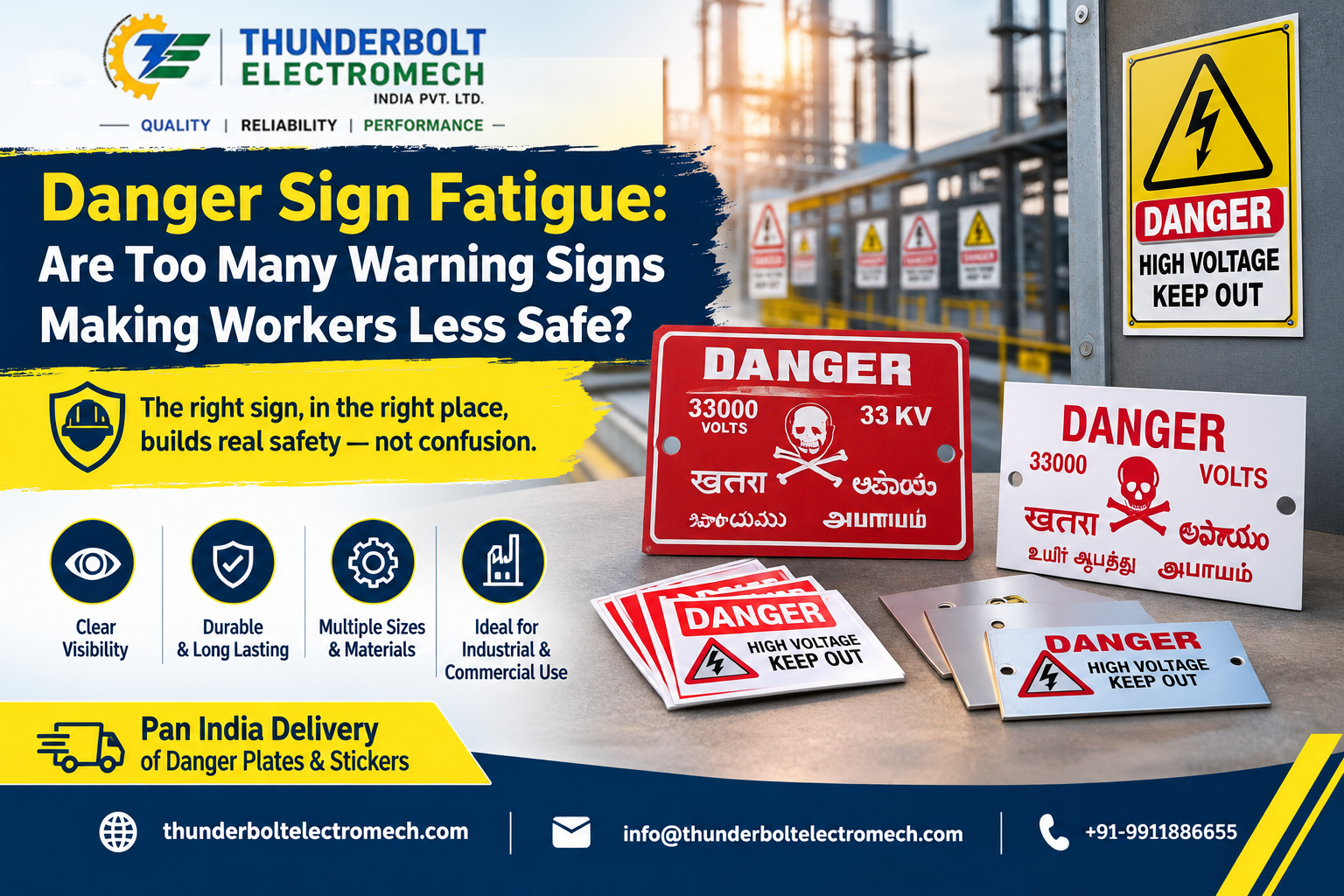
Quick Answer: Yes, when signs multiply without a plan, workers stop reading them. Research shows attention to repeated warnings fades, and in a study of 513 construction workers, none recalled more than eight signs at once. The fix is a sign budget: keep every legally required danger plate, remove duplicates, rank hazards and refresh secondary formats. As a Danger Plate Supplier, Thunderbolt Electromech stocks powder coated plates, aluminium plates and danger stickers for that layered approach.
Introduction
Walk through any older substation, panel room or factory yard and count the signs on one wall. Danger plates, caution stickers, “authorised personnel only” boards, fire notices, PPE reminders, half-peeled labels from three contractors ago. Someone added each sign with good intent. Nobody removed any.
Then ask the electrician who walks past that wall twice a day what it says. He usually cannot tell you.
That gap between posting a sign and being warned by it is the subject of this article. We supply danger plates to plant teams, contractors and utilities. We also see the aftermath of over-signing: crowded panels, faded red-and-white boards and workers who no longer look up.
Below, we cover what the research says about danger sign fatigue, why India’s regulations make the issue sharper, and how to build a sign plan that keeps the legally required plates and restores their impact. Our complete danger plate buying and standards guide covers specifications, and this cluster article covers the human side.
What Danger Sign Fatigue Actually Is
Researchers call it habituation, meaning a reduced response to a stimulus you see again and again. In a controlled study, 72 participants viewed 40 warnings repeated eight times, 320 trials in all. Their alertness ratings dropped from start to finish, and ratings rose again when the warning format changed. (Direct: Kim & Wogalter, 2009.) Participants rated alertness lower across the 320 initial trials, and higher ratings appeared when the format changed.
Two points matter for plant managers.
First, habituation reaches well-designed signs too. A review chapter on warnings notes that even a good warning loses attention-capturing power when people meet it repeatedly, and it suggests changing the warning’s format where feasible. Long exposure can reduce a warning’s ability to capture attention, even with well-designed warnings. (Direct: Wogalter handbook chapter.)
Second, this is biology, not laziness. A neuro-imaging study of computer security warnings found that neural activity in visual processing areas fell sharply with repeated exposure, and the authors concluded the effect reflects how the brain works rather than carelessness. Neural activity in the visual processing centres sharply decreased with repeated exposure to warnings. (Direct, but adjacent domain: software warnings, not industrial signs.)
Construction research shows the same pattern with alarms. Workers who spend time around vehicles tend to become inattentive to warning alarms, and some individuals habituate faster than others. Workers still tend to become inattentive to vehicle warning alarms after working around vehicles for some time. (Direct: NSF-hosted construction paper.)
So blaming workers misses the point. Design the environment for a brain that filters repeated stimuli, because it will filter them either way.
What New Research Says About Sign Counts
Habituation explains why one sign fades. A separate question asks what happens when many signs compete in the same glance.
The 2024 construction study
A 2024 study in the journal Buildings tested 513 Korean construction workers aged 20 to 50. Signs appeared for seven seconds, and workers then recalled what they could. Key results:
- The average recall was 3.32 items, and over 95% of workers recalled six or fewer.
- The success rate of conveying hazard information fell from 51.5% with six signs to 38.6% with nine and 28.5% with twelve.
- Years of experience did not improve recall, but age did affect it, with workers in their fifties recalling fewer items than those in their twenties.
- Placement order mattered more than colour, and recall dropped from the first sign onward.
The authors advise limiting the number of signs and note that recall of pictogram-based signs dropped significantly above nine items. (Direct: Kwon et al., Buildings 14(8):2391, 2024.)
Their practical advice: keep any one display to about three signs when hazard severity is high, put the most important message first, and use text-only signs when a display must carry many items.
Read the limits honestly. The authors state that controlled conditions and prior training may overstate real-world performance, and workers had no reason to memorise the signs. Real plants probably do worse. (Direct: same paper’s limitations section.)
The 2025 laboratory study
A 2025 Scientific Reports study tested warning sign designs with 120 participants using eye tracking, comprehension tests and behavioural observation. It reported that better-designed signs raised attention capture by 35.9%, hazard perception accuracy by 42.3% and compliance by 37.8%. The study linked these gains to strong colour contrast (at least 7:1), standardised symbols, short text (about ten words or fewer) and eye-level placement. The optimised system improved attention capture, hazard detection accuracy and procedural compliance significantly. (Direct: Weng & Ren, 2025.)
Caution here as well. The authors ran the study mainly in academic laboratories and say industrial settings may differ. Treat its numbers as design direction, not as a specification for an 11 kV yard. (Direct: authors’ stated limitation.)
What the two studies say together
More signs do not produce more warning. Past a small number, each added sign lowers the chance that any sign registers. A road-safety guidance document from the UK Department for Transport says the same in another setting: overusing warning signs dilutes their effect. Overuse of warning signs can dilute their effectiveness. (Direct, adjacent domain: road signage.)
Why India’s Plants Face a Sharper Version of This Problem
Indian electrical sites carry a legal floor that many other sites do not. The Central Electricity Authority’s 2023 safety regulations require the owner of any installation above 250 V to affix a permanent danger notice in Hindi or English and the local language, with a skull-and-bones sign, on motors, generators, transformers and other electrical plant and apparatus. Regulation 20 requires danger notices in Hindi or English and the local language, with a skull and bones sign, in a conspicuous position. A conference summary of the regulations states the symbol design follows IS 2551. (Direct: CEA Regulations 2023; the IS 2551 reference comes from a secondary summary.)
That floor changes how you fight sign fatigue. You cannot cure clutter by stripping mandatory plates. You cure it by removing everything around them that has no legal or risk-based reason to exist, so the mandatory plates stand out.
A second pressure is coming. The CEA notified an amendment in 2026 adding a safety chapter for battery energy storage systems. It applies to installations above 650 V and takes effect on 1 April 2027, and it covers fencing, fire audits and emergency shutdown. The amendment applies to BESS installations above 650 volts from April 2027 and requires a third-party fire audit within three months. A separate 2026 technical amendment sets a minimum 25-year design life for solar plants. The technical standards amendment prescribes a minimum design life of 25 years for solar power plants. (Direct: news reports of both CEA notifications; verify against the gazette text before you rely on clause detail.)
We draw three conclusions from those facts, and they are our analysis, not sourced findings. (No direct source found: engineering judgement.)
- New storage and solar yards will add hazard zones, and every zone tempts someone to add signs.
- A sign hung for a 25-year asset must keep its contrast for decades, so material choice matters more than unit price.
- The sign plan belongs in the design stage, before commissioning, not in the punch list.
This is the core of warning fatigue safety signs work in India: obey the legal floor, budget everything above it, and keep what remains legible.
The Sign Budget Method: Field Rules From a Danger Plate Supplier
We have watched plants add signs for years, and we have watched the better ones prune them. These rules come from that pattern. They are our engineering judgement, informed by the studies above. (No direct source found for the rules as a set.)
Rule 1: Count signs per sightline, not per wall.
Stand at the normal approach point and note what enters your field of view in one glance. That number is your sign load. If it exceeds what a worker can hold, six at most on the evidence above and three where severity is high, cut or consolidate.
Rule 2: Rank hazards into three tiers.
Tier 1 covers life-threatening hazards such as live equipment, and these get the standard danger plate at the boundary. Tier 2 covers serious but survivable hazards, which get warning or caution signs. Tier 3 covers information and housekeeping, which get stickers or nothing. When every hazard uses the same red board, none of them wins.
Rule 3: Protect the legal floor first.
List every item that needs a danger notice under the CEA rules, then add nothing until those are correct, durable and visible.
Rule 4: Vary the second layer, not the danger plate.
Habituation research points to changing the format. The danger plate itself must stay standard, because workers must recognise it instantly. Put your variation in the supplementary layer: a rotating toolbox message, a different-coloured job-specific tag, a permit-linked label. Workers keep the constant and get the surprise.
Rule 5: Fix the height and distance.
The laboratory study found the best results at eye level, roughly 150 to 170 cm, and weaker performance beyond about 4 m for its sign sizes. Apply that as a starting point and verify on your own site.
Rule 6: Size for approach distance.
International sign-design guidance relates viewing distance to sign height through a distance factor. A UK supplier’s guidance table lists a 300 × 100 mm sign at about 11.8 m in good light and 6.6 m in poor light. The table shows maximum viewing distance falling from good to poor light conditions for each size. Use the pattern: distance drops sharply in poor light, so size up for dim rooms and long approaches. (Direct: supplier guidance citing ISO 3864-1; check the standard for your sign type.)
Rule 7: Audit on a schedule.
Once a quarter, walk the site with a checklist: faded, dirty, missing, duplicated, obsolete. A faded plate loses contrast, and contrast was the strongest predictor in the laboratory study. Replace before it fails.
Danger Plate Supplier Comparison: Powder Coated Plate, Aluminium Plate and Danger Sticker
Different signs do different jobs in the hierarchy. This table reflects the sizes Thunderbolt Electromech lists; confirm current stock and thickness when you enquire.
| Feature | Powder coated plate | Aluminium plate | Danger sticker |
| Sizes we list | 200 × 150 mm and 200 × 250 mm | 150 × 75 mm, 200 × 150 mm, 200 × 250 mm | 75 × 150 mm, 150 × 200 mm, 200 × 250 mm |
| Base material | 1.6 mm mild steel with powder coating (per our 200 × 150 listing) | Aluminium; confirm thickness on enquiry | Adhesive-backed film |
| Fixing | Pre-drilled corner holes (per listing) | Drilled or fixed as specified | Peel-and-stick to a clean surface |
| Best zone | Boundary fences, doors, outdoor substations | Panels and enclosures where weight matters, small equipment | Indoor sub-labels, temporary and secondary notices |
| Hierarchy tier | Tier 1 anchor | Tier 1 or 2 | Tier 2 or 3 |
| Main strength | Rigid, holds contrast outdoors | Light and does not rust | Cheap, quick to change |
| Watch out | Steel edges rust if the coating is damaged | Softer than steel and can dent | Peels and fades if applied to dusty, hot or wet surfaces |
Our 200 × 150 mm listing states IS 2551 compliance, a 1.6 mm mild steel base, powder coating, voltage marking options from 415 V to 66 kV and a listed minimum order quantity of 100 pieces. (Direct: our product page; check current terms.) Browse the 200 × 150 mm powder coated danger plate, the 200 × 250 mm version and our full danger plate category for aluminium plates and stickers.
One engineering note on the table. Aluminium resists rust because it forms a protective oxide layer, a well-known property of the metal. (No direct source found in this research; general materials knowledge.) That suits damp panel rooms. Steel with powder coating suits exposed fences where a plate must survive knocks. Neither material is “better”; each belongs in a different tier.
Customer Problems and Solutions
These cases come up in enquiries and site conversations. We describe them as patterns, not client stories. (No direct source found: our operating experience.)
Problem 1: Every door carries five signs
What happens: Contractors add labels over the years, and nobody owns the wall.
Why it fails: Six-plus signs per glance pushes recall down sharply, according to the 2024 recall study.
Solution: Run the sightline count. Keep the mandatory danger plate, keep one Tier 2 sign that matters, and remove the rest. Where a message must survive, merge it into a single, short text line.
Problem 2: The danger plates have faded
What happens: Sun and grime turn red into pink, and white lettering goes grey.
Why it fails: Low contrast weakens detection, and contrast was the top predictor in the 2025 study.
Solution: Replace faded plates on your audit schedule. For outdoor fences, choose a rigid, coated plate; for sheltered panel rooms, aluminium works well. Do not repaint over old signs, because it blurs the symbol.
Problem 3: Stickers peeling off hot or dusty panels
What happens: A contractor applies stickers as the “permanent” warning, and they curl within a season.
Why it fails: Adhesive film suits clean, stable surfaces, and a danger notice is a legal safeguard, not a label.
Solution: Put the plate on the boundary and use stickers only for secondary or temporary messages. If you must stick, clean the surface first and press edges firmly.
Problem 4: A new solar or BESS yard needs many signs at once
What happens: The commissioning team orders signs late and adds them fast.
Why it fails: Late additions produce clutter and mismatched formats.
Solution: Build a sign map during design: list hazard zones, assign tiers, size each sign for its approach distance and order plates in one batch. With storage rules taking effect in April 2027, do this planning now rather than during handover. (Analysis, not sourced advice.)
Problem 5: Workers walk past the same sign daily and ignore it
What happens: Familiar routes get processed on autopilot.
Why it fails: Habituation is normal, and years of experience did not improve recall in the 2024 study.
Solution: Keep the danger plate constant, and vary the layer beside it: rotate a weekly toolbox topic, use permit-linked tags for specific jobs and refresh briefings. Habituation research supports changing the format to restore alertness.
Problem 6: Uncertainty about language and wording
What happens: A site wonders whether Hindi, English or a regional language satisfies the rule.
Why it matters: The CEA text asks for Hindi or English plus the local language of the district.
Solution: Confirm the local-language requirement with your electrical inspector or safety officer before you print. We cannot give a district-by-district ruling, and we found no single source that settles it for every site. (No direct source found.)
Problem 7: Small orders across mixed sizes
What happens: A plant needs a few plates of one size, a few of another and some stickers.
Solution: Send your size list and quantities. Our listing shows a minimum order quantity on the 200 × 150 mm plate, so check current terms before you order and ask us about mixed requirements.
Safety Signage Consultant Delhi: When to Bring One In
A supplier sells signs. A consultant assesses your site and decides which signs you need. Thunderbolt Electromech works as a supplier, and we do not present ourselves as an audit firm. For a full hazard-zone review, hire a qualified safety signage consultant Delhi plants can verify, and use us to supply what the audit specifies.
Bring one in when:
- you are commissioning a new substation, solar plant or storage yard;
- an incident or near miss points to a signage failure;
- you have merged sites and inherited mixed sign styles;
- your insurer or client asks for a documented signage audit.
Ask any consultant these questions:
- How many signs will one sightline carry after your plan?
- Which items meet the legal floor, and which come from risk assessment?
- How will you size signs for approach distance and lighting?
- What is the replacement cycle, and who owns it?
Delhi NCR sites add their own conditions: dense industrial belts such as Okhla, Bawana, Narela and Faridabad, hot summers that stress outdoor coatings, and a growing number of solar and storage installations. (Regional context; no direct source found for site-level conditions.) A consultant who knows those conditions will specify materials for them.
Latest Trends in Warning Design
Four trends stand out this year. We flag which have evidence and which are still early.
Hierarchy over volume. The 2024 and 2025 studies both point toward fewer, ranked, better-designed signs. This has the strongest evidence.
Photoluminescent and high-contrast materials. The 2025 laboratory study reported much better visibility under emergency lighting for photoluminescent and high-contrast schemes than for conventional signs. Treat this as promising rather than proven for industrial yards, since the work was done in laboratories.
QR links from signs. The same study reported better procedural compliance where signs linked to detailed protocols by QR code, especially near complex equipment. It suggests keeping the sign short and moving detail to a linked page. (Direct, laboratory setting.)
Digital and sensor-driven warnings. The authors point to digital displays, augmented reality and sensor-based alerts as future directions for changing hazards. These remain research proposals, not established practice. (Direct: authors’ outlook section.)
Our view is that static danger plates stay essential. They work without power, need no software and meet the legal requirement. The trend adds layers around them; it does not replace them. (Analysis.)
Buying Checklist From a Danger Plate Supplier
Before you order, confirm each item:
- Standard: Does the plate follow IS 2551 for the danger notice design?
- Language: Does the wording match your regulatory need?
- Voltage marking: Is the correct voltage printed, for example 415 V to 66 kV?
- Size and distance: Does the size suit the approach distance and lighting?
- Material: Coated steel, aluminium or sticker, matched to the tier and environment?
- Fixing: Pre-drilled holes, hardware and surface ready?
- Quantity and terms: Minimum order, lead time and GST invoice confirmed?
- Replacement plan: Who checks and replaces plates, and when?
Our danger plate blog collection covers related topics such as standards and installation.
FAQs
What is danger sign fatigue?
It is the drop in attention that follows repeated exposure to the same warnings, or exposure to too many at once. Research calls the repeated-exposure effect habituation.
How many warning signs can a worker remember?
In one study, workers recalled about three items on average, and over 95% recalled six or fewer.
Should I remove danger plates to reduce clutter?
Not the required ones. CEA regulations require danger notices on electrical plant above 250 V. Remove duplicates and low-value signs instead.
Do experienced workers notice signs better?
Not in the 2024 study, where experience did not improve recall. Familiarity may even encourage autopilot behaviour.
Are stickers acceptable as danger notices?
The CEA text calls for notices affixed permanently in a conspicuous position. We recommend plates for that role and stickers for secondary messages. Confirm acceptance with your electrical inspector.
What contrast should a warning sign have?
The 2025 laboratory study used a ratio of at least 7:1. Treat that as a design target and confirm against standards for your sign type.
How often should we audit signs?
We suggest quarterly walk-throughs. No source we found sets a required interval.
Contact Thunderbolt Electromech in Delhi
Thunderbolt Electromech India Pvt. Ltd.
Shop no 3538, Sitaram Bazar Rd, Bazar Sirkiwalan, Chawri Bazar, Chandni Chowk, Delhi 110006
Phone: +91-9911886655 | +91-6391217408
Email: Info@thunderboltelectromech.com
Hours: Monday to Saturday, 11:00–19:00
Send your sign list, sizes and site photos, and we will help you match plates and stickers to your plan. Our site states delivery partners across more than 20 states. (Site claim.)
Conclusion: Fewer Signs, Better Signs
Danger sign fatigue does not mean signs fail. It means signs fail when nobody manages them. Repetition dulls attention, crowding overloads memory and fading removes the contrast that made a plate work.
Keep the plates the law requires. Rank the rest by hazard. Limit what any one glance must carry, place signs at eye level, size them for the approach and vary the layer around the standard plate. Audit on a schedule, and plan new solar and storage yards before the first sign goes up.
If you need plates, aluminium boards or stickers for that plan, browse our danger plate range, read the pillar guide, or call +91-9911886655.