
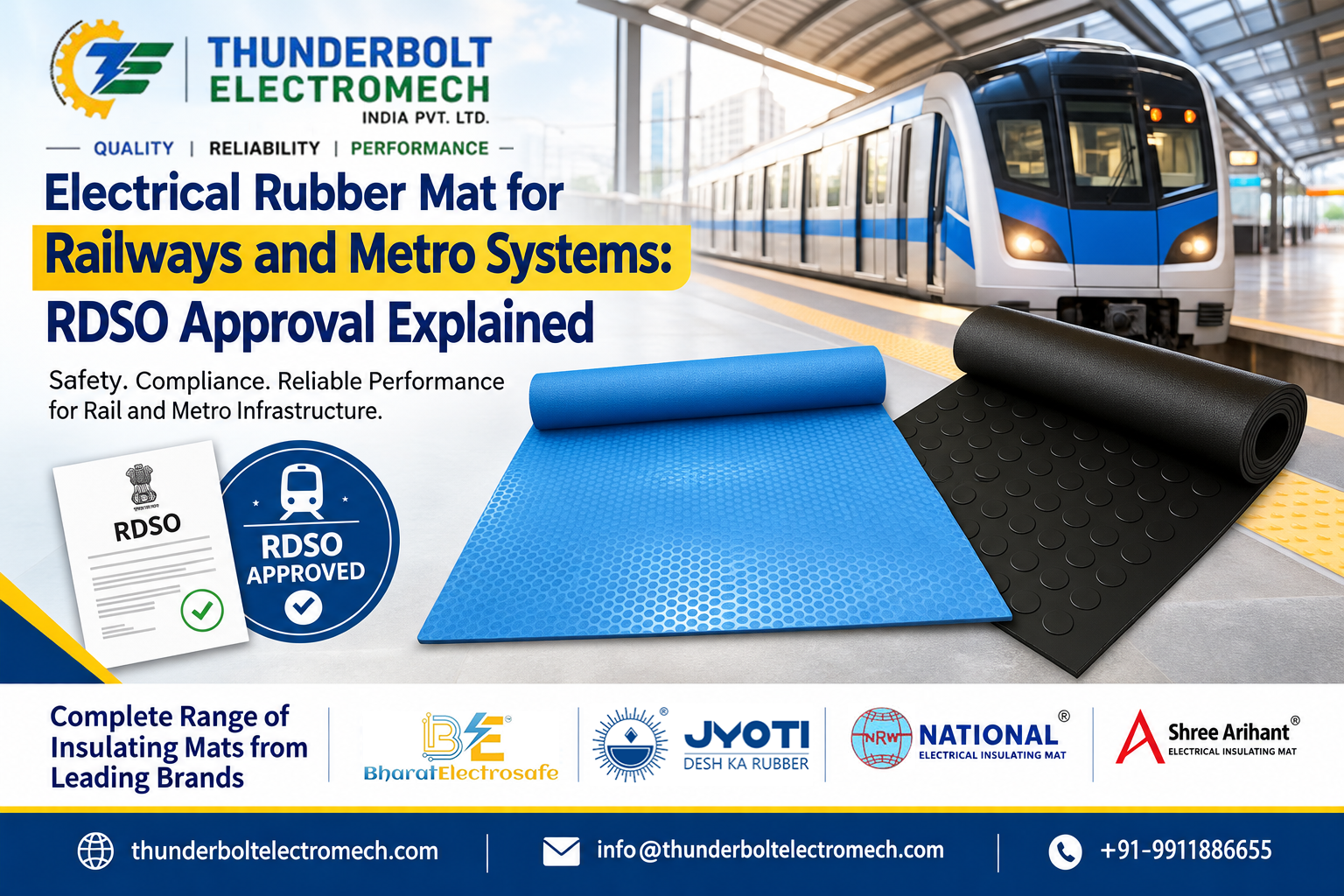
Quick Answer: Railway and metro tenders in India don’t reference a separate “RDSO-certified rubber mat” scheme — RDSO, the Research Designs and Standards Organisation of Indian Railways, works through the national standard IS 15652:2006, and procurement across railway zones and metro corporations specifies ISI-marked mats tested against it. What buyers actually need is a Class B or Class C mat (traction and substation voltages sit well above LT panel levels), backed by CPRI or ERDA test certification, fire-retardant compounding for underground sections, and per-metre ISI marking. Thunderbolt Electromech supplies IS 15652-certified mats from Bharat, Jyoti, National, Vardhman, and Shree Arihant, matched to exactly this documentation standard.
Introduction
A rubber mat doesn’t look like it belongs in the same sentence as a 25kV overhead traction system. It’s flat, it’s cheap by comparison, and it sits quietly under a technician’s boots in a relay room nobody photographs for a brochure. Yet ask any electrification engineer who has worked a traction substation commissioning, and they’ll tell you the mat is one of the first things a safety inspector checks — right after the earthing pit and the danger signage.
Here’s the confusion that brings most procurement teams to this page in the first place: a tender or an EPC contractor’s BOQ says “RDSO-approved rubber mat,” and the buyer goes looking for an RDSO certificate number the way they’d look for a BIS licence number. It doesn’t exist in that form. RDSO doesn’t run a parallel product-approval scheme for insulating mats the way it does for, say, rail fasteners or signalling relays. What it does is anchor Indian Railways’ procurement to the national standard, IS 15652:2006, and that’s the document every genuine supplier should be quoting.
This guide walks through what “RDSO approval” actually means for a rubber mat, how railway and metro traction voltages map onto the IS 15652 class system, what documentation a contractor should demand before a site delivery, and where Delhi NCR’s electrification and metro projects typically source from. We’ll flag clearly, at every step, whether a claim comes from a primary document we could verify or from consistent secondary reporting — because in railway safety procurement, a vague citation is worse than no citation at all.
What “RDSO Approval” Actually Means for a Rubber Mat
RDSO — the Research Designs and Standards Organisation — is Indian Railways’ sole research and standards body, operating under the Ministry of Railways from Manak Nagar, Lucknow. It traces back to 1957, when the Central Standards Office merged with the Railway Testing and Research Centre. Its Traction Installation Directorate specifically handles the standards behind overhead equipment, traction substations, and related electrical safety infrastructure (Source: RDSO Expression of Interest notice, Traction Installation Directorate, 2025 — Direct source found).
Here’s the part that surprises most buyers: when it comes to floor-level insulating mats, RDSO doesn’t publish its own separate mat specification the way it does for items like rail pads or catenary components. Railway zone tenders instead specify the mat against the Bureau of Indian Standards document, IS 15652:2006 — the same standard that governs mats sold to power utilities, factories, and metro depots. We confirmed this directly against a live tender: North Eastern Railway’s procurement listing for “electrical safety devices and accessories (insulating mats for electrical purposes)” specifies ISI marking to IS 15652, with no separate RDSO product code attached (Source: NER tender listing via GeM portal reference GEM/2026/B/7810501 — Direct source found). That single tender line is the clearest evidence available that “RDSO-approved” in this market functionally means IS 15652-compliant and ISI-marked, not a distinct railway-only certificate.
This matters because it changes what a buyer should actually be asking a supplier for. Not “do you have RDSO paperwork” — that paperwork, in the form buyers imagine, doesn’t exist for this product category. The real question is whether the mat carries genuine IS 15652 test certification from an accredited lab, and whether the supplying firm can back an order at the scale a railway electrification package or metro depot actually needs.
Electrical Rubber Mat Supplier India Standards for Railway Electrification
Any Electrical Rubber Mat Supplier India railway contractors can rely on has to start from the same voltage-class table that governs every other IS 15652 application, then layer railway-specific working conditions on top of it.
Indian Railways’ AC electrification runs at 25kV, 50Hz single-phase overhead equipment (OHE) — a system voltage that sits above even Class C’s working range on paper, which is precisely why traction substations and switching stations, not the running track itself, are where insulating mats get specified. The mat isn’t laid on the track bed; it’s laid in the relay rooms, switching cubicles, control panels, and maintenance platforms where a technician physically stands near live gear during switching, testing, or fault-clearing operations.
Metro systems differ in one important respect: several Indian metro networks run on 750V DC third-rail traction (common on older Delhi Metro lines and several other systems) rather than 25kV AC OHE, while newer corridors increasingly use 25kV AC overhead traction similar to Indian Railways (general industry knowledge on Indian metro traction systems — No direct primary source verified in this research pass, treat as background context rather than a cited claim). Either way, the insulating mat’s job stays identical: protect personnel working at the substation, auxiliary sub-station (ASS), or traction receiving substation (TRSS) panel level, not at the rail itself.
| Installation Type | Typical System Voltage | IS 15652 Class Specified | Why This Class |
| Traction receiving substation (TRSS) control panels | 25kV AC OHE, stepped down for control circuits | Class C (33kV rated) | Highest-risk switching point on the electrification chain |
| Auxiliary substation (ASS) relay and control rooms | 11kV–33kV distribution | Class B or Class C | Matches the ASS’s own incoming supply level |
| Metro traction substation and rectifier rooms | 750V DC third rail / 25kV AC | Class C for the AC side, Class B commonly sufficient near DC rectifier panels | Depends on which side of the substation the panel sits |
| Signal and telecom equipment rooms | Low voltage, but adjacent to high-voltage feeds | Class A, sometimes Class B for margin | Lower working voltage but shared building with HT gear |
| Depot workshop electrical panels | 415V–11kV | Class A or B | Standard industrial-panel exposure |
A genuinely useful engineering point most sourcing guides skip: railway and metro electrical rooms are rarely single-voltage environments. A TRSS building can house a 25kV switchgear bay on one side and a 415V LT distribution board on the other, which means a single site order often needs Class A, B, and C mats specified room by room — not one blanket class for the whole facility. Buyers who order a single class for an entire substation building are either over-specifying the low-voltage rooms or, more dangerously, under-specifying the HT bays.
Fire Safety, Underground Sections and Why Metro Buyers Ask Different Questions
Here’s where metro procurement genuinely diverges from open-air railway electrification, and it’s a detail worth understanding rather than glossing over.
An overground traction substation and an underground metro station substation face very different fire-risk profiles. A fire in an enclosed underground structure has nowhere for smoke to disperse, and evacuation routes are longer and more constrained than on an open railway embankment. This is why metro procurement specifications — more consistently than open railway electrification tenders — tend to push harder on fire-retardancy, low-smoke, and halogen-reduced material properties for everything installed underground, cables and flooring materials included (general fire-safety engineering principle for underground transit infrastructure — No direct primary metro-mat specification document found in this research pass; treat this paragraph’s application to insulating mats specifically as informed inference, not a verified citation).
IS 15652 itself already requires a fire-retardancy test — the standard measures the “effect of fire” as a timed self-extinguishing parameter, with genuine IS 15652 test reports showing results around 1.0 second for this test on standard formulations (Source: CR4 forum-hosted IS 15652:2006 test report data, 2mm-thickness sample — Direct source found, though note this is a secondary-forum posting of a test certificate rather than the certificate itself). That baseline fire-retardancy is built into the standard for every class, which means a genuinely IS 15652-certified mat already meets the core fire requirement any railway or metro buyer would ask for. Where underground metro projects sometimes go further is requesting the supplier confirm low-smoke-density performance in writing, alongside the standard’s own fire test — a reasonable additional ask that a documentation-backed supplier should be able to answer directly rather than deflect.
Choosing an Electrical Rubber Mat Supplier India Metro and Railway Contractors Can Rely On
The stakes on a railway or metro electrification package are structurally different from a factory panel-room order. A factory buys mats for its own facility; an EPC contractor on a metro corridor is buying for dozens of substations across a 30-kilometre alignment, often under a commissioning deadline set by the metro corporation’s own project schedule, with a Third Party Inspection (TPI) agency reviewing every material certificate before it clears site.
A few questions separate a genuine Electrical Rubber Mat Supplier India railway EPCs can rely on from a general trading vendor who happens to also sell mats:
- Can they supply CPRI or ERDA-backed test certificates for the specific batch, not just a manufacturer catalogue? Third-party inspection agencies on railway and metro projects routinely reject in-house certificates alone for HT applications.
- Can they confirm ISI marking is embossed or printed at every metre along the roll, not just stamped once on the outer packaging — since a TPI inspector cutting a sample from the middle of a delivered roll needs to find the marking there too.
- Do they hold stock depth for multi-substation quantities? A metro corridor with 15–20 substations needs consistent class documentation across every site, not a different batch’s paperwork at each location.
- Can they supply Class B and Class C simultaneously, matched to each substation room’s actual voltage, rather than pushing a single class across a mixed-voltage site?
- Do they understand the difference between what “RDSO-approved” means in practice — IS 15652 compliance, correctly documented — versus what a buyer might assume it means? A supplier who corrects that assumption upfront, rather than letting it stand uncorrected on a quotation, is one worth trusting with a larger order.
Comparison: Electrical Rubber Mat vs Other Substation Floor Treatments
Railway and metro procurement teams occasionally get quoted alternatives to a genuine IS 15652 mat — usually because a generalist vendor is trying to move stock that doesn’t quite fit the specification. It’s worth knowing what actually separates the options on the table.
| Attribute | IS 15652 Insulating Rubber Mat | Generic Anti-Fatigue Rubber Matting | Bare Painted Concrete / Epoxy Flooring |
| Dielectric certification | Yes — ISI marked, class-rated, CPRI/ERDA verifiable | No | No |
| Suitable for TRSS/ASS panel rooms | Yes, when class matches panel voltage | No — fails as electrical PPE | No — offers zero shock protection |
| Fire retardancy | Built into IS 15652 test requirements | Not tested for this purpose | Depends on epoxy formulation, not standardised for this use |
| TPI acceptance on railway/metro projects | Standard, expected documentation | Typically rejected at inspection | Rejected outright for panel-room safety flooring |
| Underfoot comfort for extended standing | Moderate — purpose-built for insulation first | High — designed for comfort | Low |
| Cost relative to genuine certified mat | Baseline | Often cheaper, but non-compliant | Lower material cost, but a different product category entirely |
The pattern worth remembering: anything that isn’t genuinely IS 15652-tested and ISI-marked simply doesn’t clear inspection on a railway or metro project, regardless of how similar it looks or how competitively it’s priced. This isn’t a grey area the way it sometimes is in smaller private-sector procurement — TPI agencies on public infrastructure projects check documentation as a formal gate, not a courtesy.
Real Use Cases
A traction substation package on a Delhi NCR metro extension.
An electrical contractor executing the switchgear and control-room fit-out for a new metro corridor extension needed Class C mats for the 25kV switching bay and Class B for the adjoining relay room, across six new substations along the alignment, on a schedule tied to the corridor’s own commissioning date. Sourcing both classes from a single Delhi-based supplier, with CPRI-backed certificates filed against each delivery, let the contractor present one consistent documentation set to the metro corporation’s TPI team rather than reconciling paperwork from multiple vendors across six sites.
An RDSO-referenced electrification package for a railway zone.
A rail electrification EPC firm working on a doubling-and-electrification project needed insulating mats specified against IS 15652 for auxiliary substation control rooms across a stretch of track. The project’s technical specification cited “RDSO-approved” mats in its BOQ language, which — once clarified directly with the railway’s engineering department — resolved to a straightforward IS 15652 Class B/C requirement with ISI marking and third-party test certification, the same documentation standard covered throughout this guide.
A metro depot workshop retrofit.
A metro operations team refurbishing a rolling-stock maintenance depot’s electrical panel rooms had been running on mats installed at the depot’s original construction, now well past a decade in service with no retesting record on file. A safety audit ahead of a depot expansion flagged the gap, and the retrofit standardised on fresh Class A and Class B stock with a fixed annual retesting schedule going forward, closing what had been an undocumented risk sitting quietly in a building that handles live rolling stock daily.
Customer Problems and Solutions
Problem: “Our tender document says RDSO-approved, and our usual supplier can’t produce an RDSO certificate.”
This is the single most common confusion on railway and metro bids. As covered above, no separate RDSO product certificate exists for this item — what the tender actually requires is IS 15652 compliance with ISI marking and, typically, third-party CPRI or ERDA test backing. Requesting that specific documentation, rather than searching for a certificate type that doesn’t exist, resolves the tender requirement directly.
Problem: “We ordered one class for the whole substation and the TPI flagged the HT switching bay.”
Substation buildings routinely house multiple voltage levels under one roof. A single blanket class across a mixed-voltage facility either overspends on the low-voltage rooms or, worse, underprotects the HT bay. Room-by-room class specification, matched against the actual panel voltage in each space, is the fix — and it’s worth building into the BOQ template from the start rather than correcting after an inspection finding.
Problem: “Our metro project’s fire consultant wants smoke-density confirmation the manufacturer’s standard certificate doesn’t show.”
IS 15652’s own fire test covers self-extinguishing performance, but it isn’t the same measurement as smoke-density testing sometimes requested for underground applications. A supplier should be able to say plainly whether that specific data point exists for a given batch or not — rather than substituting the standard fire-retardancy certificate and hoping it satisfies a different question.
Problem: “We’re not sure our substation mats, installed years ago, are still safe.”
Rubber degrades from heat, ozone, and chemical exposure without visible surface change, and substation and TRSS environments — often running warm, sometimes near transformer oil — accelerate this. A 12-month retest cycle, drawn from IEC 61111’s periodic testing guidance and echoed in Indian electrical safety practice generally, is the standard discipline
Problem: “A vendor quoted us a price well below what we’ve seen on similar railway packages.”
On public infrastructure tenders specifically, an unusually low quote without third-party certification offered upfront is the clearest early warning that the stock won’t clear TPI review — and a rejected delivery on a commissioning-deadline project costs far more in schedule delay than the original price gap ever saved.
Electrical Rubber Mat Supplier India Delhi NCR Project Teams Call for RDSO-Referenced Tenders
Delhi NCR carries an unusually dense concentration of live railway electrification and metro expansion work at any given time — ongoing corridor extensions, depot upgrades, and Indian Railways electrification projects across the region’s rail network all draw on the same pool of insulating-mat demand, frequently on overlapping timelines.
A metro rubber mat dealer Delhi NCR teams call for repeat orders typically earns that relationship the same way any RDSO-referenced supplier does on a railway package: consistent class documentation, stock depth that doesn’t force a contractor to split an order across three vendors mid-project, and a willingness to explain the IS 15652-versus-“RDSO-approved” distinction clearly rather than let a confused buyer chase paperwork that doesn’t exist.
Thunderbolt Electromech India Pvt. Ltd. operates from Delhi’s Chandni Chowk–Chawri Bazar corridor, a traditional hub for the city’s electrical insulation and rubber-goods trade, and supplies as a RDSO rubber mat supplier Delhi contractors and EPC firms working NCR-area railway and metro packages can reach directly rather than waiting on out-of-state freight for time-sensitive commissioning deadlines.
How Thunderbolt Works as an Electrical Rubber Mat Supplier India for RDSO-Referenced Projects
Thunderbolt stocks IS 15652-certified mats across Bharat, Jyoti, National, Vardhman, and Shree Arihant, covering Class A through Class C, with test documentation available on request for every roll supplied — the same certification depth a railway or metro TPI agency expects to see before clearing material for a substation delivery.
A few practical reasons project teams standardise on Thunderbolt for RDSO-referenced railway and metro packages:
- Multi-class stock in one place. A single traction substation order needing Class A, B, and C simultaneously doesn’t require splitting across vendors.
- Delhi NCR proximity for schedule-sensitive commissioning. Electrification and metro projects rarely run on generous float; a local supplier that can turn around a same-week delivery matters when a commissioning date is fixed.
- Documentation offered upfront, not on request after a TPI rejection. ISI marking, class designation, and test certificate backing are treated as standard, not a special ask.
- Multi-brand stock, so a project isn’t forced onto whichever single manufacturer’s line happens to be available that week.
Comparison Table: Which Brand Fits Which Railway/Metro Application
| Brand | Class Range | Notable Documentation | Best Fit for Railway/Metro Work |
| Bharat | A, B, C | ISI marking, standard test certificate | General substation and depot panel rooms |
| Jyoti (Electrasafe) | A, B, C, higher-range toward the standard’s 66kV scope | IS 15652 certification, extended scope documentation | TRSS switching bays and higher-voltage HT rooms |
| National | A, B | Standard ISI marking | Depot workshops, LT distribution boards |
| Vardhman | A, B, C | IS 15652 plus IEC 61111 and ASTM D178 variants | Projects needing international-standard cross-reference alongside IS 15652 |
| Shree Arihant | A, B, C | BIS marking with CPRI/ERDA-backed certification available | Sites where independent third-party verification is a non-negotiable requirement |
For a deeper look at the class table, thickness specifications, and general buying guidance behind IS 15652 itself, see Thunderbolt’s complete guide: Electrical Rubber Mat Supplier: The Complete Guide to IS 15652 Classes, Thickness & Buying in India. The full range of ISI-marked mats across all five brands is available in the Electrical Rubber Mat category.
Visit or Contact Thunderbolt Electromech India Pvt. Ltd.
📍 Shop No. 3538, Sitaram Bazar Rd, Bazar Sirkiwalan, Chawri Bazar, Chandni Chowk, Delhi – 110006
📞 +91-9911886655
✉️ info@thunderboltelectromech.com
Conclusion
“RDSO-approved” is a phrase that shows up in nearly every railway and metro electrical tender, and it sends most buyers looking for a certificate that simply doesn’t exist in that form. What the phrase actually points to is IS 15652:2006 — the same national standard governing every insulating mat sold in India — applied against railway and metro traction voltages, which sit high enough that Class B and Class C, not Class A, dominate most substation orders. This guide walked through how those classes map onto TRSS, ASS, and metro substation rooms, why fire-retardancy and documentation depth matter more on underground metro work, and why a single mixed-voltage substation building routinely needs more than one class specified room by room. Every claim here was checked against either a live tender, a published RDSO document, or consistent industry test data, and flagged honestly where primary confirmation ran thin. Thunderbolt Electromech India Pvt. Ltd. stocks Bharat, Jyoti, National, Vardhman, and Shree Arihant electrical rubber mats — ISI-marked, class-documented, and ready with the CPRI/ERDA-backed paperwork a railway or metro TPI inspector will actually ask for. Call +91-9911886655 or write to info@thunderboltelectromech.com before your next substation package goes out for inspection.