
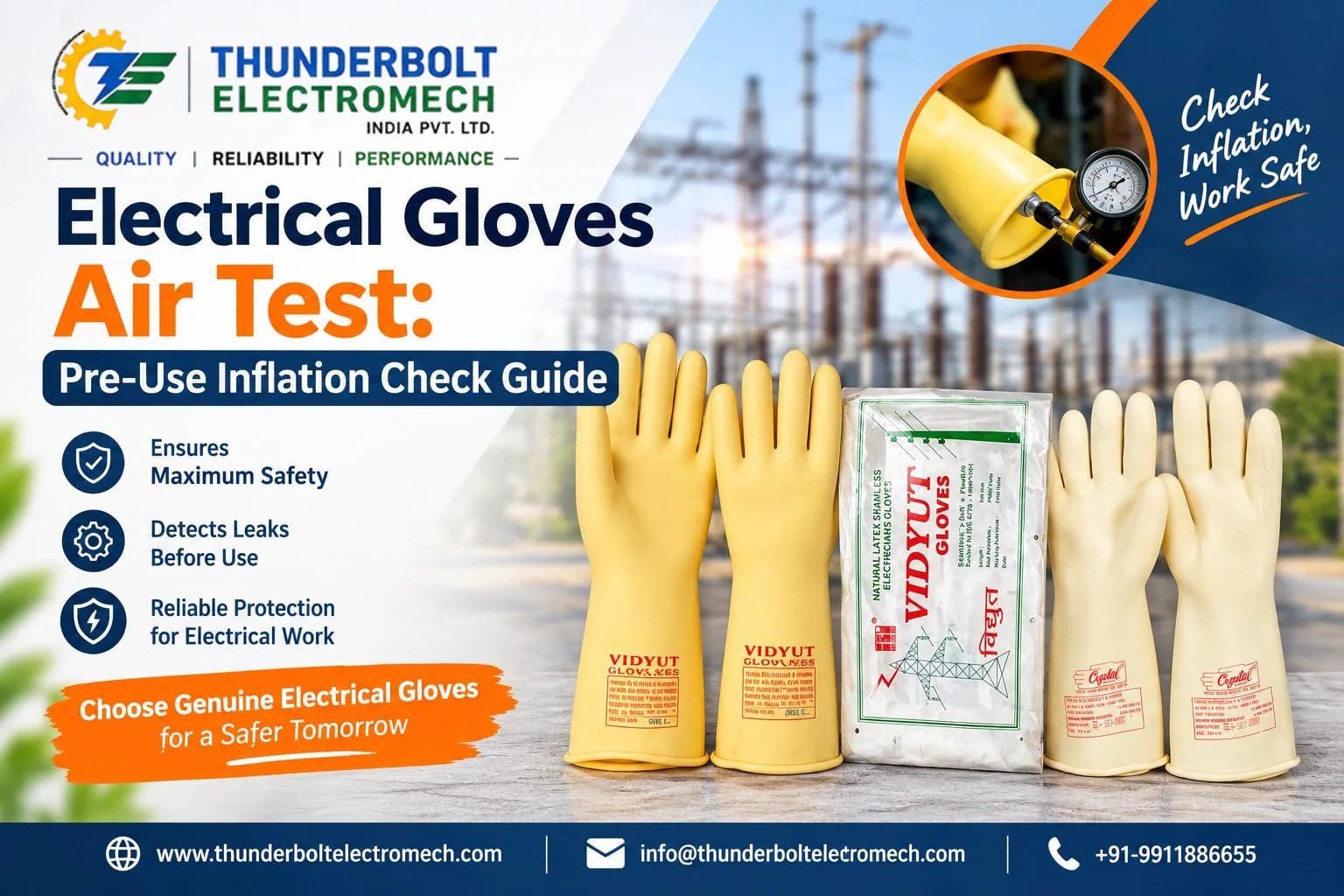
Quick Answer: An electrical gloves air test checks rubber insulating gloves for pinholes, cuts and ozone cracks before every use. Roll the cuff tightly or use an inflator, squeeze the trapped air, and listen and feel for leaks. Repeat with the glove turned inside out, check the date code, and withdraw any pair that leaks. As an electrical hand gloves supplier India relies on, Thunderbolt Electromech India Pvt. Ltd. recommends this check at the start of every shift, on top of the periodic lab test.
Introduction
Most glove failures start small. A pinhole you cannot see. A hairline ozone crack hiding in the fold between two fingers. The rubber looks fine in your hand, so the pair goes back on the shift, and nobody finds the fault until current finds it first.
At Thunderbolt Electromech India Pvt. Ltd., we hear this story from maintenance teams more often than we would like. We work as an electrical hand gloves supplier Delhi electricians know, and we sell Raychem, Vidyut and crystal electrical hand gloves from our shop in Chawri Bazar. We also see what comes back when a pair has gone wrong.
This guide teaches one habit that catches most of those faults: the electrical gloves air test. It takes about two minutes. It costs nothing if you roll the cuff, and very little if you buy an inflator. You will learn the method, the engineering reasons it works, what it cannot catch, how it fits each glove class, and when a pair must leave service.
If you want the full buying picture first, read our pillar guide to electrical hand gloves supplier in India. For more articles on inspection, testing and storage, browse our electrical hand gloves cluster.
Why an Electrical Hand Gloves Supplier Insists on an Air Test Before Every Use
What the rules say
The rule is short. OSHA 29 CFR 1910.137(b)(2)(ii) says insulating equipment must be inspected for damage before each day’s use. It must also be inspected right after any incident that could have damaged it. The same paragraph adds that insulating gloves get an air test along with the inspection.
OSHA’s guidance for power work goes one step further. Gloves must be electrically tested before issue. They need a visual check and an air test before each day’s use. Best practice, says OSHA, is to inspect and air test before every use. That second wording matters. A glove can pick up a cut at 10 a.m. and still be in your hand at 2 p.m.
The periodic test is a separate layer. ASTM F496 sets in-service retest intervals for gloves at no more than six months. A narrow exception allows nine months for industries that use gloves only as precautionary protection. Glove makers also tell you to read the date code at each inspection, so you know the lab test is still valid.
IEC 60903 takes a similar line. Guidance built on that standard says both gloves of a pair should get a visual check and a manual air test before each use, where practicable. For Class 00 and Class 0, a routine dielectric test is the best check. Local rules may accept air inflation plus visual inspection for those two lower classes. For Class 1 to Class 4, treat the dielectric test as non-negotiable.
Notice what this adds up to. Three checks, three jobs:
- Lab proof test: proves the rubber still holds its rated voltage.
- Daily air test: proves the glove has no hole today.
- Visual inspection: proves the surface shows no damage that the first two checks cannot see.
Skip one, and you leave a gap the other two cannot fill.
What a quick look misses
Put a good glove and a damaged glove on a table. Under a normal shop light, you will struggle to tell them apart.
The reason is geometry. Class 00 and Class 0 gloves have thin walls, around a millimetre or less. A pinhole through that wall is a channel a fraction of a millimetre wide. Your eye cannot resolve it against a textured, glossy surface. But sweat inside the glove and moisture or dust outside can fill that channel. Now you have a conductive path through the insulation.
Ozone cracks hide for a different reason. Rubber under no strain keeps those cracks closed. The fold at the finger web, the thumb crotch and the rolled cuff all sit slightly stretched or creased in storage. Ozone attacks the stretched skin first, and the cracks run at right angles to the stress. They stay shut until you stretch the glove again. That is exactly what an air test does.
Where does ozone come from? Sunlight and heat in the open air produce it, and ground-level ozone climbs in hot months across Delhi NCR. Corona discharge around energised switchgear produces it too. A pair left hanging in a panel room, folded over a hook or tossed in a toolbox lid, collects exposure all year.
Customer problems and solutions
These are the cases our team hears most from buyers and site supervisors.
| Problem on site | What goes wrong | Practical fix |
| Gloves “look fine,” so nobody tests them | Pinholes and fold cracks stay hidden | Air test every pair at the start of each shift |
| Noisy yard or plant floor | Technician cannot hear a faint hiss | Hold the glove against your cheek, or test indoors |
| No record of who checked what | Supervisor cannot prove the test happened | Tag each pair with date and inspector’s initials; keep a simple log |
| Pairs mixed between crews | Nobody owns a damaged pair | Issue numbered pairs to named people |
| Gloves bought without class marking or test papers | Class and test date are unknown | Buy from an electrical hand gloves supplier who gives class marking and test documents |
| Leather protectors missing or oil-soaked | Rubber takes cuts and chemical damage | Inspect and replace protectors; keep oil away from the rubber |
Real use cases
The air test earns its place in many jobs. Here are a few from the sites we serve.
- LT panel maintenance in a factory. An electrician opens a motor control centre on a 415 V system. A Class 0 pair goes on after a 90-second air test.
- DG set changeover. A technician works on the changeover panel during a monsoon outage. Damp air raises the risk, so the pair gets a full inside-out check.
- 11 kV feeder isolation. A switchyard crew uses Class 2 gloves. The supervisor inflates each glove and checks the date code before the permit is signed.
- Solar plant combiner box work. Teams handle DC strings in direct sun. Heat ages rubber fast, so the air test happens in a shaded room, not at the array.
- Substation operator rounds. An operator carries gloves in a bag all shift. The check happens at the start and again after any drop or scrape.
Electrical Hand Gloves Supplier Guide: The Roll-the-Cuff and Inflator Methods
Set up the test
Good results need a good setup. Take two minutes to get it right.
- Pick a quiet, indoor spot. Wind and machinery noise mask small leaks.
- Let the gloves reach room temperature. A glove from a hot vehicle or a cold store behaves differently.
- Use clean, dry hands. Take off rings and watches.
- Remove the leather protectors. Test the rubber glove alone.
- Read the markings. Check class, size, maker and date code before you do anything else.
Place both gloves under bright light. Angle the light across the surface so shallow defects throw a shadow.
Step 1: Visual inspection (electrical gloves inspection)
Start with your eyes. The ASTM specification defines “harmful irregularities” as anything that breaks the smooth surface and could hurt the user. Look for these:
- Pinholes, cuts and tears
- Cracks, especially at the thumb crotch and finger webs
- Blisters and swelling
- Embedded foreign matter, such as metal chips
- Creases, pinch marks and prominent ripples
- Voids (trapped air under the surface) and mould marks
- Soft, sticky or swollen rubber from oil or solvent contact
- Hardened, glazed or discoloured rubber from heat and age
- Damage at the cuff edge
Check the inside as well as the outside. If you feel grit, a hard lump or a tacky patch, stop. Withdraw the pair.
Step 2: The roll-the-cuff air test
This method needs no equipment. It is the standard field check when you have no inflator.
- Trap the air. Hold the glove by the cuff with both hands. Open the cuff wide, flick the glove once to catch air, then pinch the cuff shut.
- Roll the cuff. Roll it tightly toward the palm. Three or four tight turns usually work. The trapped air now sits in the fingers and palm.
- Squeeze in sections. Use your free hand. Work from the fingertips to the palm, then the thumb, then the back of the hand.
- Listen and feel. Bring the glove close to your cheek or lips. Skin senses a tiny airflow better than your ear hears it.
- Hold for ten to fifteen seconds. A sound glove keeps its shape. A leaking glove slumps.
- Repeat inside out. Release the air, turn the glove inside out, and run steps 1 to 5 again. The inner surface hides cracks the outer surface does not show.
A short field tip: if a finger tip goes soft first, the leak is almost always there. If the whole glove sags slowly, check the cuff roll itself. A loose roll leaks and fools you into blaming the rubber.
Step 3: The inflator method
A construction safety paper explains that a mechanical inflator gives a better check of the whole glove surface. We agree. The roll method pressurises mostly the fingers and palm. An inflator fills the full volume up to the cuff.
- Fit the glove over the inflator nozzle and hold the cuff closed.
- Inflate gently. Do not go past the limit your glove maker states. One major manufacturer says to expand Type I gloves no more than twice their normal size.
- Rotate the glove in bright light. Stretched rubber opens fine cracks, so ozone damage becomes visible.
- Listen and feel for escaping air along every finger and the thumb.
- Deflate slowly. A fast release can stress the cuff.
- Turn inside out and repeat.
Over-inflation is a real risk. Rubber stretched past its design limit can open micro-cracks that were not there before you started. Gentle and slow wins.
Step 4: Read the date code and tag the pair
Find the test date on the cuff. Compare it with the retest interval your site follows. In India, many sites follow IS 4770 together with the six-month ASTM F496 practice. Check which standard your own safety rules name, and follow the stricter one.
Tag each passed pair with the date and your initials. A simple tag turns a private check into a record a supervisor can audit.
Step 5: Pass, or withdraw
A pair passes only if both gloves hold air, show no cracks under stretch, and carry a valid test date.
If a glove leaks, do not argue with it. Tag it “Do Not Use,” take it out of the issue area, and send it to a test lab or replace it. Do not patch a leak in the field. Even a small hole means the glove failed its one job.
Method comparison
| Method | Surface covered | Tools needed | Time | Best for | Weak spot |
| Roll the cuff | Fingers, palm, thumb | None | 2 minutes | Daily field check | Cuff area gets less pressure |
| Hand inflator | Whole glove | Inflator | 2 to 3 minutes | Daily check at stores or workshop | Over-inflation if rushed |
| Lab dielectric proof test | Whole glove, electrically | Test bench | Lab turnaround | Periodic and pre-issue test | Does not happen in the field |
Engineering notes from the shop floor
Most guides stop at “listen for air.” These points come from watching crews do the test, and from what we see when pairs come back.
Your cheek beats your ear. In a plant with an 85 dB background, a pinhole hiss disappears. Facial skin feels a thin stream of air long before you hear it.
Temperature changes what you see. Warm rubber and warm air expand. A glove straight from a sunny dashboard feels firmer and may hide a slow leak. A cold glove feels stiff and may look like it leaks at the cuff. Test at room temperature.
An air test finds holes. It does not find weak rubber. A glove can hold air and still fail at its proof voltage. Embedded conductive particles, moisture soak and ageing all lower dielectric strength without making a hole. This is why the periodic lab test stays on the calendar no matter how well you air test.
The fold zones fail first. Thumb crotch, finger webs and the cuff roll edge take the highest strain and the most ozone. Spend your attention there.
Test the pair, not one glove. People test the right glove and skip the left because “they came together.” They age separately. Handedness matters too: the dominant hand flexes more.
Check the leather, too. Leather protectors guard the rubber from cuts. A protector with a metal chip inside can punch through rubber in one grip. Also confirm the rubber cuff extends past the leather cuff, which preserves flashover distance.
Case study: a two-minute check on an 11 kV maintenance shift
This is a composite scenario built from findings we commonly hear from industrial buyers around Delhi NCR. It shows the process, not a single named client.
A maintenance team at a mid-sized manufacturing plant handled an 11 kV ring main unit. The crew held Class 2 gloves, tested at the lab on schedule, with valid date codes. Supervisors counted that as compliance. Daily checks meant a glance.
The plant then changed one rule. Each technician inflated both gloves at the start of the shift, listened with the glove near the cheek, and turned the glove inside out for a second pass. The supervisor tagged each pair with the date and initials.
Within the first weeks, the team caught a left glove that lost shape at the thumb crotch in under ten seconds. Under stretch, the area showed a cluster of fine cracks. The pair had a valid date code. It also had a defect that no lab calendar would have caught for months.
The crew withdrew the pair, sent it for testing, and drew a replacement. They also moved storage. The gloves had hung folded on hooks near a switch room, a spot with ozone and strain at the same time. Rolled storage in a bag, away from the switchgear, followed.
The lesson is simple. The lab test gave the plant a date. The air test gave the plant a daily answer.
Electrical Hand Gloves Supplier Reference: All Glove Classes, Voltages and Air Test Rules
The six classes at a glance
Insulating gloves come in six voltage classes: Class 00, 0, 1, 2, 3 and 4. Each class carries a maximum use voltage (AC, rms) and a proof test voltage the glove must withstand at the lab. Always choose the class by the highest voltage you may touch, with margin, never by thickness or feel.
| Class | Label colour | Max use voltage (AC) | Proof test voltage (AC) | Typical Indian use | Air test note |
| 00 | Beige | 500 V | 2,500 V | Battery rooms, control panels, low-voltage electronics | Air test plus visual; dielectric test best, local rules may accept air check |
| 0 | Red | 1,000 V | 5,000 V | 415 V panels, MCCs, DG sets | Same as Class 00 |
| 1 | White | 7,500 V | 10,000 V | 3.3 kV and 6.6 kV systems | Air test plus dielectric test |
| 2 | Yellow | 17,000 V | 20,000 V | 11 kV and 15 kV systems | Air test plus dielectric test |
| 3 | Green | 26,500 V | 30,000 V | 22 kV systems | Air test plus dielectric test |
| 4 | Orange | 36,000 V | 40,000 V | 33 kV systems | Air test plus dielectric test |
Class 00 and Class 0: low-voltage work
Class 00 protects up to 500 V AC. Thin walls make the gloves flexible, which suits fine work on control panels and battery banks. Thin walls also mean one small cut reaches the full wall depth quickly. Air test them with care, and expect to replace them more often.
Class 0 covers up to 1,000 V AC. This is the workhorse for 415 V panels, motor control centres, DG set sync panels and LT distribution boards. Many Indian maintenance teams buy this class in the largest volume. It is also the class where local rules may accept air inflation plus visual inspection instead of a routine dielectric test. We suggest you still send Class 0 gloves to a lab on a regular schedule. A glove that holds air is not proof that it holds voltage.
Class 1 to Class 4: medium and high voltage
Class 1 goes up to 7,500 V AC. It suits 3.3 kV and 6.6 kV motor and distribution work.
Class 2 goes up to 17,000 V AC. Most 11 kV and 15 kV switchyard work in India uses this class.
Class 3 goes up to 26,500 V AC. It covers 22 kV systems.
Class 4 goes up to 36,000 V AC. It covers 33 kV systems.
Thicker walls in these classes give more insulation but less feel. Higher classes also use longer cuffs, which gives you more surface to roll for the air test and more length to inspect. Take your time. The longer the glove, the more places a defect can hide.
Types and categories that affect air test findings
Rubber gloves also carry a type or category marking. ASTM calls them Type I (not ozone resistant) and Type II (ozone resistant). IEC 60903 uses category letters: A for acid, H for oil, Z for ozone, R for all three, and C for extreme cold.
If your work sits in a high-ozone area, such as near switchgear that corona-discharges or in strong sun, ozone-resistant gloves give you more margin. They do not remove the need for the daily air test. They just slow the damage.
What changes by class for the daily check
Every class gets the same daily routine: visual check, air test, date code. What changes is what you do next.
- Class 00 and 0: if your site rules allow, the daily air test plus visual check can stand in for routine dielectric checks between lab tests. Do not stretch that allowance past your written rules.
- Class 1 to 4: the dielectric lab test is required at the set interval. The daily air test sits on top of it.
One more rule applies to all classes. Wear leather protectors over the rubber glove. OSHA allows a narrow exception for Class 0 under limited-use conditions, where small equipment handling needs more feel. Do not treat that as a default. Gloves worn without protectors cannot return to use without a retest.
Reading class and buying the right glove
Before you buy, check four things on any pair:
- Class marking clearly printed on the cuff
- Maximum use voltage for that class
- Manufacturer name, size and date of manufacture or test
- Test certificate or batch document from the supplier
If the seller cannot show those, walk away. A cheap glove with no paperwork costs more than a good one.
Electrical Hand Gloves Supplier in Delhi: Raychem, Vidyut and Crystal Gloves from Thunderbolt
What Thunderbolt supplies
Thunderbolt Electromech India Pvt. Ltd. supplies electrical safety equipment across India from Delhi. For hand protection, we stock three lines:
- Raychem electrical hand gloves, a name many maintenance teams already trust.
- Vidyut electrical hand gloves, for teams that want dependable protection at a practical price.
- Crystal electrical hand gloves, including the 1100 volt crystal electrical hand gloves used in low-voltage panel work.
Ask us for the class marking and test document before you place an order. Tell us your system voltage and the work you do. We will help you pick a class, and we will answer glove-care questions after you buy.
If you search for an electrical gloves dealer Delhi NCR or insulating gloves Delhi, you will find many shops. What separates a good supplier is simple: clear class marking, honest advice on class selection, and a phone number that gets answered when a glove question comes up on site.
Pair your gloves with the right signs
Gloves protect the person. Signs protect the area. A danger plate on a panel door, a transformer enclosure or a substation fence tells people the equipment is live before anyone reaches for it. We also work as a danger plate supplier in Delhi, with powder coated and aluminium danger plates, and danger stickers for switchgear rooms and panels. Many customers buy gloves, danger plates and tools in one order, which saves a second trip and keeps the safety kit consistent.
Build a simple glove programme in five rules
- Air test and inspect every pair before each use.
- Tag every pair with the date and the inspector’s initials.
- Send gloves for lab testing within the set interval.
- Store gloves rolled or flat in a bag, away from sun, oil and switchgear.
- Withdraw any leaking pair the same day.
A programme this size fits any crew. It also gives auditors something concrete to read.
Frequently asked questions
How long should an air test take?
About two minutes per pair with the roll method, including the inside-out pass. An inflator takes about the same time.
Does the air test replace the lab test?
No. The air test finds holes and cracks. The lab test proves the rubber still holds its rated voltage. You need both.
Can I repair a glove that leaks?
Not in the field. OSHA allows repairs only for minor defects and demands a retest before the glove returns to service. For most crews, replacing the pair is safer and cheaper than chasing a repair.
How often should I test gloves at the lab?
ASTM F496 sets a maximum of six months for gloves in service, with a narrow nine-month exception. Follow the stricter rule your site or local regulator sets.
Trust and contact details
We built this guide from OSHA’s published rule text, OSHA’s electric power guidance, ASTM F496 practice, glove-maker instructions and field experience with Indian maintenance teams. Always follow your own site rules, the standard your plant adopts, and your safety officer’s decisions. Our guidance supports those, and does not replace them.
Looking for an electrical hand gloves supplier Delhi buyers can reach quickly? Contact us:
Thunderbolt Electromech India Pvt. Ltd. Shop No. 3538, Sitaram Bazar Rd, Bazar Sirkiwalan, Chawri Bazar, Chandni Chowk, Delhi, 110006 Phone: +91-9911886655 Email: info@thunderboltelectromech.com
Conclusion: Make the Air Test Part of Every Shift
The electrical gloves air test is a short, cheap, field-ready check that catches the faults the eye misses. Here is the whole guide in one place.
The rule. OSHA requires inspection and an air test of insulating gloves before each day’s use and after any damaging incident. OSHA’s own guidance says best practice is to test before every use. ASTM F496 adds a lab retest at no more than six months for gloves in service.
The method. Set up in a quiet, indoor spot. Inspect the glove visually. Then roll the cuff tightly, or use an inflator within the maker’s limit. Squeeze section by section, and listen with the glove near your cheek. Hold for ten to fifteen seconds. Repeat inside out. Read the date code, tag the pair, and withdraw any glove that leaks.
The engineering insight. An air test finds holes and stretched cracks. It cannot find weak rubber, so the lab proof test stays on the schedule. The thumb crotch, finger webs and cuff edge fail first. Cheeks hear better than ears in noisy plants. Heat, ozone and bad storage age gloves faster than most crews expect.
The classes. Class 00 (500 V), Class 0 (1,000 V), Class 1 (7,500 V), Class 2 (17,000 V), Class 3 (26,500 V) and Class 4 (36,000 V) each suit a voltage band. Class 00 and 0 may accept air inflation plus visual checks under local rules. Class 1 to 4 need the dielectric lab test.
The practice. Tag pairs, keep a log, rotate stock, store gloves away from sun, oil and switchgear, and pair your gloves with proper danger plates for the area.
When you choose an electrical hand gloves supplier, look for clear class marking, test papers and advice that continues after the sale. Thunderbolt Electromech India Pvt. Ltd. supplies Raychem, Vidyut and crystal electrical hand gloves across India from Chawri Bazar, Delhi. Call +91-9911886655, write to info@thunderboltelectromech.com, or visit us at Shop No. 3538, Sitaram Bazar Rd, Bazar Sirkiwalan, Chawri Bazar, Chandni Chowk, Delhi, 110006. For deeper reading, return to our electrical hand gloves supplier in India buying and safety guide and the electrical hand gloves article library.