Quick Answer: Pick industrial electrical gloves in this order. First, find the highest voltage your team will touch. Second, choose a class rated above it, with margin. Third, match thickness to the task, because thicker gloves insulate more but cost you feel. Fourth, add leather protectors for mechanical wear. Fifth, plan inspection and retesting. A reliable Electrical Hand Gloves Supplier will ask for your voltage, task and site conditions before quoting. Price comes last.
Introduction
A maintenance electrician rarely thinks about his gloves until they fail.
Then it is too late. A pinhole the size of a pencil tip can carry enough current to injure a hand. You cannot see it. You cannot feel it. The glove looks fine and passes a casual glance.
That is why glove selection deserves more attention than most factories give it. Plants buy by voltage label, compare one price, and move on. Teams then wear the gloves for years, wash them with whatever is handy and store them in a toolbox next to a screwdriver.
This guide fixes that. You will learn how glove classes work, what the numbers on the cuff mean, how thickness changes dexterity, how to match gloves to real factory tasks and how to build an inspection routine. We also cover common buying mistakes and show how a supplier should support you after the sale.
If you want the wider buying picture first, read our complete electrical hand gloves buying and safety guide. Then come back here for the factory-floor details.
Glove Classes Explained by an Electrical Hand Gloves Supplier
Start with the basics. Insulating gloves are graded by class. Each class sets a maximum use voltage and a test voltage the glove must survive.
The most widely used scheme comes from IEC 60903 and ASTM D120. Both define six classes. Indian buyers also meet IS 4770, and many Indian listings use “11 kV” or “33 kV” labels. Those labels do not always map neatly to IEC classes. So read the test voltage printed on the glove, not just the marketing name.
The six classes
Class 00. Maximum use voltage of 500 V AC. Proof test around 2.5 kV AC. This class suits low-voltage control panels, battery work and instrument servicing. It is thin and gives the best feel.
Class 0. Maximum use voltage of 1,000 V AC. Proof test around 5 kV AC. Most factory maintenance teams working on 415 V distribution boards, motor control centres and sub-distribution panels fit here.
Class 1. Maximum use voltage of 7,500 V AC. Proof test around 10 kV AC. Useful where 3.3 kV or 6.6 kV equipment exists.
Class 2. Maximum use voltage of 17,000 V AC. Proof test around 20 kV AC. This class covers 11 kV and 15 kV work, which is common in HT switchrooms and substations.
Class 3. Maximum use voltage of 26,500 V AC. Proof test around 30 kV AC. Plants with 22 kV systems and utility crews often reach for this class.
Class 4. Maximum use voltage of 36,000 V AC. Proof test around 40 kV AC. This class covers 33 kV work. Gloves at this level are thick and stiff.
Comparison table
| Class | Max use voltage (AC) | Approx. proof test | Typical factory use | Dexterity |
| 00 | 500 V | 2.5 kV | Control panels, batteries, instruments | Very good |
| 0 | 1,000 V | 5 kV | 415 V boards, MCCs, motor terminals | Good |
| 1 | 7.5 kV | 10 kV | 3.3 kV and 6.6 kV equipment | Moderate |
| 2 | 17 kV | 20 kV | 11 kV HT rooms, ring main units | Limited |
| 3 | 26.5 kV | 30 kV | 22 kV systems, line work | Low |
| 4 | 36 kV | 40 kV | 33 kV switchyards | Lowest |
Notice the pattern. As class rises, protection rises and dexterity falls. No class gives you both. Your job is to pick the lowest class that still carries a real safety margin.
The mistake that costs the most
Many buyers match glove class to nominal system voltage. That works until a fault. Transients, switching surges and phase-to-phase exposure can push stress above nominal. Engineers therefore choose a class with headroom. For 11 kV work, Class 2 is the baseline. Many safety managers keep Class 3 gloves available for unusual jobs.
Also check how voltage is defined. Maximum use voltage in these standards refers to AC rms phase-to-phase on the system. Do not confuse it with phase-to-earth voltage. Using the lower figure leaves you under-protected.
What the Label Doesn’t Tell You: Engineering Details That Change Your Choice
A glove label gives you class and size. It leaves out five details that matter.
Thickness and its trade-off
Standards set maximum thickness by class. ASTM D120 limits run roughly as follows: Class 00 near 0.5 mm, Class 0 about 1.0 mm, Class 1 about 1.5 mm, Class 2 about 2.3 mm, Class 3 about 2.5 mm and Class 4 about 3.2 mm. Cuff areas often run thicker.
Why does this matter? Thickness limits your finger feel. Tightening a terminal screw with a Class 2 glove feels very different from doing it in Class 00. Teams working on small terminals sometimes remove gloves to finish a task. That decision exposes them. Pick a class that lets people work in gloves without fighting them.
Category markings
IEC 60903 lets manufacturers add category letters. They tell you what the rubber tolerates.
- A: resists acid
- H: resists oil
- Z: resists ozone
- M: resists mechanical damage
- R: resists acid, oil and ozone together
- C: works in extreme cold
ASTM uses a simpler split. Type I gloves lack ozone resistance. Type II gloves resist it. For a factory with motors, welders or ozone-producing equipment nearby, Type II or Category Z gloves last longer. Many buyers skip this check and then wonder why cracks appear within a year.
Why dielectric testing is not a yes-or-no question
Production gloves face two tests. A proof test applies voltage for a short time. A withstand test pushes toward breakdown. Good manufacturers also measure leakage current during the test. Low, steady leakage points to uniform rubber. A spike hints at a flaw.
Ask your supplier for test records tied to your batch. A glove that passes proof testing at the factory has earned its rating on that day. Ageing then starts the clock.
Retest intervals
Practice in many countries follows ASTM F496. New, unused gloves go for retest within twelve months of issue. Gloves in service go for retest every six months. Indian plants often adopt similar cycles through their own safety procedures. Whatever interval you choose, write it down and stick to it.
Compound and cure
Natural rubber gloves give good flexibility. Synthetic blends can add ozone and chemical resistance. Cure quality shapes everything. Under-cured rubber stays tacky. Over-cured rubber turns brittle. You cannot judge this by eye, which is why you buy from sources that keep batch records.
Choosing Gloves for Factory Tasks with an Electrical Hand Gloves Supplier
Now put the theory to work. Different factory jobs call for different gloves.
Ask these five questions first
- What is the highest voltage on the job, phase to phase?
- Is the work live, or de-energised with testing needed?
- How fine is the hand work: terminals, lugs, relays, or large switches?
- What surfaces and chemicals will the glove touch: oil, solvents, sharp edges, heat?
- How many people share each pair, and how often?
A responsible Electrical Hand Gloves Supplier will ask you all five. If a seller quotes without asking, take your business elsewhere.
Task-to-class guide
| Task | Likely class | Add-ons to consider |
| Panel voltage testing, 415 V | 00 or 0 | Leather protector, arc-rated sleeves if hazard analysis calls for them |
| Motor control centre maintenance | 0 | Leather protector, oil-resistant category |
| 3.3 kV or 6.6 kV switchgear racking | 1 | Leather protector, insulating mat underfoot |
| 11 kV HT room operations | 2 | Leather protector, insulating mat, rated stick |
| Substation switching at 22 kV | 3 | Leather protector, full PPE kit |
| 33 kV yard work | 4 | Leather protector, hot sticks, full approach controls |
Matching brands to your needs
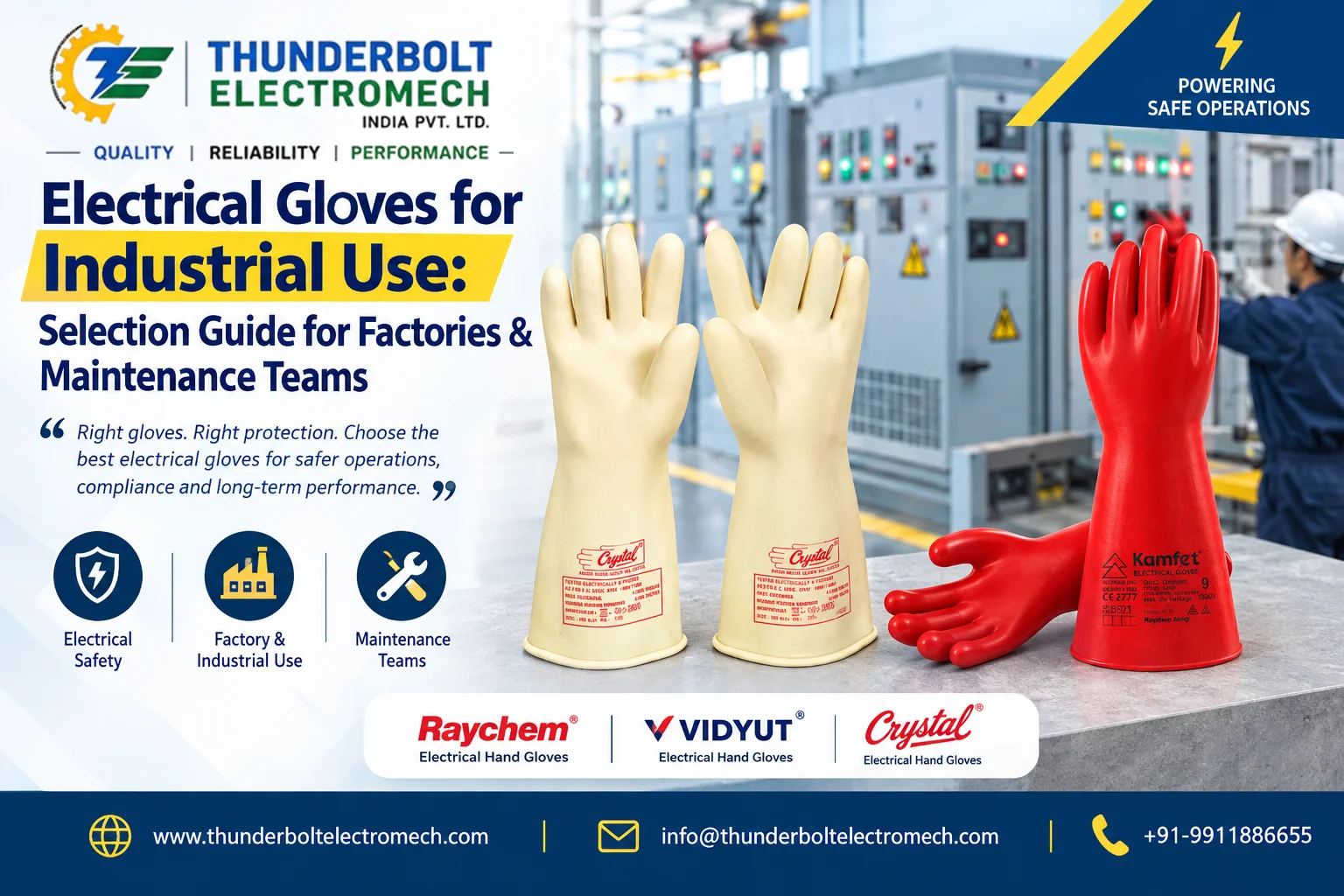
Thunderbolt Electromech supplies Raychem electrical hand gloves across India. We also stock Vidyut and Crystal electrical hand gloves. For 1,100 V work, our Crystal 1100 volt electrical hand gloves cover most factory distribution tasks.
Which brand is best? That is the wrong question. Ask which brand gives you the documents, class and fit you need.
| What to verify | Raychem | Vidyut | Crystal |
| Voltage class and test voltage printed on glove | Check | Check | Check |
| Batch number matching test report | Check | Check | Check |
| Size range (usually 9 to 12) | Check | Check | Check |
| Ozone and oil resistance category | Check | Check | Check |
| Cuff length and glove length | Check | Check | Check |
| Supplier support for retesting and claims | Ask | Ask | Ask |
Bring this table with you when you request quotes. Collect the same answers from each seller. Then compare.
Size and fit
Most buyers pick size by guesswork. That leads to trouble. A loose glove lets fingers slide and stumble on tools. A tight glove stresses the rubber across knuckles, which speeds up cracking. Measure the hand around the palm, just below the knuckles, and match to the maker’s chart. If your team includes workers with larger hands, stock sizes at the top of the range.
Leather Protectors, Arc Flash and What Rubber Cannot Do
Rubber insulating gloves stop current. They do not stop cuts, abrasion or heat.
That gap catches many plants. A glove touches a sharp bus bar edge. The rubber nicks. Nobody notices. Next shift, someone wears it on a live board.
Leather protector gloves fix this. Workers wear them over the rubber glove. The leather takes the mechanical wear. Many standards require protectors when working with insulating gloves, and for good reason. Treat them as part of one system, not as an optional accessory.
Arc flash is a separate hazard
Insulating gloves do not give arc flash protection by themselves. An arc produces extreme heat and pressure. Rubber melts. Plants with exposed energised equipment should run an arc flash risk assessment and add arc-rated clothing, face shields and gloves suited to incident energy. Insulating gloves handle shock. Arc-rated gear handles thermal injury. You need both when the hazard analysis calls for it.
Moisture and contamination
Damp gloves can raise leakage current. Dust and metal particles on the glove surface create paths for current across the cuff. Wipe gloves before use. Keep a clean pair for each shift, and rotate instead of reusing wet ones.
Delhi NCR Buyers: Pair Your Electrical Hand Gloves Supplier With a Danger Plate Supplier
A glove protects one person. A sign protects everyone who walks into the room.
Many factories buy gloves and signage from different sources, which leads to mismatched specs and missed items during audits. If you manage a substation, plant or workshop in Delhi, you gain by sourcing both from a single danger plate supplier Delhi buyers can reach by phone and visit in person.
What proper signage adds
A high voltage danger plate warns workers before they touch anything. A danger board for electrical panel doors tells visitors to keep out. A powder coated danger plate holds colour under heat and sun, where cheap stickers peel within a season. Place signs at room entries, panel fronts, transformer fences and cable trenches.
Good signage and good gloves work together. The sign says “stop.” The glove protects the person who must proceed after following lockout and permit steps.
Why local sourcing helps
Faster sampling. You handle gloves and plates before ordering.
Quicker replacements. A damaged lot gets swapped in days, not weeks.
Simpler audits. One invoice, one supplier, one contact for questions.
Staged delivery. Large plants take stock floor by floor, inspecting each batch.
If you plan a bulk order for electrical gloves in Delhi NCR, visit us in Chawri Bazar. Check stock, review test records and ask about danger plates for the same project. Explore our electrical hand gloves category to see the full range.
Inspection, Storage and Retesting: Making Gloves Last
Gloves fail more often from poor handling than from poor manufacture.
The pre-use check, every time
Do these before each shift.
Air test. Roll the cuff toward the palm to trap air. Squeeze gently. Listen for hissing. Watch for deflation. Test both gloves.
Visual check. Hold the glove under bright light. Look for cuts, bubbles, embedded particles, swelling, tackiness and colour changes.
Stretch check. Gently stretch the rubber between your fingers in several spots. Cracks open under tension.
Date and tag check. Confirm the retest date has not passed.
If a glove fails any step, tag it out of service. Do not argue. Do not patch it.
Storage rules
- Store gloves in a bag or box made for them.
- Keep them flat or hanging by the cuff, not folded.
- Keep them away from sunlight, heat, oil and chemicals.
- Keep them away from sharp tools.
- Avoid direct contact with ozone sources such as arc welders and large motors.
- Never wash with solvents. Use mild soap and water, then dry in shade.
Build a glove register
Give each pair a unique ID. Record issue date, user, class, test date and next retest. When a pair fails, you know which user, which batch and which job. That record turns scattered gloves into an asset you can manage.
What research suggests about ageing
Elastomer research points to a few steady truths. Ozone cracks form faster in stretched rubber. Heat accelerates chemical ageing, so storage near furnaces shortens life. UV exposure breaks down surface chains and causes chalking. Oil swells many rubber compounds and weakens them. These findings explain why storage rules look strict. Each rule blocks one ageing path.
Field experience matches the lab. Pairs kept in a clean bag and tested on schedule often outlast pairs left on a hook near a window.
Customer Problems with an Electrical Hand Gloves Supplier and How to Solve Them
These issues come up again and again.
Problem 1: The class label does not match the test voltage.
A buyer finds “11 kV” on the glove but no matching test data.
Solution: Ask for the test voltage in kV and the standard cited. Request the batch report.
Problem 2: Gloves feel too thick for the work.
Technicians remove them to handle small terminals.
Solution: Review the task. If the voltage allows, drop to a lower class. If not, add tools with insulated handles that suit thicker gloves.
Problem 3: Cracks appear after a few months.
The gloves sat near motors or under direct sun.
Solution: Pick an ozone-resistant compound. Change storage conditions. Record the storage plan.
Problem 4: Sizes run wrong.
Workers receive gloves that slip or pinch.
Solution: Measure hands in advance. Order a size spread, not a single size.
Problem 5: No retest schedule exists.
Gloves stay in use for years with no check.
Solution: Set a six-month cycle for in-service gloves. Use a register and tag system.
Problem 6: Mechanical damage goes unnoticed.
Rubber gets nicked and keeps working until it fails.
Solution: Mandate leather protectors. Inspect before every shift.
Problem 7: Gloves arrive with no paperwork.
The seller provides price and nothing else.
Solution: Write the requirement into your PO: class, standard, test report, batch number.
Problem 8: Signage does not match the gloves’ risk level.
A room needs HV protection but displays no warning.
Solution: Audit your site. Add danger plates where voltage rises above a set threshold.
Real Use Cases: How Plants Apply These Rules
Here are typical situations from factories and maintenance teams.
Textile unit, 415 V MCC maintenance.
A maintenance team worked on motor control centres every week. They used thick high-class gloves because “higher is safer.” Fingers felt clumsy, so workers pulled gloves off. After a review, the plant switched to Class 0 gloves with leather protectors. Work got easier and glove use went up.
Steel plant, 11 kV switchroom.
The plant ran 11 kV breakers and kept one old pair of gloves per shift. Retesting had never happened. A safety audit flagged the gap. The plant bought Class 2 gloves in a size range, set up a glove register and began six-month retests. Failures fell out of service before they caused harm.
Packaging factory, small-terminal work.
Technicians fixed PLC terminals and relays inside live control cabinets. Class 00 gloves gave the best touch. The plant paired them with insulated screwdrivers and kept gloves in sealed bags between jobs.
Facility team, mixed work across a campus.
A campus maintenance group handled panels, UPS rooms and a small HT substation. They kept two glove sets: Class 0 for daily panel checks, Class 2 for HT room entries. Each set had its own colour-coded bag and register. Mix-ups stopped.
Each case shows one pattern. Better selection plus routine checks beat higher class alone.
Questions Buyers Ask
Can one pair serve every job?
Rarely. Different voltages and tasks call for different classes.
Do I need leather protectors with every pair?
For most live work, yes. They guard the rubber from cuts and wear.
How long do gloves last?
It depends on class, storage, use and testing. Retest schedules decide, not a fixed number of years.
Can I repair a small cut?
No. Pull the glove from service.
Which Electrical Hand Gloves Supplier should I trust?
Pick one who provides test reports, answers questions and handles claims promptly.
Our Contact Details
Thunderbolt Electromech India Pvt. Ltd.
Shop No. 3538, Sitaram Bazar Rd, Bazar Sirkiwalan, Chawri Bazar, Chandni Chowk, Delhi, 110006
Phone: +91-9911886655
Email: info@thunderboltelectromech.com
Visit us, bring your voltage list and compare gloves on the table.
Conclusion
Industrial glove selection comes down to a handful of decisions made well.
Here is the summary. Insulating gloves fall into six classes, 00 through 4, each with a maximum use voltage and a proof test. Higher class brings more protection and less feel, so pick the lowest class that still gives a real margin. Read the test voltage on the glove, not just the marketing label. Check thickness, ozone and oil categories and size. Wear leather protectors over rubber. Remember that insulating gloves stop shock but not arc flash. Inspect before every shift with an air test and visual check, store gloves flat in a clean bag and retest on a fixed schedule. Keep a register so every pair has a history. Pair your glove purchase with proper danger plates and boards, so your people get both personal protection and clear warnings.
Why choose Thunderbolt Electromech India Pvt. Ltd.? We are a Delhi-based supplier with a clear focus on electrical safety. We supply Raychem electrical hand gloves across India, along with Vidyut and Crystal gloves. We ask about your voltage and task before we quote. We help you read the paperwork. And because we also supply danger plates, you can cover glove and signage needs from one source, with one contact who picks up the phone.
Looking for a dependable Electrical Hand Gloves Supplier? Browse our electrical hand gloves category, read the complete buying and safety guide, and call +91-9911886655 with your voltage and quantity. Ask for class, test voltage and batch records in writing. We will provide them.