By Thunderbolt Electromech India Pvt. Ltd. — Delhi-based Safety Equipment Supplier of the Complete Electrical Product Range
📞 +91-9911886655 | ✉️ info@thunderboltelectromech.com | 🌐 thunderboltelectromech.com | 📍 Shop No. 3538, Sitaram Bazar Rd, Bazar Sirkiwalan, Chawri Bazar, Chandni Chowk, Delhi – 110006
Quick Answer: LT and HT panels should not be equipped with the same safety package simply because both are electrical panels.
An LT panel normally operates within the low-voltage range covered by the low-voltage assembly framework, while HT switchgear involves voltages above 1 kV and requires a different approach to isolation, earthing, access control, working clearances, discharge procedures and personnel protection. IEC 61439 covers low-voltage switchgear and controlgear assemblies, while IEC 62271-200 addresses AC metal-enclosed high-voltage switchgear above 1 kV up to and including 52 kV.
For an engineer selecting safety equipment, the practical starting point is:
LT panel: electrical rubber mat + appropriate electrical hand gloves + danger plate/signage + panel identification + suitable emergency equipment.
HT panel: all relevant LT-type controls where applicable, plus voltage-appropriate gloves/PPE, discharge/earthing equipment, rescue hook, controlled access, danger notices, appropriate insulating arrangements and procedures for proving dead before work.
India’s Central Electricity Authority (Measures relating to Safety and Electric Supply) Regulations, 2023 are particularly important. Regulation 20 requires installations above 250 V to have a permanently affixed danger notice in a conspicuous position, in Hindi or English and the district’s local language, with a skull-and-bones sign designed according to relevant standards. Regulation 21 also addresses PPE, including rubber gloves and safety footwear suitable for the working voltage, earthing devices, voltage detectors and other protective equipment.
The key engineering point: do not select safety equipment from the panel name alone. Select it from the system voltage, working task, exposure, equipment construction, environment, access arrangement and applicable standards.
Introduction
A panel room can look deceptively simple.
A row of LT panels may contain ACBs, MCCBs, busbars, meters, control circuits and outgoing feeders. An HT room may contain metal-enclosed switchgear, circuit breakers, isolators, bus sections, cable compartments and earthing arrangements. Both may have doors, labels and warning signs.
But the consequences of an incorrect safety decision are very different.
That is why engineers, electrical contractors, facility managers and purchase teams should treat safety equipment selection as an engineering decision rather than a routine procurement exercise.
The first question should not be:
“How much does the safety kit cost?”
It should be:
“What hazard does the worker face, and what equipment and procedure control that hazard?”
That distinction becomes important when selecting an Safety Equipment Supplier for LT and HT electrical installations.
A good supplier should be able to understand whether the requirement is for a 415 V distribution panel, an 11 kV HT panel, a transformer yard, a substation, a motor control centre, a DG synchronization panel or another industrial installation.
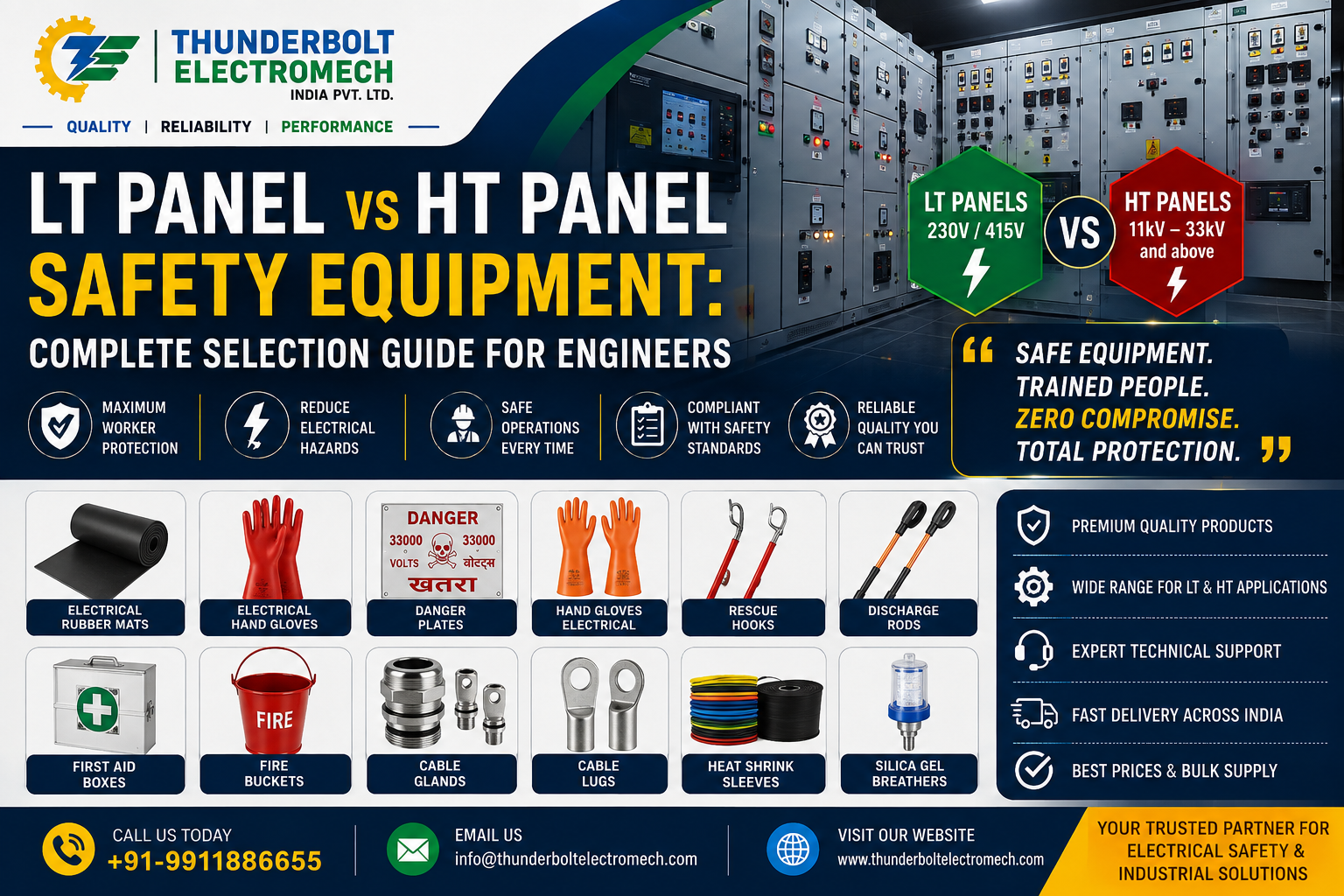
Thunderbolt Electromech India Pvt. Ltd. supplies electrical safety products and industrial electrical accessories for engineers, contractors, industries, utilities and procurement teams. Its product range includes electrical rubber mats, hand gloves, danger plates, rescue hooks, discharge rods, first aid boxes, fire buckets, cable glands, cable lugs, heat shrink sleeves and silica gel breathers. (Thunderbolt Electromech)
This guide explains how those products fit into an LT-versus-HT safety strategy.
Safety Equipment Supplier for LT Panel Safety
What is an LT panel?
LT means Low Tension or low-voltage electrical distribution.
The precise classification should always follow the project’s applicable specification and standard rather than a casual voltage label. For international reference, IEC 61439-1 covers low-voltage switchgear and controlgear assemblies and applies to assemblies within its stated voltage scope. IEC 61439-2 specifically addresses power switchgear and controlgear assemblies. (IEC Webstore)
Typical industrial LT panels can include:
- Main LT distribution panels
- PCC panels
- MCC panels
- APFC panels
- AMF panels
- Feeder panels
- Distribution boards
- Motor control panels
- Control panels
- Solar AC distribution panels
In Indian industrial installations, 230 V and 415 V systems are common examples, although the actual panel rating, system arrangement and working conditions must be verified from the project documents.
Why LT does not mean “low risk”
The term low voltage can create a dangerous psychological trap.
A 415 V panel can still deliver substantial fault current. A short circuit can produce intense heat, molten metal, pressure and arc energy. A worker can also encounter exposed conductors, stored energy, backfeed, capacitors or incorrectly isolated circuits.
So LT panel safety should address shock, arc-related hazards, unexpected energization, mechanical injury, fire and emergency response.
Core LT panel safety equipment
1. Electrical rubber mat
An insulating mat provides an additional insulating layer between the worker and floor.
This is particularly useful at panel operating positions where personnel routinely stand while operating, inspecting or maintaining equipment.
The mat does not make an energized panel safe by itself.
That distinction matters.
A mat is one layer of protection within a broader safety system involving equipment condition, earthing, isolation, PPE, procedures and competent personnel.
CEA Regulation 21 specifically states that insulating floors or mats conforming to relevant standards and appropriate to the voltage level should be provided in front and rear of switchgear and control panels where personnel carry out operation, maintenance or testing work. (www.slideshare.net)
2. Electrical hand gloves
Electrical gloves should be selected according to the intended electrical work and applicable voltage/classification.
Do not select a glove merely because its label says “electrical.”
Check:
- Working voltage
- Voltage class
- Applicable standard
- Test requirements
- Manufacturing date
- Inspection condition
- Storage condition
- Size and fit
- Compatibility with other PPE
Thunderbolt lists Raychem, Crystal and Vidyut electrical hand gloves among its hand-glove offerings. (Thunderbolt Electromech)
3. Danger plate
A danger plate gives an immediate visual warning.
For a panel room, the sign should communicate the electrical hazard clearly enough that a person does not need to open the panel or consult a drawing to understand that the equipment is hazardous.
For installations above 250 V, CEA Regulation 20 requires a permanently affixed danger notice in a conspicuous position and specifies Hindi or English plus the local language of the district, together with a skull-and-bones sign according to relevant standards.
4. Panel identification
A danger sign should not replace equipment identification.
Engineers should also consider:
- Panel number
- Feeder identification
- Source identification
- Voltage
- Equipment designation
- Incoming/outgoing indication
- Relevant operating instructions
This reduces the chance of someone isolating the wrong feeder.
5. Rescue and emergency equipment
Depending on the facility’s risk assessment and emergency plan, panel areas can also require:
- Rescue hooks
- First aid boxes
- Fire buckets
- Appropriate fire extinguishing arrangements
- Emergency communication
- Shock treatment information
- Suitable emergency lighting
The exact emergency provision should follow the installation’s risk assessment and applicable fire/electrical requirements.
LT panel safety checklist
| Safety item | Why it matters | Selection point |
| Electrical rubber mat | Adds insulating separation from floor | Voltage/application and relevant standard |
| Electrical hand gloves | Hand protection during electrical work | Correct class and working voltage |
| Danger plate | Communicates electrical hazard | Voltage, language, visibility and location |
| Panel identification | Prevents wrong-equipment operation | Clear equipment/feeder designation |
| Rescue hook | Emergency response | Suitable construction and location |
| First aid box | Initial injury response | Facility risk assessment |
| Fire bucket/fire equipment | Emergency response | Site fire plan |
| Lockout/Tagout equipment | Controls accidental energization | Isolation procedure |
| Cable glands | Protect cable entry | Cable type, size, enclosure/environment |
| Cable lugs | Reliable termination | Conductor material and cable size |
| Heat shrink sleeve | Insulation/protection | Cable and application requirements |
Customer Problem 1: “We already have a circuit breaker, so why do we need a rubber mat?”
Problem
A facility may have a properly rated breaker and still lack appropriate personnel protection around the panel.
Solution
Treat the circuit breaker and worker protection as different layers.
The breaker protects the circuit under specified fault/overcurrent conditions. It does not replace:
- Safe isolation
- Earthing
- Appropriate PPE
- Insulating floor arrangements
- Danger notices
- Competent working practices
CEA’s safety framework itself separates equipment protection and personnel protection requirements. (Supreme Today AI)
Customer Problem 2: “We use ordinary gloves because the work is only 415 V.”
Problem
Ordinary industrial gloves may provide mechanical protection but are not automatically electrical insulating gloves.
Solution
Specify gloves according to the actual electrical task and applicable standard.
This is an area where procurement should never substitute price for specification.
Customer Problem 3: “The danger sticker is small but the panel room is large.”
Problem
A warning that cannot be seen from the relevant approach route has limited practical value.
Solution
Position the warning where it is conspicuous and select the size, contrast and mounting arrangement based on viewing distance and equipment geometry.
The objective is not to make the panel decorative.
It is to make the hazard unmistakable.
Customer Problem 4: “Can the same safety kit be used for LT and HT?”
Problem
A procurement team wants one standardized kit for every panel.
Solution
Standardize the procurement process, not blindly every component.
Create two equipment matrices:
LT safety matrix
- Panel type
- System voltage
- Mat
- Gloves
- Danger sign
- Emergency equipment
- Isolation/LOTO requirements
HT safety matrix
- Voltage
- Switchgear type
- Glove class
- Voltage detector
- Discharge/earthing equipment
- Rescue equipment
- Danger notice
- Access control
- Operating procedure
- Maintenance procedure
This approach saves time while avoiding unsafe substitutions.
Safety Equipment Supplier for HT Panel Safety
HT panel safety needs a different mindset.
Once the voltage rises above 1 kV, the system’s insulation, clearances, switching arrangements, access restrictions, earthing and maintenance procedures become increasingly important.
IEC 62271-200:2021 applies to prefabricated metal-enclosed AC switchgear and controlgear above 1 kV up to and including 52 kV, for indoor and outdoor installations. The standard also addresses classifications and testing, including internal arc considerations. (IEC Webstore)
This means an HT panel should not be treated as an oversized LT panel.
It is a different engineering environment.
Common HT voltage applications
Industrial and utility projects may encounter:
- 11 kV
- 22 kV
- 33 kV
- 66 kV
- Higher-voltage systems
The equipment, clearance, PPE and operating procedure must correspond to the actual system.
A danger plate saying “11 kV” is not an adequate substitute for engineering controls.
Likewise, using an 11 kV accessory on a higher-voltage installation without verification is unacceptable.
HT panel safety equipment
Electrical hand gloves
The glove class must correspond to the intended application and applicable requirements.
A procurement specification should identify the required voltage class rather than simply stating “HT glove.”
Discharge rod
A discharge rod can form part of the procedure for safely discharging electrical equipment after isolation where the equipment and procedure require it.
It is especially important to understand that switching off is not automatically the same thing as proving safe.
Stored electrical energy, capacitive effects or induced voltages can remain.
CEA Regulation 21 requires adequate precautions before handling conductors or apparatus, including earthing or other suitable means to electrically discharge them and prevent accidental re-energization.
Rescue hook
A rescue hook is intended for emergency response where a person may be in contact with electrical equipment.
It should be positioned where trained personnel can access it quickly without creating another hazard.
Electrical rubber mat
The mat remains relevant around suitable panel operating positions, subject to the applicable voltage and specification.
The mat should be treated as one protection layer, not the primary isolation method.
Danger plate
HT panels should display highly visible danger notices.
For installations above 250 V, CEA Regulation 20 is especially relevant because it specifies permanent danger notices and the skull-and-bones symbol, with language requirements. (Supreme Today AI)
Access control
HT rooms frequently require controlled access.
The goal is simple:
Only appropriately designated and competent persons should enter and operate the equipment.
CEA’s 2023 regulations also contain provisions addressing the accessibility and protection of conductors and apparatus at higher voltages.
HT panel safety is a system, not a shopping list
Consider an 11 kV switchgear room.
A procurement team might order:
- Gloves
- Mat
- Danger plate
- Rescue hook
That is useful, but it does not automatically produce a safe HT installation.
The engineer must also consider:
- Isolation point
- Lockout arrangements
- Earthing point
- Voltage detection
- Discharge procedure
- Interlocks
- Access restrictions
- Working clearances
- Equipment condition
- Arc/internal fault considerations
- Maintenance procedure
- Competent personnel
- Emergency response
This is why the best Safety Equipment Supplier should understand the application instead of merely sending a catalogue.
HT panel selection by voltage
| Application | Typical example | Safety planning focus |
| LT distribution | 230/415 V | Panel protection, insulating arrangements, PPE, signage, isolation |
| LT industrial panel | 415 V | PCC/MCC operation, arc/shock risk, maintenance controls |
| HT distribution | 11 kV | Controlled access, voltage-appropriate PPE, isolation, discharge and earthing |
| HT distribution | 22 kV | Same principles with equipment-specific ratings and procedures |
| HT distribution | 33 kV | Higher-voltage equipment, clearances, switching/earthing procedure |
| Higher-voltage installation | 66 kV and above | Project-specific high-voltage design, clearances, switching, earthing and statutory requirements |
Engineering note: voltage alone does not determine every PPE or equipment selection. Fault level, task, exposure, equipment construction, approach distance and the applicable standard also matter.
Safety Equipment Supplier: LT vs HT Panel Comparison
The most useful comparison is not simply “low voltage versus high voltage.”
It is hazard versus control.
| Factor | LT Panel | HT Panel |
| Typical industrial application | PCC, MCC, DB, feeder panel | HT switchgear, substation, transformer feeder |
| Voltage environment | Low-voltage system | Above 1 kV applications |
| Main concern | Shock, arc, fault current, unexpected energization | Shock, arc/internal fault, clearance, stored/induced energy, switching |
| Electrical rubber mat | Commonly relevant | May be required according to application/specification |
| Electrical hand gloves | Task and voltage appropriate | Strict voltage-class selection |
| Danger plate | Required where applicable | Critical and highly visible |
| Rescue hook | Site-dependent | Common emergency consideration |
| Discharge rod | Task-dependent | Important where discharge/earthing procedure requires it |
| Access control | Important | Particularly important |
| Earthing | Essential | Critical, including high-voltage earthing arrangements |
| Lockout/Tagout | Recommended/required by procedure | Essential for maintenance control |
| Panel standard reference | IEC 61439 framework where applicable | IEC 62271 framework where applicable |
| Procurement mistake risk | Wrong PPE/signage/accessory | Potentially much more severe |
| Supplier requirement | Product knowledge | Product + application knowledge |
IEC 61439-1 provides general requirements for low-voltage assemblies, while IEC 62271-200 addresses high-voltage metal-enclosed switchgear above 1 kV up to 52 kV. (IEC Webstore)
Why the danger plate deserves more attention
A danger plate looks like a small component.
Engineering teams sometimes treat it as an afterthought.
That is a mistake.
A warning plate is part of the human-machine interface of an electrical installation.
Before a technician operates a panel, the technician needs to understand:
- What equipment is this?
- What voltage is involved?
- Is there an electrical hazard?
- Is this the correct panel?
- Is there a restriction on access?
- Is the equipment energized or potentially energized?
The sign cannot answer all of these questions. But it can deliver the first and most important warning.
Electrical panel safety equipment should work together
Think about a panel as a chain.
Danger plate → identification → isolation → lockout → prove dead → discharge/earth where required → PPE → work → restore safely
A weak link can undermine the process.
For example:
Correct gloves + no isolation = unsafe.
Correct isolation + wrong equipment identification = unsafe.
Correct isolation + no verification = unsafe.
Correct equipment + damaged PPE = unsafe.
This systems approach is more useful to engineers than a product-by-product catalogue.
Where Thunderbolt’s product cluster fits
Thunderbolt Electromech’s electrical product range allows procurement teams to source several connected requirements from one supplier. Its website lists electrical rubber mats, discharge rods, rescue hooks, first aid boxes, fire buckets, silica gel breathers, cable glands, cable lugs and shrink sleeves among its products. (Thunderbolt Electromech)
Electrical Rubber Mats
Used around electrical operating and maintenance positions where insulating floor protection is specified.
Electrical Hand Gloves
Used for appropriate electrical work when the glove class and application match the task.
Danger Plates
Used to communicate electrical hazards and voltage information.
Hand Gloves Electrical
For procurement searches, this is often the phrase buyers use when looking for insulating electrical gloves. The technical specification should still identify the actual required class.
Rescue Hooks
Emergency response equipment for electrical work areas.
Discharge Rods
Used where the approved electrical safety procedure requires discharge/earthing equipment.
First Aid Boxes
Useful as part of site emergency preparedness.
Fire Buckets
Part of appropriate site fire response arrangements where specified.
Cable Glands
Protect and secure cable entry into panels and enclosures. The correct gland must match cable construction, size and environmental requirements.
Cable Lugs
Support secure conductor termination when the correct lug type, material and size are selected.
Heat Shrink Sleeves
Used for insulation, protection and identification applications according to the product’s design and installation requirements.
Silica Gel Breathers
Relevant to transformer oil-breathing arrangements rather than panel PPE itself. They belong in the broader electrical infrastructure safety/product cluster because transformers and substations form part of the same electrical environment.
Safety Equipment Supplier: Complete Selection Method for Engineers
A technically sound procurement process can be reduced to a sequence of questions.
Step 1: Identify the equipment
Write down:
- LT panel
- HT panel
- Transformer
- RMU
- Substation
- MCC
- PCC
- Outdoor feeder
- Indoor switchgear
- Other electrical equipment
Do not begin with a generic “safety items required” list.
Step 2: Identify voltage
Record the actual:
- System voltage
- Rated voltage
- Working voltage
- Maximum equipment voltage where relevant
For example:
415 V ≠ 11 kV.
That seems obvious.
Procurement errors still happen when purchase descriptions use generic terminology.
Step 3: Identify the work
Ask whether the person will:
- Operate
- Inspect
- Test
- Maintain
- Isolate
- Earth
- Discharge
- Replace components
- Work near energized parts
- Work at height
The same panel can require different controls for different tasks.
Step 4: Identify environment
Consider:
- Indoor/outdoor
- Dust
- Moisture
- Rain
- UV exposure
- Oil
- Chemicals
- Temperature
- Mechanical impact
- Public accessibility
- Restricted-access electrical room
The environment influences both equipment and signage selection.
Step 5: Determine the required PPE
PPE should be selected from the task and hazard assessment.
Potential equipment includes:
- Electrical gloves
- Safety footwear
- Helmet
- Face/eye protection
- Arc-related PPE where required
- Insulating mat
- Voltage detector
- Earthing/discharge equipment
- Other task-specific protection
CEA Regulation 21 explicitly lists rubber gloves and safety footwear suitable for the working voltage along with several other protective tools/devices, while also requiring appropriate maintenance of such equipment.
Step 6: Specify danger signage
For the danger plate, specify:
- Word: DANGER
- Voltage
- Symbol
- Language
- Size
- Material
- Mounting method
- Indoor/outdoor requirement
- Visibility requirement
- Quantity
For Indian installations above 250 V, CEA Regulation 20 is a key reference for the permanent danger notice and language requirements.
Step 7: Check equipment standards
Do not ask a supplier only:
“Is this standard quality?”
Ask:
“Which standard, test requirement or specification does this product comply with?”
Then record the answer in the purchase specification.
That creates an auditable procurement trail.
Step 8: Ask for documentation
Depending on the product, ask for:
- Datasheet
- Test certificate
- Compliance information
- Manufacturer details
- Batch information
- Product class
- Voltage rating
- Dimensions
- Material specification
- Warranty where applicable
For safety-critical equipment, paperwork is not bureaucracy.
It is traceability.
Step 9: Inspect before use
When the goods arrive, verify:
- Correct quantity
- Correct voltage class
- Correct size
- Correct material
- Correct marking
- Damage-free condition
- Packaging
- Test information
- Manufacturing/inspection information where relevant
Do not put unidentified electrical PPE directly into service.
Step 10: Establish an inspection/replacement system
Electrical safety equipment should not sit in a store indefinitely.
The facility should establish procedures for:
- Inspection
- Cleaning
- Storage
- Periodic testing where applicable
- Replacement
- Damaged equipment quarantine
- Expired/obsolete stock control
Customer Problems and Engineering Solutions
Problem: “The panel already has a danger sticker.”
Solution: Check whether it communicates the correct voltage, remains legible, is permanently mounted where required and satisfies the applicable installation requirements.
Problem: “We bought HT gloves but do not know their class.”
Solution: Stop treating them as generic gloves. Verify the manufacturer’s class/rating, standard, test information and intended use before issuing them to workers.
Problem: “The supplier quoted three different mat prices.”
Solution: Compare specification rather than only thickness or price. Check voltage/application suitability, dimensions, material, testing/certification information and relevant standard.
Problem: “The same danger plate is being used on every panel.”
Solution: Standardize the design language but customize the technical information where the voltage or equipment changes.
Problem: “The HT room has a rescue hook but no clear procedure.”
Solution: Equipment without training and procedure is incomplete risk control. Define who may use it, where it is stored, how it is inspected and what emergency response procedure applies.
Problem: “We need all safety products from multiple vendors.”
Solution: Consolidating related products with a specialist Safety Equipment Supplier can simplify procurement, product identification and repeat ordering. But consolidation should never override technical suitability.
Real Engineering Use Cases
Use Case 1: 415 V manufacturing plant PCC
A manufacturing plant has a main PCC panel supplying production lines.
Risk profile
- High available fault current
- Frequent switching
- Maintenance exposure
- Multiple outgoing feeders
- Potential arc/shock exposure
Appropriate safety planning
- Electrical rubber mat where specified
- Suitable electrical gloves for the work
- Clearly visible danger notice
- Panel and feeder identification
- Isolation/LOTO procedure
- Suitable emergency equipment
- Cable glands and lugs matched to cable specifications
- Heat shrink products where required for insulation/protection
The critical point is that the safety equipment must support the operating procedure.
Use Case 2: 11 kV HT panel in an industrial substation
The panel supplies a transformer feeding an LT network.
Risk profile
The voltage is substantially higher, and the installation may include stored or induced electrical energy, switching operations and restricted access.
Safety strategy
- Correctly classified electrical gloves
- Voltage detection
- Isolation procedure
- Discharge/earthing procedure
- Appropriate discharge rod where required
- Rescue hook
- Suitable insulating floor/mat arrangement
- Permanent danger notice
- Restricted access
- Clear equipment identification
- Competent designated personnel
CEA Regulation 21 requires precautions to discharge conductors/apparatus and prevent inadvertent energization before work.
Use Case 3: 33 kV outdoor substation
An outdoor substation creates another layer of complexity.
The engineer must consider:
- Weather
- UV
- Rain
- Dust
- Corrosion
- Access
- Sign visibility
- Safe clearances
- Earthing
- Equipment condition
- Emergency access
IEC 62271-200 specifically includes indoor and outdoor metal-enclosed high-voltage switchgear within its scope for equipment above 1 kV and up to 52 kV.
The safety package should therefore not be selected from an indoor panel-room checklist without modification.
Use Case 4: Transformer and HT/LT room
A transformer room often creates a transition between HT and LT systems.
The engineer may need to coordinate:
HT side
- Danger notice
- HT PPE
- Isolation
- Earthing/discharge arrangements
- Restricted access
- Rescue equipment
LT side
- Panel safety
- Rubber mat
- Suitable electrical gloves
- Danger notice
- Panel identification
- Emergency equipment
The transformer itself should also be identified appropriately.
CEA Regulation 20 specifically includes transformers among equipment on which danger notices are required for installations above 250 V.
How to Choose a Safety Equipment Supplier in Delhi
Delhi has a large industrial and electrical procurement ecosystem, but proximity alone is not enough.
If you are searching for a Safety Equipment Supplier Delhi, evaluate five things.
1. Product depth
Can the supplier provide:
- Electrical rubber mats
- Electrical hand gloves
- Danger plates
- Rescue hooks
- Discharge rods
- First aid boxes
- Fire buckets
- Cable glands
- Cable lugs
- Heat shrink sleeves
- Silica gel breathers
A broader range can reduce procurement fragmentation.
2. Technical understanding
Can the supplier distinguish:
- LT from HT
- Operating voltage from rated voltage
- Ordinary gloves from insulating gloves
- Indoor from outdoor signage
- Cable gland sizes
- Cable lug materials
- Application-specific requirements
3. Documentation
Ask for product specifications and test/compliance documentation appropriate to the product.
4. Availability
For plant maintenance, a technically correct item that arrives after shutdown can still create operational problems.
5. Communication
A supplier should ask questions before quoting when the specification is incomplete.
That is a good sign.
How Thunderbolt Electromech Supports Electrical Panel Procurement
Thunderbolt Electromech’s published product range covers multiple categories relevant to industrial electrical safety and infrastructure, including danger plates, electrical gloves, rubber mats, rescue hooks, discharge rods and other electrical accessories. (Thunderbolt Electromech)
The company positions itself as an electrical safety products and industrial electrical components supplier serving engineers, contractors, industries, utilities and purchase teams across India. (Thunderbolt Electromech)
For a project purchase, provide:
- Panel type
- Voltage
- Quantity
- Application
- Indoor/outdoor condition
- Required standards
- Required dimensions
- Delivery location
- Any language requirements
- Project-specific specification
This information allows the supplier to respond more accurately.
Danger Plate Supplier Delhi: Why Signage Belongs in the Safety Package
Danger plates are sometimes purchased separately from electrical PPE.
That can create inconsistencies.
Imagine a project with:
- 415 V LT panels
- 11 kV HT panels
- 33 kV equipment
- Transformers
- Cable trenches
- Outdoor switchgear
If every contractor uses a different warning format, the installation becomes visually inconsistent.
A better approach is to create a site-wide signage specification.
Specify:
- Red/white warning format as applicable
- DANGER wording
- Voltage
- Skull-and-crossbones symbol
- English
- Hindi
- Local district language where required
- Equipment identification
- Material
- Dimensions
- Mounting arrangement
CEA Regulation 20 gives a particularly important Indian requirement here: for installations exceeding 250 V, the danger notice is to be in Hindi or English and the local language of the district, with a skull-and-bones sign according to relevant standards.
Electrical Panel Safety Equipment Procurement Table
| Product | LT panel | HT panel | Main selection parameter |
| Electrical rubber mat | ✓ | ✓ where applicable | Voltage/application and relevant standard |
| Electrical hand gloves | ✓ | ✓ | Class and working voltage |
| Danger plate | ✓ | ✓ | Voltage, language, size, material |
| Rescue hook | Site-dependent | ✓ commonly considered | Application and emergency plan |
| Discharge rod | Task-dependent | ✓ where procedure requires | Voltage/class and design |
| First aid box | ✓ | ✓ | Site risk assessment |
| Fire bucket/fire equipment | Site-dependent | Site-dependent | Fire plan |
| Lockout equipment | ✓ | ✓ | Isolation procedure |
| Cable gland | ✓ | ✓ | Cable/enclosure/environment |
| Cable lug | ✓ | ✓ | Conductor material and size |
| Heat shrink sleeve | ✓ | ✓ | Application and cable dimensions |
| Silica gel breather | Transformer application | Transformer application | Transformer/breather specification |
What Should Engineers Ask Before Ordering?
Use this checklist when sending an enquiry to a supplier.
Panel information
- What is the panel type?
- What is the voltage?
- Is it LT or HT?
- Is the panel indoor or outdoor?
- What is the operating environment?
PPE information
- What work will personnel perform?
- What voltage are they exposed to?
- What glove class is required?
- What other PPE is specified?
Signage information
- What voltage should appear?
- What language is required?
- What size is needed?
- What material is preferred?
- Is the plate exposed to weather?
Emergency equipment
- Is a rescue hook required?
- Is a discharge rod required?
- Where will it be mounted?
- What inspection regime applies?
Documentation
- Is a test certificate required?
- Is a manufacturer’s datasheet required?
- Is a compliance declaration required?
- What standard is specified in the project?
Safety Equipment Supplier: Research, Standards and Evidence
This article uses a hierarchy of evidence rather than treating every web statement as equally authoritative.
Primary research/source — Direct
Central Electricity Authority, Measures relating to Safety and Electric Supply Regulations, 2023
The CEA’s official website confirms the 2023 regulations and maintains the current regulatory publication page. The CEA’s Chief Electrical Inspectorate Division states that it administers these safety regulations and performs statutory inspection functions.
Relevant provisions include:
- Danger notices
- PPE
- Discharging conductors/apparatus
- Electrical installation safety
- Earthing
- High-voltage installation requirements
Evidence status: Direct primary source.
CEA — Measures relating to Safety and Electric Supply Regulations
Primary technical source — Direct
IEC 61439-1:2020
IEC states that IEC 61439-1 establishes general definitions, service conditions, construction requirements, technical characteristics and verification requirements for low-voltage switchgear and controlgear assemblies.
Evidence status: Direct primary standards source.
IEC 61439-1:2020 official publication page
Primary technical source — Direct
IEC 62271-200:2021 + Amendment 1:2024
IEC states that this standard covers AC metal-enclosed high-voltage switchgear and controlgear above 1 kV up to and including 52 kV, for indoor and outdoor installation.
Evidence status: Direct primary standards source.
IEC 62271-200 official publication page
Indian earthing reference — Direct
BIS material identifies IS 3043:2018 as the Indian Code of Practice for earthing. A later BIS draft revision also explains the safety purposes of protective earthing and equipotential bonding, including controlling touch and step potentials.
Evidence status: Direct BIS material; draft revision separately identified as draft.
No direct product-specific evidence found
There is no single IEC/CEA source identified in the research that says “this exact mat dimension, exact danger plate size, exact glove model or exact rescue hook is mandatory for every LT/HT panel.”
That distinction is important.
Product selection must be tied to:
- Applicable regulation
- Applicable standard
- Voltage
- Equipment design
- Task
- Environment
- Risk assessment
- Project specification
Therefore, Thunderbolt or any other supplier should not claim that one generic product automatically satisfies every electrical installation.
Price Factors: What Determines Electrical Safety Equipment Cost?
When comparing quotations, avoid comparing only the unit price.
Electrical rubber mat price
Factors may include:
- Material
- Thickness
- Width/length
- Voltage/application
- Testing
- Certification
- Brand
- Quantity
Electrical glove price
Factors include:
- Class
- Size
- Manufacturer
- Material
- Testing
- Certification
- Packaging
- Availability
Danger plate price
The Danger Plate Price can vary according to:
- Aluminium/PVC/MS/other material
- Thickness
- Size
- Printing method
- Reflective finish
- Language count
- Voltage customization
- Quantity
- Mounting holes
- Outdoor durability
- Special artwork
Discharge rod price
Consider:
- Voltage class
- Length
- Insulating construction
- Earthing arrangement
- Manufacturer
- Accessories
- Testing/documentation
The cheapest quotation is not necessarily the lowest-cost engineering solution.
A missing certificate, incorrect class or wrong size can turn a cheap purchase into a replacement purchase.
Customization: When Is It Useful?
Customization makes sense when the standard product does not adequately communicate the actual hazard or equipment identity.
Examples:
DANGER — 415 VOLTS
DANGER — 11 kV
DANGER — 33 kV
Additional requirements can include:
- Hindi
- English
- Local language
- Skull-and-crossbones symbol
- Equipment number
- Transformer identification
- Substation identification
- Custom dimensions
- Mounting holes
- Reflective finish
For permanent installations, ensure the final design aligns with the applicable regulation and relevant standards rather than simply reproducing an old sign.
Installation of Electrical Safety Equipment
Danger plate installation
Install where:
- It is conspicuous
- It is not obstructed
- It remains legible
- It is permanently fixed where required
- It can be seen before the person approaches the hazard
For equipment inside an enclosure, the CEA regulations provide specific treatment of where the notice can be placed when direct placement on the apparatus is not possible.
Rubber mat installation
The mat should:
- Lie flat
- Cover the intended standing/working position
- Remain free of damaging contamination
- Be inspected according to site procedure
- Be replaced if its condition no longer supports its intended use
Rescue hook installation
Place it where:
- It is visible
- It can be reached quickly
- It is not blocked
- Personnel know its location
Discharge equipment
The discharge/earthing process must follow the approved electrical safety procedure.
Do not improvise.
Inspection and Maintenance
Safety equipment is not “fit and forget.”
Inspect electrical gloves
Look for:
- Cuts
- Punctures
- Cracks
- Hardening
- Chemical deterioration
- Contamination
- Age/inspection status
Follow the manufacturer’s and applicable standard’s testing and storage requirements.
Inspect rubber mats
Look for:
- Cracks
- Cuts
- Tears
- Surface deterioration
- Contamination
- Damage from oil or chemicals
Inspect danger plates
Check:
- Fading
- Peeling
- Corrosion
- Missing fasteners
- Obstruction
- Incorrect voltage
- Damaged lettering
A 415 V label on equipment that has since been upgraded is not a minor documentation error.
It is a safety issue.
How Engineers Can Build a Better Panel Safety Specification
Instead of writing:
“Supply electrical safety items for panel.”
write:
“Supply safety equipment suitable for the identified electrical installation, including voltage-appropriate electrical gloves, insulating floor mat, permanent danger notice, emergency rescue equipment and discharge/earthing equipment where applicable, with product specifications and test/compliance documentation as required by the project.”
Then attach a schedule.
Example schedule
| Item | Application | Required information |
| Rubber mat | Panel front/rear | Size, material, voltage/application, standard |
| Electrical gloves | Maintenance | Class, size, voltage, standard |
| Danger plate | Panel | Voltage, language, size, material |
| Rescue hook | Electrical room | Type, length, location |
| Discharge rod | HT panel | Voltage/class, length, earthing method |
| First aid box | Electrical room | Contents/specification |
| Fire equipment | Electrical room | Site fire specification |
| Cable gland | Panel entry | Cable OD, thread, material, IP/environment |
| Cable lug | Termination | Conductor material, cross-section |
| Heat shrink | Termination | Cable/application dimensions |
This document is much easier for a supplier to quote correctly.
Internal Linking Strategy for Thunderbolt Electromech
This article should act as a cluster bridge rather than becoming a dead-end blog.
Recommended internal links include:
- Electrical Safety Equipment Supplier in India — anchor: electrical safety equipment supplier
- Danger Plate category — anchor: danger plate supplier
- Electrical Hand Gloves category — anchor: electrical hand gloves
- Electrical Rubber Mat category — anchor: electrical rubber mats
- Cable Gland content — anchor: industrial cable glands
- Cable Lug content — anchor: electrical cable lugs
- Heat Shrink Sleeve content — anchor: heat shrink sleeves
- Silica Gel Breather content — anchor: transformer silica gel breather
Thunderbolt’s current website already presents these products as connected parts of its electrical product ecosystem. (Thunderbolt Electromech)
For example, the existing article Electrical Safety Equipment Supplier in India | Industrial Safety Products & PPE Solutions already covers danger plates, electrical gloves, heat shrink sleeves and several other product categories. (Thunderbolt Electromech)
Read Thunderbolt’s Electrical Safety Equipment Supplier guide
FAQs
1. What is the difference between LT and HT panel safety equipment?
LT and HT safety equipment differs mainly because the electrical system, equipment construction, working voltage, clearances, isolation and maintenance hazards differ. HT equipment generally requires more controlled access and voltage-specific isolation, discharge, earthing and PPE procedures.
2. Can one electrical rubber mat be used for every panel?
Do not assume that. Select the mat according to its intended application, voltage level, dimensions and applicable specification.
3. Are ordinary industrial gloves suitable for LT panel work?
Not automatically. Mechanical gloves and electrical insulating gloves serve different purposes. Use electrical gloves where the task requires electrical insulation and select the appropriate class.
4. Is a danger plate required on an electrical panel?
For installations exceeding 250 V, CEA Regulation 20 requires permanent danger notices in specified locations and includes language and skull-and-bones requirements.
5. Should HT panels have danger plates?
Yes, appropriate danger notices are a fundamental part of electrical hazard communication, and Indian regulatory requirements should be checked for the installation.
6. What voltage should be written on a danger plate?
The voltage information should accurately represent the relevant equipment/system and follow the project specification. Do not use a generic voltage number simply because it is common.
7. Is 415 V considered LT?
In common Indian industrial terminology, 415 V three-phase distribution is generally treated as an LT application. However, engineers should use the actual project and regulatory definitions rather than relying only on terminology.
8. What safety equipment is required for an 11 kV panel?
The exact package depends on the installation and work procedure but can include voltage-appropriate gloves/PPE, danger notices, isolation/LOTO equipment, voltage detection, discharge/earthing equipment, rescue equipment and appropriate insulating arrangements.
9. Why is a discharge rod important for HT work?
Where required by the approved procedure, it helps discharge electrical energy and establish safe conditions before work. CEA Regulation 21 requires adequate precautions to electrically discharge conductors/apparatus and prevent inadvertent energization.
10. Why do HT panels require controlled access?
High-voltage equipment can expose unauthorized personnel to severe electrical hazards. Controlled access helps ensure that only designated and competent persons operate or work on the equipment.
11. Can a danger sticker replace a danger plate?
The answer depends on the installation requirement and specification. Where a permanent danger notice is required, the chosen sign must satisfy the relevant requirement rather than being selected merely because it is inexpensive.
12. What should I ask a Safety Equipment Supplier?
Provide the supplier with voltage, panel type, application, indoor/outdoor condition, quantities, required standards, dimensions and project specifications.
13. How do I select a Safety Equipment Supplier Delhi?
Look for product range, technical knowledge, documentation, availability, delivery capability and the ability to understand LT/HT application differences.
14. What does an Electrical Safety Equipment Supplier provide?
A specialist supplier may provide electrical gloves, insulating mats, danger plates, rescue equipment, discharge rods and related electrical safety products. Thunderbolt also supplies cable accessories and other industrial electrical products. (Thunderbolt Electromech)
15. Does Thunderbolt Electromech supply electrical safety products across India?
Thunderbolt’s website states that it supplies electrical safety products and industrial electrical components to customers across India. (Thunderbolt Electromech)
16. Can Thunderbolt help with a complete panel safety requirement?
Yes, the company offers several relevant categories, including electrical rubber mats, hand gloves, danger plates, rescue hooks and discharge rods, along with other electrical products. The exact requirement should be specified according to the installation. (Thunderbolt Electromech)
17. What is more important: price or certification?
For safety-critical equipment, technical suitability and compliance should come before price. Compare equivalent specifications rather than comparing only the cheapest unit price.
18. Does a danger plate protect a worker from electric shock?
No. A danger plate is a warning/communication device. It does not physically isolate electrical energy and should never be treated as a substitute for isolation, earthing, PPE or safe working procedures.
Conclusion: Choose Safety Equipment by Hazard, Not by Panel Name
The difference between LT and HT panel safety is not simply a difference between two voltage labels.
It is a difference in risk, equipment construction, access, isolation, energy, working procedure and personnel protection.
For LT installations, engineers should build a safety package around appropriate insulating arrangements, electrical gloves, danger notices, identification, isolation and emergency response.
For HT installations, the same thinking becomes more rigorous. Voltage-specific PPE, controlled access, voltage detection, discharge and earthing procedures, rescue equipment, danger notices and competent operation become central parts of the safety system.
The CEA’s 2023 safety regulations provide an important Indian regulatory foundation. They specifically address danger notices for installations exceeding 250 V and require specified PPE and precautions when working on electrical supply lines and apparatus. (Supreme Today AI)
The technical standards also reinforce the distinction between equipment categories: IEC 61439 provides the framework for low-voltage switchgear and controlgear assemblies, while IEC 62271-200 covers AC metal-enclosed high-voltage switchgear above 1 kV up to 52 kV. (IEC Webstore)
For engineers and procurement managers, the best approach is straightforward:
Identify the voltage.
Identify the task.
Identify the hazard.
Specify the equipment.
Verify the standard.
Check the documentation.
Inspect before use.
Maintain it throughout its service life.
That is also how to evaluate a Safety Equipment Supplier.
Thunderbolt Electromech India Pvt. Ltd. can support procurement requirements involving electrical safety products and related electrical accessories, including electrical rubber mats, hand gloves, danger plates, rescue hooks, discharge rods, cable glands, cable lugs, heat shrink sleeves and silica gel breathers. (Thunderbolt Electromech)
Thunderbolt Electromech India Pvt. Ltd.
Address: Shop No. 3538, Sitaram Bazar Road, Bazar Sirkiwalan, Chawri Bazar, Chandni Chowk, Delhi – 110006
Phone: +91-9911886655
Email: info@thunderboltelectromech.com
Contact Thunderbolt Electromech
Evidence note: This article distinguishes direct regulatory/standards evidence from engineering interpretation. Product-specific selection should always be verified against the current project specification, applicable Indian regulations, relevant IS/IEC standards, manufacturer documentation and the actual electrical installation. It should not be used as a substitute for a site-specific electrical safety assessment.