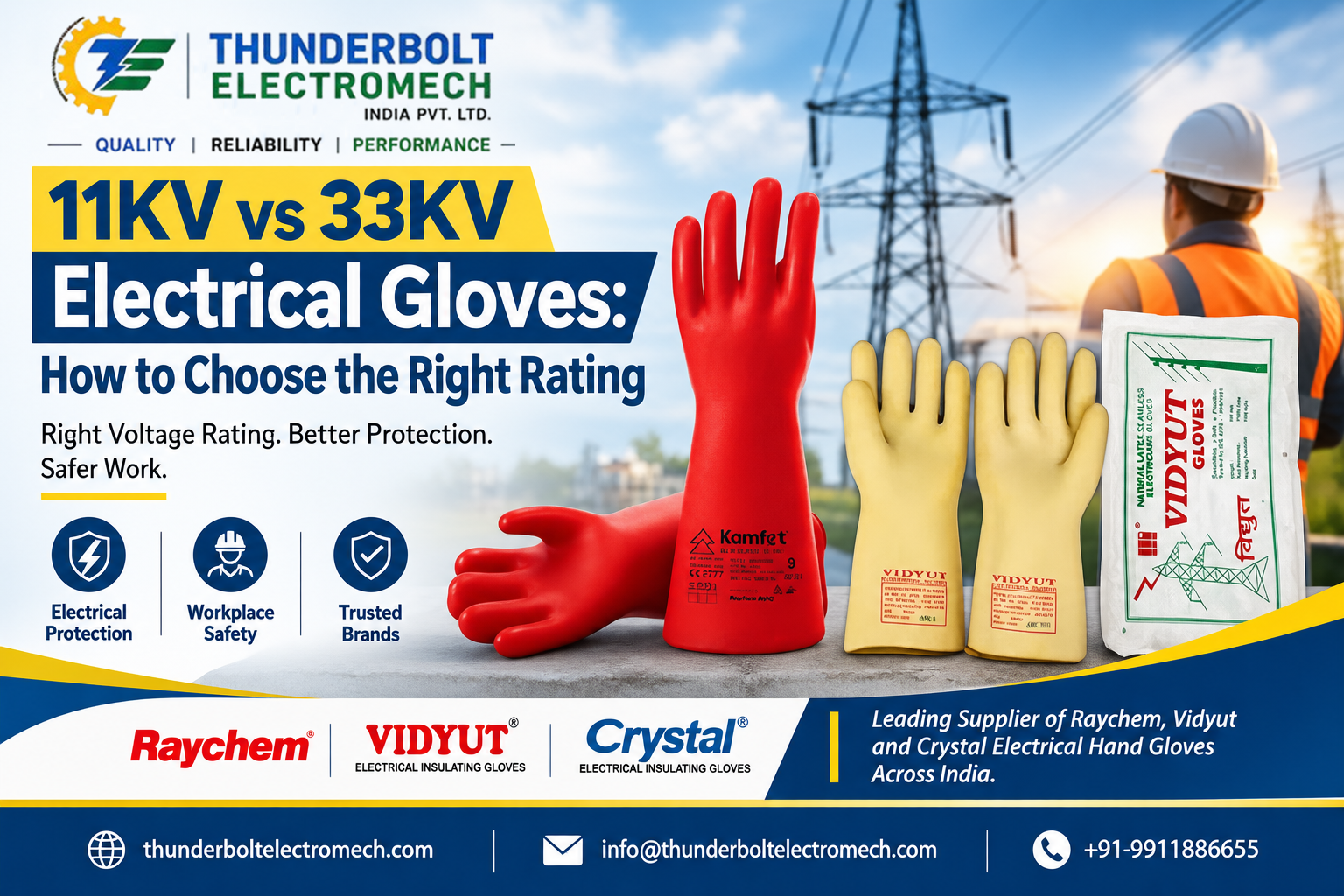
Quick Answer: 11KV and 33KV gloves are not interchangeable, and matching them by “nominal voltage” alone is the most common buying mistake in Indian industry. IEC 60903 and IS 4770 rate gloves by maximum use voltage, not the system voltage printed on a switchgear nameplate. For dependable protection on an 11KV network, you need Class 2 gloves (max use 17,000V AC). For 33KV work, Class 3 gloves fall short — you need Class 4 (max use 36,000V AC). Getting this wrong doesn’t just fail an audit; it can fail a life.
Introduction
A lineman picks up a pair of gloves stamped “11KV” and assumes the job is covered. Nine times out of ten, it is. The tenth time, the glove was tested to a lower proof voltage than the site’s actual switching transients demand, and nobody caught it until an inspection — or worse, an incident.
Electrical hand gloves aren’t marked the way most buyers think. A glove doesn’t say “safe for 11KV” in the way a fuse says “15 amp.” It carries a Class, a proof test voltage, and a maximum use voltage — three numbers that map to a working voltage range, not a single figure. If your procurement team, your safety officer, or your EPC contractor doesn’t know how those three numbers relate, the gloves in your store cupboard might be the wrong ones, even if the box says the right kV rating.
This blog breaks down exactly how 11KV and 33KV gloves differ, what class each one actually belongs to, and what an experienced Electrical Hand Gloves Supplier checks before shipping a single pair.
Electrical Hand Gloves Supplier 101: How Voltage Classes Actually Work
Most buyers ask for “11KV gloves” or “33KV gloves” because that’s how the site engineer talks. But insulating gloves are engineered and tested against IEC 60903 internationally, and against IS 4770:1991 in India — and both standards classify gloves by number, not by kV.
Here’s the part that trips up even experienced procurement teams: the class number tells you the maximum voltage the glove is rated to work at, plus a proof test voltage the glove must survive during dielectric testing with a safety margin built in. A responsible Electrical Hand Gloves Supplier will never sell against a kV number alone — they’ll ask what class the site actually requires.
The Six Glove Classes, Explained Properly
| Class | Max Use Voltage (AC) | Proof Test Voltage | Typical Thickness | Where It’s Used |
| Class 00 | 500 V | 2,500 V | ~0.5–1.1 mm | Panel wiring, low-voltage control rooms |
| Class 0 | 1,000 V | 5,000 V | ~0.8–1.6 mm | LT distribution boards, residential-scale work |
| Class 1 | 7,500 V | 10,000 V | ~1.1–2.1 mm | Industrial maintenance below 11KV |
| Class 2 | 17,000 V | 20,000 V | ~1.5–2.9 mm | 11KV substations, ring main units |
| Class 3 | 26,500 V | 30,000 V | ~2.3–3.5 mm | 22KV and lower 33KV-adjacent work |
| Class 4 | 36,000 V | 40,000 V | ~3.0–4.2 mm | 33KV switchyards, transmission maintenance |
Notice something. Class 1’s ceiling is 7,500V — that’s below 11,000V. A worker who grabs a Class 1 glove because “it feels close enough” for an 11KV bus bar is standing on the wrong side of a 3,500-volt gap. This single number is the reason a trustworthy Electrical Hand Gloves Supplier trains its sales team to ask about system voltage before quoting a class.
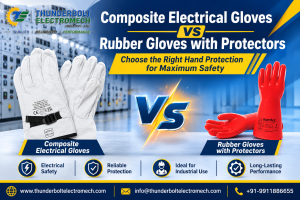
Thickness rises with class, and that’s not incidental. Thicker rubber means more dielectric material between the worker’s palm and the conductor, but it also means less finger dexterity — which is why linemen at 33KV often pair Class 4 gloves with leather protectors rather than working bare-gloved for fine motor tasks.
11KV vs 33KV Gloves: What Every Electrical Hand Gloves Supplier Should Tell You
Here’s where most buying guides stop short. They’ll tell you “use Class 2 for medium voltage and Class 4 for high voltage” and leave it there. That’s not wrong, but it skips the engineering reasoning — and reasoning is what keeps a warehouse from stocking the wrong SKU.
Why 11KV Needs Class 2, Not Class 1
An 11KV network is rarely a flat 11,000 volts. Distribution voltage fluctuates with load, and switching operations generate transient overvoltages that can briefly exceed nominal system voltage by a noticeable margin. IS 4770 and IEC 60903 build that margin into the proof test, which is why Class 2’s proof voltage sits at 20,000V — nearly double the nominal 11KV figure. A glove tested only to Class 1’s 10,000V proof voltage doesn’t have that buffer. It’s not a matter of “usually fine.” It’s a matter of no safety margin left when it matters.
Why 33KV Needs Class 4, Not Class 3
The same logic repeats at the top end. Class 3 caps out at 26,500V max use voltage — comfortably below 33,000V but not enough to cover a 33KV system with any working margin. Field engineers sometimes assume Class 3 is “the 33KV class” simply because it’s the second-highest tier available, and that assumption has led to under-rated gloves being issued at switchyards. Class 4, with its 36,000V max use voltage and 40,000V proof test, is the only rating that actually clears a 33KV system with room to spare.
Direct Comparison: 11KV Gloves vs 33KV Gloves
| Parameter | 11KV Application (Class 2) | 33KV Application (Class 4) |
| Required Glove Class | Class 2 | Class 4 |
| Max Use Voltage (AC) | 17,000 V | 36,000 V |
| Proof Test Voltage | 20,000 V | 40,000 V |
| Approx. Thickness | 1.5–2.9 mm | 3.0–4.2 mm |
| Dexterity | Moderate | Lower — often paired with leather over-gloves |
| Common Sites | 11KV ring main units, distribution transformers | 33KV switchyards, transmission substations |
| Retest Interval | Every 6 months (or per site EHS policy) | Every 6 months (or per site EHS policy) |
| Typical Buyer | DISCOM contractors, industrial electricians | Transmission utilities, large industrial plants |
A glove doesn’t get “more universal” as it gets thicker — it gets more specialized. Class 4 gloves aren’t simply “better” than Class 2; they’re heavier, stiffer, and slower to work in for tasks that don’t need that level of insulation. Buying Class 4 for an 11KV job wastes dexterity and budget. Buying Class 2 for a 33KV job risks a life. The right answer is always the class matched to the actual site voltage, not the highest or cheapest option available.
Choosing a Delhi-Based Electrical Hand Gloves Supplier for 11KV and 33KV Sites
Voltage class is only half the decision. The other half is who you’re buying from — because a glove is only as trustworthy as its testing paperwork.
What to Verify Before You Order
A genuine Electrical Hand Gloves Supplier should be able to produce, without hesitation:
- A batch-wise test certificate referencing IS 4770 or IEC 60903
- A clearly stated proof test voltage and max use voltage — not just a printed kV number
- Manufacturing traceability (Raychem, Vidyut, or Crystal branding, in Thunderbolt’s case)
- A defined retest and shelf-life policy, since rubber degrades even in unopened packaging
If a vendor can’t answer these four points on a phone call, that’s a sourcing risk, not a bargain.
Customer Problems and Solutions
Problem: “Our gloves passed inspection six months ago and failed this quarter.”
Rubber insulating gloves age even in storage — ozone exposure, UV, and heat all reduce dielectric strength over time. The fix isn’t a better glove; it’s a retest schedule tied to the calendar, not the last incident. Most sites re-test every six months regardless of use.
Problem: “We bought 11KV-labelled gloves, but our auditor flagged them as under-rated.”
This usually means the gloves were sold by kV label without a matching class certificate. The solution is simple going forward: ask your Electrical Hand Gloves Supplier for the class number and proof voltage in writing before the purchase order is raised, not after the audit.
Problem: “Our linemen say Class 4 gloves are too stiff for fine panel work.”
That’s expected — Class 4’s extra rubber thickness trades dexterity for insulation. The fix is stocking both classes: Class 2 for 11KV panel and RMU work, Class 4 reserved specifically for 33KV switchyard tasks, so workers aren’t over-gloved for jobs that don’t need it.
Real Use Cases
A Delhi-NCR DISCOM maintenance contractor servicing 11KV ring main units standardized on Class 2 gloves after an internal audit found mixed-class stock in the same van — some Class 1, some Class 2, unlabelled after repeated use. Standardizing on one class per voltage tier, with color-coded storage pouches, cut audit findings to zero over the following cycle.
A transmission-side industrial client working on a 33KV switchyard upgrade paired Class 4 rubber gloves with leather over-gloves for every live-line task, following the standard practice of using leather protectors to guard the rubber from punctures during hot-stick work — extending glove service life while keeping the dielectric layer intact.
Electrical Hand Gloves Supplier and Danger Plate Supplier: One Safety Partner, Two Critical Products
Gloves protect the hand. They don’t warn the next person walking past the panel. That’s where a Danger Plate Supplier comes into the same conversation as your glove vendor — because voltage-class gloves and voltage-rated warning signage solve two different halves of the same compliance requirement.
Sites that pass electrical safety audits cleanly tend to source both from one accountable vendor. It removes the gap where PPE is compliant but signage is outdated, mismatched, or missing at a panel that was recently re-energized. Thunderbolt Electromech supplies both — Raychem, Vidyut, and Crystal electrical hand gloves alongside powder-coated and aluminium danger plates — precisely because a single audit trail across PPE and signage is easier to defend than two separate vendor relationships.
If your 11KV or 33KV site is due for a safety stock review, it’s worth checking glove class certificates and panel signage in the same walkthrough, not two separate ones months apart.
Frequently Asked Questions
Is a 33KV glove automatically safe to use on an 11KV system?
Technically yes on voltage margin, but it’s not efficient. Class 4 gloves are stiffer and reduce dexterity for tasks that Class 2 handles comfortably. Match the class to the job, not just the ceiling.
How often should 11KV and 33KV gloves be retested?
Most Indian industrial sites retest every six months, aligned with IS 4770 guidance and internal EHS policy — sooner if the gloves show visible wear, punctures, or have been stored improperly.
Can leather over-gloves replace insulating rubber gloves?
No. Leather protects the rubber glove from mechanical damage — cuts, abrasion, punctures — but has no dielectric rating of its own. The rubber glove underneath does the insulating work.
Do Raychem, Vidyut, and Crystal gloves differ in class availability?
Class availability depends on the specific model within each brand. Always confirm the class and proof voltage certificate for the exact SKU you’re ordering, not just the brand name.
Sources and Evidence Labels
- IEC 60903 class voltage table (max use voltage, proof test voltage, thickness by class) — direct source found, cross-verified across multiple manufacturer datasheets (CATU, Boddingtons Electrical) and independent safety-equipment references.
- IS 4770:1991 (Rubber Gloves — Electrical Purposes — Specification), the Indian standard referenced by BIS and cited on Indian industrial marketplaces for 11KV and 33KV glove listings — direct source found via BIS standard records.
- Retest interval guidance (six-monthly, condition-dependent) — primary/peer industry practice, consistent across multiple insulating-glove manufacturer technical sheets rather than a single fixed regulatory number; site-specific EHS policy should be treated as the governing document.
For the complete framework on selecting, storing, and certifying electrical hand gloves, see Thunderbolt’s Hand Gloves Buying and Safety Guide, and browse the full range on the Electrical Hand Gloves category page. For panels and switchyards that also need updated warning signage, see the Danger Plate Supplier Buying Guide.
Get in Touch with Thunderbolt Electromech
Thunderbolt Electromech India Pvt. Ltd. — Delhi-based supplier of Raychem, Vidyut, and Crystal electrical hand gloves, and danger plates for industrial and utility sites across India.
📞 Phone: +91-9911886655
📍 Address: Shop no 3538, Sitaram Bazar Rd, Bazar Sirkiwalan, Chawri Bazar, Chandni Chowk, Delhi, 110006
✉️ Email: info@thunderboltelectromech.com
Conclusion: Matching the Right Glove to the Right Voltage Isn’t Optional
The gap between 11KV and 33KV gloves comes down to three numbers most buyers never ask about: class, proof test voltage, and max use voltage. Class 2 gloves, rated to 17,000V, are the correct minimum for 11KV work — Class 1’s 7,500V ceiling falls short. Class 4 gloves, rated to 36,000V, are the correct minimum for 33KV work — Class 3’s 26,500V ceiling falls short there too. A kV number printed on packaging is a starting point for a conversation, not a substitute for a class certificate.
Beyond the technical rating, the vendor relationship matters just as much. A reliable Electrical Hand Gloves Supplier verifies class and proof voltage in writing, tracks retest schedules, and — ideally — can also supply the danger plates and warning signage that complete a site’s electrical safety compliance. Thunderbolt Electromech supplies Raychem, Vidyut, and Crystal gloves across both the 11KV and 33KV range, alongside powder-coated and aluminium danger plates, so Delhi-based and pan-India buyers can source PPE and signage from one accountable partner rather than reconciling two separate vendor records at audit time.
If your site’s glove inventory hasn’t been checked against class certificates recently, that’s the first place to look before the next inspection does it for you.