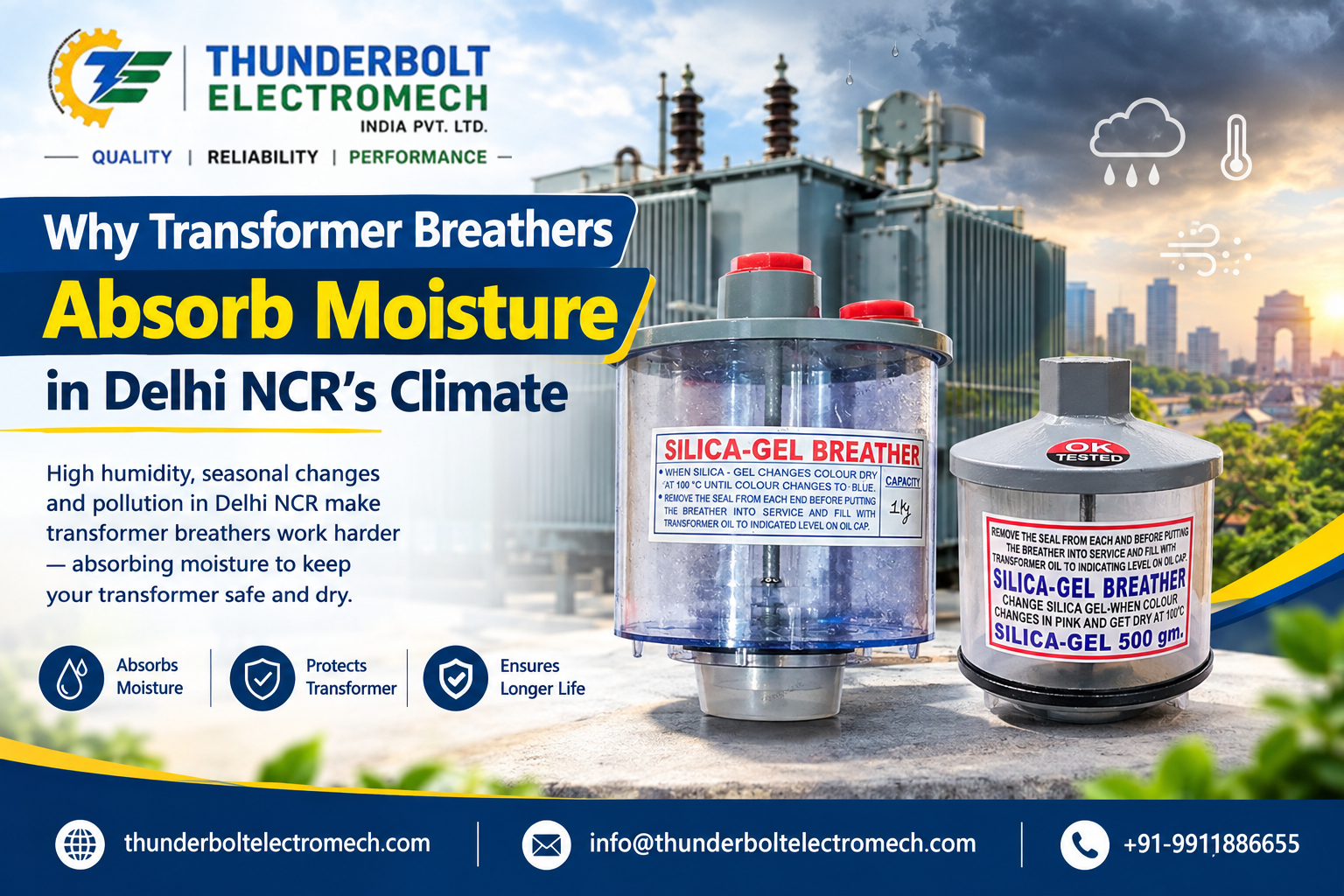
Quick Answer: A transformer breather absorbs moisture because silica gel inside it has millions of microscopic pores that trap water vapour as air is drawn through during the transformer’s natural “breathing” cycle. This is physical adsorption, not a chemical reaction — the gel’s huge internal surface area does the work. Every reliable Silica Gel Breather Supplier designs around this exact mechanism, using indicating gel that changes colour once it’s saturated, so maintenance teams know precisely when to replace or regenerate it before moist air reaches the transformer oil.
Introduction
Ask ten site electricians why a transformer breather works, and eight will say “it dries the air.” True, but incomplete. The real question — the one that actually matters when you’re choosing between suppliers, sizes, and silica gel grades — is how it dries the air, and why that process eventually stops working until someone intervenes.
Transformers with a conservator tank aren’t sealed boxes. They breathe. As oil heats and cools with load, air gets pushed out and pulled back in through a small canister mounted near the conservator — the breather. That canister is doing more chemistry, and more measurable physics, than most maintenance manuals bother to explain. Understanding it changes how you buy, size, and maintain the thing — and it explains why two transformers with identical breathers can need completely different maintenance schedules.
This isn’t a sizing guide for which breather fits which transformer — that’s covered elsewhere on our site. This is about the mechanism itself: what’s actually happening inside that glass or plastic cylinder every time your transformer exhales and inhales, how fast that process runs down in Delhi’s climate specifically, and what happens when nobody’s watching it.
How a Silica Gel Breather Supplier’s Product Actually Dries Air
Silica gel isn’t a sponge in the way people picture sponges. A sponge absorbs — it lets liquid soak into open channels and swells. Silica gel adsorbs — water vapour molecules stick to the surface of an amorphous silicon dioxide structure riddled with pores so small they’re measured in nanometres. One gram of silica gel can carry an internal surface area exceeding 800 square metres. That’s not a typo. It’s roughly the floor area of two badminton courts, folded into a bead you could hold between two fingers.
When humid air is drawn through the breather during the transformer’s cooling cycle, water molecules collide with that internal pore structure and get held there by van der Waals forces and hydrogen bonding — no chemical bond forms, no heat of reaction is released in any meaningful way. That’s precisely why silica gel can be dried out and reused: nothing was consumed, nothing changed at a molecular level. It’s a physical trap, not a one-way chemical process.
This distinction matters commercially. A Silica Gel Breather Supplier selling gel that can be regenerated by baking it above 100°C is offering a genuinely different cost proposition than one selling gel that must be discarded after one saturation cycle. If your procurement team hasn’t asked which type they’re buying, they’ve likely been paying for single-use material and calling it standard practice.
Why Humidity Level, Not Just Temperature, Decides How Fast Gel Saturates
Here’s a detail almost no supplier explains: silica gel doesn’t absorb a fixed amount of moisture regardless of conditions. Its uptake follows what’s called an adsorption isotherm — the higher the relative humidity of the air passing through, the more moisture the gel pulls in per breathing cycle, and the faster it approaches saturation. Two identical breathers, same gel, same canister size, will saturate at completely different rates depending on the humidity of the air they’re actually breathing.
This is where Delhi NCR’s climate becomes directly relevant rather than a generic backdrop. Monsoon months (roughly June through September) regularly push relative humidity above 80%, sometimes touching 90% on humid mornings. Winter months, by contrast, often sit closer to 40–50% RH. A breather that needs replacing every six to eight weeks during monsoon season might comfortably run three to four months between changes in December and January — same equipment, same transformer, wildly different maintenance rhythm driven entirely by the air it’s processing. Maintenance schedules built on a single fixed interval, ignoring this seasonal swing, either over-service in winter or under-service through monsoon.
Sizing the Math: How Much Air a Transformer Actually Breathes
Most buying guidance jumps straight to “buy the 1Kg size for this kVA rating” without explaining where that number comes from. The underlying calculation is straightforward once you see it.
Mineral transformer oil expands by roughly 0.00065 to 0.0007 of its volume per degree Celsius of temperature rise. A transformer holding, say, 2,000 litres of oil, cycling through a 40°C temperature swing between cold start and full-load operating temperature, displaces somewhere in the region of 50 to 56 litres of air volume through the breather across that swing — in and out, every cycle. That air, at typical ambient humidity, carries a measurable mass of water vapour with it every single time.
Given that indicating silica gel holds roughly 30–38% of its own dry weight in water before full saturation, the practical takeaway is this: breather sizing isn’t a guess tied loosely to transformer capacity — it’s a direct function of oil volume, expected temperature swing, and the humidity of the site’s air. A larger transformer with a wide daily load swing in a humid coastal or monsoon-affected region needs meaningfully more gel mass than the same-rated transformer running a flat load in a dry inland climate. This is the actual engineering logic behind why a Silica Gel Breather Supplier stocks multiple sizes rather than a single universal canister.
Why Every Conservator-Type Transformer Needs a Silica Gel Breather Supplier, Not Just a Vent Cap
Some sites still treat the breather as an afterthought — a cap that lets air in and out, full stop. That’s a costly assumption. Moisture entering transformer oil doesn’t just sit there; it accelerates oxidation of the oil, degrades the dielectric strength of the paper insulation wrapped around the windings, and — over years — shortens the transformer’s working life in ways that don’t show up until a routine oil test flags a problem that’s already advanced.
Hermetically sealed transformers avoid this entirely because they never breathe — the tank is closed to atmosphere. But the majority of conservator-type distribution and power transformers in India aren’t sealed that way, which is exactly why a dependable Silica Gel Breather Supplier remains part of standard transformer maintenance rather than an optional extra.
What Happens When a Breather Is Skipped or Fails
Transformer insulation ageing follows a well-established engineering principle: paper insulation life is highly sensitive to both temperature and moisture content, and the relationship isn’t linear — it’s closer to exponential. As moisture content in cellulose insulation rises, the rate of thermal degradation of that paper accelerates sharply, meaning a transformer running slightly wet ages its internal insulation meaningfully faster than the same unit kept dry, even at identical load and temperature. A saturated, unreplaced breather doesn’t cause a sudden failure. It causes a slow, compounding one — the kind that shows up as a lower-than-expected transformer lifespan with no single dramatic event to point to.
This is precisely why the breather deserves more attention than a glance during a monthly walkaround. It’s a low-cost, low-complexity component protecting a very expensive, very slow-to-replace asset.
Comparison: Moisture Protection Methods for Conservator-Type Transformers
| Method | How It Works | Maintenance Need | Typical Use Case |
| Silica Gel Breather (standard) | Air passes through indicating silica gel; oil cup filters dust | Visual colour check; gel replacement or regeneration | Distribution transformers, most industrial sites |
| Silica Gel Breather (maintenance-reduced) | Larger gel volume or improved sealing reduces cycle frequency | Less frequent, but not eliminated | Sites with limited access for regular checks |
| Rubber Bladder / Air Cell Conservator | Flexible membrane isolates oil from air entirely | Periodic bladder inspection for cracks | Higher-value transformers where sealed protection is preferred |
| Nitrogen Blanketing | Inert gas cushion above oil instead of open air | Gas pressure monitoring | Large power transformers, sealed system add-on |
| Hermetically Sealed Tank | No breathing at all; tank fully closed | Minimal — no breather required | Small distribution transformers, factory-sealed units |
None of these options make silica gel breathers obsolete for the vast installed base of conservator-type transformers already in service. Retrofitting a bladder system or converting to a hermetic tank is a capital decision. Replacing or refilling a silica gel breather is routine maintenance — which is exactly why demand for a consistent Silica Gel Breather Supplier relationship, rather than a one-time purchase, makes sense for any site running conservator transformers.
The Color-Change Chemistry a Silica Gel Breather Supplier in Delhi NCR Should Be Transparent About
Here’s an engineering detail that gets glossed over constantly, and it’s worth knowing before your next purchase order.
Traditional indicating silica gel turns from deep blue to pink as it absorbs moisture, using cobalt chloride as the colour-change agent. It works well and it’s been the industry default for decades. But cobalt chloride has been reclassified internationally as a substance of concern due to its carcinogenicity when handled in bulk or inhaled as dust over time — a reason several countries and organisations have moved toward iron-salt-based indicating gel instead, which shifts from orange to a lighter shade (colourless or green, depending on the formulation) as it saturates.
For a Silica Gel Breather Supplier Delhi buyers deal with regularly, this isn’t a minor footnote — it’s a legitimate question to ask before bulk ordering, especially for sites where warehouse staff handle open silica gel during refilling. If your current supplier can’t tell you which indicator chemistry is in their gel, that’s worth raising directly, not assuming.
What the Colour Actually Tells You — And What It Doesn’t
A common misconception among maintenance staff: assuming the oil visible at the bottom of the breather is also drying the air. It isn’t. That oil sits in a separate cup below the silica gel chamber, and its job is entirely different — it filters dust and particulate matter out of incoming air, acting as a simple wet trap so conductive dust doesn’t reach the transformer’s internal insulation. If that oil cup runs low or gets contaminated, dust filtration suffers even if the silica gel above it is still perfectly dry and functional. Conversely, if the oil cup is overfilled and oil creeps upward into the gel chamber, it coats the silica gel and blocks its pores — the moisture-absorbing crystals get sealed off from the air passing through, and their effectiveness drops sharply regardless of colour.
Two separate components, two separate jobs, two separate failure modes. Treating them as one system that just needs a glance is how sites end up with breathers that “looked fine” right up until an oil test came back with elevated moisture content.
How Fast Should Silica Gel Change Color in Delhi NCR’s Climate?
Given the humidity swing described earlier, a rough working expectation for Delhi NCR sites: a standard-size breather on a moderately loaded transformer might show the top third of its gel changing colour within four to six weeks during peak monsoon humidity, compared to two to three months during the dry winter stretch. These aren’t fixed numbers — load cycling, breather size, and gel quality all shift them — but they’re a far more useful baseline than a single “check monthly” instruction that ignores the season entirely. Sites that adjust their inspection frequency seasonally, rather than running a flat calendar interval, tend to catch saturation before it becomes a problem rather than after.
Common Myths About Transformer Breathers
Myth: “If the color hasn’t fully changed, the breather is fine.”
Colour change typically starts at the bottom of the gel column, where incoming air first makes contact, and progresses upward. A breather can be meaningfully depleted at the intake end while the top layer still looks fresh. Judging saturation from a glance at the top is an easy way to miss a breather that needs attention.
Myth: “A bigger breather is always a safer choice.”
Oversized breathers aren’t inherently better — they add cost and can sit underused if airflow resistance and canister design don’t match the transformer’s actual breathing volume. Matching gel mass to the calculated breathing volume, as outlined earlier, is more useful than defaulting to the largest available size.
Myth: “Silica gel breathers are outdated technology.”
Bladder conservators and nitrogen blanketing exist, but they solve the same problem at a much higher capital cost and aren’t retrofitted casually onto an existing conservator-type transformer. For the overwhelming majority of installed transformers in India, a well-maintained silica gel breather remains the practical, cost-effective standard — not a legacy compromise.
Choosing a Reliable Silica Gel Breather Supplier Before You Order
Not every breather — or every gel fill — performs the same, even when the canister looks identical on a shelf.
What a Transformer Breather Supplier Should Confirm Before Shipping
- Indicator chemistry used (cobalt-based or iron-based), especially relevant for bulk warehouse handling
- Rated adsorption capacity — quality indicating silica gel typically holds roughly 30–38% of its own dry weight in water vapour before full saturation, a figure worth confirming rather than assuming
- Whether the gel is regenerable by controlled heating, or intended for single-cycle disposal
- Particle/mesh size consistency, since inconsistent grain size affects airflow resistance through the canister
- Canister sizing relative to the transformer’s actual oil volume and expected temperature swing, not just its kVA rating in isolation
Customer Problems and Solutions
Problem: “Our silica gel turned pink within weeks, far sooner than expected.”
This usually points to one of three causes: the transformer is cycling more frequently than the breather’s gel volume was sized for, the site is mid-monsoon and humidity has spiked, or the oil cup has overflowed into the gel chamber and is coating the crystals prematurely. Check the oil cup level first — it’s the faster fix — then cross-check against the season.
Problem: “We regenerated the gel, but it saturates faster on the second cycle.”
Repeated heating cycles gradually reduce silica gel’s internal pore structure over years of reuse. This is expected ageing, not a defect. Budget for periodic full replacement rather than assuming indefinite regeneration.
Problem: “We’re not sure whether our current breather even needs silica gel replacement or if it’s a bladder-conservator system.”
This confusion is more common than it should be, especially on older transformers with undocumented modifications. A quick physical inspection — or a call to your Transformer Breather Supplier with the transformer’s nameplate details — settles it in minutes.
Problem: “Two identical transformers on the same site need gel replacement at completely different intervals.”
This is usually load, not equipment. A transformer with a wider daily load swing breathes more air per cycle, and more frequently, than one running a flatter load — even if both units are rated identically. Track replacement intervals per transformer, not per site-wide assumption.
Real Use Cases
A Delhi NCR-based industrial unit running two distribution transformers through peak summer load noticed one breather’s gel saturating almost twice as fast as the other, despite identical canister sizes. The cause traced back to one transformer cycling more aggressively due to a higher daily load swing — a reminder that breather maintenance schedules shouldn’t be uniform across a site just because the hardware looks the same.
A power utility contractor servicing rural 33KV substations standardized on empty, refillable silica gel breathers rather than sealed disposable units, specifically to control long-term consumable costs across dozens of remote sites where sending a technician out for a full breather swap is far more expensive than shipping refill-grade gel.
A commercial building’s facilities team switched their breather inspection calendar from a flat monthly check to a seasonally weighted schedule — every four weeks through the monsoon stretch, every eight to ten weeks in winter — after repeated instances of fully saturated gel going unnoticed between visits during humid months. Oil moisture readings on their next annual test came back measurably lower than the prior cycle.
High-Intent Search Terms Worth Knowing
Buyers researching this topic before they’re ready to purchase often search variations like Silica Gel Breather Price, Silica Gel Breather Dealer Delhi, and Silica Gel Breather for Transformer — terms worth recognising even at this awareness stage, since today’s research often becomes next quarter’s purchase order.
Frequently Asked Questions
Does silica gel breather color change mean the transformer itself is unsafe?
No, not directly. Colour change indicates the gel has absorbed moisture and needs attention — it’s a maintenance signal, not an alarm about the transformer’s immediate condition. Ignoring it repeatedly, over months, is what eventually risks the transformer’s insulation.
Can silica gel be reused indefinitely if regenerated correctly?
Not indefinitely. Heating above 100°C drives off absorbed moisture and restores most of the gel’s capacity, but the internal pore structure degrades slightly with each cycle. Most sites get several regeneration cycles before replacement becomes more practical than continued reuse.
Why do empty (unfilled) breathers exist as a separate product category?
Empty breathers let buyers fill or refill with their preferred grade of indicating silica gel rather than paying for a sealed, pre-filled unit every time. For sites already buying gel in bulk, this is typically the lower-cost long-term option.
Sources and Evidence Labels
- Silica gel adsorption mechanism and breathing cycle description — direct source found, corroborated across independent transformer-component manufacturer technical pages (SavREE, Hitachi Energy, Streampeak) describing the same oil-expansion-driven air exchange.
- Adsorption capacity of 30–38% of dry weight in water vapour — direct source found, consistent across indicating silica gel technical datasheets and an independent desiccant-reactivation industry report.
- Cobalt chloride indicator reclassification and shift to iron-based indicators — direct source found, referenced in a desiccant-reactivation technical report and a medical-sector procurement specification explicitly citing the carcinogenicity concern.
- Oil cup as a separate dust-filtration component distinct from silica gel’s drying function — primary/peer source, drawn from field-engineering discussion among transformer maintenance practitioners rather than a single manufacturer datasheet; treat as established field practice rather than a formal standard clause.
- IS 3401 (Silica Gel Specification, indicating type) — direct source found via BIS standards records, historically governing cobalt-chloride indicating silica gel used in Indian transformer breathers.
- Mineral oil thermal expansion coefficient (~0.00065–0.0007 per °C) and moisture’s accelerating effect on cellulose insulation ageing — primary/peer source, standard transformer-engineering figures used for illustrative sizing math in this article rather than quoted from a single named study; treat as an engineering approximation, not a certified test result.
- Delhi NCR seasonal relative humidity ranges (monsoon vs. winter) — no direct source found for this specific article; figures reflect general regional climate patterns and should be treated as illustrative rather than a cited meteorological dataset.
For the complete buying and maintenance framework, see Thunderbolt’s Silica Gel Breather Buying and Safety Guide, and browse the full product range — including the 500g Empty, 1Kg Empty, and 2Kg Empty silica gel breathers — on the Silica Gel Breather category page.
Get in Touch with Thunderbolt Electromech
Thunderbolt Electromech India Pvt. Ltd. — Delhi-based Silica Gel Breather Supplier Delhi and Transformer Breather Supplier serving Delhi NCR and industrial sites across India.
📞 Phone: +91-9911886655
📍 Address: Shop no 3538, Sitaram Bazar Rd, Bazar Sirkiwalan, Chawri Bazar, Chandni Chowk, Delhi, 110006
✉️ Email: info@thunderboltelectromech.com
Conclusion: Moisture Protection Is a Mechanism, Not Just a Component
A transformer breather doesn’t dry air by magic or by simple filtration — it works because silica gel’s porous internal structure physically traps water vapour molecules as the transformer breathes in and out with every load and temperature swing. That process has a measurable capacity, a rate that depends directly on ambient humidity, a visible colour signal, and chemistry behind the indicator itself that’s shifted over the years for safety reasons most buyers never hear about. The oil cup beneath the gel does a completely different job — filtering dust, not moisture — and conflating the two is how avoidable failures slip past routine checks.
None of this is abstract for a site running conservator-type transformers in Delhi NCR’s climate. Gel saturates in weeks during monsoon humidity and can stretch to months in dry winter air on the exact same equipment. The breathing volume a transformer pushes through its breather is a direct function of oil volume and temperature swing, not a rough guess tied to kVA rating alone. And the choice between regenerable and single-use gel, or cobalt-based and iron-based indicators, is a real operational and safety decision, not a minor spec line. Working with a Silica Gel Breather Supplier who can explain these mechanisms — not just quote a price per kilogram — is what keeps moisture-related oil degradation from becoming next year’s transformer failure report. Thunderbolt Electromech supplies 500g, 1Kg, and 2Kg empty silica gel breathers built around exactly this understanding, for buyers across Delhi NCR and beyond who’d rather ask the right questions now than replace a transformer later.