
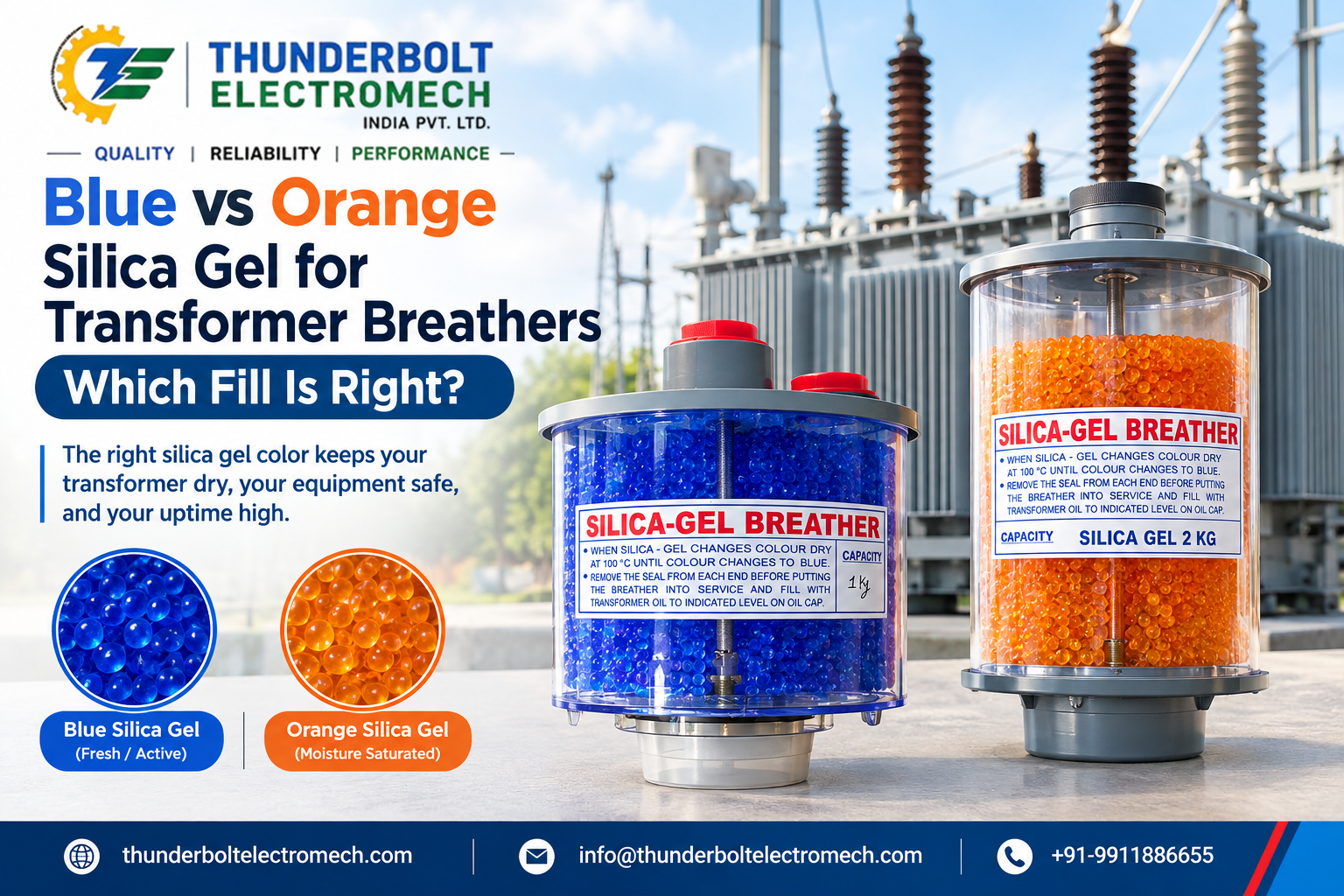
Quick Answer: Choose orange silica gel if you want a cobalt-free fill. Choose blue only if your maintenance rules already cover cobalt chloride, which carries cancer and reproductive hazard classifications. Both grades adsorb similar amounts of water, so the colour only signals saturation. Blue turns pink and gives sharper contrast. Orange turns green and contains no cobalt. A Silica Gel Breather Supplier like Thunderbolt Electromech in Delhi can match the breather size, 500g, 1Kg or 2Kg, to your transformer.
Introduction
A maintenance engineer in Noida opens the store room and finds two bags of breather gel. One is deep blue. The other is bright orange. Same job, different chemistry. Which one goes into the breather?
The question looks small, but it isn’t. The colour you pick decides how your crew reads saturation. It decides which hazard sheet sits in your workshop. It also decides how you handle regeneration and disposal. It does not change how much water the gel can hold, and that surprises many buyers.
This guide is for people who haven’t bought a breather fill yet, or who just noticed a hazard label on the blue gel they have used for years. We explain the chemistry and compare the two grades side by side. We also put numbers on breather life, using basic physics you can check on a calculator.
Thunderbolt Electromech India Pvt. Ltd. works as a Silica Gel Breather Supplier from Chawri Bazar, Delhi. We sell empty breathers in three sizes: 500g, 1Kg and 2Kg. Every factual claim below carries an evidence tag such as [E1]. The tags point to a source list at the end. Where we found no direct source, we say so.
For the full buying and safety framework, read our complete transformer breather buying and safety guide. You can find the other articles in this series in our silica gel breather blog category.
Silica Gel Breather Supplier Guide to the Chemistry Behind Blue and Orange Indicators
What the colour actually measures
The colour is a label, not the product. Indicating gel is ordinary silica gel with a dye soaked into the beads. The indicator is a quality-control feature, and the adsorption capacity matches non-indicating gel. [E7] So the dye never makes the gel dry the air better or worse.
That has a practical consequence. When a supplier claims one colour “absorbs more”, ask for test data. The dye can’t do that. Bead quality, pore structure and moisture content at packing can. Indian standard IS 3401:1992 sets a minimum adsorption capacity of 27 percent for silica gel, and its scope covers transformer breather use. [E9] Ask for a test report against that figure, whatever the colour.
Blue gel: cobalt chloride and a three-stage colour walk
Blue gel carries cobalt chloride. Manufacturers impregnate the gel with a cobalt chloride solution to reach at least 0.5 percent cobalt chloride, and the product turns from blue to pink as it adsorbs water. [E4]
In a breather, you see three stages. Supplier data describes deep blue as dry. Light blue means roughly 15 percent water by weight. Pink means saturation at about 30 to 40 percent. [E13] That gradual fade is a real advantage. You see saturation arrive, not just finish.
Orange gel: methyl violet and a quieter signal
Orange gel uses an organic dye, methyl violet. Safety data sheets we read list it at around 0.3 percent in one case [E5], and many suppliers sell it for transformer breathers. The colour moves from orange to green, and some grades end nearly colourless. [E12]
Orange gel changes colour in a narrower band. One supplier guide says it passes through a pale-green phase that still holds 20 to 30 percent of its working capacity. [E7] That is a supplier claim, not an independent test. It matters because a crew that reads “green” as “dead” may throw away usable gel.
The regulatory facts, without the myths
Blue gel’s hazard is real. Safety data sheets classify cobalt chloride as a Category 1B carcinogen, and they list it as a Category 1B reproductive toxicant and a candidate Substance of Very High Concern under EU REACH. [E1] The candidate list itself names its use as a moisture indicator in silica gel. [E2]
Many web pages go further and say the EU banned blue gel in 1998. We checked. A 1998 EEC notification did tighten the classification of cobalt chloride, and patent filings of that era describe it. [E4] But ECHA’s own record shows something less dramatic. Annex XIV listing of cobalt dichloride had not happened as of 2018, and the Commission ended the restriction process on 8 April 2022. [E3] We found no direct regulatory text that bans indicator gel outright. So the honest statement is “heavily classified and flagged”, not “banned”.
For India, we found no direct source showing a BIS ban on blue gel. IS 3401’s own revision history mentions cobalt content limits for the indicating type, which tells you the standard has long treated cobalt as part of the specification. [E9]
Orange gel is not a magic safe option either. At least one current EU safety data sheet does not classify an orange-to-colourless grade as hazardous. [E6] Yet methyl violet is a dye, and one sheet we read sets a 0.5 mg/m³ workplace dust figure for it. [E5] Treat both gels as dusty materials. Wear gloves and a dust mask during refilling.
Why a transformer breather deserves this much attention
Water does quiet damage in an oil-filled transformer. A peer-reviewed study in Energies reports that rising moisture raises dielectric loss and cuts the breakdown voltage of oil-paper insulation. [E10] Industry sources add numbers. Cellulose insulation holds about 400 times as much water as oil at a given temperature, so nearly all the moisture ends up in the paper. [E11] One technical article reports that moving paper moisture from 0.5 to 3.0 percent can halve the partial discharge inception voltage. [E14]
Aging follows the same pattern. Patent literature citing transformer practice states that paper at 1 percent moisture ages about six times faster than paper at 0.3 percent. [E11] That is a secondary source, so treat the exact ratio with care. The direction is not in doubt.
The breather is the cheapest barrier against all of this. It is also the one barrier a crew can see through a window. That is why the choice of fill, and the ability to read it, matters more than it first appears.
Blue vs Orange Silica Gel Comparison: What a Silica Gel Breather Supplier Wants You to Check
Side-by-side comparison table
| Factor | Blue silica gel | Orange silica gel |
| Indicator chemical | Cobalt chloride, about 0.5% or more [E4] | Methyl violet, roughly 0.2–0.3% in sheets we read [E5] |
| Colour path | Deep blue → light blue → pink [E13] | Orange → yellow-green → dark green or colourless [E12] |
| Hazard status of indicator | Carcinogen 1B, reproductive toxicant 1B, SVHC candidate [E1][E2] | Several SDS do not classify the finished gel [E6]; dye still needs dust control [E5] |
| Colour contrast | Sharper, graded fade [E7][E13] | Lower contrast, pale-green transition [E7] |
| Water capacity | Same as non-indicating gel [E7] | Same as non-indicating gel [E7] |
| Regeneration | Oven drying near 120 °C for about 2 hours cited by an engineering forum [E12] | No direct source found for a safe regeneration temperature |
| Handling burden | Higher: dust and spent-gel disposal need controls | Lower, though dust control still applies |
| Price | No direct price source found; request both quotes | No direct price source found; request both quotes |
| Best fit | Sites with established cobalt handling rules and a need for fine colour reading | Sites that want cobalt out of the workshop and can train crews on the green shift |
Engineering insight 1: read the front, not the colour name
Air enters a breather at the bottom, through the oil cup, and rises through the gel. The gel at the bottom loads first. As weeks pass, a boundary climbs the column. Below it, the gel has taken up water. Above it, the gel is still dry.
Experienced technicians treat that boundary as the real measurement. We found no direct source describing this in transformer breather literature, so we label it engineering inference. It follows from how adsorption beds behave in any fixed column.
The rule that follows: change gel by the fraction of the column that has shifted, not by the colour name on the bag. One engineering education site advises that a breather holding less than one-third dry gel raises the chance of moisture reaching the oil. [E8] Apply the same fraction rule to blue and orange alike. Change at two-thirds converted.
Engineering insight 2: the pale-green trap
With orange gel, the transition zone is wide and low in contrast. A crew that sees any green may pull the whole charge. That wastes money. A crew that waits for full green may miss the point where the dry fraction fell too low. Neither habit is good.
The fix costs almost nothing. Keep a small sealed jar of fresh orange gel and one of fully loaded gel in the store room. Technicians compare the window against the jars. Blue gel needs the same step, but its graded fade makes the mistake less likely.
Engineering insight 3: your window ages too
Many breather bodies use polycarbonate. Outdoor yards in Delhi NCR see heavy sun and dust. A yellowed or scratched window changes how every colour looks. Orange gel behind amber plastic can look nearly unchanged. We found no direct study on this exact effect, so we label it engineering inference from field practice. Clean the window at each inspection. Replace the housing when it stops showing a true colour.
Engineering insight 4: do not mix grades or lots
Never mix blue and orange in the same column. Your crew will lose the single reading scale, and mixed lots may differ in bead size and dust. Powdery material restricts airflow. One engineering forum recommends beads of 4 to 5 mm for breather use and warns that powder can choke breathing. [E12] That source is a discussion thread, so treat it as practitioner opinion. Still, the airflow logic holds. Buy one lot per fill.
Engineering insight 5: a worked example of breather life
Here is a back-of-envelope estimate. It uses our own arithmetic and stated assumptions, so label it illustrative, not measured.
- A common working figure says silica gel holds about 20 percent of its own weight in water before saturating. [E8] So 1 kg of gel holds about 200 g of water.
- Applying the one-third rule leaves roughly two-thirds usable. That gives about 133 g per 1Kg charge.
- Assume a transformer with 10,000 litres of mineral oil. Oil expands roughly 0.0007 per kelvin. A 20 K daily swing moves about 140 litres, or 0.14 m³ of air in and out.
- Air at 30 °C and 70 percent relative humidity carries about 21 g of water per cubic metre. That is a textbook psychrometric value.
- Daily intake is then about 3 g of water. A 1Kg charge lasts around 44 days.
On the same assumptions, a 500g charge lasts roughly 22 days and a 2Kg charge roughly 88 days. Real life differs. A dry winter week slows loading. A leaking flange speeds it up. The estimate still shows why size matters and why a monthly look beats a yearly one.
Customer Problems and Real Use Cases We Hear as a Silica Gel Breather Supplier in Delhi NCR
Common customer problems and solutions
| Problem | Likely cause | Practical solution |
| Gel turns pink or green within weeks | Dry-out of the oil cup, failed gasket, or a leak at the conservator joint | Refill the oil cup, replace gaskets, check every flange before blaming the gel |
| Top layer saturates first | Moist air entering from the conservator side (engineering inference) | Pressure-check the joint above the breather |
| Crew cannot tell orange from pale green | Low contrast, yellowed window | Use reference jars, clean the window, apply the two-thirds rule |
| Safety officer rejects blue gel | Cobalt hazard sheet [E1] | Move to orange, or document dust control and disposal for blue |
| Gel dust reaches the oil cup | Powdery or crushed beads | Buy uniform, low-dust beads and fill gently |
| Two quotes look far apart | Different bead quality, capacity, or lot size | Ask both quotes to state adsorption capacity against IS 3401 [E9] |
Real use cases
The four cases below are representative scenarios built from common maintenance patterns in the region. They are not named client projects.
Use case 1: the monsoon surprise.
A distribution maintenance team in Gurugram fills a 1Kg breather in June. By mid-July the bottom third has shifted. The team blames the gel. An inspection finds a hardened gasket at the breather flange. They replace the gasket, refill the oil cup, and the new charge now lasts the expected weeks. The lesson: a short life is a system fault more often than a gel fault.
Use case 2: the audit flag.
A manufacturing unit in Ghaziabad runs its own transformers. An environmental health and safety audit flags cobalt chloride in the store. The plant switches to orange gel and sets up reference jars for the crew. Training takes one toolbox talk. The lesson: switching grades is a small task when you plan the colour-reading step.
Use case 3: the repair workshop.
A rewinding workshop in Delhi keeps spare empty breathers for field jobs. Staff pre-fill breathers in the workshop, seal them, and carry them to site. They choose breather size from the transformer’s nameplate and OEM guidance, not from guesswork. The lesson: an empty breather in stock gives you control over which gel and which lot goes in.
Use case 4: the dusty solar yard.
An EPC contractor maintains inverter-duty transformers in a hot, dusty site in western Uttar Pradesh. Windows scratch quickly. Orange gel behind a scratched window reads poorly, so the team adds a monthly window cleaning step and swaps scratched housings. The lesson: site conditions can matter more than gel colour.
Choosing a Silica Gel Breather Supplier: Size, Silica Gel Breather Price and Dealer Checks
Match the breather size to the transformer first
Pick the breather before the gel. One engineering education source notes that breathers are rated by drying capacity per volume of insulating liquid, and the transformer manufacturer usually sets the size. [E8] Check your nameplate and OEM manual.
Thunderbolt Electromech supplies a Silica Gel Breather for Transformer duty in three empty sizes:
If you replace a breather on an existing transformer, match the OEM capacity or go up one size. Going down shortens service life, as the worked example above shows.
What drives Silica Gel Breather Price
Buyers search for a Silica Gel Breather Price and expect one number. The honest answer has several parts. Price moves with:
- housing size and body material
- fitting thread and flange type
- bead quality and lot size of the gel you add
- whether you buy one unit or a batch for several substations
We found no reliable public price data that compares blue and orange gel in the Indian market, so we do not quote a gap. Ask your Silica Gel Breather Supplier for a written quote for each housing size, and request gel quotes with adsorption capacity stated. Call +91-9911886655 for a current quote.
Questions to ask any Silica Gel Breather Dealer Delhi buyers meet
A dealer’s answers reveal more than a catalogue page. Ask these:
- Which sizes do you stock, and are they ready for dispatch?
- Does the housing include an oil cup and seals, and what are the thread sizes?
- Can you supply test data against IS 3401 for the gel?
- Which grade do you recommend for my site, and why?
- Can I visit or call someone who knows the product?
A Transformer Breather Supplier who cannot answer questions three and four deserves caution. A good Silica Gel Breather Supplier Delhi buyers trust will answer in plain language and put the answers in writing.
Which Silica Gel Breather Delhi NCR buyers should pick: a decision rule
Use this short rule.
- Choose orange if your site audits chemical hazards, if you want cobalt out of the workshop, or if your crew can learn the green shift with reference jars.
- Choose blue if your procedures already control cobalt chloride, if your crew reads the graded fade well, and if you accept the disposal duties.
- Choose either with the same two-thirds rule, one lot per fill, and a monthly window check.
For deeper detail on sizing and moisture behaviour, browse the other articles in our silica gel breather category and the pillar guide.
Conclusion: Pick the Gel You Can Read and Handle Safely
Blue and orange silica gel dry the air equally well. The difference lies in what the dye does to your people and your process. Blue gives a finer colour fade and carries a cobalt hazard classification. Orange removes cobalt from the column but asks your crew to read a wider, lower-contrast change. Neither colour rescues a leaking flange or an empty oil cup.
Start with the right breather size. Fill it with one lot of gel. Change the charge when about two-thirds of the column has shifted. Look at the window every month, and clean it.
Thunderbolt Electromech India Pvt. Ltd. is a Delhi-based Silica Gel Breather Supplier. Call or write to us for sizing help and a quote.
- Phone: +91-9911886655
- Email: info@thunderboltelectromech.com
- Website: thunderboltelectromech.com
- Address: Shop No. 3538, Sitaram Bazar Rd, Bazar Sirkiwalan, Chawri Bazar, Chandni Chowk, Delhi, 110006
Evidence Map: Claims, Sources and Labels
| Tag | Claim | Label | Source |
| E1 | Cobalt chloride: Carcinogen 1B, Reproductive toxicant 1B, SVHC candidate | Direct (safety data sheets) | https://dept.harpercollege.edu/chemistry/sds/CHM110/Cobalt%20Chloride%20Hexahydrate.pdf and Carl Roth SDS “SDB-T889-MT-EN” |
| E2 | Cobalt dichloride named as a silica gel moisture indicator on the SVHC list | Direct | https://www.cirs-group.com/files/attach/Uploads/file/20220311/1646974960_33308.pdf |
| E3 | Annex XIV listing not realised (2018 document); Commission ended restriction process 8 April 2022. A blanket EU ban on indicator gel: no direct source found | Direct for ECHA record; no direct found for a ban | https://echa.europa.eu/registry-of-restriction-intentions/-/dislist/details/0b0236e181d575c8 |
| E4 | Blue gel carries at least 0.5% cobalt chloride, blue to pink; 1998 EEC notification | Direct (patent text) | https://image-ppubs.uspto.gov/dirsearch-public/print/downloadPdf/6753184 |
| E5 | Methyl violet around 0.3% in one orange gel SDS; 0.5 mg/m³ EU limit listed | Direct (SDS) | https://www.labtech.com/wp-content/uploads/2022/08/SDS-13-078045-orange-indicating-silica-gel.pdf |
| E6 | Some orange gel SDS do not classify the product as hazardous | Direct (SDS) | https://www.elementalmicroanalysis.com/documents/product/sds/SILICA-GEL-SELF-INDICATING-ORANGE-COLOURLESS_20241129_EN.pdf |
| E7 | Same capacity as non-indicating gel; orange pale-green phase keeps 20–30% capacity; lower contrast | Indirect (supplier guide) | https://www.drygelworld.com/blog/indicating-silica-gel-orange-blue-color-change-guide |
| E8 | Breather operation, about 20% water uptake, one-third dry rule, sizing by liquid volume | Indirect (engineering education site) | https://savree.com/en/product/silica-gel-breather |
| E9 | IS 3401:1992 scope, transformer breather use, cobalt requirement history, 27% capacity | Direct (BIS standard) | https://law.resource.org/pub/in/bis/S02/is.3401.1992.pdf |
| E10 | Moisture raises dielectric loss, lowers breakdown voltage | Direct, peer-reviewed | https://doi.org/10.3390/en10081195 |
| E11 | Cellulose holds about 400× more water than oil; 1% vs 0.3% moisture aging ratio | Indirect (white paper; patent text) | https://tjh2b.com/white-papers/premature-aging-of-the-transformer-due-to-inadequate-drying-of-the-insulating-system/ |
| E12 | Orange colour path; 4–5 mm beads; 120 °C regeneration for blue | Indirect, low confidence (engineering forum) | https://www.eng-tips.com/threads/specification-of-the-silica-gel-used-in-transformer-breather.363190/ |
| E13 | Blue gel colour states vs water percentage | Indirect (supplier data) | https://eastindiachemicals.com/product/silica-gel-breather-blue |
| E14 | Moisture 0.5% to 3.0% may halve partial discharge inception voltage | Indirect (trade article) | https://electricenergyonline.com/energy/magazine/333/article/Assessing-Water-Content-in-Insulating-Paper-of-Power-Transformers.htm |
Labelled engineering inference or illustration (no direct source found): colour-front reading, the pale-green decision rule, window yellowing, the mixing-lots warning, the top-layer-first diagnosis, and the breather life estimate.