By Thunderbolt Electromech India Pvt. Ltd. — Delhi-based Electrical Hand Gloves Supplier of Raychem, Vidyut & Crystal
📞 +91-9911886655 | 📍 Shop No. 3538, Sitaram Bazar Rd, Bazar Sirkiwalan, Chawri Bazar, Chandni Chowk, Delhi – 110006
Quick Answer: The right electrical glove class depends on the highest voltage you may encounter, not simply the equipment’s normal operating voltage. Under IEC 60903, Class 00 gloves are rated for up to 500 V AC (750 V DC), making them suitable for lower-voltage electrical work. Class 0 is rated up to 1,000 V AC (1,500 V DC), commonly used for LV systems. Class 1 provides protection up to 7,500 V AC (11,250 V DC) for higher-voltage work. Always select a glove with a rating above the maximum system voltage, and follow required testing, inspection, leather protector, and workplace safety procedures applicable.
Introduction
A maintenance electrician in an Okhla factory pulls on a pair of gloves labelled “Class 1” before opening an LT distribution panel. He assumes higher number means safer. What he doesn’t know: that same pair is rated for up to 7,500 volts AC, built thicker, and stiffer to work in, for a task that only ever touches 415 volts. He’ll fumble a screwdriver connection for twenty extra minutes today, and he’ll do it again tomorrow, because nobody explained that “higher class” doesn’t mean “better choice” — it means “different voltage band, different trade-offs.”
This confusion sits at the centre of nearly every electrical hand glove purchase decision in India, and it gets worse the moment a buyer starts comparing catalogues, because Indian manufacturers print two different labelling systems on their gloves — sometimes on the same box. This article untangles Class 00, Class 0, and Class 1 specifically, since that’s where the vast majority of Indian industrial and commercial buyers actually shop, while also mapping the full Class 00-to-4 range so nothing is left half-explained. Along the way, we’ll flag an engineering detail almost no supplier blog mentions: India’s own glove standard doesn’t actually use the word “Class” at all.
Electrical Hand Gloves Supplier India: The Complete Class System, 00 Through 4
Before comparing three classes side by side, it helps to see where they sit inside the full range. Insulating rubber gloves are classified by their maximum safe working voltage, and every class carries its own colour code, proof-test voltage, and retest requirement.
| Class | Max Working Voltage (AC) | Max Working Voltage (DC) | AC Proof/Retest Voltage | Label Colour | Typical Use |
| Class 00 | 500V | 750V | 2,500V | Beige | LT control panels, low-voltage board work |
| Class 0 | 1,000V | 1,500V | 5,000V | Red | General facility maintenance, 415V systems |
| Class 1 | 7,500V | 11,250V | 10,000V | White | Substation work, HT-side switchgear |
| Class 2 | 17,000V | 25,500V | 20,000V | Yellow | Medium-voltage overhead and underground work |
| Class 3 | 26,500V | 39,750V | 30,000V | Green | Distribution-level utility maintenance |
| Class 4 | 36,000V | 54,000V | 40,000V | Orange | High-voltage transmission work |
(Sources: class voltage and colour data cross-referenced across Burlington Safety Laboratory, AMSAFE PPE, and Indian manufacturer documentation referencing IEC 60903 and ASTM D120 alignment — Direct source found for each individual class figure; a single official BIS-published colour chart matching every class was not located, so colour codes here reflect the internationally referenced ASTM D120 convention that most Indian brands, including Raychem, also print on their packaging.)
Two classes deserve a separate note. Class 00 and Class 0 are the only classes made in both Type I (non-ozone-resistant natural rubber) and Type II (ozone-resistant synthetic rubber) construction — every class above that is Type I only. That’s not a minor manufacturing detail. It means a Class 0 glove bought for outdoor switchyard work, near equipment that generates ozone, needs a Type II variant specifically, while the same class bought for an indoor panel room can use either type without a meaningful safety difference.
The Engineering Insight Nobody Explains: IS 4770 Doesn’t Actually Have “Classes”
Here’s the detail that trips up more Indian procurement teams than almost anything else in this category, and it’s worth reading slowly.
India’s own glove standard, IS 4770:1991, doesn’t classify gloves as Class 00, 0, 1, 2, 3, or 4 at all. It uses an entirely different nomenclature — Type 1, Type 2, Type 3, and Type 4 — with its own voltage bands that don’t line up cleanly against the international Class system printed on most catalogue listings.
Under IS 4770’s current revision, the working voltage limits are:
- Type 1 — wrist-type glove, natural rubber only, rated up to 650V AC
- Type 2 — gauntlet type, natural or synthetic rubber, rated up to 1,100V AC
- Type 3 — gauntlet type, rated up to 7,500V AC
- Type 4 — gauntlet type, rated up to 17,000V AC
(Source: IS 4770:1991, Bureau of Indian Standards specification text — Direct source found)
Now compare that against the international Class table above. Type 1’s 650V ceiling sits between Class 00 (500V) and Class 0 (1,000V) — it doesn’t match either one exactly. Type 2’s 1,100V ceiling sits just above Class 0’s 1,000V limit, close enough that many Indian suppliers market a Type 2 glove as “Class 0” on their product listing, which is approximately true but not a precise equivalence. Type 3 lines up almost exactly with Class 1 at 7,500V, and Type 4 lines up almost exactly with Class 2 at 17,000V — but there’s no IS 4770 equivalent at all for Class 3 or Class 4’s higher voltage bands, since the Indian standard’s scope simply stops at 17,000V.
What this means practically: if a supplier hands you a glove marked “IS 4770 Type 2” and calls it “Class 0” in the same sentence, that’s a reasonable shorthand, not a certification error — but if you’re specifying gloves for an export order or a multinational client’s audit checklist that names “Class 0” specifically, ask whether the glove has actually been tested against the international proof-voltage figures, not just the closest Indian Type. The two systems overlap in intent but not in exact numbers, and treating them as interchangeable paperwork is exactly the kind of gap that surfaces during a safety audit, not before one.
Class 00 vs Class 0 vs Class 1 Electrical Gloves: Full Comparison
With that context in place, here’s the direct comparison this article’s title promises — the three classes covering the overwhelming majority of Indian commercial, industrial, and light-utility glove purchases.
| Attribute | Class 00 | Class 0 | Class 1 |
| Max Working Voltage (AC) | 500V | 1,000V | 7,500V |
| Max Working Voltage (DC) | 750V | 1,500V | 11,250V |
| Closest IS 4770 equivalent | Below Type 1’s 650V ceiling | Close to Type 2 (1,100V) | Close to Type 3 (7,500V) |
| AC Proof/Retest Voltage | 2,500V | 5,000V | 10,000V |
| Typical Thickness | Thinnest in the range | Slightly thicker than Class 00 | Noticeably thicker, less dexterity |
| Available in Type II (ozone-resistant) | Yes | Yes | No — Type I only |
| Typical Buyer | Low-voltage panel technicians, control-room staff | General electricians, 415V three-phase work | Substation and HT switchgear personnel |
| Dexterity for fine work | Highest | High | Moderate — bulkier gauntlet-style build |
| Common Indian Price Band | Lower end of the market | Mid-range | Meaningfully higher, given thicker compound and gauntlet length |
The single most common mistake in this comparison isn’t choosing too low a class — that’s rare, because most buyers instinctively over-specify out of caution. It’s choosing Class 1 for a job that only ever needed Class 0, because “Class 1” sounds like a safer, more serious choice. It isn’t automatically safer for a 415V panel — it’s simply rated for a voltage band you’ll never actually touch, while costing more and reducing the finger dexterity your technician needs for precise terminal work.
Comparison Table: Class 00/0/1 vs Higher Classes — Where the Real Trade-Off Sits
Buyers occasionally ask why anyone would choose a lower class at all, if higher classes offer “more protection.” The honest answer is that voltage rating and usability move in opposite directions.
| Factor | Class 00–0 (Low Voltage) | Class 1 (Transition) | Class 2–4 (High Voltage) |
| Voltage range covered | Up to 1,000V AC | Up to 7,500V AC | 17,000V–36,000V AC |
| Glove flexibility | High — close to bare-hand dexterity | Moderate | Low — thick, stiff compound |
| Leather protector required | Optional, task-dependent | Recommended | Mandatory per most safety programmes |
| Cuff style available | Straight only | Straight only | Straight, bell, or contour |
| Typical work pace impact | Minimal | Noticeable slowdown on fine tasks | Significant — designed for gross-motor switching tasks, not fine wiring |
| Retest interval (active use) | Every 6 months | Every 6 months | Every 6 months |
A genuinely useful rule of thumb we give every buyer who calls asking “should I just get the higher class to be safe”: match the class to the panel’s actual working voltage, not to a vague sense of caution. Over-specifying doesn’t buy extra protection against a voltage that’s never present — it buys a thicker, stiffer glove that makes your technician work slower and more clumsily on a task that was never that dangerous to begin with.
Glove Material Science: Why Type I and Type II Aren’t Interchangeable
The Type I vs Type II distinction gets treated as a footnote in most catalogues, but it’s worth understanding properly, because getting it wrong is the single biggest cause of premature glove failure we see reported.
Type I gloves are made from natural rubber latex. It’s an excellent dielectric — flexible, comfortable, and cheaper to manufacture — but natural rubber has a genuine weakness against ozone. Ozone attacks the double bonds in natural rubber’s polymer chain, causing a specific kind of surface cracking called “ozone checking,” which appears as fine cracks running perpendicular to any stress the rubber is under. This isn’t a slow, uniform ageing process; it can visibly appear within weeks in a high-ozone environment.
Type II gloves use synthetic rubber compounds specifically formulated to resist this reaction, at some cost to flexibility and, generally, at a higher purchase price. The trade-off is straightforward once it’s stated plainly: Type I where ozone exposure is low, Type II where it isn’t. Common ozone sources in Indian industrial settings include certain classes of electric motors, older-style fluorescent lighting, UV-emitting equipment, and — critically for outdoor switchyard work — corona discharge from HT equipment itself. A glove protecting a worker from the exact voltage class that also generates ozone is a scenario where Type II stops being optional and starts being the only sensible specification.
Sizing and Cuff Length: What the Numbers on the Glove Actually Mean
Buyers occasionally focus so heavily on class that they order the wrong size or length, which causes its own set of problems — a glove that’s too tight restricts dexterity and can develop stress cracks faster at the fold points; one that’s too loose reduces grip and increases the chance of the glove slipping during a task that needs a firm hold.
Glove sizing follows a numeric scale, typically 7 through 12, corresponding to the circumference of the hand measured around the palm. It’s worth actually measuring rather than guessing based on regular clothing-glove size, since insulating rubber gloves fit differently than fabric or leather work gloves.
Length matters just as much as size, and it isn’t arbitrary — it’s tied to reach requirements at the voltage class in question. Class 00 and Class 0 gloves are typically available in 11-inch lengths, sufficient for reaching into standard panel enclosures. Higher classes commonly extend to 14-inch or longer gauntlet styles, since HT switchgear work often requires reaching further into an enclosure while keeping a larger margin of insulated coverage above the wrist. A short glove used for a job that calls for a longer gauntlet leaves a gap of exposed skin at exactly the point where a fault could otherwise be contained.
Electrical Hand Gloves Price in India: What Drives the Cost
Electrical hand glove pricing varies meaningfully across class, brand, and type, and buyers should expect that variation rather than treat it as inconsistent supplier pricing.
Class. Higher classes use more raw rubber compound per glove and require tighter manufacturing tolerances to meet their higher proof-voltage targets, which is reflected directly in price — a Class 4 glove will always cost several times more than a Class 00 glove of similar brand and size.
Type. Type II ozone-resistant construction commands a premium over Type I natural rubber, generally in the range of 10-20% depending on brand, since the synthetic compound and manufacturing process differ meaningfully from standard latex dipping.
Brand and documentation depth. A brand offering full Class 00-to-4 range documentation, like Raychem, alongside third-party test certification, typically sits at a different price point than a brand focused on a narrower voltage band, though narrower-range brands like Vidyut and Crystal often price competitively within their specific class.
Order volume. Bulk orders for multi-site industrial teams generally secure better per-unit pricing than single-pair purchases, since suppliers can plan stock and logistics around larger, predictable commitments.
The genuine red flag in glove pricing isn’t a higher-than-expected quote — it’s a glove priced dramatically below the visible market range with no class certification or test documentation offered unprompted. That combination usually means either the rubber compound isn’t genuinely insulation-grade, or the printed class doesn’t match what’s actually been tested.
Where to Buy: Delhi’s Electrical Hand Gloves Trading Hub
Anyone who has sourced electrical hand gloves in Delhi knows the trade concentrates in the same pocket of the old city that handles most industrial electrical PPE — Chandni Chowk, Chawri Bazar, and the neighbouring Bhagirath Palace wholesale market. If you’re searching “electrical hand gloves Chandni Chowk” or “electrical hand gloves dealer Delhi,” this stretch of the city is where genuine stockists, not resellers drop-shipping from elsewhere, actually hold class-documented inventory.
Thunderbolt Electromech India Pvt. Ltd. operates directly from this belt, on Sitaram Bazar Road in the Chawri Bazar–Chandni Chowk corridor, which lets a Delhi-based buyer walk in, check the class marking on the glove in person, and leave with stock the same day. For teams outside the immediate area — particularly those running maintenance operations across Gurugram, Noida, Faridabad, and Ghaziabad — sourcing from a supplier who carries Raychem’s full range alongside Vidyut and Crystal’s lower-voltage lines means one paperwork trail covers every site, rather than a different vendor’s documentation at each location.
Electrical Hand Gloves Supplier India: Raychem, Vidyut & Crystal — Brand Snapshot
Thunderbolt Electromech India Pvt. Ltd. stocks three brands that, between them, cover nearly every voltage class an Indian industrial buyer needs.
Raychem Electrical Hand Gloves — the brand most frequently specified where a buyer wants documentation across the full Class 00-to-4 range on a single, widely recognised name. Raychem’s higher classes (2, 3, and 4) are commonly stocked for substation and transmission-adjacent work, while their lower classes cover standard panel-room duty.
Vidyut Electrical Hand Gloves — positioned squarely in the low-to-medium voltage band. The Vidyut 11kV series, for instance, is built around a working buffer suited to 415V three-phase industrial systems with headroom up to 1,100V, making it a common choice for electricians who need one reliable glove for daily panel work rather than a full class range.
Crystal Electrical Hand Gloves — another established name in the same working-voltage territory as Vidyut, frequently chosen for its balance between glove thickness and everyday handling comfort on 1,100V-class work.
| Brand | Class Range Typically Stocked | Best Fit |
| Raychem | Class 0 through Class 4 | Buyers needing full-range documentation from one brand, including HT and substation classes |
| Vidyut | Low-to-medium voltage (up to ~1,100V band) | Daily electrician use on 415V three-phase systems |
| Crystal | Low-to-medium voltage (up to ~1,100V band) | General industrial and commercial panel-room maintenance |
None of these three is a blanket “best” choice — the right brand depends on the class your specific task requires and whether your project needs one voltage band covered or the entire range from a single, consistent supplier relationship.
Customer Problems and Solutions
Problem: “Our technician’s Class 1 gloves feel bulky and slow him down on routine panel work.”
This almost always means the class was over-specified for the actual task. If the panel in question runs at 415V or similar LT levels, a Class 0 glove provides the correct voltage margin with meaningfully better dexterity. Reserve Class 1 specifically for jobs that genuinely approach the 7,500V band.
Problem: “We bought gloves marked ‘IS 4770 Type 2’ but our client’s audit checklist asks for ‘Class 0’ certification.”
As explained above, Type 2 and Class 0 overlap closely in voltage but aren’t an automatic one-to-one certification match. Confirm with your supplier whether the specific product has been tested and documented against the international Class 0 proof-voltage figure, not just the IS 4770 Type 2 figure, before submitting it against that checklist.
Problem: “Our gloves look fine but we’re not sure if they’re still safe to use.”
Rubber degrades from ozone, heat, and chemical exposure in ways that aren’t always visible. A glove that looks perfectly intact can fail a proof-voltage retest. Gloves in active use should be retested at the standard interval, and any visible damage — pinholes, cuts, swelling — should trigger immediate replacement regardless of the last test date.
Problem: “We need gloves for outdoor switchyard work, but our current stock keeps cracking within months.”
This usually points to a Type I (non-ozone-resistant) glove being used in an environment with real ozone exposure — near certain motors, older fluorescent fixtures, or corona-generating HT equipment outdoors. Switching to a Type II variant in the same class, available for Class 00 and Class 0, resolves this specific failure pattern.
Problem: “Our procurement team keeps ordering the wrong class because nobody explains the difference between voltage rating and glove thickness.”
This is a documentation problem more than a product problem. Attaching the panel’s actual working voltage to every purchase order, matched against the class table in this guide, removes the guesswork the next time a reorder happens under a different staff member.
Real Use Cases
Use case 1 — A Faridabad control-panel workshop standardising on Class 0.
A control panel fabrication unit in Faridabad had been issuing Class 1 gloves to every technician by default, regardless of the panel’s actual voltage, on the reasoning that “higher is safer.” After a productivity review flagged repeated delays on fine terminal work, the workshop audited its panel voltages and found the overwhelming majority sat well under 1,000V. Switching daily-use stock to Class 0, while keeping a smaller Class 1 reserve for the occasional HT-side task, cut glove-related handling delays without any change in the actual protection the technicians needed.
Use case 2 — A Gurugram export unit resolving documentation mismatch.
An electronics assembly exporter in Gurugram supplying panels to a European client had been sourcing “Class 0 equivalent” gloves based on their IS 4770 Type 2 marking alone. A pre-shipment audit flagged the mismatch when the client’s checklist specifically required Class 0 test documentation referencing the international proof-voltage figure. Switching to Raychem stock with explicit Class 0 documentation, rather than relying on the Type 2 label as an informal substitute, resolved the finding before the shipment was held.
Use case 3 — A Delhi NCR facilities team addressing outdoor cracking complaints.
A facilities management team responsible for an outdoor substation-adjacent switchyard in Noida had been issuing standard Type I Class 0 gloves that cracked within a few months of outdoor use. Once the ozone exposure from nearby HT equipment was identified as the cause, switching to Type II ozone-resistant Class 0 stock extended glove service life meaningfully, resolving a recurring replacement-cost complaint that had been treated as a quality issue rather than a specification mismatch.
Beyond the Glove: Danger Plates and the Rest of the Panel Room Kit
A pair of electrical hand gloves rarely gets ordered in isolation. It’s one part of a complete panel-room safety setup, and the same site visit that specifies glove class almost always needs to confirm a second, unrelated item: the panel’s Danger Plate signage.
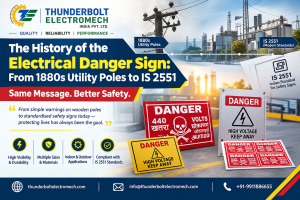
IS 2551 requires every medium- and high-voltage installation to display a permanent danger notice — the familiar skull-and-bones warning sign — sized and worded to the standard, in Hindi, English, and the local language. A hand glove protects the worker’s hands from current at the point of contact; a danger plate protects them earlier, by making the hazard visible before anyone reaches for a panel door. Facilities restocking Raychem, Vidyut, or Crystal gloves often restock IS 2551-compliant Danger Plates in the same order, since both items surface together during almost every safety inspection. For a full breakdown of Danger Plate sizing, wording, and compliance requirements, see our detailed guide, Electrical Danger Plate Standards in India: IS 2551, Design & Compliance Guide.
Electrical Hand Gloves Supplier India: Testing, Retesting & Storage Rules That Keep the Rating Alive
Pre-Use Inspection
Before every single use, a rubber insulating glove should be visually inspected and air-tested — rolled from the cuff to trap air inside, then checked for pinholes, cuts, or swelling by listening and feeling for escaping air. This takes under a minute and catches the most common in-service failures before they matter.
Periodic Electrical Retesting
Gloves in active use should undergo a full dielectric proof-voltage retest at a fixed interval, commonly every six months for gloves that see regular field use, in addition to the pre-use air check. This is a genuinely different test from the visual inspection — it measures whether the rubber’s dielectric strength has degraded below its rated proof voltage, which isn’t always visible to the eye.
Storage That Actually Protects the Rating
Store gloves in a cool, dry space, away from direct sunlight, ozone sources, and sharp objects that could puncture the rubber during storage. Folding a glove sharply at the same crease repeatedly, whether in storage or during removal, creates a localised weak point over time — the same ageing mechanism that affects electrical rubber matting.
When to Retire a Glove Immediately
Any visible mechanical damage — a cut, a puncture, unusual swelling, or a chemical stain from oil or solvent contact — should trigger immediate replacement, regardless of when the glove was last tested. A glove is a consumable safety item, not a durable asset to stretch as far as possible.
Why Buyers Across Delhi NCR Choose Thunderbolt
Thunderbolt Electromech India Pvt. Ltd. is a Delhi-based electrical hand gloves supplier stocking Raychem’s full Class range alongside Vidyut and Crystal’s low-to-medium voltage lines, with documentation available for every class supplied. We’re based in the Chawri Bazar–Chandni Chowk trading belt, which means a buyer can walk in, check a glove’s class marking in person, and leave with stock the same day — no waiting on a courier for an urgent panel-room requirement.
For buyers running multi-site operations across Gurugram, Noida, Faridabad, and Ghaziabad, we supply consistent class documentation from a single relationship, which matters more as project scale grows — a mismatched glove class at even one site becomes an audit finding waiting to happen. Whether you’re searching for an electrical hand gloves supplier near me for a same-day walk-in purchase, comparing electrical hand gloves price across brands before a bulk order, or looking to buy electrical hand gloves online for a project spanning several cities, the same certified stock applies across every order channel.
You can browse our full range across Raychem, Vidyut, and Crystal on our Electrical Hand Gloves category page, including the Crystal 1100 Volt Electrical Hand Gloves commonly specified for standard industrial panel work.
Visit or contact Thunderbolt Electromech India Pvt. Ltd.: 📍 Shop No. 3538, Sitaram Bazar Rd, Bazar Sirkiwalan, Chawri Bazar, Chandni Chowk, Delhi – 110006 📞 +91-9911886655
Frequently Asked Questions
What’s the actual difference between Class 00 and Class 0 electrical gloves?
Class 00 tops out at 500V AC and 750V DC, while Class 0 extends to 1,000V AC and 1,500V DC. Class 00 is the thinner, more flexible option for genuinely low-voltage tasks; Class 0 is the more commonly stocked general-purpose glove for standard 415V–480V three-phase electrical work, since it covers a wider practical voltage band without a major dexterity penalty.
Can I use a Class 1 glove for a Class 0 job?
Mechanically, yes — a higher class always covers the working voltage of every class below it. But it comes with reduced dexterity and a higher price for a protection margin the task doesn’t need. Match the class to the job rather than defaulting upward.
Is “IS 4770 Type 2” the same certification as “Class 0”?
They’re closely aligned in voltage — 1,100V for Type 2 versus 1,000V for Class 0 — but they’re tested under different specifications with different proof-voltage figures. Treat them as similar in intent, not as an automatically interchangeable certificate, especially for export or audit purposes that name one standard specifically.
How often should electrical hand gloves be retested?
The widely referenced practice for gloves in active field use is a full dielectric retest every six months, in addition to a pre-use visual and air-inspection before every single use. Gloves in storage that haven’t been tested within that window shouldn’t be issued for live work until retested.
Do I need a leather protector glove over my rubber insulating glove?
For Class 00 and Class 0 work, a leather protector is often optional depending on the task’s mechanical risk, though it does extend the rubber glove’s service life. For Class 1 and above, most safety programmes treat a leather protector as effectively mandatory, since the rubber glove alone offers no meaningful resistance to cuts or punctures.
Why does my glove’s test voltage look so much higher than the voltage I actually work at?
That gap is the built-in safety margin. A Class 0 glove works at up to 1,000V but gets retested at 5,000V — five times the rated working voltage — specifically to confirm a buffer against surge conditions and fault transients that briefly exceed steady-state voltage on a live system.
What class of glove does a residential or light-commercial electrician actually need in India?
For standard single-phase and three-phase work up to 415V–440V, Class 0 covers the practical voltage range most Indian electricians encounter day to day, with enough safety margin above nominal system voltage to handle typical fault conditions.
Are Raychem, Vidyut, and Crystal gloves interchangeable for the same class?
Within the same certified class, yes — all three brands test against the same voltage and proof-test requirements for that class. The difference between brands comes down to fit, thickness feel, class range stocked, and price, not the underlying safety rating once the class is matched.
What happens if I use an expired or untested glove and it looks fine?
Rubber can lose dielectric strength from age, heat, and ozone exposure without any visible change. A glove that looks intact can still fail a proof-voltage test, which is exactly why the retest schedule exists independently of visual condition — appearance alone isn’t a reliable safety indicator for insulating rubber.
Do electrical hand gloves protect against arc flash as well as electric shock?
No, and this is a distinction worth being precise about. A rubber insulating glove’s class rating is a shock-protection figure — it tells you the voltage it insulates against on contact. Arc flash is a thermal and pressure hazard from a fault event, and protecting against it requires separately rated arc-flash PPE assessed against the specific incident energy of the equipment involved. A correctly classed insulating glove is necessary for shock protection, but it isn’t, by itself, a complete answer to arc-flash risk on higher-energy equipment.
Why do some Indian suppliers list both an IS 4770 Type and an international Class on the same product page?
Because Indian manufacturers frequently test and market to both systems at once, particularly for buyers who might need either domestic or export-facing documentation. This is generally a helpful practice, not a red flag, provided the supplier can produce the actual test certificate for whichever standard your specific project requires — the risk is only in assuming the two labels are automatically the same certification without checking.
Conclusion
Class 00, Class 0, and Class 1 electrical gloves aren’t a ladder where higher is automatically better — they’re three different answers to three different voltage questions, and matching the right one to your actual panel voltage matters more than defaulting to caution. Class 00 and Class 0 cover the vast majority of Indian commercial and light-industrial electrical work up to 1,000V, Class 1 steps up specifically for substation and HT-side switchgear tasks up to 7,500V, and India’s own IS 4770 Type system runs alongside — not identically to — that international Class numbering, which is exactly where documentation gaps quietly start for export orders and multinational audits. Thunderbolt Electromech India Pvt. Ltd. stocks Raychem’s full Class 00-to-4 range alongside Vidyut and Crystal’s low-to-medium voltage lines, with the class documentation to back whichever voltage band your project actually needs — not the class that merely sounds safest on paper. Call +91-9911886655 or visit our Chandni Chowk store to get the right class, correctly documented, before your next panel-room job or safety audit asks the question first.