
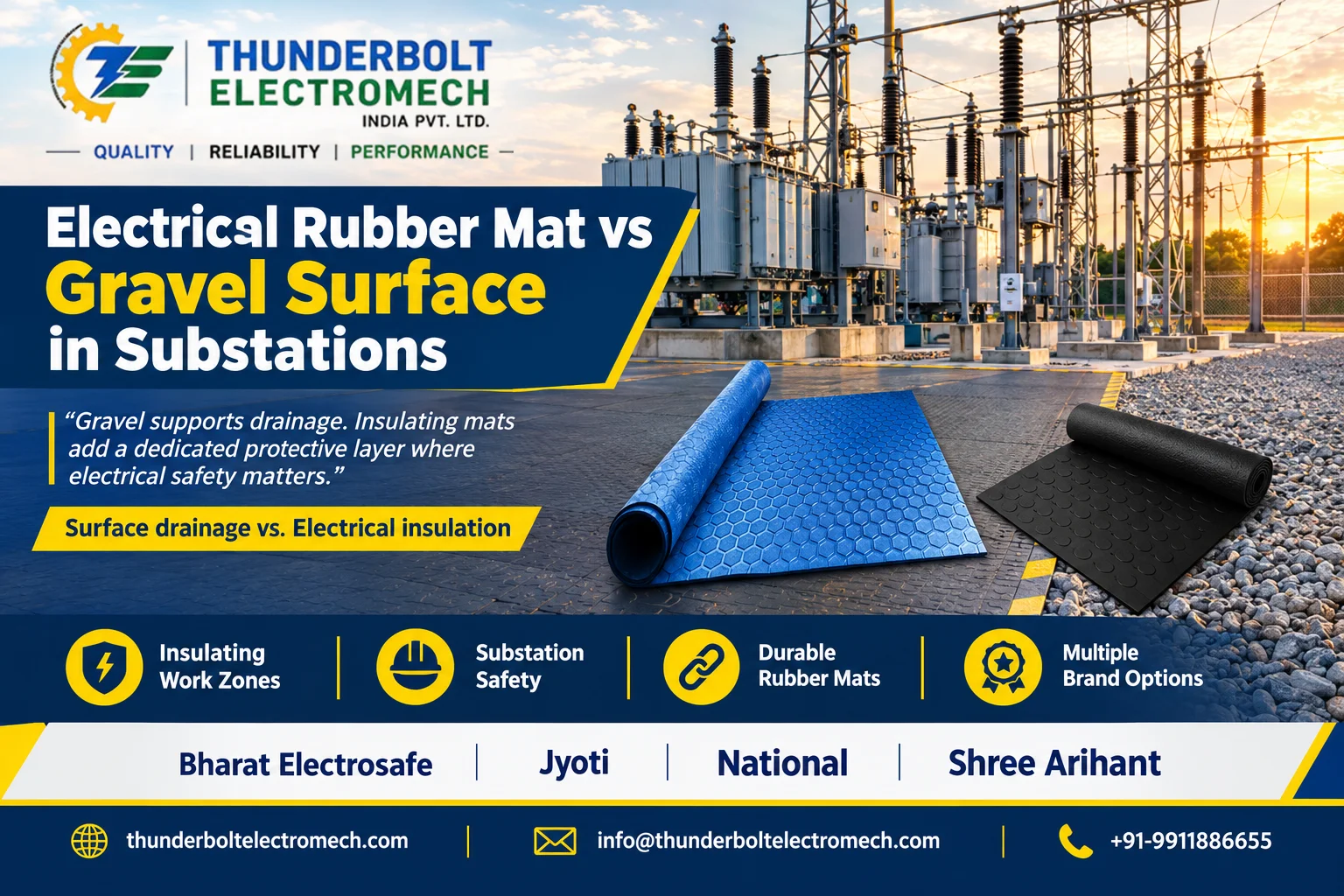
Quick Answer: Gravel and an electrical rubber mat do different jobs. Crushed rock spreads across the yard and raises the tolerable touch and step voltage for anyone walking there. A rubber mat protects one worker at one fixed spot, such as a panel or control cubicle. Neither replaces the other. Most substations need both. Pick the mat by IS 15652 class, and buy it from a substation rubber mat supplier who shows test proof.
Introduction
Ask ten substation engineers whether gravel or a rubber mat keeps people safe, and a few will say “either one.” That answer is wrong, and it costs money when a design review catches it late.
Thunderbolt Electromech India Pvt. Ltd. is an Electrical Rubber Mat Supplier India buyers reach from Chawri Bazar, Delhi. Our team talks to EPC designers and maintenance heads every week. The same confusion comes up again and again. People treat the yard surface and the operator’s mat as one system. They are two layers of protection, and they work on different physics.
This blog separates them. You will see how the IEEE 80 surface layer factor works, what a simulation says about its size, where contamination quietly wrecks a gravel layer, and where a mat fills a gap that gravel cannot. If you are a designer in Delhi NCR or anywhere else in India, the comparison table and the case study will help you write a better specification.
Electrical Rubber Mat Supplier India: Why Gravel and a Mat Do Different Jobs
Start with the hazard. During an earth fault, current flows into the ground through the earthing grid. The soil surface rises in potential. A person standing in the yard can end up with a voltage between their feet (step voltage). Or between a hand on grounded steel and their feet (touch voltage).
Gravel attacks this problem at the foot. A layer of crushed rock sits between the soil and the shoe. It adds resistance in series with the body. Less current flows through the person for the same voltage. That is all it does. It does not stop the voltage from existing.
A rubber mat works at a smaller scale. It sits at one position, usually where a person stands to operate equipment. It insulates the feet from the floor or ground at that point. The person can touch a panel handle without a conductive path from the feet to earth.
Here is the simplest way to hold the two ideas:
- Gravel protects feet across the whole yard. It governs the tolerable touch and step voltage in the design calculation.
- A mat protects a worker at a fixed operating point. It is a local barrier, bought as personal protective equipment.
The scope is the real difference. Gravel covers acres. A mat covers one square metre or a few metres of switchboard front. A mat never protects the person walking to the panel. Gravel never protects the person leaning on a live cubicle indoors, because indoor floors do not carry a crushed rock layer at all.
That last point surprises many designers. Control rooms and GIS halls have concrete floors. The surface layer factor from the yard does not travel inside the building. If you want added foot resistance at an indoor operating position, a mat is the practical answer.
Our own reading of the IEEE 80 method is that mats do not enter the tolerable voltage equations. The standard uses the surface layer factor Cs for a spread layer of rock. It does not credit a portable mat. Please ask your earthing engineer to confirm that reading against your project’s design basis. We are a supplier, not a design authority, and the final call belongs to the person who signs the earthing report.
How IEEE 80 Gives Gravel Its Credit
IEEE 80 does not assume the ground under your feet is uniform. It models two layers: the thin crushed rock on top and the native soil below. The surface layer derating factor, written Cs, captures how much of the rock’s high resistivity actually reaches the foot.
For a person of 70 kg, the tolerable voltages take this form:
- Tolerable touch voltage = (1000 + 1.5 × Cs × ρs) × 0.157 / √t
- Tolerable step voltage = (1000 + 6 × Cs × ρs) × 0.157 / √t
Here ρs is the rock resistivity in ohm-metres, and t is the fault duration in seconds. The 1000 ohm term is the body. The second term is the foot contact resistance, and Cs scales it.
Cs depends on three things: the thickness of the layer, the rock resistivity, and the resistivity of the soil underneath. The 2000 edition of the standard writes it as:
Cs = 1 − 0.09 × (1 − ρ/ρs) / (2hs + 0.09)
where ρ is the soil resistivity and hs is the layer thickness in metres. When there is no surface layer, ρs equals ρ and Cs equals 1. The layer then adds nothing.
A worked example
Take a yard with soil at 100 ohm-metres. Spread 100 mm of crushed rock at 3000 ohm-metres. Use a 0.5 second fault.
- Cs works out to about 0.70.
- Tolerable touch voltage rises from roughly 255 V (bare soil) to roughly 920 V.
- Tolerable step voltage rises from roughly 355 V to roughly 3000 V.
The same grid now passes a design check that it would have failed on bare soil. Gravel did not lower the fault voltage by a single volt. It raised the line that the fault voltage must stay under.
One published earthing simulation shows the same effect in sharper form. With a 0.5 second fault and no surface layer, the tolerable touch voltage came out near 144 V. With 100 mm of crushed rock, it rose to about 818 V. The exact figures depend on body model, soil and standard, so treat them as a pattern rather than a number to copy. The pattern is clear: the surface layer can multiply the tolerable value several times over.
Our worked example above uses the 70 kg formulas and a different soil, so its numbers will not match the simulation. Both land on the same conclusion.
The five-times rule
There is a second point engineers sometimes miss. The layer only matters when it is much more resistive than the soil beneath it. A practical guide is that the rock should be at least five times more resistive than the topsoil. If your site soil is already a dry, stony 2000 ohm-metres, a thin layer of 3000 ohm-metre rock adds little. The reflection between the two layers is weak, and Cs stays close to 1.
This is why gravel earns its keep on clay, black cotton soil and river-plain sites. It earns far less on rocky ground. Check the soil survey before you count on the credit.
What an Electrical Rubber Mat Supplier India Should Tell You About Touch and Step Voltage
Touch and step voltage protection is a design target. A mat is a product. A good supplier keeps the two apart and tells you where the product stops.
Here is what a mat does well:
- It raises foot-to-earth resistance at a fixed standing position.
- It adds a dielectric barrier rated by class (A, B or C under IS 15652).
- It works indoors, where gravel cannot go.
- It moves with the equipment. You can place it at a new panel the day you commission it.
Here is what a mat does not do:
- It does not cover the yard. A person steps off it and loses the protection.
- It does not lower ground potential rise.
- It does not replace the earthing grid or the surface layer in the design calculation.
- It does not protect against hand-to-hand contact between two different live parts.
An insight that saves rework: the operating handle
Consider an outdoor isolator with a manual operating handle. The handle is bonded to the earthing grid. When a fault happens elsewhere in the yard, the grid potential rises, and so does the handle. The operator’s feet sit on gravel at a lower potential. The voltage between hand and feet is the touch voltage.
Gravel helps here. It raises the tolerable limit. But many utilities go a step further and place a bonded metal platform at the handle, so the hand and the feet rise together. In that arrangement an insulating mat is not the main tool. The metal platform equalises potential, and gravel handles the rest of the yard.
An insulating mat suits a different case: operating live or potentially live equipment at a panel, where the worker could become the path between a live part and earth. That is the classic switchgear front. Mixing up these two situations leads to mats laid where a bonded platform should go, and the reverse.
If you are unsure which applies to a given position, ask the earthing designer. We will help you pick the right class once the use is clear.
Why the national searches matter
Buyers who search “substation rubber mat” or “touch and step voltage protection” usually do not know the product yet. They have a design question. Our job is to answer it honestly. Sometimes the honest answer is “you need gravel and a bonded platform here, and a mat only at the panel.” That kind of answer builds trust. It also brings buyers back when the panel mats are due.
Electrical Rubber Mat vs Gravel Surface: Comparison Table
| Factor | Crushed rock / gravel layer | Electrical rubber mat |
| What it protects | Anyone walking in the yard | One worker at a fixed spot |
| Where it works | Outdoor switchyard only | Indoors and outdoors |
| Role in IEEE 80 | Included through the Cs factor | Not part of the tolerable voltage equations (confirm with your earthing engineer) |
| Typical thickness | 75 to 150 mm of spread rock | 2.0, 2.5 or 3.0 mm rubber (IS 15652 classes A, B, C) |
| Main benefit | Raises tolerable touch and step voltage | Adds dielectric insulation under the operator’s feet |
| Main weakness | Loses value when fouled by soil, dust or weeds | Wears at edges, cuts and chemical exposure |
| Maintenance | Inspect, rake, top up, wash or replace fines | Visual check, periodic dielectric test, replace when damaged |
| Cost pattern | Large one-time civil cost, low repair cost | Low unit cost, replaced on a cycle |
| Works for mobile equipment | No | Yes |
| Best use | Whole-yard step and touch control | Panel fronts, control cubicles, switchgear aisles |
Read the table as two columns of a single plan. They are not competing options.
How Contamination Quietly Cuts a Gravel Layer’s Value
Gravel does not fail loudly. It fails slowly, and nobody sees it until a test or an incident.
The layer works because rock stones sit apart and trap air. That air gap is what gives high resistivity. When soil, dust, bird droppings or vegetation fill those gaps, the layer starts to conduct through the fines. Resistivity falls. Cs moves back toward 1. The tolerable voltages in your design report stop describing the real yard.
Three site conditions speed this up:
- Dusty yards. In Delhi NCR and across the Indo-Gangetic plain, fine dust settles and works down into the stones every dry season.
- Monsoon. Wet rock has lower resistivity than dry rock. Published design examples often use a wet value near 2500 ohm-metres for exactly this reason.
- Construction traffic. Vehicles crush stones into fines and push soil upward from below.
A design that assumed 3000 ohm-metres on day one may deliver half that after a few years. The yard still looks fine. The numbers behind the safety claim have moved.
What does this mean for the rubber mat? It makes the mat more valuable, not less. At a panel front, the mat’s insulation is fixed by its class and thickness. Dust on gravel cannot degrade it the same way. You still need to keep it clean and inspect it, but its protective value is easier to verify. You can test a mat. Testing a gravel layer’s resistivity in service takes field measurement and expertise.
Customer Problems and Solutions
These are the situations we hear most often from EPC firms, plant maintenance heads and utility contractors.
Problem 1: “Our design report credits gravel, so we skipped panel mats.”
Gravel does not exist inside the control room. The operator at an indoor HT panel stands on concrete.
Solution: Add a class-matched rubber mat at every indoor operating position. Pair it with a bonded floor or earth strip as your designer specifies.
Problem 2: “The gravel was laid five years ago. Is it still doing its job?”
Possibly not. Fines, weeds and compaction all cut resistivity.
Solution: Ask for a resistivity check on a sample of the layer. Rake, wash or replace the contaminated top section. Document the result.
Problem 3: “We bought a mat, but it has no test report.”
This happens when buyers go by price alone.
Solution: Ask for the IS 15652 marking, the class and thickness, and a dielectric test report. Do not accept a thin plain rubber sheet sold as an insulating mat.
Problem 4: “The mat slides and curls at the edges.”
Loose mats become tripping hazards and expose gaps.
Solution: Choose anti-slip patterns and lay the mat flat on a clean floor. Replace mats whose corners no longer lie flat.
Problem 5: “We have 11 kV and 33 kV panels in one room.”
One mat class will not suit both.
Solution: Match the class to the highest working voltage at each position. Class B covers working voltage up to 11 kV. Class C covers up to 33 kV.
Problem 6: “We need mats in a hurry for a shutdown.”
Delays during a shutdown cost days.
Solution: Order from a stocked source with Delhi NCR delivery. We hold common sizes and can cut to length.
Real Use Cases
Use case 1: Indoor 11 kV switchgear room.
The operator pulls and pushes a breaker trolley several times a shift. The floor is polished concrete. A Class B mat runs the full length of the panel front, wide enough for the operator and the trolley path. Gravel plays no part here.
Use case 2: Outdoor 33 kV switchyard.
Gravel covers the entire yard and carries the step and touch voltage credit. At the control cubicle, a class C mat sits on the stone to give the technician a stable, insulated standing spot while opening the cubicle door.
Use case 3: Captive power plant HT room.
The plant maintenance head wants a single procedure for all panels. A Class B mat is fixed in front of every HT panel. The shift sheet records a visual check at each handover.
Use case 4: Solar plant inverter station.
The outdoor yard has gravel. The inverter skid sits on a concrete plinth. A mat on the plinth covers the technician during live checks. The gravel handles the walk from the gate to the skid.
Use case 5: Industrial LT panel room.
Class A mats suit up to 3.3 kV working voltage. They cover the LT and 415 V switchboards where most daily maintenance happens.
Case Study: Gravel Alone Left a Panel Gap at a Distribution Substation
This is an illustrative composite based on typical project reviews. We have removed names and adjusted figures. Use it as a pattern, not as a record of one client.
The site. A 33/11 kV distribution substation on clay soil, about 90 ohm-metres. The EPC designer laid 100 mm of crushed rock at 3000 ohm-metres across the yard. The earthing report passed the touch and step check with margin.
The review. During commissioning, the maintenance head asked a simple question: “Where do my operators stand when they open the 11 kV panel in the control room?” The answer was concrete. The report’s Cs credit did not apply inside the building.
The gap. The control room had eight HT panels. None had an insulating mat. Operators had used plain rubber sheets from a local store, with no class marking and no test report.
The fix.
- The team kept the gravel design unchanged. It was correct for the yard.
- They specified Class B electrical rubber mats, 2.5 mm thick, in front of all eight panels.
- They added a Class C mat at the outdoor 33 kV marshalling kiosk, where the operator stood on stone to open the door.
- They wrote a quarterly inspection step into the maintenance plan: look for cuts, curled edges, oil contamination and loss of surface texture.
- They set a yearly dielectric test for the mats and a resistivity spot check for the gravel.
The result. The site closed the gap before energisation. The audit file now shows two separate protections with two separate owners: civil and earthing for the gravel, operations for the mats. The mix of fixes cost a small fraction of the yard civil work.
The lesson. Design reports describe the yard. Operators work at the panel. Review both.
Choosing an Electrical Rubber Mat Supplier India Buyers Can Trust
You can buy a rubber mat anywhere. Buying the right one takes more care. These are the points we suggest you check, whether you buy from us or from anyone else.
1. IS 15652 class and thickness
The standard classifies mats by working voltage. A common summary is:
| Class | Thickness | Working voltage | AC proof voltage |
| A | 2.0 mm | Up to 3.3 kV | 10 kV |
| B | 2.5 mm | Up to 11 kV | 22 kV |
| C | 3.0 mm | Up to 33 kV | 36 kV |
Confirm the figures against the current edition of the standard before you write them into a tender. BIS certification is mandatory for insulating mats for electrical purposes, so look for the ISI mark and licence number on the mat.
For the full class and thickness breakdown, read our pillar guide: Electrical Rubber Mat Supplier: The Complete Guide to IS 15652 Classes, Thickness and Buying in India 2026.
2. Test reports
Ask for a dielectric or proof voltage test report from a recognised lab. A mat without paperwork is a rubber sheet with a blue colour.
3. Surface and construction
Look for a ribbed or textured top for grip and a flat underside that lies without curling. Check for colour strips and voltage marking. Reject mats with fabric inserts or visible air bubbles.
4. Brand range
Different brands suit different budgets and site rules. Thunderbolt supplies the complete range of Bharat electrical rubber mat, along with Jyoti, National, Vardhman and Shree Arihant electrical rubber mats. You can see sizes, classes and availability on our electrical rubber mat category page.
5. Size and layout
Measure the actual standing area. The mat should extend past the operator’s reach and cover the trolley path or door swing. Overlap and gaps are weak points. Where you need more than one mat, butt the edges tight or order a single long piece.
6. Delivery and support
Shutdowns do not wait. A supplier close to the buyer cuts the delay. For sites in Delhi NCR, a rubber mat dealer in Delhi NCR can often deliver within a day or two. For sites across India, ask for a dispatch time and a transit plan before you confirm the order.
Gravel and Mat Together: A Simple Design Checklist
Use this list in your next design review. It takes five minutes.
For the yard (gravel):
- Is the soil resistivity measured and documented?
- Is the rock resistivity at least five times the topsoil?
- Is the layer thick enough for the Cs value used in the report?
- Does the plan include inspection, raking and replacement of fouled stone?
- Does the design use a wet-rock value, not only a dry one?
For the panel front (mat):
- Is there a mat at every indoor operating position?
- Does the class match the highest working voltage at that position?
- Does the mat carry the ISI mark and a test report?
- Is it wide and long enough for the operator and the trolley path?
- Is there a written visual check and a yearly test?
For the handoff:
- Does your earthing engineer agree on how mats are treated in the calculation?
- Does the maintenance team know the mat is not a substitute for the grid?
If any answer is “no” or “unsure,” close that gap first.
Electrical Rubber Mat Supplier India: Thunderbolt Electromech Trust and Contact Details
Thunderbolt Electromech India Pvt. Ltd. is a Delhi-based supplier of electrical safety equipment. We serve substation contractors, EPC firms, plant maintenance teams and utilities. If you search for an electrical rubber mat supplier Delhi buyers can visit in person, or a substation safety equipment Delhi NCR team that delivers on time, you can find us in Chawri Bazar.
What you get when you buy from us:
- A full range of IS 15652-class mats from five brands
- Clear guidance on which class suits which voltage
- Test reports and ISI marking details on request
- Delhi NCR delivery and dispatch across India
- Honest advice, including when a mat is not the right answer
Registered office: Shop No. 3538, Sitaram Bazar Rd, Bazar Sirkiwalan, Chawri Bazar, Chandni Chowk, Delhi, 110006
Phone: +91-9911886655
Email: info@thunderboltelectromech.com
Call or write with your panel list, voltage and quantities. We will suggest the class and size, and we will tell you if something in your plan needs a second look from your earthing engineer.
Conclusion: Use Gravel for the Yard, Use a Mat at the Panel
Here is the whole argument in a few lines.
Gravel and an electrical rubber mat are not rivals. Gravel protects feet across the yard. In the IEEE 80 method, it enters through the surface layer factor Cs and lifts the tolerable touch and step voltage. One published simulation showed the tolerable touch voltage rising from about 144 V to about 818 V with 100 mm of crushed rock. That is a large gain, and it only holds while the layer stays clean and at least five times more resistive than the soil.
Contamination eats that gain. Dust, soil, weeds and monsoon water pull the resistivity down. The report on your desk may describe a yard that no longer exists.
A rubber mat solves a different problem. It protects one worker at one operating point, indoors or out. In our reading, mats sit outside the IEEE 80 calculation, so ask your earthing engineer to confirm that for your project. A mat cannot fix a weak grid. It can close the gap where a person stands at a panel with no gravel under their feet.
Most sites need both. Design the yard with a verified surface layer. Place class-matched mats at every operating position. Write inspection steps for each.
Why choose Thunderbolt Electromech India Pvt. Ltd. as your Electrical Rubber Mat Supplier India?
- We sell the complete range of Bharat, Jyoti, National, Vardhman and Shree Arihant electrical rubber mats.
- We explain classes, thickness and use in plain language, and we tell you when you need something else.
- We supply from Delhi, deliver across Delhi NCR quickly, and dispatch across India.
- We stand behind the product with markings, reports and a phone number that gets answered.
Start with our pillar guide to IS 15652 classes, thickness and buying in India. Then browse the full electrical rubber mat range and send us your requirement.
Call +91-9911886655 or email info@thunderboltelectromech.com.