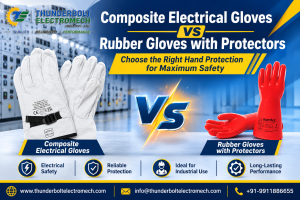
Quick Answer: Rubber insulating gloves protect against shock. Leather protectors worn over them add cut, puncture and arc protection, but give no shock protection. An arc rating says nothing about voltage, and a voltage class says nothing about arc energy. You need both layers, and the protector must fit the glove. Buy from an electrical hand gloves supplier India trusts, and ask for arc flash gloves India sites can verify by test report.
Introduction
A safety officer once told us, “Our gloves are arc-rated, so we are covered.” We asked which gloves. He pointed to a pair of leather protectors with a 25 cal/cm² label. The rubber gloves underneath had expired test dates.
That mix-up is common. It is also dangerous.
Thunderbolt Electromech India Pvt. Ltd. is an Electrical Hand Gloves Supplier in Chawri Bazar. If you search for an electrical hand gloves supplier Delhi buyers can call, you will find us. We supply Raychem, Vidyut and crystal electrical hand gloves to plants, utilities and contractors across India. This blog explains what each layer does, what an arc rating means, and where buyers go wrong. It also covers every glove class, a comparison table, a case study and a buying checklist.
Electrical Hand Gloves Supplier Guide: What Each Layer Actually Does
Two layers work together. They solve different problems.
The rubber insulating glove is the shock barrier. It sits on your skin. It is made of natural or synthetic rubber, tested in a water bath at a set AC or DC proof voltage. If your hand touches a live part, the rubber blocks current from passing through the body.
The leather protector goes over the rubber glove. Its job is mechanical. It stops cuts, punctures, abrasion and burns on the rubber. Some leather protectors also carry an arc rating.
Think of it like this. Rubber stops current. Leather stops damage to the rubber.
That is the full division of work. Everything else in this blog comes from that split.
Why the split matters
Rubber insulating gloves are thin by design. A Class 0 glove is about 1 mm thick. A sharp edge, a hot spark or a small crush can open a defect. A defect you cannot see can still pass current.
Leather protects against that. It does not insulate. Leather is a conductor when wet or contaminated with sweat and dust. So a leather protector alone gives no shock protection at all.
Now flip it around. Rubber gloves alone give shock protection, but they have little arc resistance. Rubber can melt and stick to skin in an arc flash. We will cover that below.
Arc Rating Facts: What the Numbers Mean and What They Do Not
An arc rating is a measure of thermal energy. It is reported in cal/cm². It tells you how much heat energy a material can take before a person behind it would likely get a second-degree burn.
It does not tell you anything about voltage.
This is the point many buyers miss. Read it twice. A label saying “25 cal/cm²” says nothing about whether the product stops shock. A label saying “Class 2, 17,000 V” says nothing about whether it survives an arc.
What the research shows
We reviewed manufacturer data, forum discussions among practising safety engineers and standards guidance. Four findings stand out.
- One maker of arc-rated leather protectors lists 25 and 36 cal/cm² ratings. Their data sheet uses ASTM F2675, the test method for glove arc ratings. The same sheet carries a clear warning: the protector does not protect against shock or voltage.
- No standard rates a rubber or leather glove by incident energy in the way a flame-resistant shirt is rated. A practitioner discussion thread makes this point. The arc rating on a protector comes from the maker’s own testing under the test method, not from a general rule about leather.
- NFPA 70E requires leather protectors over rubber insulating gloves in most cases. The standard treats them as a system. The rubber handles shock. The protector handles the rest.
- A commenter in the same discussion adds the key warning: an arc rating says nothing about voltage rating. We agree.
Treat the first finding as one maker’s published data, not a universal figure. Two makers can test two leathers and get two ratings.
What an arc flash does to rubber
An arc flash is a burst of heat, light and pressure. Temperatures at the arc can exceed those at the surface of the sun. Gloves a few inches away take radiant heat, hot droplets of molten metal and a pressure wave.
Rubber is organic. Heat softens it, then deforms it. In the worst case the rubber melts into the skin. Leather chars before it melts. That char layer slows the heat. A leather protector with an arc rating is made to resist that heat for the rated exposure.
In our assessment, this is the strongest reason to treat protectors as part of arc protection, even when the shock risk looks like the main story. Ask your safety engineer to confirm the exposure level for each task. We supply the gloves. The arc flash study belongs to your engineer.
One more catch: the arc rating is for the protector, not the pair
The rating on a leather protector describes that protector. It does not describe a rubber glove under it. If the rubber layer is a different thickness, or if the fit leaves gaps, the real result changes. When a buyer asks us, “What is the arc rating of our rubber gloves?” we tell them what we know: a rubber glove does not carry a standard incident energy rating. The protector over it does.
Electrical Hand Gloves Supplier India: Every Glove Class Explained
Rubber insulating gloves follow ASTM D120 and IEC 60903. In India, you will also see IS 4770 references. Class sets maximum use voltage. Here is the summary used across ASTM and IEC practice.
| Class | Maximum AC use voltage | AC proof test voltage | Maximum thickness | Typical use |
| 00 | 500 V | 2,500 V | 0.50 mm | Low voltage panels, control circuits, instrument work |
| 0 | 1,000 V | 5,000 V | 1.02 mm | LT switchboards, motor control centres, 415 V work |
| 1 | 7,500 V | 10,000 V | 1.52 mm | 3.3 kV and 6.6 kV systems |
| 2 | 17,000 V | 20,000 V | 2.03 mm | 11 kV and 15 kV distribution |
| 3 | 26,500 V | 30,000 V | 2.54 mm | 22 kV and 25 kV systems |
| 4 | 36,000 V | 40,000 V | 3.18 mm | 33 kV systems |
Check the current edition of each standard before you write class values into a tender. Values are given as AC working voltage. DC ratings are higher.
Class 00 and Class 0
These are the thin gloves. They give the best feel and the least tiring grip. Most plant electricians use them. Class 00 works where voltage stays below 500 V. Class 0 covers up to 1,000 V, so it suits 415 V and 690 V panels with some margin.
Thickness is the trade. Thin gloves puncture more easily. A leather protector matters more here, not less.
Class 1
Class 1 handles up to 7,500 V AC. Use it on 3.3 kV and 6.6 kV systems. You will meet it in older industrial plants, mines and some captive power rooms.
Class 2
Class 2 is the common utility glove for 11 kV work in India. It handles up to 17,000 V AC. It is thicker and stiffer. You will notice it when you grip small tools.
Class 3 and Class 4
Class 3 reaches 26,500 V. Class 4 reaches 36,000 V and suits 33 kV systems. Both are heavy. Both need good care and regular testing. Most buyers choose them for live-line work and substation teams.
A note on the 1100 V crystal glove
Thunderbolt supplies a 1100 V crystal electrical hand glove that suits low-voltage work. Treat it as a Class 0-style, low-voltage solution. Confirm the marking and test details with us before you use it on any system.
Length rules matter more than most buyers think
ASTM D120 offers glove lengths of 280, 360, 410 and 460 mm for Class 00 and 0. Classes 1 to 4 start at 360 mm. A longer glove gives more cuff overlap on a sleeve.
Here is the part buyers miss. A supplier source states that Class 00 and Class 0 gloves must be at least half an inch longer than the leather protector. The reason is plain. If the protector reaches the cuff edge of the rubber, there is no exposed rubber margin to roll or inspect. If the rubber is shorter than the protector, the protector’s cuff can rub the glove’s edge and cause cuts.
So the rule is simple. Size the protector to the glove. Never pick the protector first and force a glove to fit it.
Comparison Table: Insulating Gloves vs Leather Protectors
| Feature | Rubber insulating gloves | Leather protectors | Arc-rated leather protectors |
| Shock protection | Yes, by voltage class | None | None |
| Arc protection | Limited. Rubber can melt | Some heat resistance, not rated | Rated by maker under ASTM F2675 (for example, 25 or 36 cal/cm² on one maker’s data sheet) |
| Cut and puncture protection | Low | Good | Good |
| Voltage rating | Class 00 to 4 | None | None |
| Worn alone | For limited low-risk tasks only where rules allow | Never for electrical work | Never for electrical work |
| Worn over rubber | No | Yes | Yes |
| Testing required | Periodic dielectric test | Visual and wear check | Visual check plus maker’s data |
| Replacement trigger | Failed test or visible damage | Cuts, burns, stiffness, contamination | Same, plus loss of rated material |
| Typical failure | Pinhole, cut, ozone cracking | Wear and wet contamination | Mismatch between rating and task |
The most important row is shock protection. Leather says “none.” Read it as written.
Electrical Hand Gloves Supplier Delhi: Customer Problems and Solutions
These come from real conversations with plant managers, EPC safety officers and contractors.
Problem 1: “Our leather gloves say arc-rated, so we use them for panel work.” Leather gives no shock protection. Solution: Use a rubber insulating glove of the correct class underneath. Wear the protector over it. Never use the protector alone on live work.
Problem 2: “Our rubber gloves are Class 2. That should handle arc flash too.” Voltage class and arc protection are separate. Solution: Add an arc-rated protector and confirm the cal/cm² against the arc flash study for the task.
Problem 3: “The protector is too tight and the glove bunches up.” Poor fit hurts grip and makes workers remove the protector. Solution: Pick the protector for the glove, not the other way. Test the pair before issuing it.
Problem 4: “A Class 00 glove has no cuff margin beyond the protector.” This leaves the rubber cuff exposed to wear against the leather edge. Solution: Use a glove at least half an inch longer than the protector. Check this before purchase.
Problem 5: “We don’t know when our gloves were last tested.” Dielectric test dates fade from memory. Solution: Mark the date of the last test on the glove bag or tag. Keep a register. Retest on the schedule your standard sets.
Problem 6: “We need gloves quickly for a shutdown.” Delays cost money. Solution: Order from a supplier who keeps Raychem, Vidyut and crystal gloves in stock. We deliver across Delhi NCR and dispatch across India.
Problem 7: “Our team leaves gloves in toolboxes.” Heat, sunlight and sharp tools shorten the life of rubber. Solution: Store gloves in a glove bag, flat or hanging, away from sunlight and ozone sources such as electric motors.
Real Use Cases
Use case 1: LT panel maintenance in a manufacturing plant.
The electrician works inside a 415 V MCC. Class 0 gloves go on first. Protectors go over them. The protector shields the rubber from sharp lugs and cable ends. The arc rating on the protector adds a layer of thermal margin.
Use case 2: 11 kV substation switching.
The operator wears Class 2 gloves, with protectors sized to the glove length. Before each shift, the team does a visual check and an air test.
Use case 3: Solar plant inverter room.
DC strings can hold high voltage in daylight. A technician wears gloves rated for the system voltage, with protectors for the sharp frame edges.
Use case 4: Commissioning in a captive power plant.
Cables and busbars are energised for the first time. The team wears the full glove system. The protector carries an arc rating chosen against the incident energy figure in the arc flash study.
Use case 5: Cable jointing near live feeders.
The jointer wears Class 00 or Class 0 for dexterity. Leather protectors go over the rubber during the work and come off for tasks that need finer feel only when safe work rules allow it.
Case Study: A Pair That Passed Every Test and Still Failed in Use
This is an illustrative composite based on patterns we see in plant audits. We have changed names and figures. Treat it as a pattern, not as a record of a single client.
The site. A mid-sized industrial plant with an 11 kV incoming panel, two transformers and a bank of LT boards. The safety officer ran a quarterly audit.
What the audit found.
- Rubber gloves: Class 0 for LT work, Class 2 for the HT room. Test tags were four months old. Good.
- Leather protectors: marked “arc rated 25 cal/cm².” Looked fine.
- The HT room operator wore Class 2 gloves with the same protectors used for LT work.
The problem. The protectors were sized for Class 0 gloves. Class 2 gloves are thicker and stiffer. The operator could not seat the gloves fully. He rolled the protector cuff back to get a grip. That left the rubber cuff exposed at the wrist. A second finding was worse: the protector on the Class 0 pair was shorter than the rubber cuff by less than the required margin, so the leather edge pressed on the rubber cuff every time the wearer flexed the wrist.
Why it mattered. Both gloves had valid test tags. Both protectors carried a label. The system still had a gap at the cuff, which is where arc heat and sparks reach the skin first.
The fix.
- They bought protectors sized for each class, with a documented cuff margin.
- They tagged each protector and glove as a matched pair.
- They trained operators to inspect the cuff area before each use.
- They rewrote the glove register so it lists voltage class and protector size together.
- They added a rule: no protector gets issued without the matching glove present.
The result. The next audit found no cuff exposure. The plant also stopped treating the label on the protector as a sign of shock protection. Training now starts with one line: “Leather is for arc, cuts and wear. Rubber is for shock.”
The lesson. A glove system fails at its weakest interface. Test the pair, not the parts.
Electrical Hand Gloves Supplier India: How to Buy the Right System
You can buy gloves anywhere. Buying the right system takes a few checks.
1. Match voltage class to the system
Start with your highest working voltage. Pick the class that exceeds it. Do not buy a higher class “just in case” without checking dexterity. A heavier glove makes small tasks harder. Workers then take it off.
For a full buying walk-through, read our Electrical Hand Gloves Supplier in India: complete buying and safety guide.
2. Check the standard marking
Look for the class, the manufacturer’s name, the date of manufacture and the standard on the glove. A glove with no clear marking is not a safe purchase.
3. Ask for test reports
Ask for batch test reports. A reliable electrical hand gloves supplier shares them. You can also see our full range on our electrical hand gloves category page.
4. Pick the protector for the glove
Follow three steps.
- Choose the glove class first.
- Pick the protector size that fits that glove and leaves the rubber cuff at least half an inch beyond the leather.
- Ask the supplier for the arc rating test method on the protector. If the label says “arc rated” and cites nothing else, ask what test it used.
5. Plan for care and testing
Rubber ages. Heat, sunlight, ozone, oil and chemicals all shorten its life. Build a plan with three parts:
- Visual check and air test before each use.
- Periodic dielectric test at a recognised lab.
- Clear retirement rules.
6. Think about the whole kit
Gloves do not work alone. A site that cares about glove care usually cares about signage too. As a danger plate supplier Delhi buyers trust, Thunderbolt also supplies danger plates and warning signs that mark live equipment. A glove protects the hand. A danger plate keeps the wrong person from needing the glove.
Engineering Notes: Where the Two Layers Interact
Most guides describe rubber and leather as separate products. In the field, they behave as one stack. Four interactions deserve a closer look. These are our own reasoning from how the materials behave. Test them against your site conditions and your safety engineer’s advice.
1. A tight protector squeezes the rubber
A protector that is one size too small presses on the rubber across the knuckles and fingers. Rubber under constant squeeze stretches and thins at the stress points. Thin spots are where pinholes start. So an undersized protector can shorten glove life, even though it looks like extra protection.
2. A loose protector lets the rubber slide
The opposite problem shows up too. A loose protector lets the rubber glove twist inside it. The worker feels the glove slip and tightens the grip. More grip force means more load on the rubber at the fingertip seam. Fit decides both comfort and glove life.
3. Sweat builds up under the stack
Two layers trap heat and moisture. Sweat softens leather and makes it conduct more. It also makes donning harder, so workers pull on the glove with force and stress the cuff. Cotton liners can help in hot rooms. Check the liner material with your glove maker, because some fabrics can reduce arc performance. Ask for written guidance.
4. The cuff is the weak line for both hazards
Shock current looks for the shortest path past the glove edge. Arc heat and sparks look for the gap between the glove and the sleeve. Both hazards meet at the wrist. This is why length, cuff overlap and sleeve fit matter as much as the class rating. Tuck the sleeve cuff so it does not ride up. Check that the glove cuff covers the sleeve and the protector does not pull it down.
What this means for a buyer
When you compare two protectors, do not compare only the cal/cm² number. Ask four more questions:
- Which glove sizes and classes was this protector designed for?
- Which test method produced the rating?
- What is the recommended rubber cuff margin?
- What care rules apply to the leather?
A supplier who cannot answer these is selling a label, not a system.
A word on arc rating and task risk
Arc ratings only make sense next to an incident energy figure. An arc flash study gives that figure for each piece of equipment. If a task has an incident energy below the protector’s rating, the protector may suit it. If the figure is higher, the protector alone does not. That decision belongs to the engineer who signs the study. We help you buy what the study calls for. We do not replace the study.
Glove Care Notes That Most Blogs Skip
These points come from field practice and from standard guidance such as ASTM F496. Confirm the details against the current edition.
Inflate and inspect. Roll the cuff and trap air to look for leaks and cracks. Our separate guide covers this check in detail.
Keep protectors dry. Wet leather conducts better than dry leather. Dry protectors in shade. Do not leave them on a heater.
Do not mark gloves with pens. Some inks and solvents damage rubber. Use the manufacturer’s recommended marking method or a tag.
Do not store protectors folded inside the glove. Folds crease the rubber over time.
Retire what looks wrong. A stiff, glazed or charred protector has lost its protection. Replace it. Do not wait for the next audit.
Keep a register. Write the date, the class, the size and the last test for each pair. A register turns guesswork into proof.
Electrical Hand Gloves Supplier Trust and Contact Details
Thunderbolt Electromech India Pvt. Ltd. is a Delhi-based supplier of electrical safety equipment. If you need an electrical gloves dealer Delhi NCR plants rely on, or leather protector gloves Delhi buyers can pick up the same day, our team is in Chawri Bazar.
Here is what you get:
- Raychem, Vidyut and crystal electrical hand gloves
- Guidance on class, length and protector fit
- Batch test details on request
- Delhi NCR delivery and dispatch across India
- Danger plates and signage for the same site order
- Straight advice, including when a product is not the right answer
Registered office: Shop No. 3538, Sitaram Bazar Rd, Bazar Sirkiwalan, Chawri Bazar, Chandni Chowk, Delhi, 110006
Phone: +91-9911886655
Email: info@thunderboltelectromech.com
Send us your voltage, glove class and quantity. We will help you match glove and protector. We will also tell you if your task needs a second opinion from your arc flash or electrical safety engineer.
Conclusion: Rubber Stops Shock, Leather Adds Arc and Cut Protection
Here is the full argument.
Rubber insulating gloves stop shock. They are rated by class, from 00 at 500 V to 4 at 36,000 V, and tested at a proof voltage. Leather protectors give none of that. Leather brings cut, puncture and abrasion protection. Some protectors carry an arc rating, tested under ASTM F2675, with ratings such as 25 and 36 cal/cm² on one maker’s data sheet. That data sheet also warns that the protector does not protect against shock or voltage.
An arc rating says nothing about voltage. A voltage class says nothing about arc energy. Mixing them up is the mistake we see most.
NFPA 70E treats the two layers as a system. The rubber glove works as the shock barrier. The protector shields the rubber and adds thermal margin. Fit decides whether the system works. A Class 00 or 0 glove should sit at least half an inch longer than the protector, so the rubber cuff stays visible and free of rubbing.
Buy by class. Match the protector to the glove. Test the pair. Keep a register.
Why choose Thunderbolt Electromech India Pvt. Ltd. as your Electrical Hand Gloves Supplier?
- We supply Raychem, Vidyut and crystal electrical hand gloves.
- We explain classes, lengths and protector fit in plain language.
- We serve Delhi NCR quickly and dispatch across India.
- We supply danger plates and safety signs for the same site.
- We answer the phone and give honest advice.
Start with our complete buying and safety guide. Then browse the electrical hand gloves range and see the 1100 V crystal gloves.
Call +91-9911886655 or email info@thunderboltelectromech.com.