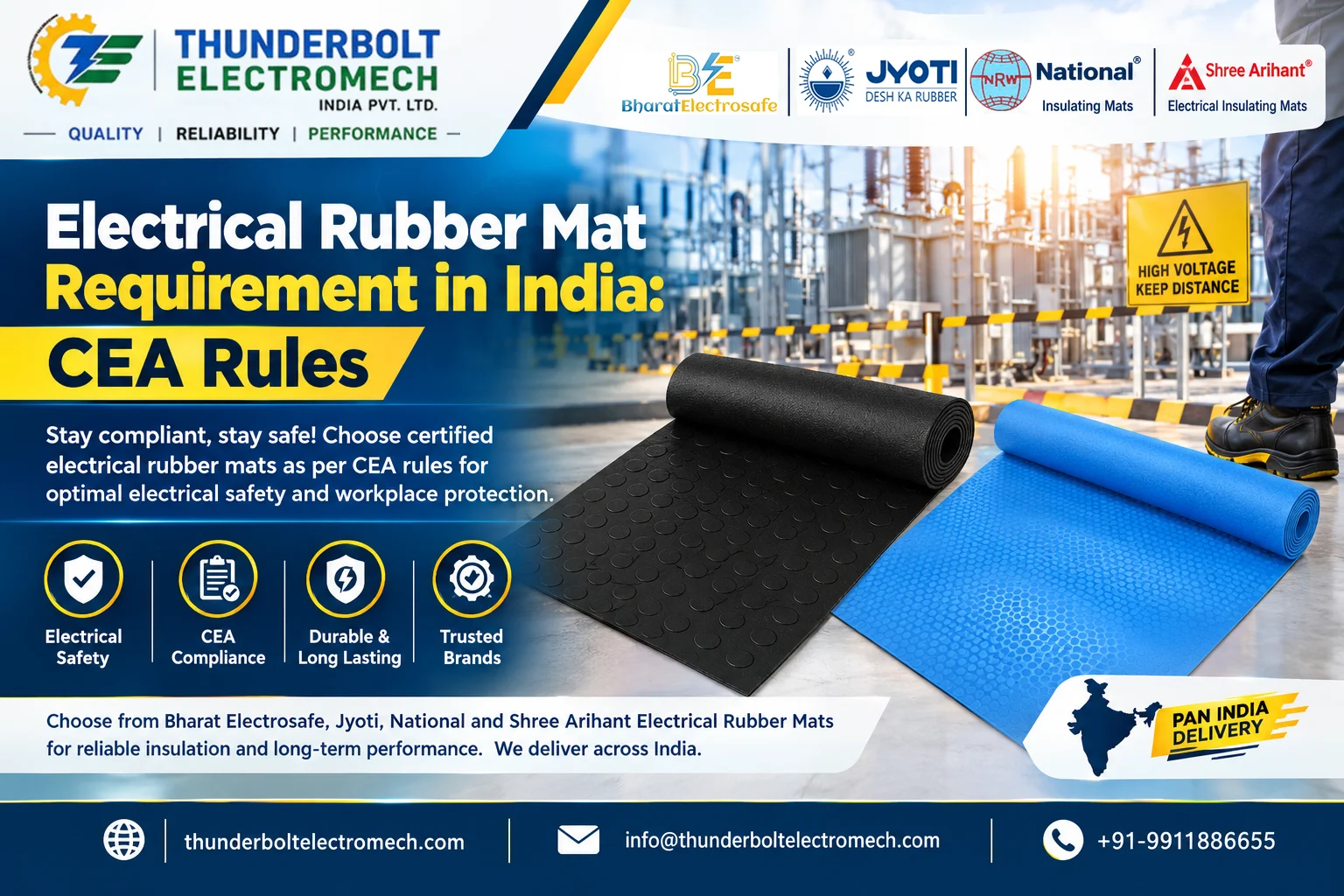
Quick Answer: Yes. The CEA safety regulations 2023 require insulating floors or mats of the right voltage level in front and rear of switchgear and control panels where people operate, maintain or test equipment. The clause also demands earthing, so a mat never replaces it. The 2010 text named IS 15652:2006. Thunderbolt Electromech, an Electrical Rubber Mat Supplier India buyers call from Delhi, supplies the IS 15652 rubber mat from Bharat, Jyoti, National, Vardhman and Shree Arihant.
Introduction
Ask ten plant managers whether a rubber mat is a legal requirement and you will hear ten answers. Some say it is optional good practice. Some say it applies only to high-voltage rooms. A few quote a clause number that turns out to be wrong.
The question matters, because an inspector will ask it, and a missing or unmarked mat is an easy finding. If you run a panel room in Delhi NCR, you may already be hunting for an electrical rubber mat supplier Delhi stockists trust, with paperwork you can hand to an inspector the same day.
This guide reads the rule itself. It compares the 2010 and 2023 wording, explains what changed, and shows what a mat can and cannot do in physical terms. It then turns the clause into a purchase-order checklist you can use today.
We are a supplier, not a law firm. This post gives general information. Confirm the clause and numbering with your electrical inspector before you cite it in a tender, a report or a dispute.
For class tables, thickness and test values, use our IS 15652 electrical rubber mat supplier guide. This post covers the legal question those pages leave open.
CEA Regulation 16(5): What an Electrical Rubber Mat Supplier India Buyer Must Know
The 2023 wording, in plain words
The CEA (Measures relating to Safety and Electric Supply) Regulations, 2023 replaced the 2010 text. The 2023 regulations run to 136 regulations in fourteen chapters, and Chapter III (Regulations 14 to 34) covers general safety requirements for all installations.
The mat clause sits in that chapter. It says that, for the safety of operating personnel, non-current-carrying metal parts of switchgear and control panels must be properly earthed, and that insulating floors or mats of the appropriate voltage level, conforming to the relevant standards, must be provided in front and rear of the panels where personnel carry out operation, maintenance or testing work.
Read that in three parts:
- Earthing comes first. The same sentence demands both measures. A mat does not substitute for an earth.
- Voltage level decides the mat. “Appropriate voltage level” means you cannot buy one mat for the whole plant.
- The work decides the position. The mat belongs wherever someone operates, maintains or tests the panel, which includes the rear.
In the 2023 gazette text we found this as sub-regulation (5) of Regulation 16, “Switchgear on consumer’s premises”. That section opens with the supplier’s duty to provide switchgear in each conductor of a service line, and then reaches the panel-safety sub-clause. We read it through a text extract, so verify the number on the official gazette copy.
What the 2010 text said
The earlier version was shorter and more specific. It required the same earthing and said insulating floors or mat conforming to IS 15652:2006, of appropriate voltage level, had to be provided in front of the panels for the safety of operating personnel.
| Point | 2010 text | 2023 text |
| Which standard | Named IS 15652:2006 | Refers to “relevant standards” |
| Where the mat goes | In front of the panels | In front and rear of the panels |
| When it applies | Stated generally | Where personnel operate, maintain or test |
| Earthing | Required in the same clause | Required in the same clause |
| Voltage wording | “Appropriate voltage level” | “Appropriate voltage level” |
What the change means in practice
Two changes matter most.
The rear is now in scope. Maintenance work often happens at the back of a panel, where covers come off and busbars sit exposed. A mat only at the front leaves that position bare.
The standard is no longer named. The 2023 text does not mention IS 15652. That does not make IS 15652 optional in practice. It remains the Indian standard for these mats, and a BIS-marked product is the easiest to defend. If you want to use an IEC 61111 or ASTM D178 mat on an export-linked project, get the inspector’s agreement in writing first. Duratuf makes the same point: it advises readers to confirm the current clause with their electrical inspector or safety consultant, since the CEA updated these regulations in 2023.
Why online sources give three different clause numbers
Search for the clause and you will find conflicting references. An engineering forum thread attributes the sentence to clause 19(5) of the Electricity Act. A legal database lists the same sentence under Regulation 19 of the 2010 regulations. Neither label matches the gazette structure we found, where the sentence sits with the switchgear regulations.
The rule is a regulation made under the Electricity Act, not a clause of the Act itself. Quote it from the gazette copy, and name the edition, when you write a tender clause or an audit reply.
Inspectors check this
This is not a rule that exists only on paper. The 2010 regulations include an inspection checklist that asks whether insulating floors or mats conforming to IS 15652:2006 have been provided. A CEA presentation on the 2023 regulations also lists a substation observation: insulation mats not provided for panels. If an inspector walks your panel room, the mat is on the list.
A parallel rule for X-ray and similar apparatus
The 2010 text carried a second hook. It required insulating floors, mats or platforms for operators near parts of X-ray and similar apparatus at voltage exceeding 650 V. Hospitals and imaging centres should check how the 2023 text numbers that provision.
For the broader question of who answers for a missing safety sign or mat, read our post on who is legally liable when a danger plate is missing. The duty-of-care logic is the same.
What a Mat Does, and What It Cannot Do
Most guides say a mat “protects against shock” and stop. The physics is more useful, because it shows you why class, condition and coverage matter.
A mat is a resistor in series
When you stand on a mat and touch a live part, current flows through your body, through the mat, and into earth. The mat adds resistance to that path. Current falls as the series resistance rises.
Here is an illustration. We assume a 1 kΩ body path and ignore skin and shoe effects. Real values vary widely, so treat this as a comparison, not a safety calculation.
| Series resistance under the feet | Current on a 415 V system (240 V to earth) | Current on an 11 kV system (6.35 kV to earth) |
| None (conductive floor) | about 240 mA | about 6,350 mA |
| 10 kΩ (damp, dusty surface film) | about 22 mA | about 577 mA |
| 100 kΩ | about 2.4 mA | about 63 mA |
| 1 MΩ | about 0.24 mA | about 6.3 mA |
| 100 MΩ | about 0.0024 mA | about 0.064 mA |
Notice two things.
First, the same mat condition gives wildly different currents on different systems. A leakage path that is harmless at 415 V stays dangerous at 11 kV. That is why “appropriate voltage level” is not a formality.
Second, the danger does not come from bulk rubber failing. It comes from the surface. A film of conductive dust, oil or moisture can drop the effective resistance from millions of ohms to thousands. IEC 60479 explains why that matters: the danger to a person depends mainly on the magnitude and duration of the current, and ventricular fibrillation is the main mechanism of death in fatal electrical accidents. Current is the number that counts, and the mat sets it.
A mat insulates feet, not hands
A mat cuts the foot-to-earth path only. If you stand on a perfect mat and touch a live part with one hand and an earthed door frame with the other, current flows hand to hand and bypasses the mat. Keep these habits:
- Keep earthed objects out of reach of the standing position where you can.
- Mind adjacent panels and open doors.
- Cover the whole standing area, not just a strip.
This is basic electrical reasoning, not a quoted rule. It explains why the clause demands earthing in the same sentence as the mat.
What “appropriate voltage level” means for you
Do not guess this one. Use a simple sequence:
- Find the highest voltage present at the panel, including adjacent compartments.
- Pick the IS 15652 class whose working voltage covers it.
- Confirm the breakdown and proof values on the test certificate, not only the class letter.
Our pillar guide lists the class table and thickness. Our post on electrical rubber mat colours explains why colour tells you nothing about voltage rating.
A short history, for context
IS 15652:2006 replaced the older IS 5424 mat standard. Jyoti states that the new standard superseded IS 5424 under Government of India gazette notification S.O. 2086, dated 17 July 2007. If a supplier still quotes IS 5424 for a new purchase, ask why.
Electrical Rubber Mat Supplier India Checklist: Turn the Clause into a Purchase Order
A legal clause becomes useful only when it lands on a purchase order. Use this table when you buy electrical rubber mat stock for a panel room.
| Purchase-order field | What to write | Why it matters |
| Panel voltage | Highest voltage present at the panel | Decides the class |
| Class | Class A, B or C, per your voltage | Meets “appropriate voltage level” |
| Standard | IS 15652, with ISI mark | Easiest to defend in audit |
| Positions | Front and rear (where work happens) | Matches the 2023 wording |
| Size | Length and width per position | Avoids short mats and joins |
| Documents | Test certificate and batch reference | Proves class on demand |
| Marking | ISI mark repeated along the roll | Lets you trace cut lengths |
| Quantity | Metres per panel, plus offcut margin | Prevents a second order |
Size by position, not by panel
Walk the room and mark every position where a person stands to operate, maintain or test. Then measure those positions. A panel line-up with rear access needs two strips, not one. Cover the full standing area plus a margin, and order a little extra for trimming around door frames and conduit.
Brands and what to ask
We supply the Bharat, Jyoti, National, Vardhman and Shree Arihant mats. Decide the class and documentation first, then choose the brand. A supplier who holds several brands can match product to need instead of pushing whatever is on the shelf.
Ask every supplier these questions:
- Which class does this roll carry, and where is it marked?
- Can you show the ISI mark and licence reference on the roll?
- Can you provide a test certificate for this batch?
- What is the width, the roll length and the cut-length option?
- What is the lead time for wholesale quantities?
Price and tender questions
IS 15652 electrical rubber mat price depends on class, thickness, certification and volume. Our pillar page covers the cost drivers. For bulk and multi-site orders, read GST rate and HSN code for electrical rubber mats, the post on freight planning and packing, and the guide to GeM tender specifications.
If you want an insulating mat for switchboard India projects covering several sites, standardise the class table in your BOQ. That way each site receives the same documentation.
Real Use Cases
The four scenarios below come from the clause, from inspection checklists and from common site layouts. They are illustrations, not client case studies.
Use case 1: An 11 kV panel line-up with rear access
A fitter removes the rear cover of an 11 kV vacuum circuit breaker panel for a busbar check. The room has a Class B mat at the front only. Under the 2023 wording, the rear position needs a mat of the right class as well. The plant adds a rear strip and writes both positions into its permit-to-work checklist.
Use case 2: An LT motor control centre
A factory’s 415 V motor control centre has a mat that covers one door’s width. Operators open two adjacent doors and stand across both. The fix is a Class A mat sized to the full standing zone, with the surface cleaned on a schedule because dust films lower the effective resistance.
Use case 3: A hospital radiology room
The 2010 text required insulating floors, mats or platforms for operators near X-ray apparatus above 650 V. A hospital engineer checks the room against that requirement and the 2023 numbering, and orders a certified mat for the operator position with documents on file.
Use case 4: A pre-inspection walkthrough
A plant manager reads the inspection checklist question about mats, then walks the substation with a clipboard. The walk finds one panel with no mat, one with an unmarked offcut and one with a mat that is clearly worn. The plant replaces all three and files the batch certificates in one folder.
Customer Problems and Solutions: Electrical Rubber Mat Supplier India Fixes
Problem 1: “Our contractor says a mat is optional for 415 V panels.”
Cause: The contractor reads the rule as a high-voltage requirement.
Solution: The clause covers switchgear and control panels and asks for the “appropriate voltage level”, which includes LT. Specify a Class A mat for 415 V panels and show the clause to your inspector.
Problem 2: “We have a mat in front, nothing behind.”
Cause: The room was laid out under the 2010 wording.
Solution: Add a rear strip wherever personnel operate, maintain or test the panel. Record both positions on your permit checklist.
Problem 3: “The auditor asks for IS 15652, but our mat shows IEC 61111.”
Cause: The 2023 text refers to “relevant standards”, and the auditor expects the Indian standard.
Solution: Ask the inspector for written acceptance of the IEC mat, or replace it with an ISI-marked IS 15652 mat. The second option closes the finding fastest.
Problem 4: “The mat looks fine, but the floor around it is oily and dusty.”
Cause: Surface contamination lowers effective resistance, as the table above shows.
Solution: Clean the mat and the floor on a fixed schedule, and follow the maker’s guidance on cleaning agents. Retest the mat on your usual interval.
Problem 5: “We have an old mat with no marking.”
Cause: The mat is an unmarked offcut or an old roll.
Solution: Replace it. Without a marked class and a batch certificate, you cannot prove it meets the clause.
Problem 6: “We upgraded the panel voltage, and the mat stayed.”
Cause: The class was chosen for the old voltage.
Solution: Recheck the highest voltage at the panel, and replace the mat if the class no longer covers it.
Problem 7: “We cannot show the mat’s class during an audit.”
Cause: No certificate or marking on file.
Solution: Keep the certificate with the panel records, and buy rolls with the mark repeated along the length.
Requirement or Good Practice? A Comparison
| Item | Required by the clause? | Our recommendation |
| Insulating mat of appropriate voltage level at switchgear and control panels | Yes | Buy by class, with ISI marking |
| Earthing of non-current-carrying metal parts | Yes, in the same sentence | Treat earthing and mat as a pair |
| Mat in front of the panel | Yes | Cover the full standing area |
| Mat at the rear where work happens | Yes, in the 2023 text | Add a rear strip |
| IS 15652 conformity | Named in 2010, “relevant standards” in 2023 | Keep IS 15652 as your default |
| Test certificate and batch record | Not named | Keep on file; inspectors ask |
| Annual dielectric retest | Not named in the clause | Follow your standard’s interval |
| Cleaning schedule | Not named | Schedule it, because films cut resistance |
| Insulating gloves | Not part of this clause | Add for live work; see our glove testing post |
| Danger plate on the panel | Covered by other rules | Read our IS 2551 standards guide |
The first five rows are the legal core. The rest are what we advise because inspectors ask and failures follow gaps.
Why Choose Thunderbolt as Your Electrical Rubber Mat Supplier India and Delhi NCR Partner
Thunderbolt Electromech India Pvt. Ltd. sells from Chawri Bazar, in the Chandni Chowk electrical wholesale belt. We stock the full range of Bharat electrical rubber mat, Jyoti electrical rubber mat, National electrical rubber mat, Vardhman electrical rubber mat and Shree Arihant electrical rubber mat.
If you need an electrical rubber mat dealer Delhi NCR teams can reach the same day, call us or walk in. We cut lengths to your measured positions, share the class and documents, and dispatch Pan India for multi-site orders. Browse the electrical rubber mat range and the full cluster of electrical rubber mat guides.
Before you order, send us:
- The highest voltage at each panel.
- The positions that need a mat, front and rear.
- The length and width for each position.
- The quantity and delivery location.
Contact Thunderbolt Electromech
Thunderbolt Electromech India Pvt. Ltd.
Address: Shop No. 3538, Sitaram Bazar Road, Bazar Sirkiwalan, Chawri Bazar, Chandni Chowk, Delhi – 110006 (rubber mat for panel Delhi enquiries welcome)
Phone: +91-9911886655 | +91-6391217408
Email: info@thunderboltelectromech.com
Website: thunderboltelectromech.com
Hours: Monday to Saturday, 11:00 – 19:00
Quick FAQ
Is a rubber mat mandatory in front of every panel?
The clause covers switchgear and control panels, at the appropriate voltage level, wherever personnel operate, maintain or test. Confirm edge cases with your inspector.
Does a mat replace earthing?
No. The clause requires both.
Is IS 15652 still required in 2023?
The 2023 text says “relevant standards”. IS 15652 remains the Indian mat standard, and it is the safest choice.
Do I need a mat at the rear of the panel?
Yes, where personnel work there, according to the 2023 wording.
Where do I buy an ISI-marked electrical rubber mat in Delhi?
At our Chawri Bazar shop, or by phone and email for dispatch.
Conclusion: Read the Clause, Then Buy the Right Mat
The rule is clear once you read it. The CEA safety regulations require insulating floors or mats of the appropriate voltage level in front and rear of switchgear and control panels where people operate, maintain or test equipment. The same sentence demands earthing, so a mat never stands in for an earth.
The 2023 text changed two things. It added the rear of the panel, and it replaced the named standard with “relevant standards”. In practice, buy an ISI-marked IS 15652 mat, and ask your inspector in writing if you want anything else.
The physics explains why details matter. A mat is a series resistor. A dusty, oily or worn surface can cut its resistance by orders of magnitude, and the same leakage is far more dangerous at 11 kV than at 415 V. So choose the class by the highest voltage at the panel, cover every standing position, keep the surface clean, and file the certificate where an inspector can find it.
Buy from an Electrical Rubber Mat Supplier India buyers can verify. Thunderbolt Electromech India Pvt. Ltd. offers the full Bharat, Jyoti, National, Vardhman and Shree Arihant range, with class guidance, batch documents and cut lengths from Chawri Bazar, plus dispatch across India. Call +91-9911886655 or email info@thunderboltelectromech.com, and we will match the class and quantity to your panels.